Get in Touch with TiAlloy Company

Inconel 625 vs 718 Comparison for Industrial Buyers

By XCX · Updated October 2026
An Inconel 625 vs 718 Comparison starts with the job: select 625 as a candidate for fabricated equipment and consider precipitation-hardened 718 where design requires higher strength. The purchase decision is dependent on product form, heat treatment, actual temperature and environment of the finished part.
A bar marked “718” can be delivered in many different conditions. A sheet of “625” can also be delivered with different annealing requirements. Looking at headline strength requirements without these details can mislead a buyer toward an incorrect manufacturing route, even when both quotations reference the correct nickel alloy.
This guide compares Inconel 625 and Inconel 718 through source-specific property data, example quotations, and a purchase order checklist. Values are attributed to the producer, and NIST and university studies provide evidence of manufacturing. Engineering approval is bound to the component’s design basis.
Inconel 625 vs 718 at a Glance
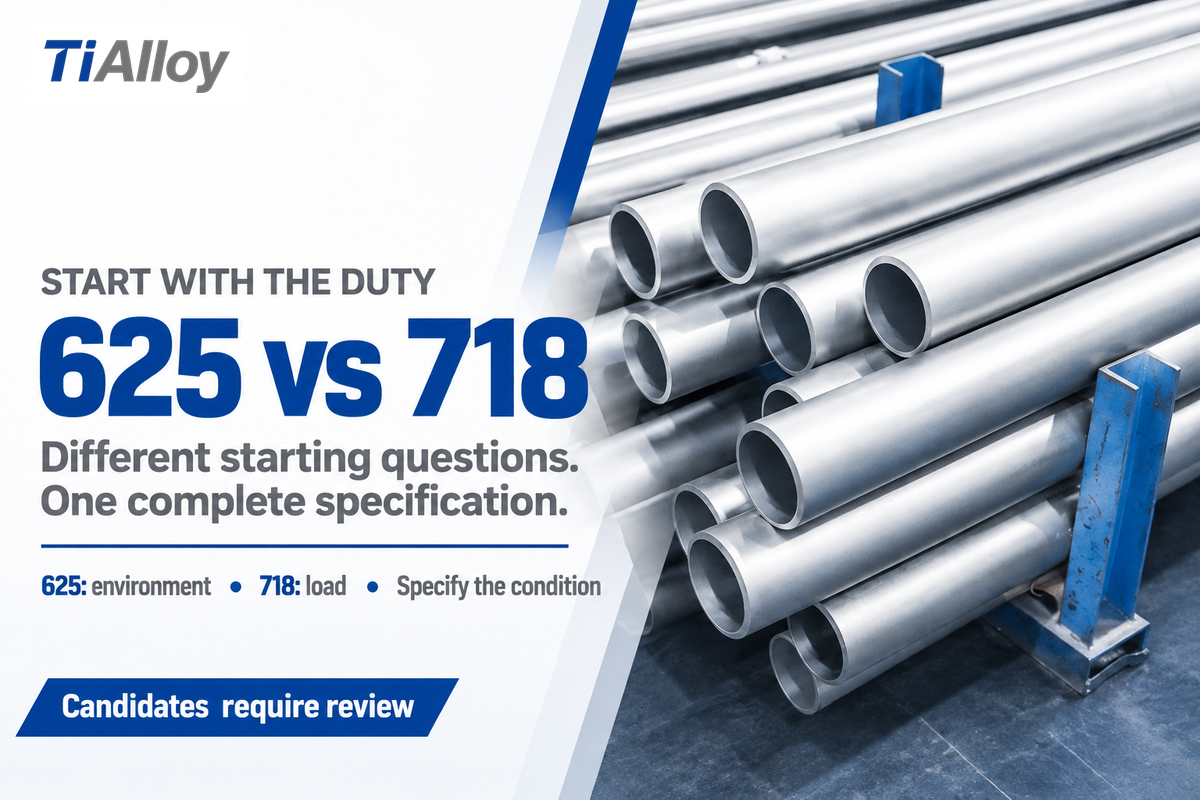
Inconel 625 favors corrosion-led selection and fabrication, while Inconel 718 favors strength-led selection after specified aging treatment. Inconel 625 and 718 are nickel alloys used in complex equipment. Useful material selection pairs alloy identity with delivered condition, evaluates the operating environment, and assesses manufacturing cost/lead time.
625: start with the environment
UNS N06625. A strong candidate for corrosion-resistant fabricated parts; specify annealed or solution-treated condition.
718: start with the load
UNS N07718. A precipitation-hardenable candidate for highly loaded parts; specify the required solution and aging route.
Neither grade substitutes the other with a name change. The difference between Inconel grades includes chemistry, strengthening mechanisms, and how the part attains its final condition. Our Inconel 625 material guide addresses the alloy in more detail.
For a drawing that already specifies N07718, a cheaper N06625 offer needs a material change approved through engineering. Procurement first needs to price the specified route. Replacing the drawn part with a lower priced part should be taken as a design trade off, not in response to a higher price quote.
Chemical Composition and Strengthening Mechanisms
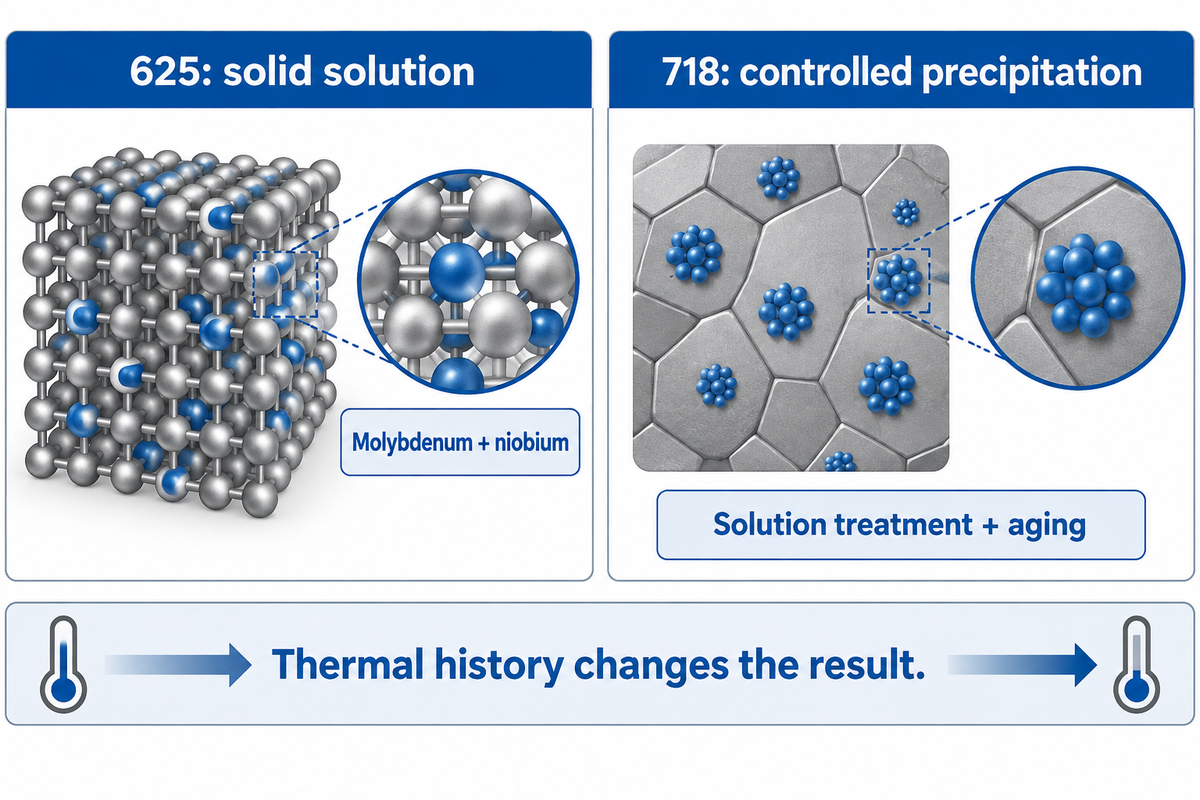
Chemical composition explains the differences between 625 and 718: molybdenum and niobium strengthen conventional 625 through solid solution, while controlled precipitation gives aged 718 its high strength. Chromium contributes to corrosion and oxidation resistance in both. History of manufacture can result in varying microstructures, especially with long durations of heating or with Additive Manufacturing.
| Feature | Inconel 625 alloy | Inconel alloy 718 |
|---|---|---|
| UNS identity | N06625 | N07718 |
| Nickel basis | 58% minimum nickel | 50–55% nickel plus cobalt |
| Chromium | 20–23% | 17–21% |
| Molybdenum | 8–10% | 2.8–3.3% |
| Niobium plus tantalum | 3.15–4.15% | 4.75–5.50% |
| Titanium | 0.40% maximum | 0.65–1.15% |
| Aluminum | 0.40% maximum | 0.20–0.80% |
| Iron | 5% maximum | Balance |
| Primary strengthening route | Solid solution in conventional supply | Precipitation hardening after solution treatment |
| Purchase condition to name | Annealed or solution treated | Solution treated, or solution treated and aged |
Sources: Special Metals’ 2013 Alloy 625 bulletin, Table 1 and 2007 Alloy 718 bulletin, Table 1. The range of nickel plus cobalt for 718 is a combined limit; 718 is a nickel based superalloy, not a cobalt-based alloy.
625 is mainly selected here for its combination of corrosion resistance and favorable fabrication characteristics. Alloy 718 is mainly selected for a specified strength requirement. Its γ′ and γ″ precipitates develop during aging. Calling 625 “non-age-hardenable” is useful shorthand for conventional procurement, but saying it will never precipitate isn’t correct. Floreen, Fuchs and Yang’s Metallurgy review paper describes how the thermal history alters 625’s structure and properties.
Special Metals records 625 hot-rolled annealed rod exposed at 1200°F for 2,000 hours: yield strength rises from 69.5 to 126.5 ksi while elongation falls from 54% to 30%. Long thermal exposure changes the balance between strength and ductility, even in a nominally solid-solution-strengthened alloy. The strengths were measured at room temperature after exposure.
Mechanical Properties: Compare the Delivered Condition
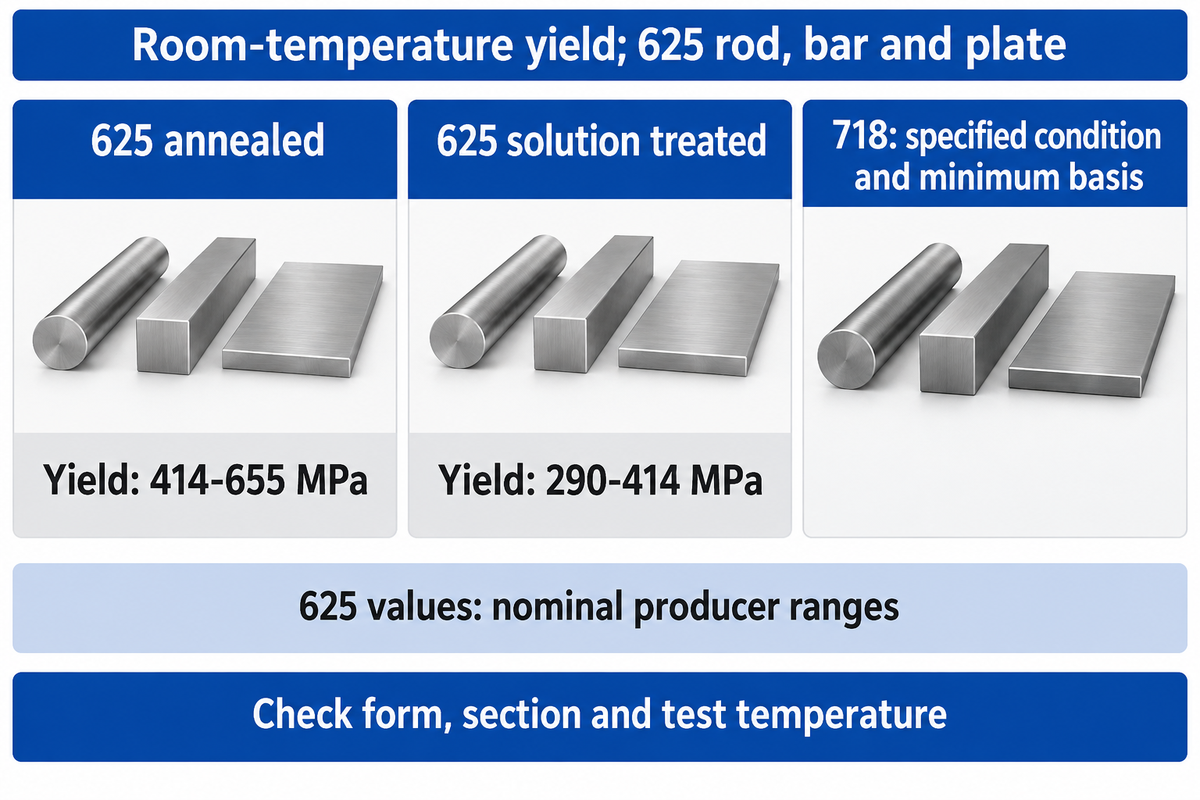
Precipitation-hardened 718 alloys typically yield higher room temperature yield strength than conventional annealed 625, but the comparison needs a shared basis. Product form, section size, heat treatment condition and test temperature are to be provided with each value. Typical producer data, contractual minimum values and experimental measurements answer different questions and should be shown separately.
| Material and form | Condition | Yield strength | Tensile strength | Value basis |
|---|---|---|---|---|
| 625 rod, bar and plate | Annealed | 414–655 MPa | 827–1,034 MPa | Special Metals nominal range |
| 625 rod, bar and plate | Solution treated | 290–414 MPa | 724–896 MPa | Special Metals nominal range |
| 718 rod/bar ≤127 mm | Solution annealed and hardened | 1,030 MPa | 1,240 MPa | VDM specified minimum values |
| 718 rolled study specimens | As supplied, ACR | 540 MPa | 958 MPa | Švec et al. experimental results |
| 718 rolled study specimens | Study heat treatment, ACR HT | 1,147 MPa | 1,370 MPa | Švec et al. experimental results |
Special Metals’ 625 Table 5 provides data for product sizes up to 4 inches and gives the values as nominal. The VDM’s 2020 Alloy 718 sheet, Table 5, provides minimum values for defined product dimensions and treatment. Dividing those two rows would mix a nominal range with a minimum, rather than establish a guaranteed strength ratio.
“production technology can strongly influence some mechanical properties”
What are the downsides of Inconel 718?
Inconel 718 adds treatment control, machining difficulty and a strength-ductility tradeoff to the buying decision. Compared to Inconel 625 in conventional annealed supply, a finished aged 718 component requires more attention to its thermal route and final acceptance condition. The increased strength of 718 is useful only in regions where design requires it.
In Švec and colleagues’ particular rolled specimens, treatment raised yield strength from 540 to 1,147 MPa while elongation fell from 39.3% to 24.1%. Those samples also differed from the study’s laser-printed material. For a cyclically loaded part, fatigue properties require their own basis: Kafka and colleagues’ 2023 LPBF 718 fatigue study found that roughness and fatigue lifetime didn’t follow a simple relationship.
The minimum yield requirement of 1,030 MPa is relevant to a defined 718 product and condition, not to every shipment identified by the alloy name. Buyers evaluating material properties should consider the same product size, treatment and test basis for both alternatives, so that the lower priced soft condition offer receives the balance of the processing cost.
Corrosion Resistance: Match the Environment
Inconel 625 is a suitable starting point for corrosion resistance in harsh process environments, and 718 is chosen when mechanical loads govern the specification. Actual performance is affected by medium, concentration, temperature, stress and metallurgical condition. Seawater, hot acids and chloride crevices therefore need separate selection decisions rather than one corrosion ranking.
Molybdenum and chromium help explain 625’s position among corrosion-resistant nickel superalloys. VDM’s 2022 Alloy 625 data sheet reports for Grade 1 soft-annealed 625 a critical pitting temperature of 75°C and critical crevice temperature of 55°C in its 10% ferric-chloride test. Those are laboratory test results for that medium; a 55°C seawater installation has different chemistry, flow and geometry.
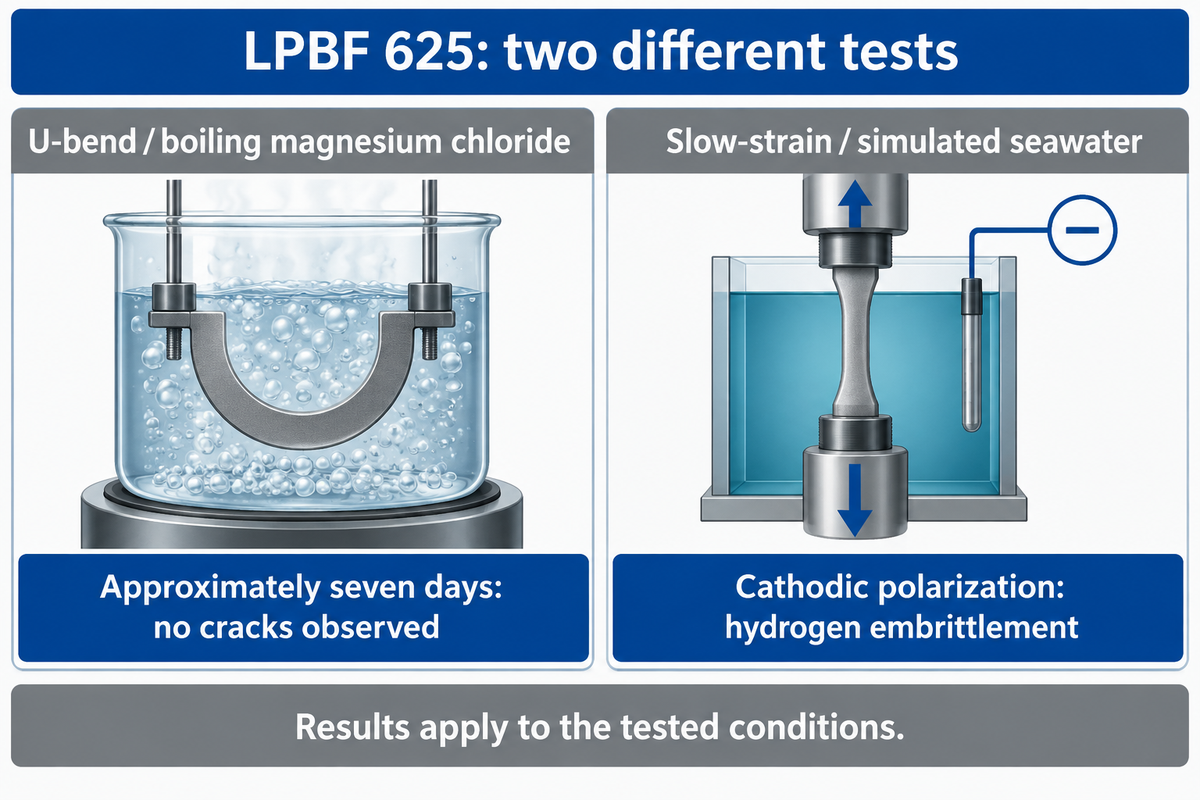
A concrete counterexample comes from Cabrini and colleagues’ 2021 LPBF 625 study. The U-bend test specimens were exposed to boiling magnesium chloride for approximately seven days, and no cracks were noted under the tested conditions. Separate slow-strain tests in simulated seawater with cathodic polarization produced hydrogen embrittlement. The same alloy family can respond differently when electrochemistry and loading change.
For a welded process vessel, the decision includes the weld region, deposited metal and fabrication sequence. A recommendation based only on parent-metal chemistry leaves the joint out of the service system. The 1994 metallurgy review also describes how prolonged exposure and chemistry affect 625’s toughness; a stronger aged microstructure is not automatically the preferred corrosion-service condition.
Temperatures of 75°C for pitting and 55°C for crevice attack describe VDM’s Grade 1 soft-annealed 625 ferric-chloride test. There’s no universal service window for these test temperatures. Procurement of corrosion-resistant alloys is most effective when the specific service fluid and joint condition are defined. If a substitution of 718 is required, a fresh environmental assessment is also required.
Strength at Elevated Temperatures: Read the Right Limit
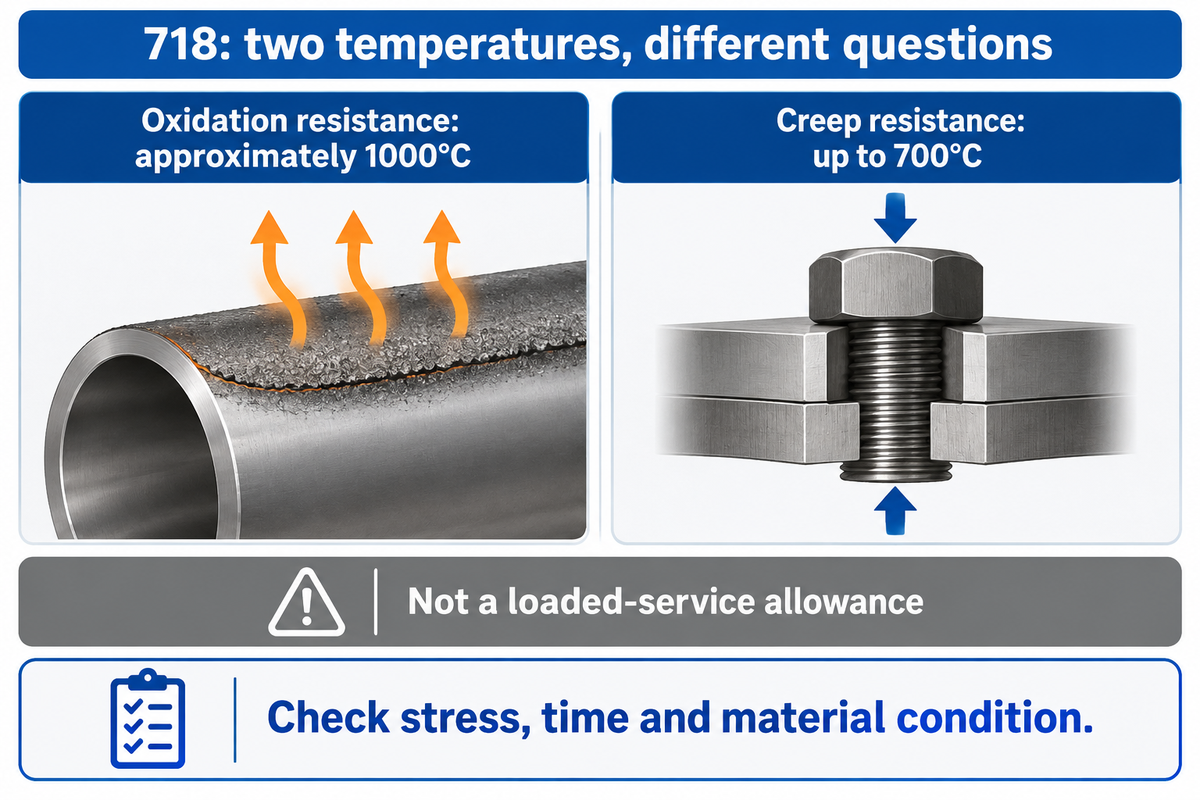
Strength at elevated temperatures asks for a load-and-time question, while oxidation resistance is concerned with reaction with the surrounding atmosphere. Inconel 625 and 718 each have a broad temperature range, but one maximum number hides those different failure mechanisms. For a loaded component, creep, rupture and exposure duration have precedence over an oxidation headline.
2 Temperatures, 2 Different Questions
Oxidation temperature is concerned with surface attack; loaded service temperature asks whether the specified material condition is capable of carrying the required stress for the required time.
Question 1: Will the surface resist oxidation? VDM describes 718 as having good resistance to oxidation up to approximately 1000°C. That’s a material characteristic. A gas turbine fastener has an additional mechanical job and resistance to oxidation, by itself, doesn’t set its allowed loaded service temperature.
Question 2: Will the part carry the load? The same VDM bulletin describes good creep resistance up to 700°C. Stress level, time and material condition still govern a design calculation. Using Inconel 718 at a temperature associated with oxidation resistance while borrowing its room-temperature tensile strength would combine incompatible design assumptions.
625 also behaves differently, depending on the selected condition. The public scope of ASTM B443-26 describes Grade 1 annealed flat products normally used up to 1100°F, or 593°C; Grade 2 solution-annealed material is normally used above that temperature when creep and rupture resistance are required. Thus, the choice of grade for plate is part of the high-temperature specification and not a detail to be decided after the purchase.
A short-term elevated-temperature tensile test is another distinct case. Švec and colleagues tested 718 from 600 to 900°C after a ten-minute temperature hold. A short test at 900°C and a continuously loaded assembly at 900°C are very different exposures. Power generation hardware requires the latter service basis.
VDM’s approximately 1000°C oxidation guidance and 700°C creep guidance for 718 differ by 300°C because they address different behavior. A temperature range becomes useful when it carries a failure mechanism and material state. Purchasing teams can then distinguish a heat-resistant enclosure from a highly loaded hot-section component.
Welding and Machining Change the Supply Route
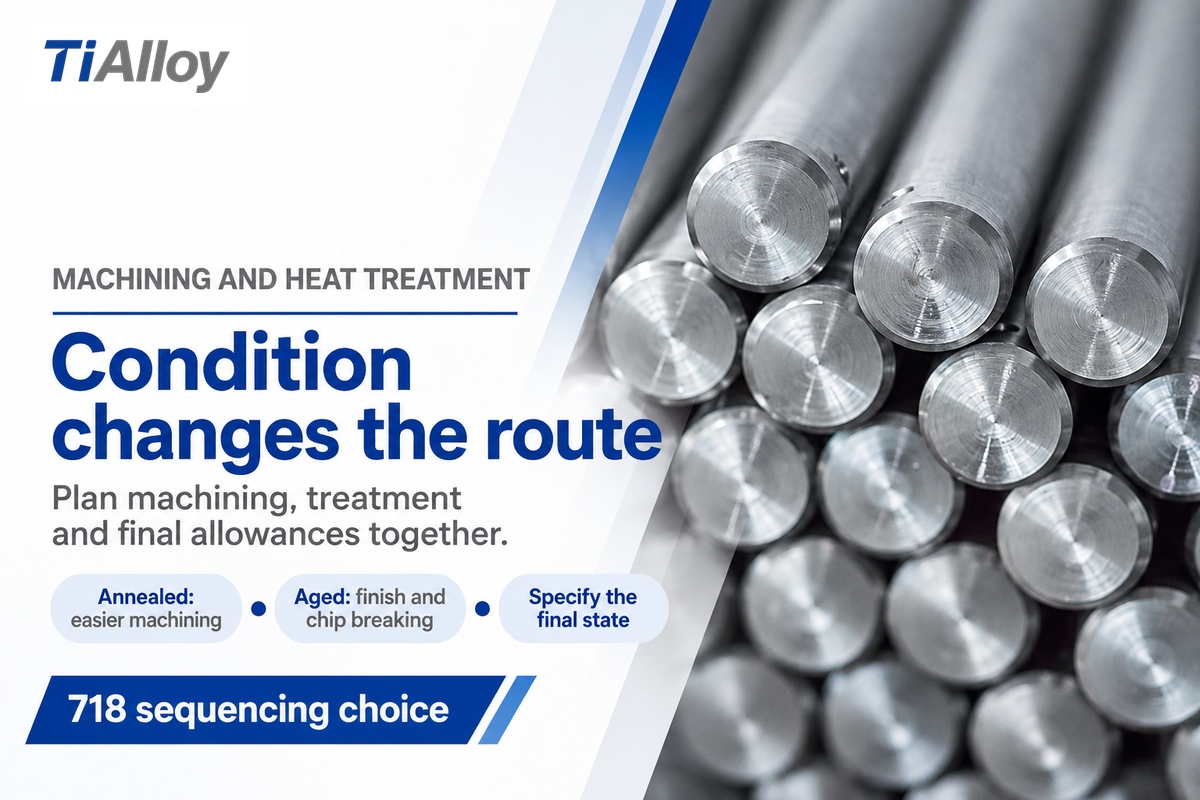
Fabrication cost follows the condition in which alloy is cut, joined and finally heat treated. Conventional 625 often fits corrosion-resistant welded assemblies, while 718 machining commonly separates softer pre-machining from aged finishing. Geometry, available spindle torque, chip control, and dimensional movement can affect the sequence in which the operations are performed and the final component quality.
Is Inconel 625 hard to machine?
Yes, Inconel 625 is difficult to machine. Inconel 625 is hard to machine because cutting generates heat and a work-hardened surface that can damage the next tool pass. The practical solution is to strike a balance between cutting speed, available torque and adequate coolant. Even when the material is annealed, machinability is a process problem.
A Practical Machinist discussion on turning 625 raises low-speed torque and chip-control problems. The useful lesson is to cost the real machine and feature, rather than apply a universal 625-versus-718 cutting-speed multiplier. A thin-wall part and a rigid bar blank expose the cutter to different stability constraints.
718 offers a sequencing choice. Special Metals reports easier machining and longer tool life in the annealed condition, but better surface finish and chip breaking in the aged condition. A supplier can pre-machine the soft material and do the required hardening treatment, and leave final allowances for critical surfaces. The TiAlloy guide to Alloy 718 provides more background on these grades.
Consider a near-net-shape 718 component with features that can’t all be turned. A shop discussion about heat-treated 718 describes exactly that geometry problem. Tool access and milling strategy matter alongside hardness. In a separate American Machinist valve-ball case, tooling changes increased productivity, but the report concerns one supplier-involved manufacturing case. Its economics belong to that operation.
Welding merits the same route-level consideration. Filler selection, joint cleanliness and post-weld requirements follow the applicable procedure and intended service. A requirement for final-aged 718 must include the joint’s treatment sequence; high strength in incoming parent bar doesn’t settle the condition of the completed weldment.
VDM lists 625 Grade 1 soft annealing at 950–1050°C and Grade 2 solution annealing at 1080–1160°C. Those differences explain the inadequacy of a “heat treated” quotation. A fabrication bid should identify the actual operation and its position prior to the last step of final sizing, inspection and delivery.
Inconel 625 vs 718 Price: Compare Finished-Part Cost
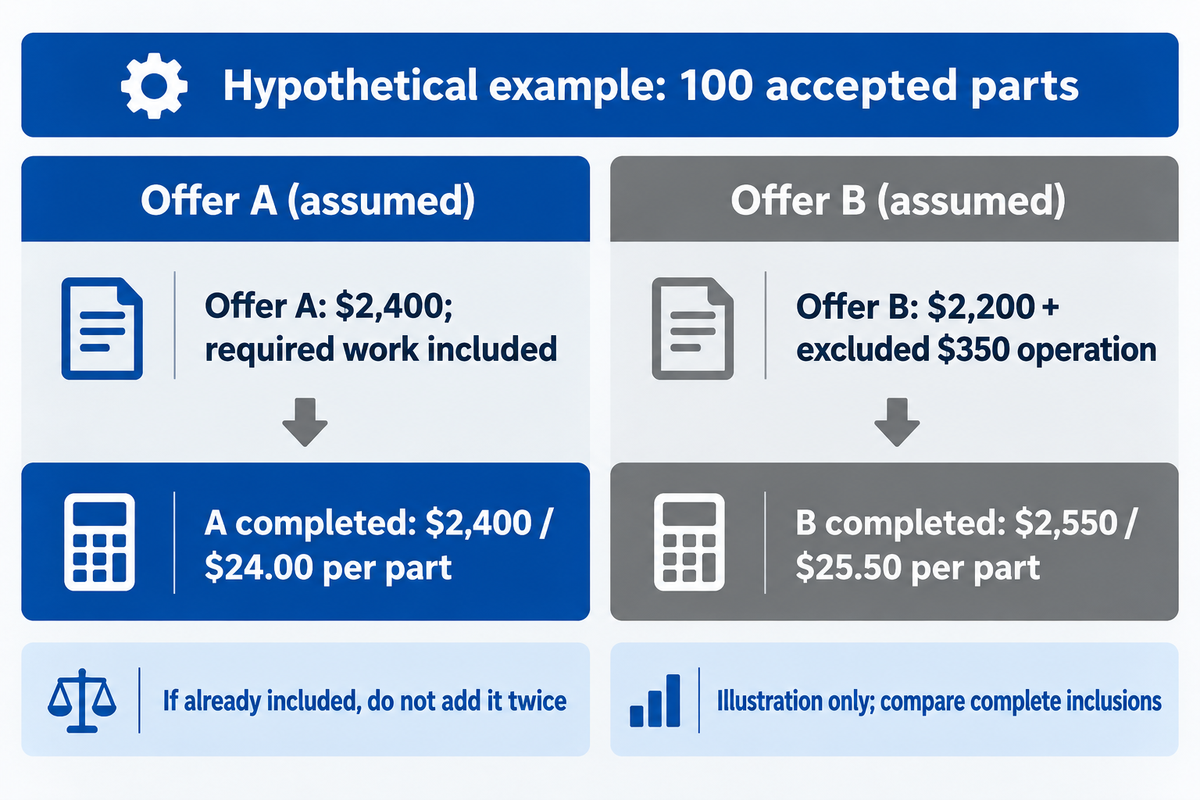
Compare Inconel 625 vs Inconel 718 price through the cost of the accepted finished part after engineering has chosen a suitable alloy. The lower raw-material offer can carry additional treatment, testing, machining or scrap cost. A complete bid provides this information.
Example: two technically acceptable offers cover 100 accepted parts. Offer A costs $2,400 including every required treatment and test. Offer B costs $2,200 but excludes one required operation quoted at $350. The completed totals are $2,400 and $2,550, or $24.00 and $25.50 per accepted part.
| Cost item | Offer A | Offer B |
|---|---|---|
| Quoted lot | $2,400 | $2,200 |
| Required excluded operation | $0 additional; included | $350 |
| Completed lot | $2,400 | $2,550 |
| Accepted quantity | 100 parts | 100 parts |
| Cost per accepted part | $24.00/part | $25.50/part |
If B already includes that operation, its total stays $2,200, or $22.00 per part. Adding another $350 would count the same work twice. An unspecified exclusion stays an open cost item rather than receiving a zero. The denominator also matters: a lot of 100 blanks is different from a lot of 100 accepted finished parts.
In a specific LPBF 718 investigation, Benzing and colleagues compared 15 hours of tailored thermal processing with 42 hours for the conventional sequence studied. That experiment shows why the quotation contains a list of operations. It neither states an alloy-wide market price nor provides a recipe for processing wrought stock.
For the 100-part example, a $200 apparent saving becomes a $150 higher completed-lot cost after one excluded $350 operation. A purchase comparison earns its result from the inclusion list and accepted quantity. Nickel content alone can’t resolve that commercial difference, even when comparing two nickel superalloys.
Which Alloy Fits Your Specific Application?
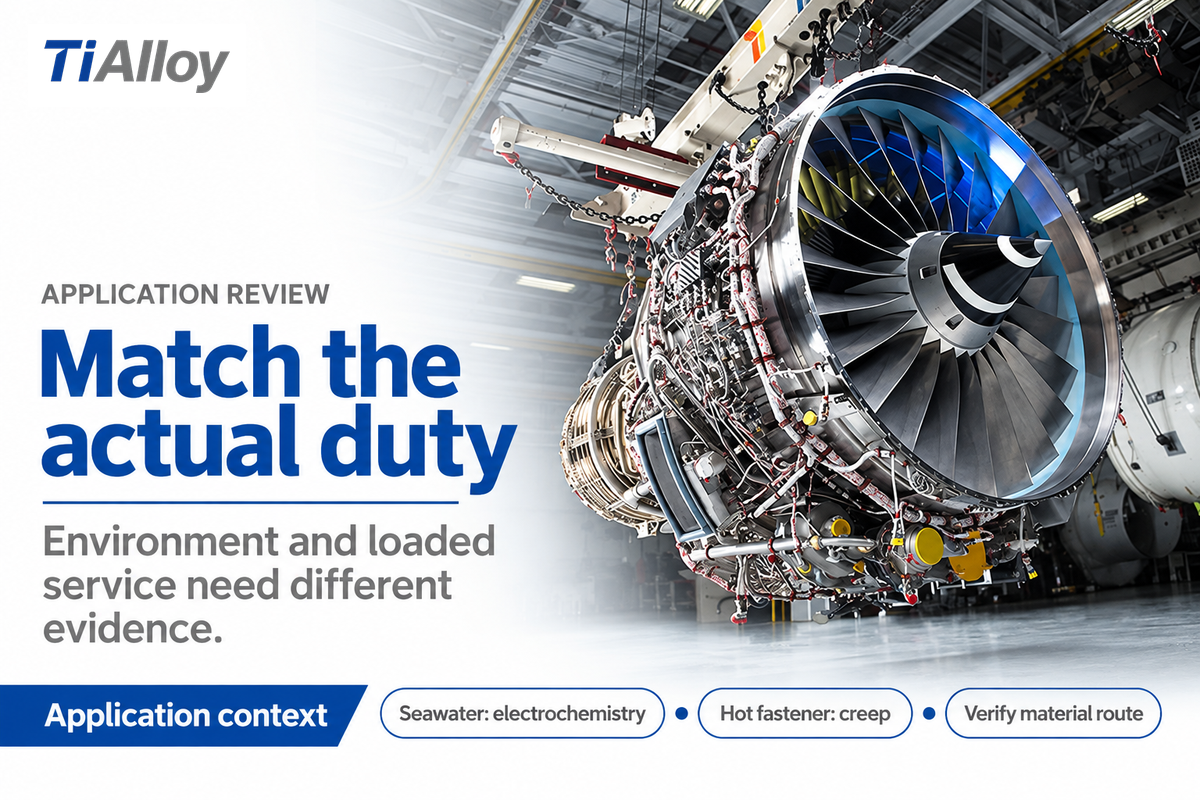
Choosing between Inconel 718 and Inconel 625 starts with the dominant duty: corrosion-resistant fabricated equipment points first toward 625, while high-load parts with a controlled aging route point toward 718. The specific application then provides the final binding constraints. Chemical exposure, cyclic loading, temperature, product form and manufacturing route determine whether the initial choice holds up through engineering review.
| Buying situation | Initial route | Controlling requirement |
|---|---|---|
| Corrosive process piping | Evaluate 625 | Medium, temperature, weld and pipe specification |
| Highly loaded fastener | Evaluate aged 718 | Required strength and final treatment condition |
| Hot load-bearing hardware | Evaluate 718 service data | Creep/rupture basis at design stress and duration |
| Welded heat-exchanger assembly | Evaluate 625 fabrication route | Fluid on each side, joints and cleaning conditions |
| Offshore wetted component | Evaluate 625 environment response | Crevices, cathodic protection, stress and material route |
| Fatigue-critical printed part | Qualify exact 625/718 route | Build orientation, surface condition and fatigue basis |
| Thin-wall precision feature | Compare complete machining sequences | Stability, thermal movement and finishing allowance |
| Existing N07718 drawing | Purchase specified 718 condition | Engineering approval before any alloy substitution |
| Alternative stock form proposed | Review form-specific standard | Plate, bar and forging acceptance requirements |
| Lowest incoming stock price | Complete accepted-part costing | Required excluded operations and final accepted quantity |
Which alloy is best for oil & gas offshore platforms?
625 is the better starting candidate for corrosion-led offshore wetted service; 718 is the better starting candidate for a highly loaded component whose design specifies its hardened condition. Aged 718 is suitable for applications that need this strength together with a controlled thermal route. Both types of service exist on offshore platforms. One all-encompassing winner for an offshore platform would be incorrect, since it wouldn’t differentiate between a process line, a fastener, and a subsea cyclically loaded part.
For a component in seawater with cathodic protection, the specification requires the electrochemical state as well as corrosion resistance. One of the LPBF tests of Cabrini 625 showed a hydrogen boundary under polarization; transferring this to wrought material also requires an adequate material basis. For a loaded hot fastener, the creep question instead controls the thermal review.
Aerospace heat exchangers offer another useful case. The Fabricator’s interview with UTC’s Venkat Vedula describes work involving 625, 718 and aluminum, including post-processing. The project shows how geometry and route can lead selection. It’s a third-party project, rather than a qualification held by TiAlloy.
What to Put on the Purchase Order
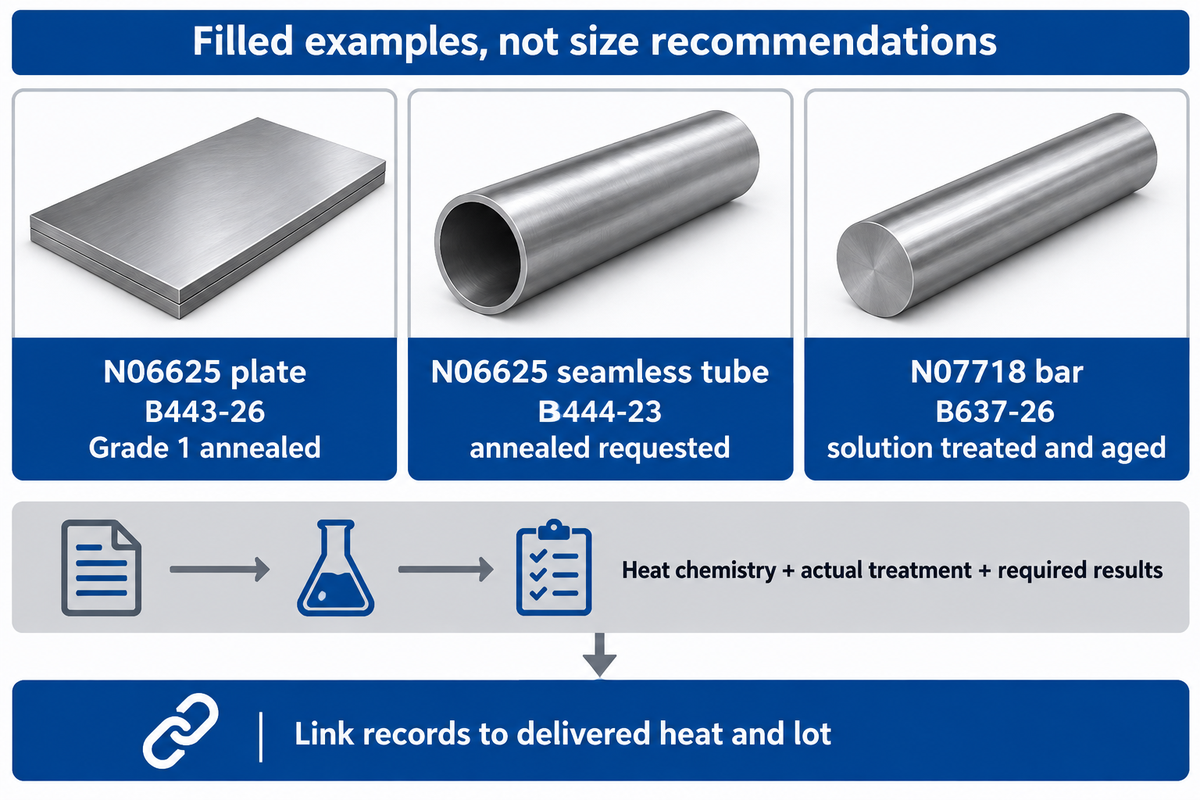
A purchase order should correlate the alloy name to product form, standard edition, delivery condition and acceptance requirements. For Inconel 625 and 718, that correlation ensures a chemically correct shipment arrives in the correct processing state. Dimensions, traceability, examination and any remaining heat treatment should travel with the same order.
ASTM B443-26 covers nickel-alloy plate, sheet and strip within its stated scope. [ASTM B637-26 addresses precipitation-hardenable nickel-alloy rod, bar, forgings and forging stock]. Other forms are addressed in separate documents. ASTM’s [current B02.07 catalog] helps determine the correct product standard family before the purchase requirements are finalized.
The following fields should be included in a request for quotation. Quantity and dimensions shown are examples and should be replaced with drawing requirements.
| Requested item | Product basis and requested state | Records linked to the delivered heat |
|---|---|---|
| N06625 plate: 10 pieces, 3 × 1000 × 2000 mm | B443-26, Grade 1 annealed | Heat chemistry, treatment identification, actual mechanical results and plate markings |
| N06625 tube without a welded seam: 20 lengths, 25 mm outside diameter × 2 mm wall × 3000 mm | B444-23 product basis, annealed condition requested in the order | Heat chemistry, treatment record, actual required tube tests and heat/lot markings |
| N07718 bar: 100 pieces, 25 mm diameter × 100 mm | B637-26 product basis, final solution-treated and aged condition requested | Heat chemistry, actual treatment and mechanical results, finished-piece traceability |
The B444-23 tube reference appears in ASTM’s current product catalog. The order determines the type of inspection documents and examinations. Heat chemistry identifies the melt; treatment records describe processing; mechanical and tube-test results address the ordered acceptance requirements. Each record must have a traceable link to the delivered pieces.
| Parameter | Recommended range | Why it matters | How to verify |
|---|---|---|---|
| Alloy and form | N07718 bar, or N06625 plate as drawn | Links chemistry to the intended stock form | Drawing and order line agree |
| Standard edition | Applicable B637-26 or B443-26 requirement | Defines the ordered product basis | Contract and certificate list the edition |
| Delivery condition | Named anneal/solution/aging state | Determines further processing | Treatment record and mechanical report |
| Dimensions and quantity | Example: 100 pieces, 25 mm diameter | Controls yield and acceptance count | Dimensional inspection to drawing tolerances |
| Service data | Actual °C, duration and load cycle | Separates oxidation, creep and fatigue needs | Engineering-approved material basis |
| Corrosive duty | Fluid, concentration, crevices and protection system | Captures the actual environmental exposure | Project corrosion specification |
| Included operations | Treatment, tests, finish and accepted quantity | Prevents cost gaps and double counting | Line-by-line quotation reconciliation |
| Traceability | Heat/lot linkage through finished delivery | Connects results with delivered material | Certificate, markings and test records |
Ask for the heat number and mill test report for the ordered alloy. Confirm whether the quoted strength is a minimum acceptance value or a typical bulletin value. Verify all the excluded mandatory operations prior to commercial approval. A 25 mm bar requiring final aging needs an explicit owner for that operation.
Alloy 625 product forms and condition-specific Alloy 718 quotations are available from TiAlloy. Sending the drawing and completed fields gives the quotation a clear material and processing basis.
Procurement Outlook: Specify the Manufacturing Route
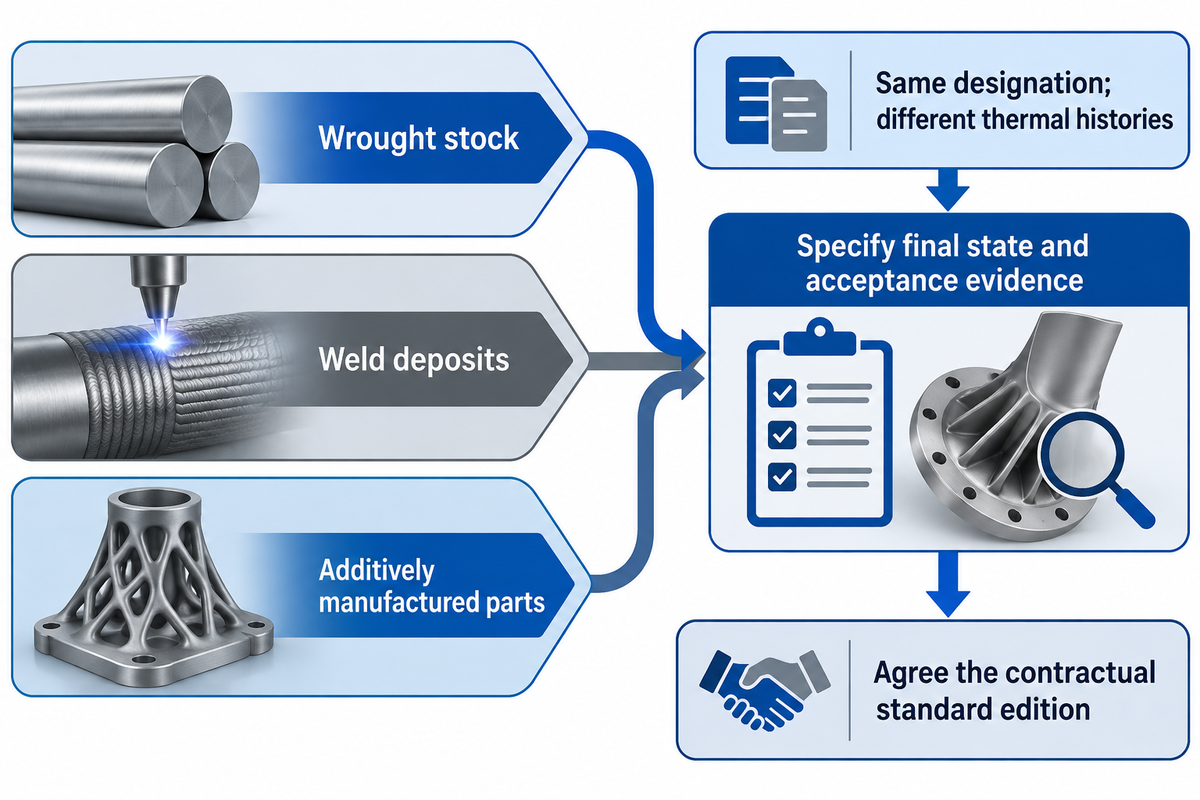
Super-alloys are transformed by manufacturing routes. Conventional wrought stock, weld deposits and additively manufactured parts can share an alloy designation while carrying different thermal histories. Present standards and route-specific tests assist customers in identifying these differences in procurement and usage.
NIST’s additive-manufacturing metals program describes phase formation and treatment effects in printed 625. In the 2023 718 investigation noted above, tailored processing produced a 1,209 MPa yield result versus 1,112 MPa for the compared conventional route, with elongation changing from 24.9% to 23.2%. The process and sample conditions explain the result; “AM 718” alone leaves too much out.
Standards change with each revision. Currently, ASTM gives B443-26 and B637-26, and its B443 revision work item shows review of the earlier edition. When making a new order in October 2026, engineering and purchasing need to agree on the actual contractual edition rather than silently carrying over an old quotation edition.
Across a range of industries, match nickel superalloys to the actual duty: petrochemical equipment and gas turbine engines need separate reviews of the environment, load, temperature and manufacturing state. Choosing the right alloy means matching properties and performance to one duty, rather than assuming every super alloy offers the same resistance and high strength.
A 15-hour thermal route and a 42-hour route can create different scheduling and processing obligations even within one 718 research comparison. Buyers using Inconel need to stipulate the required state and condition of the final product and acceptance evidence. The alloy’s ability to withstand service then has a defined basis for review.
Choose the duty, then buy the complete route.
Compare 625 vs 718 through environment, load and delivered condition. TiAlloy can quote against your drawing and purchase requirements; send the material form and treatment state with your TiAlloy alloy supply inquiry.
Frequently Asked Questions
What is the equivalent material for Inconel 625?
Alloy 625 and UNS N06625 identify the same alloy family commonly sold under the Inconel 625 trademark.
A matching designation is the first step in procurement. Product form, standard edition and delivery condition complete the material description. For flat products, ASTM B443 distinguishes annealed Grade 1 and solution-annealed Grade 2. A proposed equivalent should therefore match the drawing’s ordered condition and acceptance requirements, rather than rely on a cross-reference name alone. The B443 public scope explains that grade distinction.
What is the ASTM equivalent of Inconel 718?
ASTM B637 is a relevant product specification for ordered 718 rod, bar and forgings; UNS N07718 is the alloy identity.
ASTM is a standards organization, so an ASTM document number is not a replacement alloy name. The proper document follows the supplied form and intended requirement. A sheet order and a bar order can need different specifications even when both use 718 chemistry. The purchase order should state the applicable edition, alloy designation, dimensions, treatment condition and required test records together.
Can Inconel 625 rust?
625 resists many corrosive environments, but it can suffer localized corrosion, oxidation or surface contamination under unsuitable conditions.
Its nickel-chromium-molybdenum chemistry behaves differently from ordinary carbon steel, so familiar red rust isn’t the whole corrosion question. Fluid chemistry, temperature, crevices and deposited contamination affect a real component. VDM’s ferric-chloride pitting and crevice data describe specific laboratory exposures. For a process line, the useful material requirement names the actual medium and fabrication condition, including the welded areas, rather than a general promise that corrosion can’t occur.
Will a magnet stick to Inconel?
625 and 718 normally have low magnetic response; a magnet test is unsuitable for identifying either grade.
Positive material identification and heat-linked records distinguish alloy chemistry. The amount of iron alone doesn’t provide a reliable hand-magnet identification rule for these nickel alloys.
Can 625 and 718 be substituted on the same drawing?
625 and 718 require engineering approval before substitution on a drawing because their strengthening, environmental response and processing requirements differ.
A higher room-temperature tensile figure doesn’t settle corrosion, creep, fatigue or welding suitability. Start with the reason for the specified grade, then compare the actual supplied conditions and final manufacturing route. A 718 drawing may require a defined aging treatment; a 625 process assembly may instead prioritize a corrosion-resistant welded condition. A substitution review should cover both the material and the completed component, including dimensions after treatment, inspection and traceability. Only after that approval should procurement compare the accepted-part costs. Reusing the same standard number or requesting “equivalent performance” without those details leaves the technical change unresolved.
References & Sources
- ASTM B443-26: nickel-alloy plate, sheet and strip, public scope
- ASTM B637-26: precipitation-hardenable nickel-alloy rod, bar, forgings and forging stock, public scope.
- Floreen, Fuchs and Yang, The Metallurgy of Alloy 625, Superalloys 718, 625, 706 and Various Derivatives, 1994.
- Švec et al., Comparison of the Structure, Mechanical Properties and Effect of Heat Treatment on Alloy Inconel 718 Produced by Conventional Technology and by Additive Layer Manufacturing, Materials 16, 5382, 2023.
- Cabrini et al., Stress Corrosion Cracking of Additively Manufactured Alloy 625, Materials 14, 6115, 2021.
- Kafka et al., Effects of as-built surface on high-cycle fatigue of AM nickel alloy 718, International Journal of Fatigue, 2023.
- Benzing et al., Enhanced strength of additively manufactured Inconel 718 by simplified heat treatment, 2023.
- NIST, Additive Manufacturing of Metals program, updated February 2026.
- American Machinist, Pushing the Envelope with Inconel Machining, 2010 supplier-involved case.
- The Fabricator, High-performance 3D-printed heat exchangers cool aircraft engines, interview with Venkat Vedula.
WHY WE PUBLISH
About TiAlloy
TiAlloy supplies titanium, stainless steel, nickel alloy and clad plate for specification-driven industrial orders. Our technical guides are written to help buyers align product form, governing standard, test scope and release documents before a quotation is compared.
01Melt & formPlate, sheet, pipe, tube, bar, wire and forgings
02ProcessHeat treatment, finishing, inspection and export packing
03VerifyEN 10204 Type 3.1 certificate and order documents