Get in Touch with TiAlloy Company


Adequate service can be performed by 304 under mild conditions where corrosion resistance is acceptable. Consider 316 when chlorides make localized attacks a concern. Refer to 304 vs 316 Stainless Steel when molybdenum’s effect on corrosion behavior is the selection criterion. Strength and lifetime don’t follow from the grade number alone.
By XCX · Updated October 2026
- 316 contains 2.0–3.0% molybdenum in the ASSDA grade table.
- 316L limits carbon to 0.03%; the “L” addresses welding-related sensitization.
- Compare mechanical properties in the same product form and supplied condition.
- Obtain matching quotations before assigning a cost premium.
Quick Specs
| Parameter | 316 | 316L |
|---|---|---|
| Molybdenum | 2.0–3.0% | 2.0–3.0% |
| Chromium | 16.0–18.0% | 16.0–18.0% |
| Nickel | 10.0–14.0% | 10.0–14.0% |
| Carbon, maximum | 0.08% | 0.03% |
304 vs 316 Stainless Steel at a Glance
The main difference between 304 and 316 is molybdenum: its addition improves resistance to localized corrosion in many chloride exposures. Both are grades of stainless steel in the austenitic stainless steel family with useful formability. Their chemical composition helps explain service behavior; however, a grade designation alone doesn’t specify product condition, dimensions and acceptance requirements.
304 and 316 are austenitic alloys containing chromium and nickel. The familiar “18/8” description represents about 18% chromium and 8% nickel in 304 grade material; it’s a short-hand expression, not a complete purchase specification. Molybdenum in 316 changes the comparison most when a surface faces pitting and crevice corrosion.
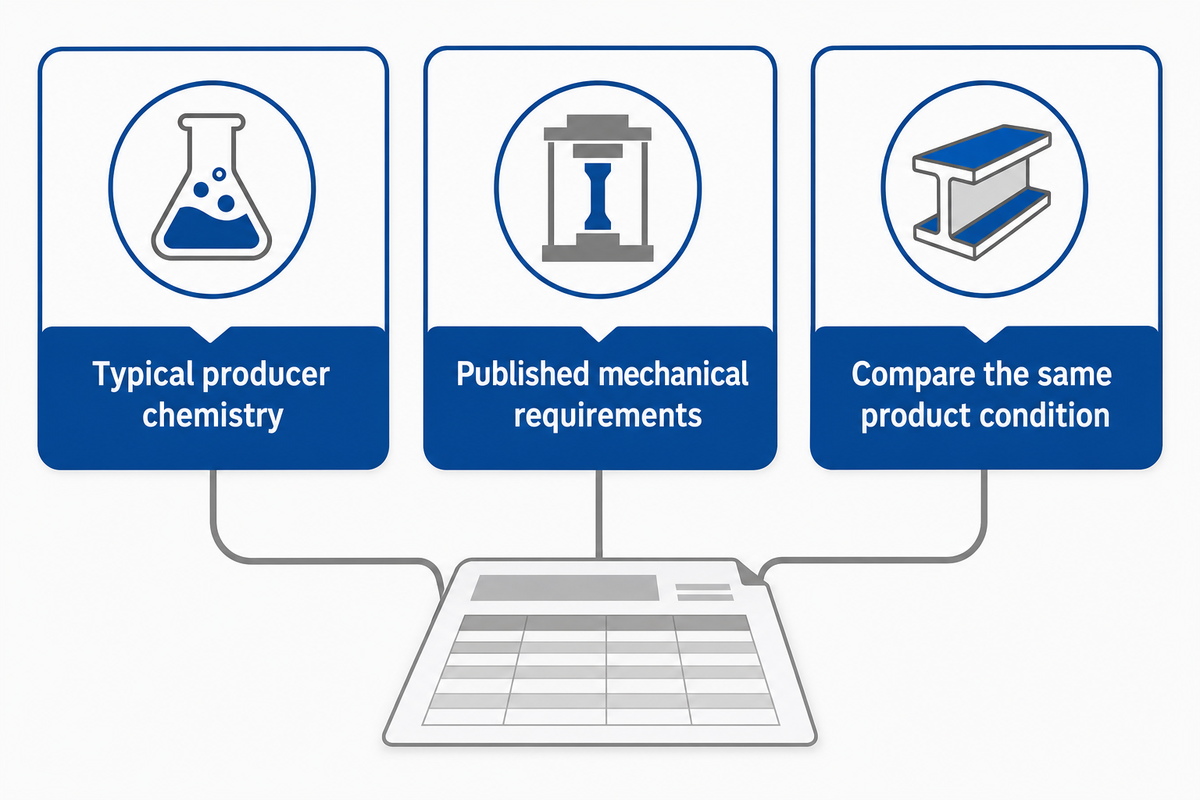
The key differences in the table separate typical producer chemistry from published mechanical requirements. Read each row in its context. Outokumpu’s Core range datasheet and Supra range datasheet provide these values.
| Property | Core 304/4301 | Supra 316/4401 | How to use it |
|---|---|---|---|
| Typical carbon | 0.04% | 0.04% | Typical chemistry, not a carbon maximum |
| Typical chromium | 18.1% | 17.2% | Producer values, not universal grade limits |
| Typical nickel | 8.1% | 10.1% | Compare the shipment’s analysis separately |
| Typical molybdenum | Not listed | 2.1% | Do not interpret a dash as measured zero |
| 0.2% proof strength, minimum | 230 MPa | 240 MPa | Compare the same product condition |
| 1.0% proof strength, minimum | 260 MPa | 270 MPa | Different offset from the row above |
| Tensile strength range | 540–750 MPa | 530–680 MPa | Overlapping ranges defeat a simple ranking |
| Elongation, minimum A/A80 | 45% | 40% | Keep the test basis with the value |
| Test temperature | 20°C | 20°C | Not a high-temperature design allowable |
In Outokumpu’s Core 304/4301 and Supra 316/4401 comparison, 316 adds a typical 2.1% molybdenum while tensile ranges overlap. Maintain acceptance lines for each requirement separately.
Corrosion Resistance: Chlorides Change the Decision
316 provides better corrosion resistance in many chloride-bearing environments. It’s more corrosion resistant than 304 where localized pitting is the relevant threat. Temperature, concentration, deposits, and crevices, for example, can render either material unacceptable. Comparing the two materials, it’s useful to consider the actual exposure and cleaning cycle. A 304 vs 316 stainless steel corrosion resistance comparison starts with the actual exposure and cleaning cycle; “marine grade” alone is too broad to select material for a working system.
Type 316 stainless steel is often referred to as marine grade because the addition of molybdenum improves resistance to chlorides. That advantage, however, has its limits. The British Stainless Steel Association’s (BSSA’s) seawater selection guidance refers to localized attack of 316 and suggests avoiding contact with stagnant seawater. Salt water trapped under a gasket is different from rain washing an open surface in outdoor environments.
Will 304 stainless steel rust in water?
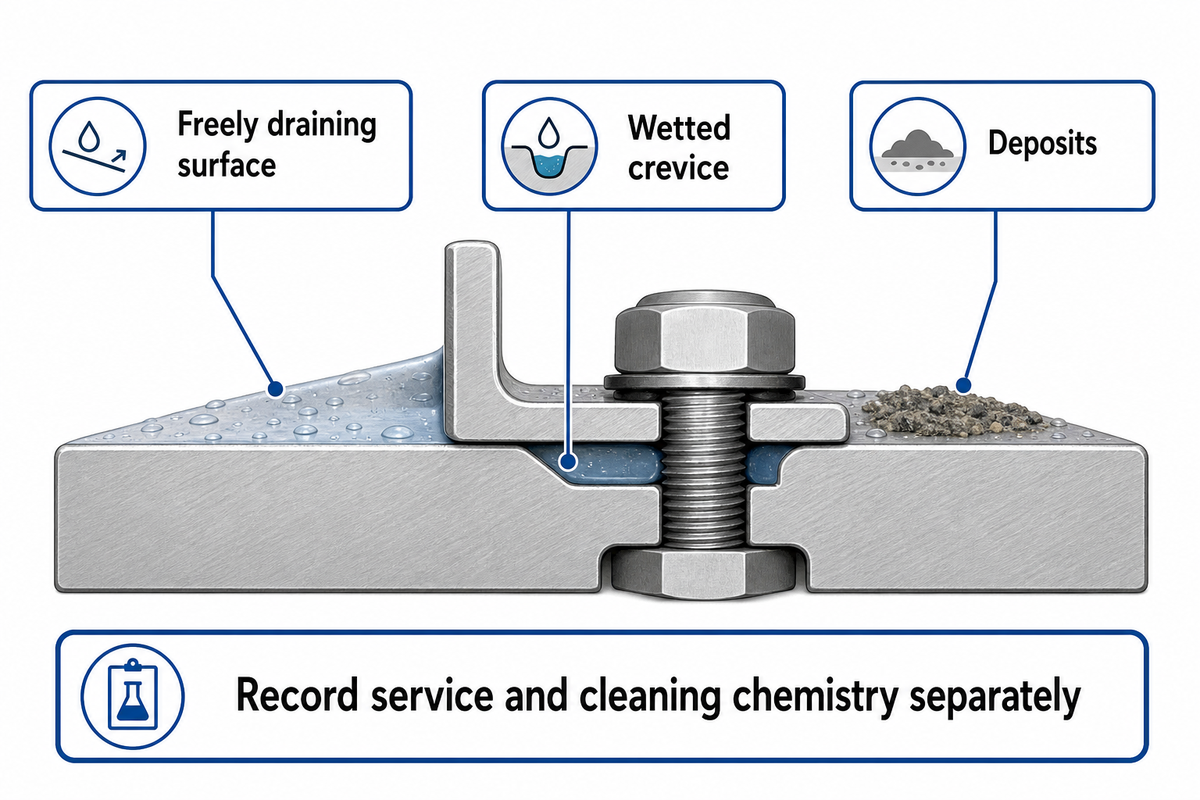
304 can develop rust staining, pitting or other attack in water when the exposure defeats its passive surface. In water, attack can be attributed to deposits, iron contamination and unfavorable temperature. The word “water” is misleading because the exposure isn’t strictly to water, for example it can be to “seawater.” In clean, mild service, the resistance 304 provides can be acceptable; a wetted crevice differs from a freely draining surface.
In a 2025 study of welded 304 by Yu and colleagues, tests across 50–300 mg/L chloride over 90 days showed worsening corrosion behavior as chloride concentration increased. The experiment concerned its stated samples and conditions. Those concentrations aren’t plant acceptance limits, and the work didn’t establish a 316 service-life advantage.
Failure scenario: Cracks develop in an insulated 304 line, and bulk-water chemistry doesn’t account for it. In IMR’s 2021 report on two segments of 304 pipe, deionized water used to prepare process fluid mixes contained 9 ppm chloride, while the silicone-based insulation contained sodium and chlorine. Stress corrosion cracking was the failure mode. For a maintenance buyer, the most useful response would be to inspect moisture retention and deposits as well as bulk-water chemistry. Merely upgrading the pipe to a more expensive grade can leave the exposure in place. The case doesn’t state a universal 9 ppm threshold or provide a controlled comparison to 316. Its lesson is to study the real environment the pipe was exposed to.
- Record normal service and cleaning chemistry separately. Stainless steel offers useful resistance only within its service limits.
- Identify liquid-retaining joints, deposits and shutdown conditions.
- Review both grades again if hot chlorides or stagnant seawater dominate.
In IMR’s pipe case, a 9 ppm bulk-water result didn’t describe the entire exposure. For purchasing, the main question is if the replacement also removes trapped moisture and deposits. Superior corrosion resistance is applicable only in an appropriate service condition; an upgrade in grade alone leaves the original geometry and contamination unchanged.
Strength and Physical Properties: Compare the Same Condition
Whether a 304 pipe or 316 stainless steel is stronger depends on what’s being compared. There are cases where cold working makes strength and hardness differ significantly. Comparisons should be limited to the same product specifications, form, thickness, processing and condition. Bar requirements, fastener strength classes or pressure-design allowables should be justified by the appropriate design basis before using room-temperature sheet values.
Which is stronger, 304 or 316 stainless steel?
For the Outokumpu cold rolled products listed above, 316 has a listed minimum proof strength that’s slightly higher, while 304 has the higher upper tensile limit. Neither observation, by itself, yields a general winner. The overlapping ranges, once again, illustrate why a single tensile strength number can’t answer a cross-form substitution question, especially when one quote is for annealed material and the other is for cold worked material.
The 230 MPa and 240 MPa values are 0.2% proof strengths; 540–750 MPa and 530–680 MPa are tensile ranges. They describe different aspects of a tensile test. For machined parts, carry the required condition into the order using the relevant bar and rod specification choices.
Engineering Note
At 20°C, compare the EN10088-2 cold-rolled rows above only with the same product basis. Put dimensional tolerances on a separate order line under the applicable product specification and drawing. No universal thickness or diameter tolerance follows from “304” or “316.” ASTM A240/A240M-26 covers plate, sheet and strip; it is not a blanket standard for all steel products.
A 10 MPa difference between the cited proof-strength minima is a narrow product comparison, not a design margin for every component. Buyers faced with a “316 is stronger” substitution should compare the guaranteed property, test temperature and supplied condition on both offers before changing a drawing or purchase requirement.
Welding and Machining: Grade Is Only One Variable
For 304 vs 316 stainless steel weldability, 304 and 316 offer useful fabrication options, but the process can change the surface and local corrosion behavior. Low-carbon versions address sensitization, but not the need for a suitable welding procedure and/or post-weld treatment. Machinability is also dependent on the material condition, tooling, and the operation being performed, so grade alone can’t determine a cutting setup.
For welded service, 316L stainless limits carbon to 0.03%, compared with 0.08% for standard 316 in ASSDA’s table. The low carbon composition helps address intergranular corrosion associated with sensitization. 316 also requires a suitable finished surface. More detail belongs in the 316L grade and service guide and the discussion of 304 and 304L weld sensitization.
Surface treatment deserves its own process decision. Zatkalíková and colleagues’ 2022 study examined sensitized 304 in 1 M chloride solution at pH 1.1, including tests at 20°C and 50°C. Its severe laboratory preparation and exposure matter: a treatment result from that experiment isn’t a general instruction to omit weld cleanup in ordinary fabrication.
| Process | Decision to carry forward | Common mistake |
|---|---|---|
| Welding | Joint, filler, procedure and required corrosion condition | Assuming the L suffix solves every weld issue |
| Cleaning | Finish and contamination control for the service | Using shared carbon steel tools on the finished surface |
| Machining | Toolmaker starting conditions and actual stock condition | Copying another shop’s speeds without its setup |
The Welder’s stainless fabrication guidance puts greater emphasis on contamination control. Use consistent tools and handling for the required finish. A quotation that alters the alloy, but omits the finishing scope, hasn’t priced the same delivered component.
Reducing the carbon limit from 0.08% to 0.03% addresses one fabrication risk, and cleaning and joint design remain separate tasks. For a welded purchase, state the low-carbon requirement and the finished condition. Neither a grade suffix nor an attractive surface finish would replace an acceptable procedure for the intended chemical environments.
304 vs 316 Stainless Steel Cost: Price the Same Scope
316 is more expensive than 304 in many comparable purchases, but there’s no uniform percent premium for every case. Quantity, form, condition, finish and delivery scope change material cost. Construct a comparative price quote for 304 and 316 stainless steel from matching offers, and compare the extra purchase cost with the avoidable consequence that engineering and maintenance can credibly describe.
Molybdenum and nickel may help explain cost difference, and alloying elements are typically part of a finished quotation. Outokumpu’s Americas surcharge selector is a good example to normalize offers, but not to determine a ready-made percentage to apply to all stainless steel products.
1-Event Upgrade Break-Even
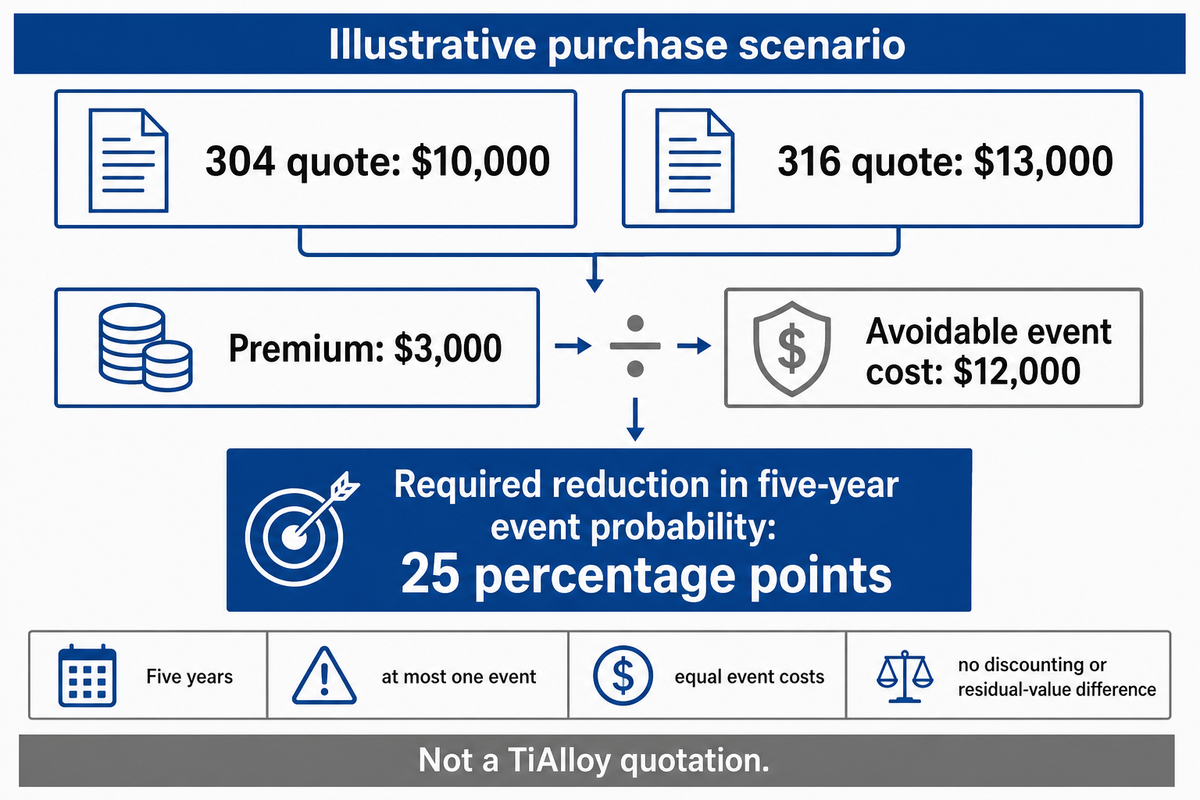
Illustrative purchase scenario: Suppose engineering has qualified both options for a component. A matching 304 quote is $10,000 and the 316 quote is $13,000. Finance therefore sees a $3,000 premium. Maintenance identifies $12,000 of avoidable cost if one corrosion-related replacement event occurs within five years. Assume no more than one such event, equal event costs between options, no discounting and no residual-value difference. The break-even condition is $3,000 ÷ $12,000 = 0.25: the upgrade needs a 25 percentage-point reduction in event probability. If the plant can’t support that probability difference, the calculation remains a sensitivity test rather than an investment forecast. It also can’t qualify an otherwise unsuitable material.
| Input or result | Value | Meaning |
|---|---|---|
| 304 purchase | $10,000 | Assumed matching scope |
| 316 purchase | $13,000 | Assumed matching scope |
| Premium | $3,000 | Additional upfront cost |
| Avoidable event cost | $12,000 | Exclude costs common to both choices |
| Required probability reduction | 25 percentage points | p 304 minus p 316, over five years |
Don’t substitute an arbitrary failure probability. Richard Ricker’s NIST discussion of corrosion service-life prediction describes why uncertainty in exposure and extrapolation is significant. If the event risk for 316 isn’t zero, the threshold is applicable to the difference between the two risks.
With a $3,000 premium and a $12,000 avoidable event, a 25 percentage point reduction is needed to break even over five years for the illustrative case. Procurement owns comparable scope, Maintenance owns event description, and Finance owns the economic assumptions. “316 costs more” or “Downtime is expensive” doesn’t give the required probability difference.
Which Grade Fits Your Application?
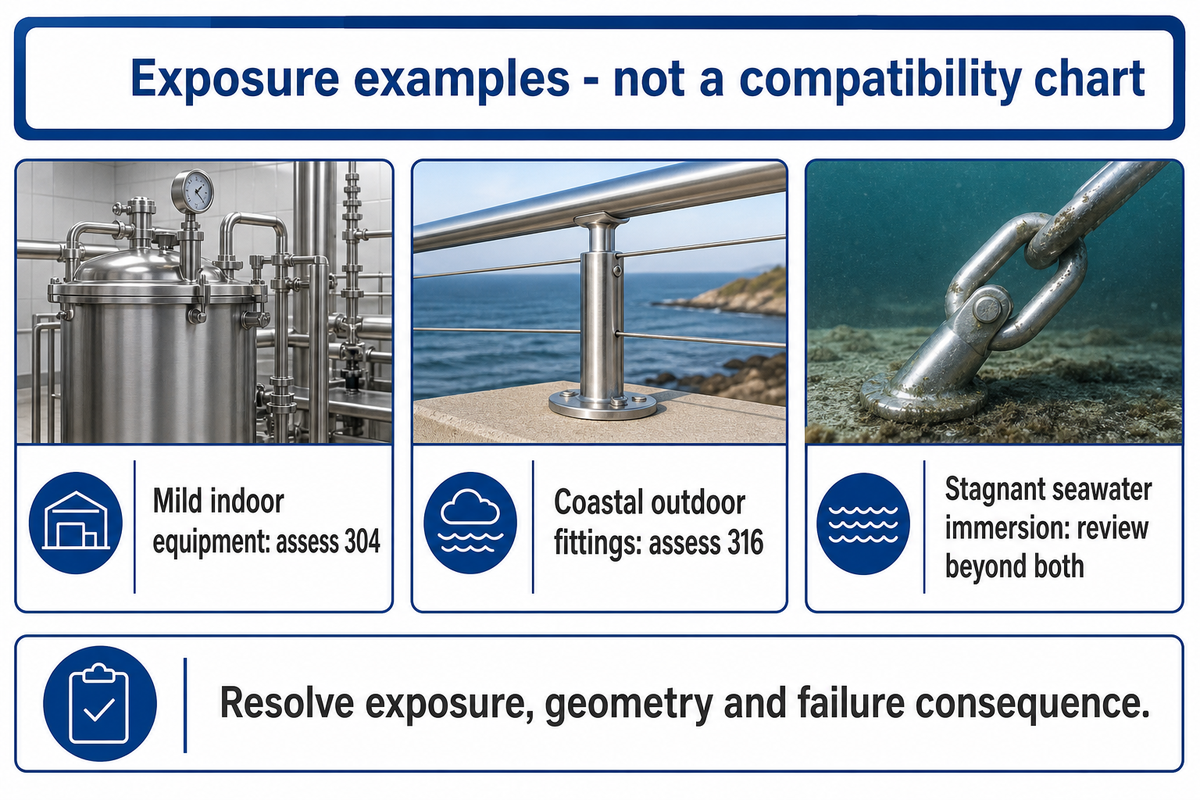
Use 304 where the exposure is mild and its properties meet the design; assess 316 when localized corrosion is a credible concern. Harsh environments may require 316 stainless steel alternatives rather than either of these grades. Applications of 316 and other stainless steel use cases should be grouped by actual exposure, geometry and failure consequence rather than by an industry label.
Exposure × Consequence Decision Map
This map correlates ASSDA’s grade-selection guidance and BSSA’s seawater limits with purchasing questions, and is intended as an editorial guidance aid only. It shouldn’t be used as a tested compatibility chart. Food processing equipment, for example, is subject to product contact and cleaning conditions, and the more onerous of these conditions may apply post-production.
| Application group | Starting choice | Hidden constraint | Owner and next action |
|---|---|---|---|
| Dry indoor trim | Assess 304 | Unexpected cleaners or iron contamination | Facilities: confirm cleaning chemistry |
| Mild indoor equipment | Assess 304 | Wet joints hidden from routine cleaning | Engineering: inspect drainage |
| Food contact surfaces | Compare both | Product, cleaning and hygienic finish differ | Process team: define both exposure cycles |
| Coastal outdoor fittings | Assess 316 | Salt accumulation and inaccessible crevices | Maintenance: establish cleaning access |
| Intermittent marine splash | Assess 316 carefully | Evaporation concentrates deposited salts | Engineering: check local wet/dry exposure |
| Stagnant seawater immersion | Review beyond both | Crevice attack despite the marine label | Corrosion specialist: qualify another system |
| Hot chloride process equipment | Review beyond both if needed | Temperature, stress and deposits combine | Process team: supply operating limits |
| Insulated wet pipework | Diagnose before substitution | Moisture and salts trapped beneath insulation | Maintenance: examine external exposure |
| Sliding contacts or fasteners | Check more than corrosion | Galling, load class and installation | Design team: assess contact and assembly |
Neither grade is completely galling immune. Rogers and colleagues’ 2022 preprint describes adhesive transfer between 304L and 316L. Sliding contact problems are to be assessed differently from static strength. A corrosion resistant fastener can still be the wrong assembly choice.
304: advantages and limitations
- Useful starting point for mild exposure.
- Good fabrication options in appropriate condition.
- Less resistance to chloride pitting than 316.
316: advantages and limitations
- Improved resistance in many chloride exposures.
- Similar fabrication considerations remain.
- Can still pit or suffer crevice attack.
Choosing 304 or 316 for outdoor use starts with exposure and drainage. Choose 316 when its corrosion benefit addresses the identified exposure. 316 grade can provide excellent corrosion resistance in that envelope. If a purchasing request includes only “food grade” or “marine grade stainless,” return the decision to the lacking service conditions, and don’t approve a substitute. A different label doesn’t change a trapped-liquid crevice.
How to Verify 304 and 316 Before Delivery
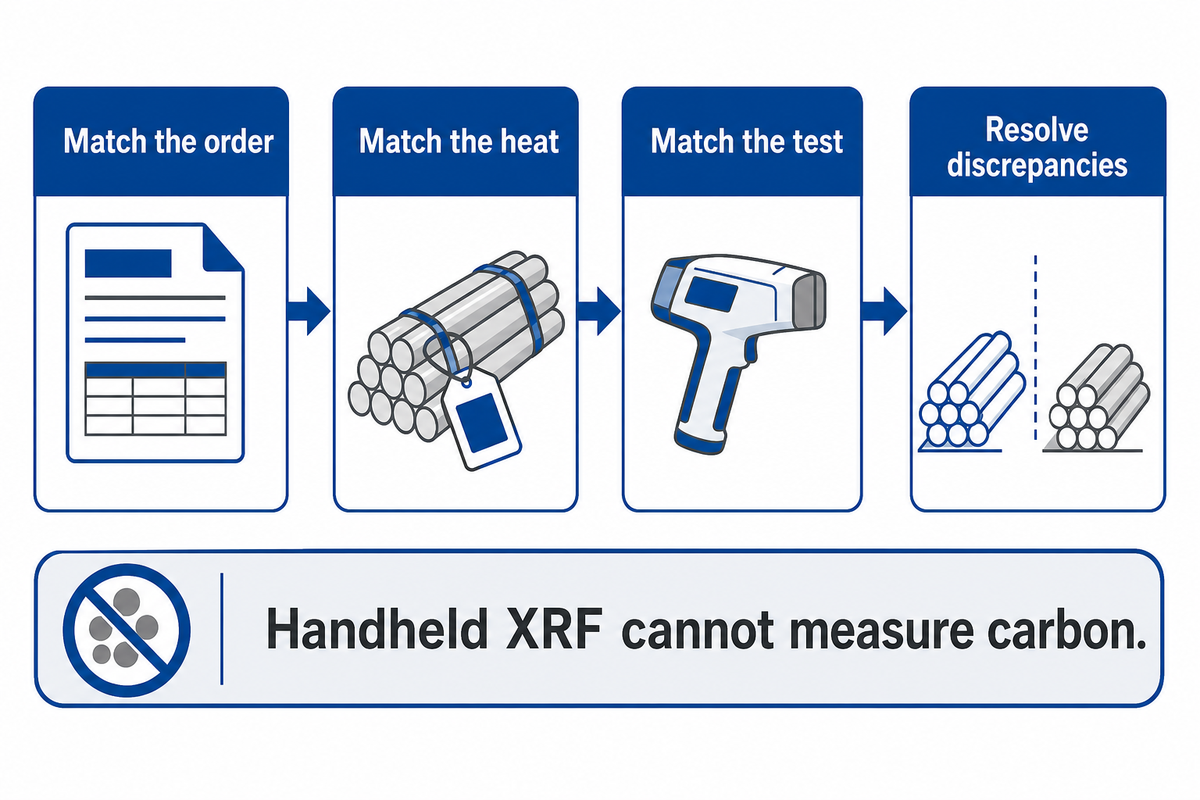
Accept a delivery by matching the order, material identification and test documentation, and perform additional testing as required. Keep grade identification separate from low-carbon verification. A magnet can mislead after fabrication, while a molybdenum-positive sorting result can have several possible alloy identities. The method of acceptance must answer the question the buyer wants to know, whether the order is named stainless steel 304 or stainless steel 316.
How can I tell if my stainless steel is 304 or 316?
Use traceable material records and a suitable chemistry test; don’t rely on appearance or a magnet. A molybdenum check can distinguish known 304 and 316 stock, but an unknown mixed lot needs broader identification. BSSA’s field-sorting table lists several other molybdenum-containing grades, including 317, 444 and 904L.
Handheld X-ray fluorescence can determine alloy chemistry, but can’t measure carbon. For an L-grade requirement, use the documentation and a carbon-capable method identified in the acceptance plan. Preparation and calibration of the instrument matter; the name of the instrument itself doesn’t define its uncertainty.
“However, the determination of elements lighter than magnesium such as carbon is not possible with this technique.”
Receiving scenario: A purchase order for low-carbon plate arrives with two similar looking bundles. The receiving team first matches the heat marking on the bundles to the certificates and order. Next, the team performs an alloy identity screen, as agreed in the inspection plan. If the screen shows molybdenum but doesn’t measure carbon, the team must have the basis for accepting the material as low-carbon. An untraceable bundle is still an issue even if the other bundle in the group has an acceptable result. This process is to prevent the receiving team from accepting bundles based on one favorable instrument result for the group. It’s a proposed receiving method and not a report on how a customer of TiAlloy inspects 316 stainless steel.
- Match the order. Confirm grade, product form, condition, dimensions and agreed standard edition.
- Match the heat. Connect physical markings to the certificate and delivered lot.
- Match the test. Use the agreed method for alloy identity, carbon or mechanical requirements.
- Resolve discrepancies. Separate mismatched material before release into production.
When evaluating 316 stainless steel suppliers, use the supplier qualification checklist. After agreeing on the grade and evidence, carry them on to the 316L supply request.
A 0.03% maximum carbon level requires evidence to support compliance with that carbon limit and alloy identity. Narrower questions may be answered with a molybdenum sort and handheld XRF testing. An acceptance plan should identify the delivered heat, review the records and take the measurements prior to acceptance of the material for production, especially if visually similar lots arrive together.
Industry Outlook: Specify the Edition, Not a Price Forecast
The most meaningful development for a buyer is the standard edition attached to an offer, rather than predicting one grade will become cheaper. Consider the agreed specification and quotation date together. General stainless steel production statistics show industry output; they don’t specify availability, lead time, or price for a particular order.
ASTM’s public A240/A240M-26 listing as of April 17, 2026 identifies the listed edition as active and lists chromium and chromium-nickel stainless plate, sheet and strip as the covered materials. The public listing also considers inch-pound and SI units separately. Updated edition labels do not, by themselves, inform a buyer of what requirements have changed in a previous version referenced in an active contract.
- Before ordering, put the agreed standard edition on the quotation comparison.
- Keep the selected unit system consistent through dimensions and acceptance values.
- If an earlier edition is contractual, resolve the proposed change before release.
As of August 27, 2026, worldstainless reported first-half melt-shop production at 33.0 million tonnes, an increase of 5% over the same period in the previous year. Total production spans all of the stainless steels and isn’t a stock report on 304 or 316 stainless steel. The stainless steel might be available in one form but not another; a supplier still needs to quote the requested form, quantity and shipment timing.
Global output of 33.0 million tonnes and 5% growth gives industry context without pricing a single order. A forecast based on a news headline isn’t as useful as a procurement agreement based on dated matching quotations and an agreed standard edition. Keep the procurement decision tied to the application and delivered scope.
Frequently Asked Questions
Questions regarding the composition and low-carbon limits of 316 and 304 become easier once corrosion and mechanical condition requirements, as well as the purchasing scope, are addressed. The remaining selection traps are addressed below. The ASSDA grade guide provides reference limits for composition and low-carbon requirements; specifying the form and type for assembly and machining requires operational details.
What are the disadvantages of 316 stainless steel?
Its extra cost may buy little benefit in mild service, and aggressive chlorides can still cause attack.
Superior resistance in a suitable exposure doesn’t make every component economical. For a dry indoor part, the practical difference is negligible if both options already meet the exposure and design requirements, while stagnant seawater may exceed the resistance of 316. Fabrication, finishing and dimensional requirements remain part of the order. Compare those requirements before paying a premium or assuming the upgrade removes maintenance needs.
What are the disadvantages of 304 stainless steel?
304 is more vulnerable to localized chloride attack than 316, so exposure can narrow its useful range.
Applications of 304 stainless steel should account for cleaning agents, trapped moisture and salt deposits as well as the product being handled. Standard 304 can be an appropriate choice in mild service, but a corrosion complaint needs diagnosis before replacement. Welded areas and contaminated surfaces deserve attention; changing the grade while retaining the same unfavorable exposure may leave the underlying problem unresolved.
Is 316 better quality than 304?
No. Quality means meeting the specified requirements; suitability depends on the application.
316 often offers superior corrosion resistance in chloride-bearing service, yet that advantage is different from manufacturing quality. Correctly supplied 304 can satisfy its order completely. Incorrect dimensions, missing heat traceability or the wrong condition remain defects in either grade. Decide which properties the component needs, then judge both offers against those requirements instead of treating the grade number as a quality score.
Is 304 or 316 stainless steel stronger for fasteners?
Use the specified fastener strength class and condition, not the alloy number alone.
Check corrosion suitability separately. Sliding contact and installation can introduce galling; neither a tensile value nor a marine label resolves the assembly requirement.
Is 316L different from 316 stainless steel?
316L has a lower carbon maximum, commonly selected to address sensitization in welded service.
ASSDA lists 0.03% maximum carbon for 316L and 0.08% for 316. The lower limit doesn’t make 316L immune to pitting or crevice corrosion in chloride environments.
Why is 316 stainless harder to machine than 304?
A universal ranking is misleading: stock condition, tool geometry, coolant and operation all affect machinability.
304 and 316 stainless steel can work-harden during cutting. When a stainless steel machining job deteriorates, examine whether the tool is rubbing, the insert suits the operation, or the setup lacks rigidity before attributing everything to composition. Start with the toolmaker’s recommendations for the actual material and operation, then adjust from observed chip formation, tool wear and finish. Copying a speed or feed from an unrelated shop omits too much context.
A statement that 316 is significantly harder to machine needs a defined comparison. Annealed bar, cold-worked stock and a thin fabricated part don’t present the same cut. For a repeated order, record the supplied condition alongside the grade so a purchasing substitution doesn’t quietly change the machining problem.
Key takeaway
316’s 2.0–3.0% molybdenum, as listed in ASSDA’s grade table, helps with localized corrosion, but selecting between 304 and 316 still requires an exposure check, a condition-matched property comparison and a traceable delivery.
Turn the comparison into a material request
Send the required grade, form, dimensions, condition, service environment and acceptance documents with your enquiry. TiAlloy’s 316L stainless steel product page is a starting point once the application calls for the low-carbon option.
About This Material Comparison
This guide compares 304 and 316 through published producer data, association guidance and original research. The exposure map is an editorial synthesis; the cost example uses disclosed assumptions rather than supplier prices or measured service lives. Product-specific numbers remain tied to their stated conditions. No laboratory results, patents or customer inspections cited here are presented as TiAlloy’s own work.
Related Articles
References & Sources
- 316: The First Step Up, ASSDA.
- Selection of stainless steels for seawater applications, BSSA.
- Welded 304 chloride-exposure research, Yu and colleagues, Materials, 2025.
- Sensitized 304 and surface-treatment research, Zatkalíková and colleagues, Materials, 2022.
- The wide world of welding stainless steel, The Welder.
- Using Laboratory Measurements to Predict Corrosion Service Lives in Engineering Applications, Richard E. Ricker, NIST, 2008.
- Adhesive Transfer operates during Galling, Rogers and colleagues, 2022 preprint.
- On-site methods for stainless steel grade product sorting, BSSA.
- ASTM A240/A240M-26 public scope, ASTM International.
- Stainless steel melt-shop production increased by 5% in the first half of 2026, worldstainless, August 27, 2026.