Get in Touch with TiAlloy Company

Hastelloy C276 Guide: Composition, Properties and Uses

Hastelloy C276 is a nickel alloy used in chemical equipment in contact with aggressive acids and chlorides. Its value comes from the combination of chromium, molybdenum and tungsten, plus low carbon and silicon that support welded fabrication. Care in selection means considering the resistance and mechanical properties of the component and the process chemistry and temperature.
A grade name gets you to a family of data. The useful questions come next: Was the number measured on sheet or plate? Does the corrosion result describe base metal or a weld? Was the solution a pure laboratory acid or a contaminated process stream? Many discrepancies on C276 datasheets can be reconciled with the above distinctions.
What Is Hastelloy C276?
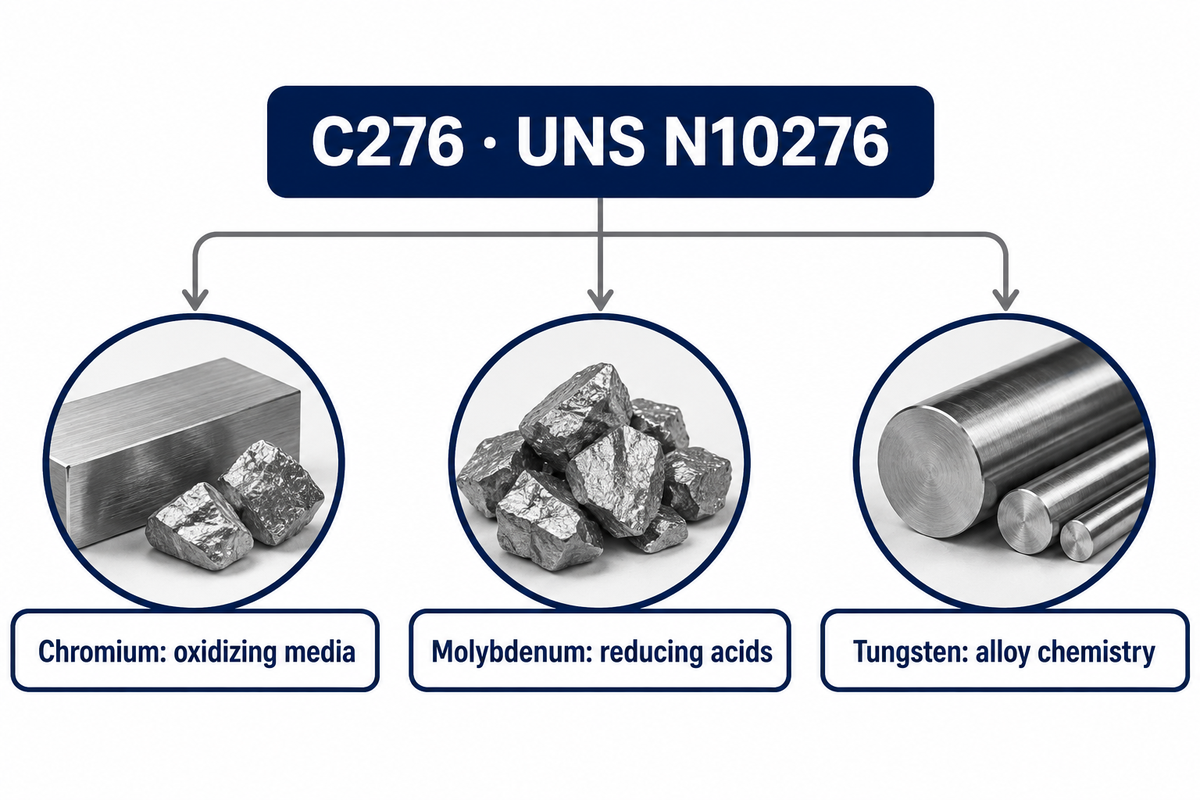
Hastelloy C276, also written Hastelloy C-276 or Alloy C-276, is a wrought nickel-chromium-molybdenum alloy containing tungsten. UNS N10276 identifies the grade, while Hastelloy® is a Haynes International trademark. The material is used for corrosion-resistant components in chemical processing, particularly where an ordinary stainless steel would suffer unacceptable attack.
Haynes describes C-276 alloy as a material developed to reduce welding concerns through very low carbon and silicon. Chromium supports resistance in oxidizing media; molybdenum is valuable in reducing acids and localized corrosion. Tungsten takes part in alloy chemistry rather than acting as a separate surface coating. Calling it a nickel-molybdenum-chromium alloy describes the same material from a different ordering of its principal elements.
Material number 2.4819 is also listed in C276 literature. The characteristics of Hastelloy C276 place it among corrosion-resistant nickel-based superalloys. A superalloy designation still needs the ordered product specification and condition. A supplier referencing a UNS N10276 plate and one referencing a finished welded assembly offer different scopes despite using the same alloy name.
Is Hastelloy a stainless steel?
No. Hastelloy C276 is a nickel-based alloy, while stainless steels are iron-based alloys containing chromium. Haynes gives a nominal nickel content of about 57% for C276, with about 16% each of chromium and molybdenum. That chemistry places C276 in a different material family from austenitic grades such as 316L, even though both can be used for corrosion-resistant equipment.
For 316L, as an example of an iron-based alloy, refer to the stainless steel properties. Appearance alone gives little help: A bright nickel alloy component can appear the same as stainless material.
With C276, nominal chromium and molybdenum are both about 16 wt.%, but the nickel balance makes it a nickel alloy. Specifying UNS N10276 retains that identity with the order; specifying only “stainless equivalent” allows for a material family change, and possibly an equivalent “substitute” that changes the corrosion behavior.
Reading C276 Composition and Properties
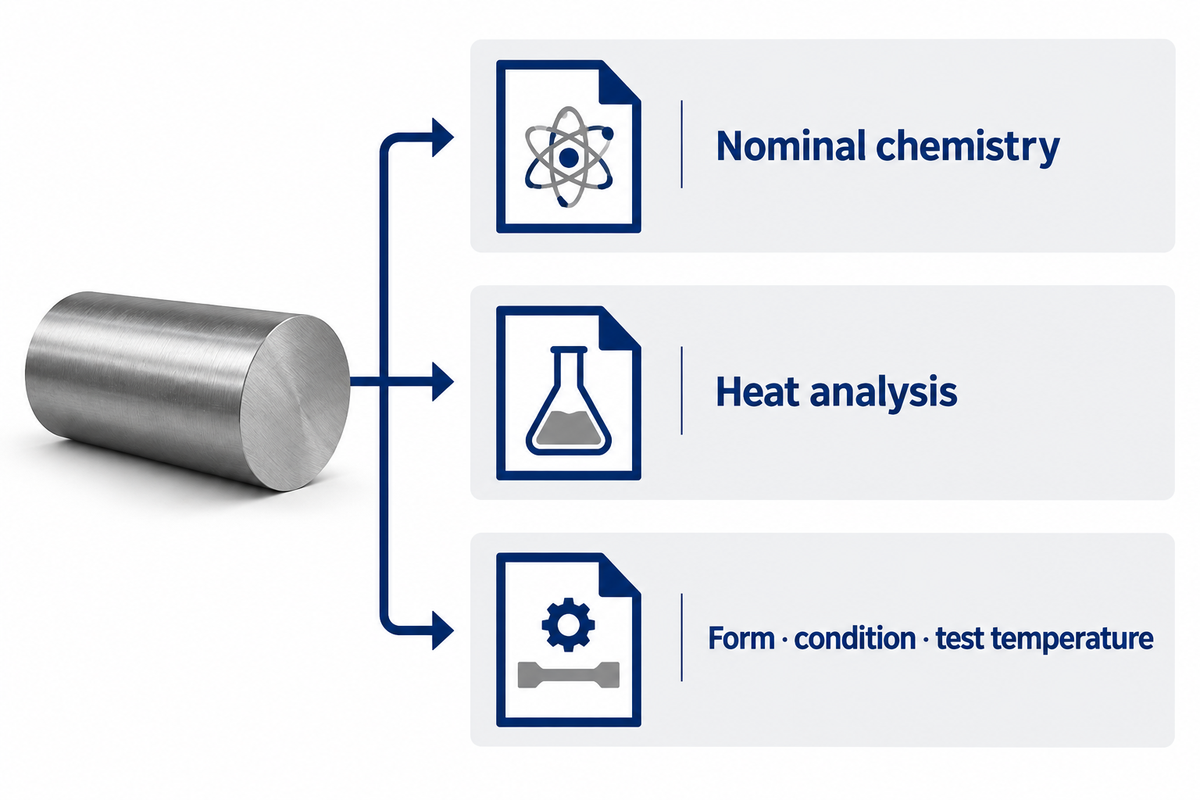
C276 chemical composition, physical properties and mechanical tests assess different features of a material. Nominal chemistry is used in alloy design; a heat analysis is done to get the composition of a particular melt. Strength figures are of no value unless a product form, condition, and test temperature of the material are specified.
Chemical Composition
Haynes gives nominal chromium and molybdenum contents of 16 wt.% each, tungsten of 4 wt.% and iron of 5 wt.%. Nominal composition states carbon is 0.01 wt.% maximum and silicon is 0.08 wt.% maximum. Low carbon helps control the formation of carbides during welding. Low silicon also aids in the prevention of unwanted precipitation during welded fabrication.
Nominal figures and allowed composition ranges serve different purposes. A nominal composition figure helps understand the alloy behavior; an allowed composition range is in consideration of a specified product requirement. A heat analysis gives the result of the material supplied. When transferring data to a material selection sheet, keep the heading of the column of the report attached to the number.
Mechanical Properties
For 2 mm sheet at room temperature, Haynes reports a 0.2% offset yield strength of 356 MPa, ultimate tensile strength of 792 MPa and elongation of 61%. Its 25.4 mm plate row gives 365 MPa, 785 MPa and 59%, respectively. These are indicative producer data for the stated forms. The difference between the rows is a reason to retain specimen details, rather than combine their highest values.
| Property or record | Published value | Basis and practical reading |
|---|---|---|
| Nickel | 57 wt.%, balance | Haynes nominal chemistry; establishes the nickel-based matrix |
| Chromium | 16 wt.% | Nominal content; relevant to passive-film behavior |
| Molybdenum | 16 wt.% | Nominal content; important in reducing and localized corrosive conditions |
| Tungsten | 4 wt.% | Nominal content; compare the heat analysis with the ordered requirement |
| Carbon | 0.01 wt.% max. | Producer composition-table limit, not a nominal target to add |
| Silicon | 0.08 wt.% max. | Producer composition-table limit associated with welded performance |
| Density | 8.89 g/cm³ | Room-temperature reference for mass estimates |
| Thermal conductivity | 10.5 W/(m·°C) at 50°C | Temperature-specific physical property |
| Specific heat | 427 J/(kg·°C) | Room-temperature producer reference |
| Dynamic modulus | 205 GPa | Room-temperature value; changes with temperature |
| 2 mm sheet, room temperature | 356 MPa yield; 792 MPa tensile | Indicative properties, not a universal acceptance pair |
| 25.4 mm plate, room temperature | 365 MPa yield; 785 MPa tensile | A different product row with 59% elongation |
| Melting range | 1323–1371°C | A phase-change range; separate from an equipment service temperature |
Source: Haynes C-276 composition and property data. Values reflect manufacturer’s stated conditions and an indicative basis.
Example: a quality engineer receives a plate report showing 720 MPa tensile strength and compares it with the 792 MPa sheet figure. Rejecting the plate on that comparison would mix a measured lot result with an indicative value from another product form. The next comparison is with the tensile requirement in the ordered plate specification, including its edition and applicable dimensions. A result above an applicable minimum can be acceptable even when it lies below a producer’s typical sheet result. Conversely, a high tensile result alone leaves chemistry, elongation and material condition unresolved. The purchasing description determines which requirements the report must meet.
At room temperature, published mechanical properties for 2 mm thick sheet and 25.4 mm thick plate are different. Preserve the form and thickness for each result. An incoming-material acceptance check, a design calculation, and an estimate of machining effort require different property readings from the same table.
Corrosion Resistance: Match the Test to the Process
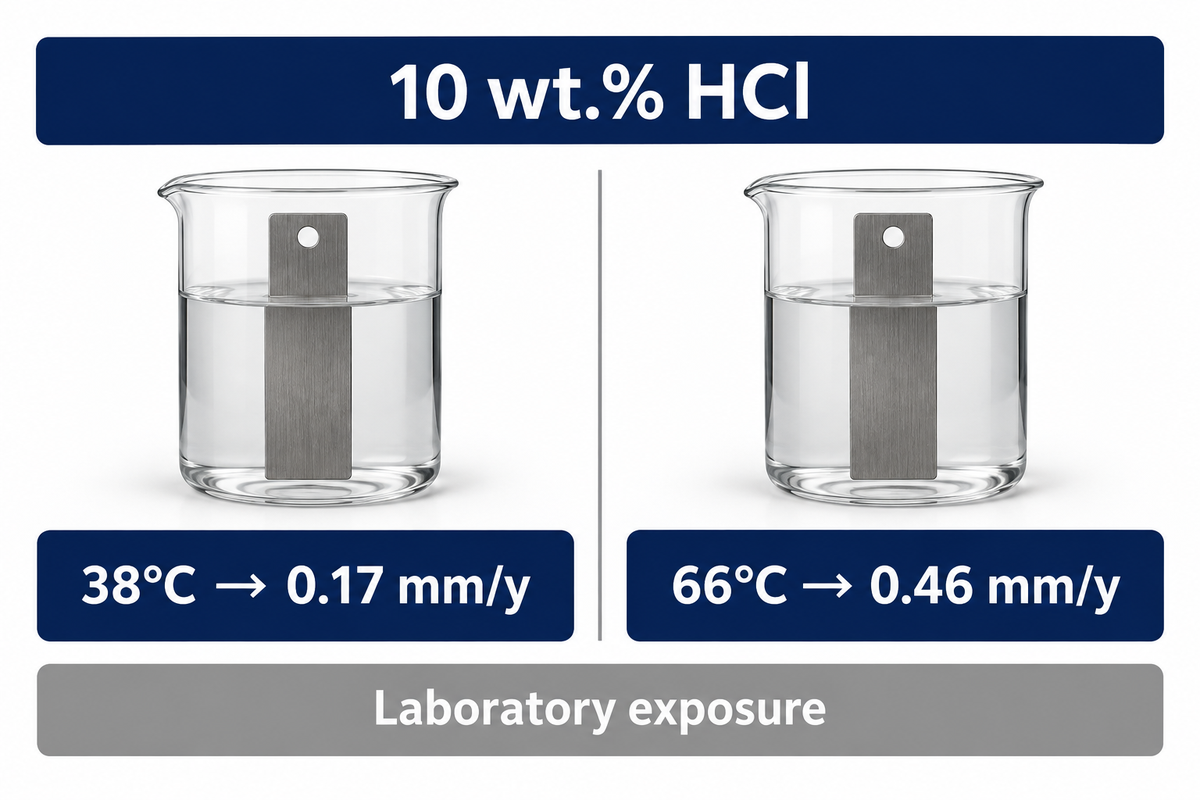
C276 corrosion resistance behaves differently with variations in acid concentration, temperature, impurities and the condition of the exposed metal. The alloy has resistance to oxidizing and reducing environments, but useful comparisons can be made for the mechanism of relevant corrosion under similar conditions. Different types of metal corrosion require different types of evidence.
Chromium and molybdenum help C276 resist attack in acidic process media. Wet chlorine gas is a further exposure described in the producer’s application literature. Moisture content and the resulting local chemistry remain part of the service definition, even for a grade chosen for demanding corrosive applications.
In Haynes reagent-grade hydrochloric acid data, a 10 wt.% solution gives 0.17 mm/y at 38°C and 0.46 mm/y at 66°C. The material and concentration remain the same; temperature dictates the corrosion rate. Those corrosion rates apply to a laboratory exposure. A process stream containing oxidizing contaminants, deposits or a vapor-liquid interface presents additional conditions to assess.
10 wt.% HClReagent-grade laboratory solution
0.17 mm/yAt 38°C in Haynes data
0.46 mm/yAt 66°C in the same concentration
Resistance to pitting and crevice corrosion also needs the test environments. Haynes reports a critical crevice temperature of 55°C for C276 in acidified 6 wt.% ferric chloride over a 72-hour test period. A seawater cooler has a different chemical environment and geometry. The result at 55°C is for the comparison of that ferric chloride case, and doesn’t apply to general seawater temperature.
Resistance to stress corrosion cracking is equally specific. According to Haynes, C276 demonstrated no cracking after 1,008 hours of a boiling test in 45% magnesium chloride. In a separate test described by Paul Crook, stressed C276 specimens developed cracking in 20 wt.% hydrofluoric acid at 79°C over 240 hours. Excellent resistance to chloride-induced cracking and susceptibility in another acid can coexist.
“In hydrofluoric acid laboratory tests, the duration of testing is important.”
| Process condition | Evidence to match | Decision it supports |
|---|---|---|
| Acid identity and concentration | Same chemical and wt.% basis | Whether the corrosion dataset addresses the process liquid |
| Normal and upset temperature | Results spanning the exposed metal temperature | Whether a hotter excursion needs separate evaluation |
| Oxidizing contaminants | Tests containing the relevant species | Whether a pure-acid result transfers to the mixture |
| Liquid, vapor or condensate | Exposure of the corresponding phase | Which surface faces the most aggressive local chemistry |
| Deposits or gasket crevices | Localized-corrosion assessment with representative geometry | Whether uniform weight loss misses the controlling damage |
| Welded joint | Base metal, weld metal and heat-affected zone identified | Which region the reported result describes |
| Applied or residual stress | Stress-corrosion test in the relevant medium | Whether cracking requires attention alongside metal loss |
| Solids and flowing slurry | Representative flow and erosion-corrosion assessment | Whether mechanical removal adds to chemical attack |
| Exposure duration and cycling | Test duration and thermal-cycle history | Whether transient behavior matters to the duty |
For a welded component, the specimen region deserves its own entry. Mishra’s C276 corrosion study distinguishes base material, simulated heat-affected zones and all-weld metal. Its author worked at Haynes; the public abstract describes the study scope. A wrought coupon and a completed joint have different microstructures and exposure histories.
A change from 38°C to 66°C raised the reported 10 wt.% HCl corrosion rate from 0.17 to 0.46 mm/y. For an acid handling component, the hottest wetted region deserves attention, especially when the bulk tank temperature is lower. Concentration, condition and local geometry should be considered in addition to temperature.
Temperature, Welding and Machining Limits
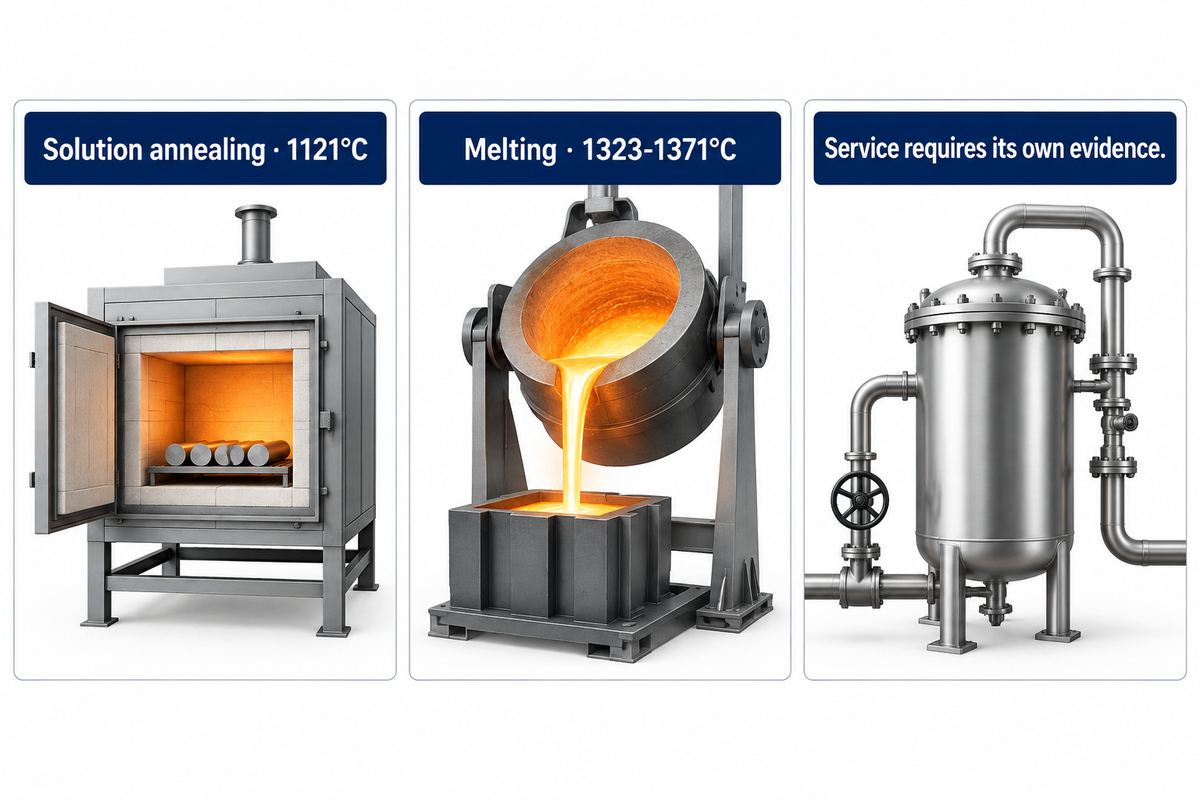
Fabrication of C276 involves close control of work hardening and heat history. A solution-annealing temperature, melting range and operating limit describe separate physical questions. Welding adds a solidification cycle; machining adds localized heat and strain. Each operation alters the conditions that a subsequent corrosion test or mechanical property evaluation will represent.
Haynes lists 1121°C for solution annealing and advises rapid cooling in its fabrication guidance. Their fabrication guidance advises rapid cooling during this controlled processing operation. It is far above many aqueous process temperatures, and the 1323–1371°C melting range answers another question entirely. Long exposure in a damaging temperature range can promote intermetallic precipitation and reduce useful ductility.
In a published report, Chen and colleagues examined the failure of a C276 pipe with an outside diameter of 170 mm and wall thickness of 4 mm. An external heater operated at 1050°C, while periodic water mist helped capture reactive decomposition products inside. After a few months, the pipe ruptured. Intergranular precipitates and preferential corrosion and cracking associated with thermal stress were reported. The temperature of the inside wall of the pipe wasn’t reported. The case links the failure to a combination of chemistry, temperature gradients and material changes. For a plant engineer, the case shows the challenges associated with describing cyclic, chemically aggressive service with a single high temperature number.
During welding, low carbon and silicon improve fabrication behavior, but weld metal can still develop solidification-related hot cracks. Cieslak and colleagues’ welding-metallurgy study associated intermetallic solidification constituents with hot cracks in C276 and C22 while describing good overall weldability. This joining-stage mechanism is separate from the later service damage in the reactor case.
Established processes for the grade include Gas tungsten arc, Gas Metal Arc and Shielded Metal Arc welding. Consumables for these processes are typically marked ERNiCrMo-4 or ENiCrMo-4. Joint preparation, cleanliness, and heat input are part of the welding procedure for the component. A statement that the alloy is acceptable for as-welded service doesn’t preclude consideration for the workmanship of the joint and exposure.
Machining requires a different approach. C276 work hardens and cutting heat tends to concentrate near the tool. With a dull edge, the next pass can be difficult and can also damage the part. Contributors in the Practical Machinist C276 discussion who have experience with this material encourage tracking insert condition and budgeting tooling per part. Their accounts identify a production concern; cutting speeds from one shop should remain attached to its tooling and operation.
A 2026 C276 turning study showed an average flank wear of 0.142 mm in dry cutting, 0.116 mm with minimum quantity lubrication (MQL) and 0.092 mm with nano-assisted lubrication (NAL) at a machining length of 900 mm. Only one uncoated ceramic tool material was used for the studies. Lubrication changed wear within that setup; a shop using carbide, another geometry or interrupted cuts needs its own production basis.
Heat history and tool condition influence different stages of a C276 part’s life. A 1121°C anneal describes processing, while 0.142 mm flank wear describes a tool measurement in one experiment. Neither of these values is an equipment rating. The condition of the part relates fabrication choices to the corrosion service.
Applications: Match the Equipment to the Exposure
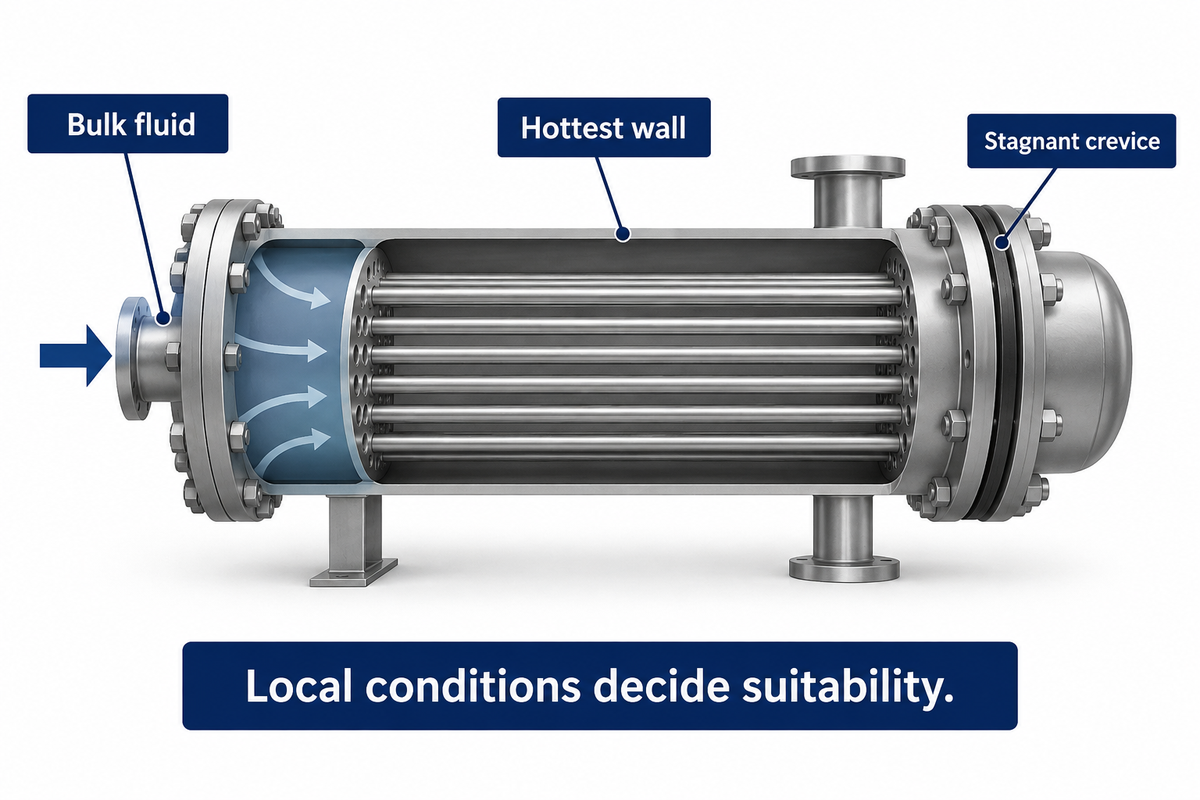
One common application of C276 is in reactors and in heat exchangers, evaporators and pollution control equipment that’s exposed to corrosive media. The chemical processing industry uses the alloy for wetted components where its corrosion resistance justifies the material and fabrication effort. Within the same plant, different parts can need different alloys because temperature, deposits and fluid phase change locally.
In a heat exchanger, the hottest wall and a stagnant crevice can face harsher conditions than the measured bulk fluid. Evaporators tend to concentrate species that are dissolved in water. A scrubber, duct or damper may alternate between exposure to wet condensate and dry gas. Equipment names give guidance; operating conditions and chemistry decide material suitability.
| Component or service | Exposure to characterize | Main selection question |
|---|---|---|
| Chemical reactor | Mixtures, reaction products and temperature cycles | How do normal and upset chemistry differ? |
| Heat-exchanger tubes | Wall temperature, deposits and tube joints | Where is localized attack most likely? |
| Evaporator surfaces | Concentration changes and hotter wetted areas | Does the exit condition exceed the inlet basis? |
| Acid transfer piping | Concentration, velocity and welded regions | Does the corrosion basis cover the completed line? |
| Scrubber internals | Chloride-containing liquid and retained solids | Can deposits create a different local environment? |
| Flue-gas duct or damper | Condensate and wet/dry transitions | Which gas-contact surfaces also become wetted? |
| Pulp and paper equipment | Bleaching chemistry and cleaning cycles | Are all process and cleaning media included? |
| Seawater cooling components | Stagnation, crevices and biofouling | Does the seawater corrosion assessment represent the geometry? |
| Oil and gas components | Sour chemistry, stress and material condition | Does the specified condition fit the defined service? |
Working with offshore and coastal equipment usually brings sea water exposure into consideration when selecting materials. Seawater crevice data from a US Navy study at LaQue Laboratories, reproduced by Haynes, offer a useful geometry lesson. Paul Crook’s technical article also presents seawater crevice tests. In tests performed at 29°C ±3°C for 180 days, the C276 samples showed attack in quiescent water and no attack in the crevice sites in flowing water. Keeping the liquid the same and changing the exposure gives a better interpretation of “excellent corrosion resistance” than considering seawater as one uniform exposure category.
For example, a cooler’s flowing channels and a stagnant gasket edge can experience different environments despite sharing the same 29°C inlet water. C276’s high resistance to many chloride environments is a reason to consider it, while crevice geometry and deposits remain part of the component selection.
C276 Alternatives and Their Tradeoffs
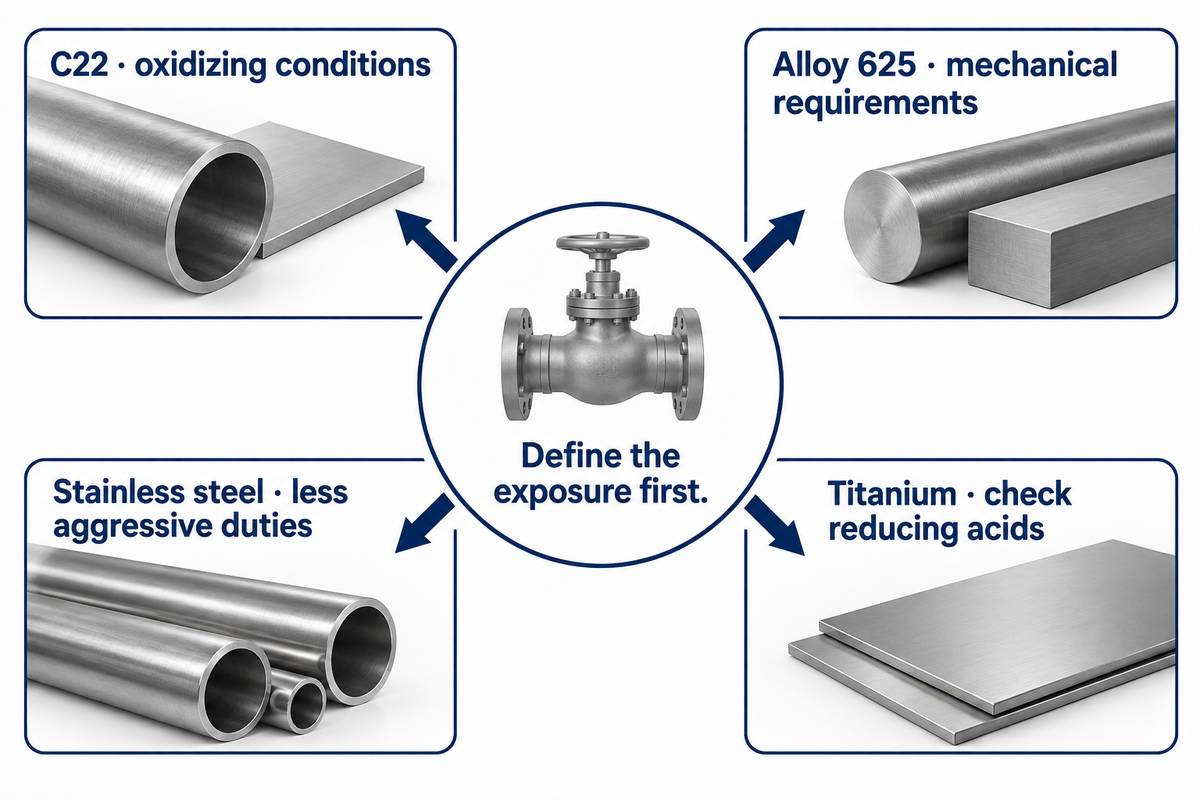
Besides C276, other materials for such functions may include C22, Alloy 625, stainless steels, and titanium. In the end, the best choice depends on the required mechanical strength and the fluid chemistry rather than a universal ranking. A material that exhibits superior corrosion resistance in one test may not be ideal for another for several reasons including fabrication costs and effort.
C22 has more chromium in its nominal chemistry, while C276 has a different molybdenum and tungsten balance. Published electrochemical work by Lloyd and colleagues examined several Ni-Cr-Mo alloys in deaerated 1.0 mol/L sodium chloride plus 0.1 mol/L sulfuric acid at 25–85°C. The alloy compositions exhibited differences in passive film behavior at controlled potentials. A detailed Hastelloy C276 vs C22 comparison addresses the separate grade-selection question.
- C22: compare its chromium-rich chemistry when oxidizing conditions are central to the duty.
- Alloy 625: assess its corrosion behavior and mechanical requirements together; Inconel 625 properties and applications cover that grade in more detail.
- Stainless steel: retain it as a candidate where the actual environment is less aggressive and its corrosion performance meets the component requirement.
- Titanium: consider its strengths in appropriate seawater or oxidizing duties while examining reducing-acid compatibility separately.
Is Hastelloy the same as Inconel?
No. Hastelloy and Inconel are alloy trade names for different product portfolios. C276 is commonly described under the Hastelloy name; Inconel 625 identifies a different grade. Alloy C-276, among others, is also produced under other trade names, and in those cases the UNS designation helps identify the material.
For a fair comparison, the components under consideration should have defined material grades and the same service duty. Comparing “Inconel equivalents” is too broad. For details see “How Inconel and Hastelloy grades compare.” The same datasets should retain their solution, condition and temperature when discussing either family.
In a different molten salt study at 800°C, a corrosion rate for C276 of about 10 μm/year was reported in the absence of air, and 500 μm/year in the presence of air, in a ternary chloride melt. The presence of air in the study definitely had a significant effect on the result. An alloy comparison is useful only after the exposure conditions have been defined.
Understanding C276 Cost
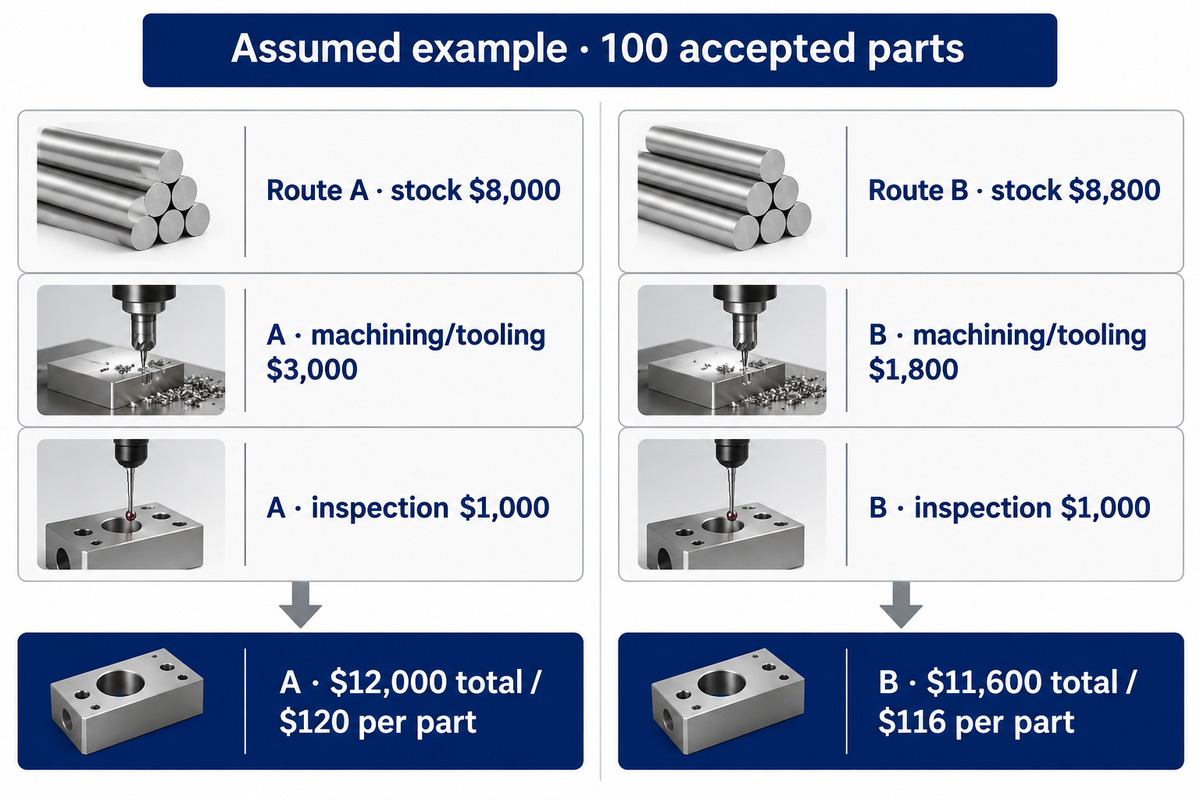
C276, with raw materials, product conversion, machining, inspections, and the quantity of accepted delivered components considered, has a combined cost. The relevant comparison may be a cut blank or finished component. Using consistent cost boundaries provides a more realistic price comparison for procurement and finance.
Is the Hastelloy C276 expensive?
C276 is a high-alloy material whose nickel, molybdenum and tungsten content, processing effort and machining demands can make it a costly choice for routine duties. Its economic value improves when the selected component needs that corrosion performance. Evaluate the cost of finished acceptable parts in the intended service against the cost of parts of the same dimensions with the same inspection requirements on both sides.
A low stock price can be offset by extra material removal or inspection work. Tooling consumption is important as work hardening and edge wear affect the production run. The measured wear differences in the cited turning study help explain that mechanism; a procurement estimate still needs the shop’s own route, time and yield inputs.
Example: two routes must deliver 100 accepted C276 components. Route A costs $8,000 for stock, $3,000 for machining and tooling, and $1,000 for inspection. Route B costs $8,800 for stock, $1,800 for machining and tooling, and $1,000 for inspection. The totals are $12,000 and $11,600. Dividing by the same 100 accepted pieces gives $120 and $116 per part. Route B’s stock costs more, yet its assumed finished-part total is lower by $400. The decision changes if either route leaves finishing operations outside the price or delivers fewer accepted pieces.
For 100 accepted pieces, a $400 difference is $4 per part. Keep accepted quantity and included operations visible when comparing a supplier’s offer. That arithmetic is more useful than comparing a finished component price with a raw-material price per kilogram.
The 9-Point C276 Evidence Check
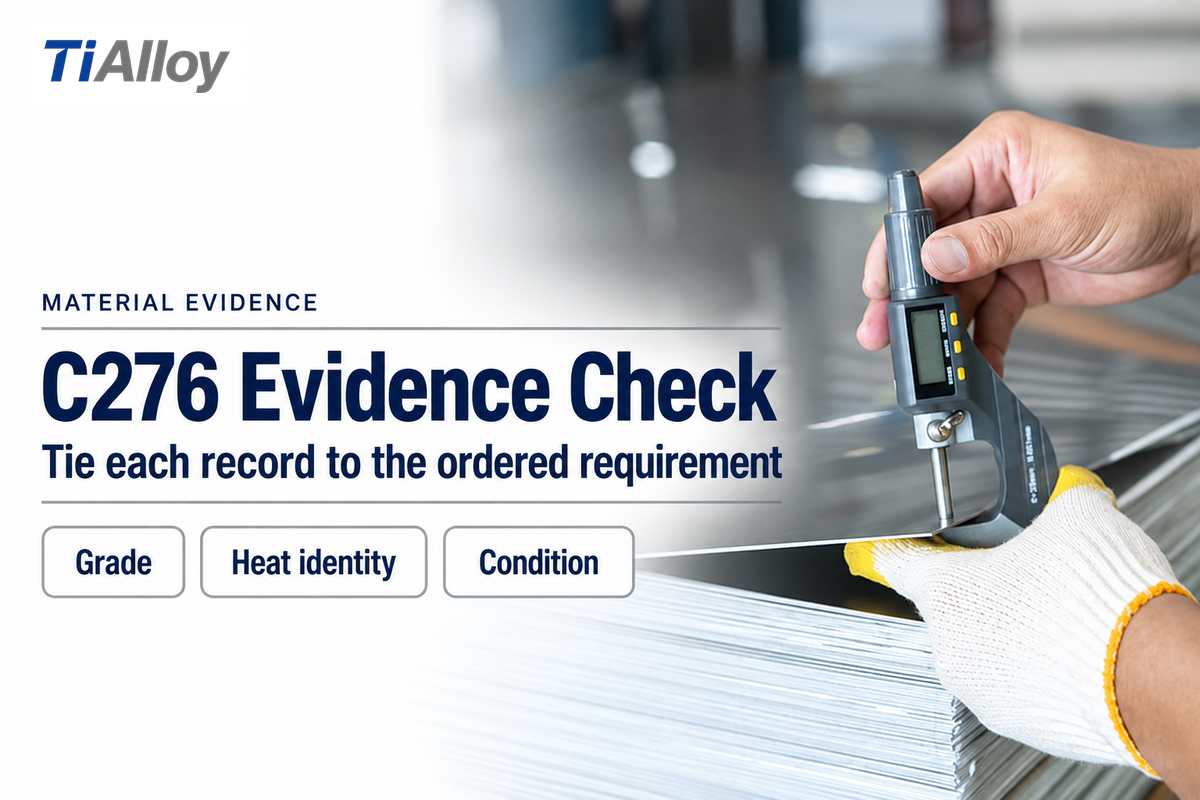
The 9-Point C276 Evidence Check connects each material record to a specific engineering or purchasing question. Work with the grade and product form and then follow the material through its heat identity, processing condition, and inspection. The aim is to ensure the delivered component is tied to the requirements it was ordered to meet.
| Record or requirement | Read it for | Question it answers |
|---|---|---|
| 1. Grade designation | UNS N10276 and agreed naming | Which alloy was ordered? |
| 2. Product specification | Form, edition and applicable requirements | Which product requirements apply? |
| 3. Delivery condition | Annealing and stated processing condition | What material state was supplied? |
| 4. Heat and cut-piece identity | Matching markings and document references | Which melt does this piece come from? |
| 5. Heat chemical analysis | Measured elements and specified limits | Does the reported heat chemistry match the requirement? |
| 6. Mechanical test results | Form, specimen, test temperature and acceptance basis | Which strength and ductility results apply? |
| 7. Dimensional record | Measured dimensions against the drawing or product requirement | Does the supplied geometry fit the order? |
| 8. Agreed inspection reports | Test method, coverage and acceptance criteria | What was examined and against which criteria? |
| 9. Fabrication and service basis | Weld route and defined process exposure | How does the finished component relate to the intended duty? |
Alloy families can be distinguished by a number of measured elements using positive material identification. A handheld X-ray fluorescence check does not measure carbon. However, for a low carbon requirement of 0.01 wt.% (max), full heat chemistry is the acceptable record. The technique, measured elements and identification of the tested piece should stay attached to any identification result.
ASTM B575 covers relevant plate, sheet and strip. ASTM B622 covers nickel and nickel-cobalt alloy pipe and tube made without a welded seam. In October 2026, the official ASTM committee list shows B575-17(2023) and B622-26 as active. Therefore, a Hastelloy C276 pipe request needs to specify the manufacturing form and alloy name of the material. The nickel alloy tube standards provide additional information on comparison of tube standards.
For a quotation handoff, confirm the missing inputs once and carry them into the same request. Use the following fields with the operating envelope and drawing for your component.
RFQ checklist — copy these into your quote request:
| Parameter | Recommended range | Why it matters | How to verify |
|---|---|---|---|
| Metal temperature | Enter normal min.–max. and upset maximum, °C | Connects corrosion and mechanical data to the duty | Operating envelope |
| Acid concentration | Enter process and cleaning min.–max., wt.% | Captures concentration changes | Process chemistry record |
| Drawing dimensions | Enter sizes and tolerances, mm | Defines finished geometry | Drawing and dimensional report |
| Quantity | Enter required accepted pieces or kg | Sets a consistent quote denominator | Order and delivery count |
| Specimen and condition | State product form, anneal and test temperature, °C | Links reported properties to the order | Material test report |
| Corrosion basis | State assessed exposure duration, h, and medium | Keeps the test tied to its conditions | Relevant test or engineering assessment |
Key takeaway
UNS N10276 identifies C276; temperature, chemistry and material condition determine how its data apply. A 0.17 mm/y result at 38°C in 10 wt.% HCl belongs to that exposure. Keep those conditions attached when moving from a datasheet to a component decision.
For product forms, processing scope and an order-specific quotation, visit Hastelloy C276 material supply. Send the drawing, quantity and defined service conditions with the request. TiAlloy provides the company background.
Discuss a C276 material requirement
Frequently Asked Questions
Is Hastelloy C276 the same as Alloy C276?
Read answer
Yes. Alloy C276 and Hastelloy C276 commonly refer to the nickel-based grade identified as UNS N10276. HASTELLOY is a trademark owned by Haynes International, while the UNS number identifies the alloy. A purchase description should also name the product specification and delivery condition so that the supplied material matches the intended requirement.
What is Hastelloy C276 used for?
Read answer
Hastelloy C276 is used for equipment exposed to aggressive process chemicals, including reactors, heat exchangers, evaporators, scrubbers and transfer piping. The material also appears in pulp and paper equipment or pollution control systems. Engineers select the wetted component and its exposure conditions first; the industry name alone leaves the local chemistry and component geometry unresolved.
Is Hastelloy C276 magnetic?
Read answer
Solution-annealed C276 has very low magnetic permeability and is commonly described as nonmagnetic. Haynes reports a relative permeability of 1.0002 under its stated test conditions. A magnet is therefore a poor way to identify this alloy. Material markings, traceable heat records and an appropriate composition check provide a firmer basis for distinguishing it from other grades.
Can C276 be hardened by heat treatment?
Read answer
C276 is strengthened by cold working rather than conventional precipitation-hardening heat treatment. Solution annealing restores a ductile material condition after suitable fabrication. Specialized surface hardening is a separate process.
How do you weld Hastelloy C276?
Read answer
Join C276 with an established fusion-welding process and a procedure qualified for the joint, thickness and service. Common matching consumables include ERNiCrMo-4 bare wire and ENiCrMo-4 covered electrodes. Gas tungsten arc, gas metal arc and shielded metal arc are established options. Clean surfaces, shielding and controlled heat input support weld quality. Dissimilar joints need separate filler decisions. Evaluate the finished weld and heat-affected region alongside the base material when corrosion performance controls the component. Low carbon and silicon help fabrication, while the procedure also addresses solidification cracking and the joint’s particular service conditions.
Why does C276 have low carbon and silicon?
Read answer
Low carbon and silicon help reduce unwanted precipitation during welding thermal cycles. That supports corrosion resistance around welded regions while joint workmanship and later thermal exposure also matter.
Is C276 automatically compliant with sour-service requirements?
Read answer
No. C276 sour-service suitability requires the specified product condition to fit the defined environment and project requirements. Haynes lists NACE MR0175 and ISO 15156 among associated specifications, but an ordered component also has a particular processing history and inspection basis. Include the applicable edition, material condition and agreed testing in the purchase description, together with the service envelope assessed by the responsible engineer.
References & Sources
- ASTM B575-17 public scope and historical product-requirement context.
- ASTM Subcommittee B02.07 active standards, status checked October 2026.
- Chen et al., Failure Analysis of a C-276 Alloy Pipe in a Controlled Decomposition Reactor, Materials, 2022.
- Paul Crook, Corrosion-Resistant Nickel Alloys, Part 3, Technical Article Hosted by the Steel Founders’ Society of America; Author Affiliated with Haynes.
- Lloyd et al., passive corrosion of Ni-Cr-Mo alloys (2004); material donated by Haynes, research funded by NSERC.
- Vignarooban et al., vapor pressure and corrosivity of ternary metal-chloride molten-salt heat-transfer fluids (2015), original abstract.
- Cieslak et al., The welding metallurgy of HASTELLOY alloys C-4, C-22, and C-276 (1986), public abstract.
- Mishra, Corrosion Study of Base Material and Welds of a Ni-Cr-Mo-W Alloy, 2017, Public Abstract, Haynes Affiliation.
- A data-driven approach for high-accuracy tool wear prediction in machining Hastelloy C276, Scientific Reports, 2026.
WHY WE PUBLISH
About TiAlloy
TiAlloy supplies titanium, stainless steel, nickel alloy and clad plate for specification-driven industrial orders. Our technical guides are written to help buyers align product form, governing standard, test scope and release documents before a quotation is compared.
01Melt & formPlate, sheet, pipe, tube, bar, wire and forgings
02ProcessHeat treatment, finishing, inspection and export packing
03VerifyEN 10204 Type 3.1 certificate and order documents