Get in Touch with TiAlloy Company

Stainless Steel Supplier Checklist for Specification-Driven Buyers

Stainless steel sourcing guide
Field-ready checklist for stainless steel quotes
Stainless Steel Products Hub is TiAlloy’s stainless steel product route for buyers comparing grade, form, standard, certificate, inspection, and export requirements.
Quick Answer – What Makes a Stainless Steel Supplier Worth Shortlisting?
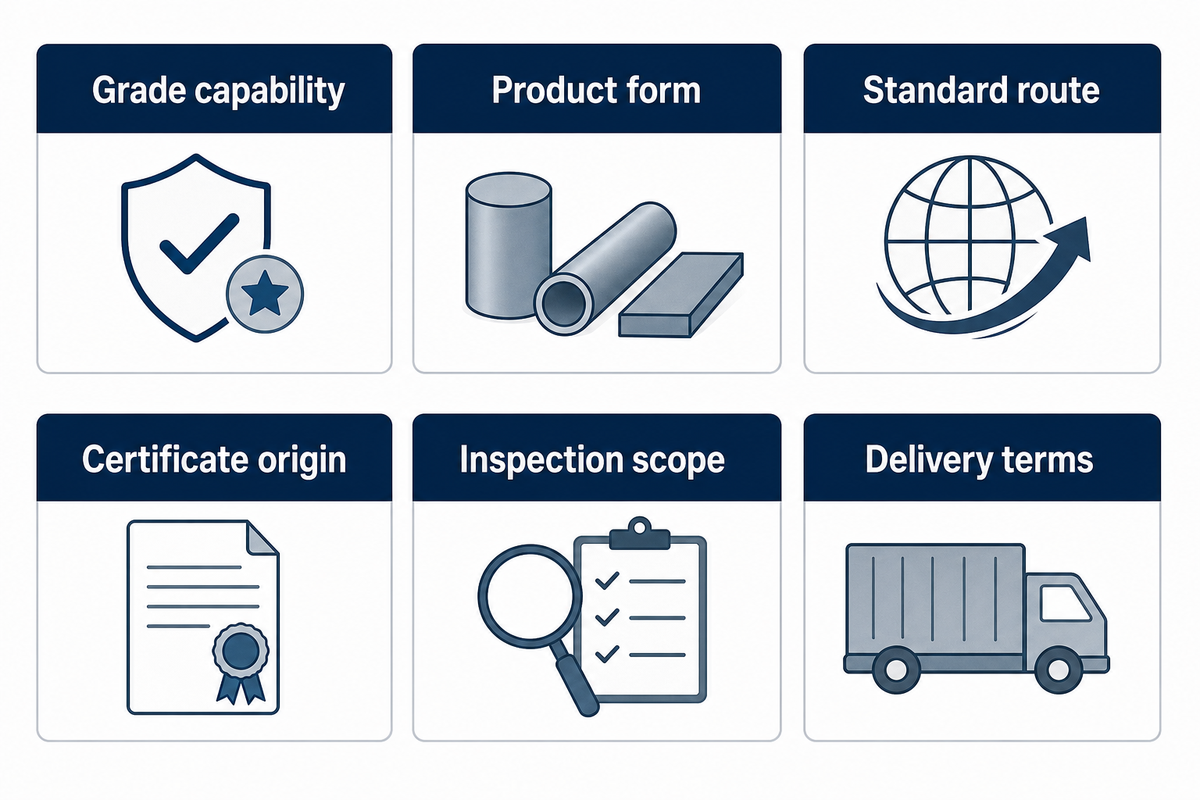
Shortlisting gets easier when a stainless steel supplier proves six items before price is discussed: grade capability, product form, standard route, certificate origin, inspection scope, and delivery terms, with certificate boundaries checked against BSSA EN 10204 guidance. When two offers do not match on those fields, the lower unit price may reflect a smaller scope, weaker paperwork, or a different supply route.
Purchasing teams comparing a stainless steel distributor, local stockholder, trading company, or mill-direct exporter should define the order before comparing quotes. Buyers who plan to buy stainless steel can use the hub as the internal product route, then use this checklist to test outside stainless steel supplier options against the same request.
The 6-Line Stainless RFQ Completeness Gate
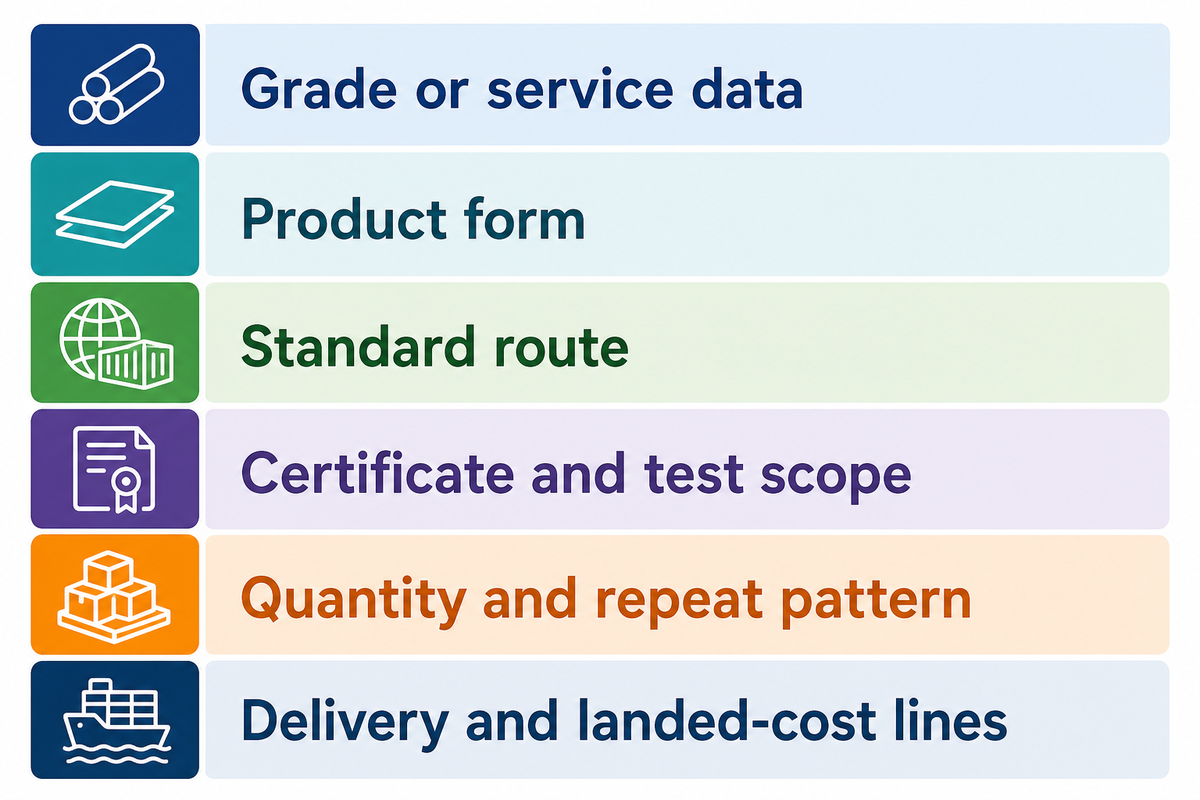
Comparable pricing starts with a cleaner six-line RFQ, not a longer email. Put the same grade, form, standard, certificate, inspection, quantity, and delivery details in front of every stainless steel supplier before asking a premium supplier for competitive pricing, prompt delivery, or cut to size processing.
| RFQ line | What to write | Why it matters |
|---|---|---|
| 1. Grade or service data | Grade if known, or chloride level, temperature, crevice risk, strength need, and whether the part will weld, bend, machine, or fabricate. | Prevents a familiar grade from being used where service conditions point elsewhere. |
| 2. Product form | Plate, sheet, coil, stainless pipe, tube, bar, rod, slit strip, stainless structural shape, or laser fused profile. | Product form changes the governing standard, production route, tolerance, packing, and inspection. |
| 3. Standard route | Examples include ASTM A240 for stainless steel plate, sheet, and strip, ASTM A312 for austenitic pipe, ASTM A213 for heat-exchanger tube, or ASTM A276 for bar. | ASTM pages show that product form and service decide the route, not only the grade name. |
| 4. Certificate and test scope | MTC, EN 10204 Type 3.1, Type 3.2, third-party inspection, PMI, chemical values, mechanical values, and heat number matching. | BSSA separates 3.1 from 3.2; a 3.2 requirement should not be treated as a normal mill 3.1 certificate. |
| 5. Quantity and repeat pattern | Prototype, one-time lot, monthly repeat, annual agreement, or project release schedule. | Sample orders, stocked replacements, and planned mill-direct lots may belong in different supply lanes. |
| 6. Delivery and landed-cost lines | Incoterm, destination, packing, insurance, freight, duty assumptions, and customs-value responsibilities. | CBP notes that CIF is not the declared CBP value, so landed-cost language should stay precise. |
9-Type Specification Boundary Table
Use these values as quote-boundary examples, not as design limits. They help a buyer separate source evidence, TiAlloy capability facts, and live-order variables from catalog claims.
| Spec type | Evidence or RFQ value | How to use it |
|---|---|---|
| Company experience | 20+ years | Brand background from TiAlloy; not a substitute for order inspection. |
| Production base | 30,000 m² | Brand-scale context for factory and export coordination. |
| Life-cycle comparison | 50 years at 3% interest | ASSDA example showing why initial price alone can mislead. |
| Market size context | $42.86 billion in 2025 | IMARC U.S. stainless market baseline; not a quote forecast. |
| Market forecast context | $73.15 billion by 2034 at 6.12% | Demand context only; do not apply it to one order price. |
| Commercial lead-time signal | 4 weeks to 8 weeks | OSS domestic mill signal; verify live availability before purchase. |
| Import timing signal | 12 weeks to 16 weeks | OSS import signal; verify with actual grade, port, and inspection scope. |
| RFQ thickness example | 0.5 mm, 2.0 mm, 6 mm, or 25 mm | Example dimensions to show why plate, sheet, and coil quotes diverge. |
| RFQ quantity example | 500 kg, 2 tons, or 24 tons | Example lot sizes that can move an inquiry between stock, trade, and mill-direct routes. |
| Chloride SCC caution | Around 100°C in BSSA’s failure discussion | Use as a caution that temperature and chloride concentration must be reviewed. |
Product Form Comes Before Unit Price
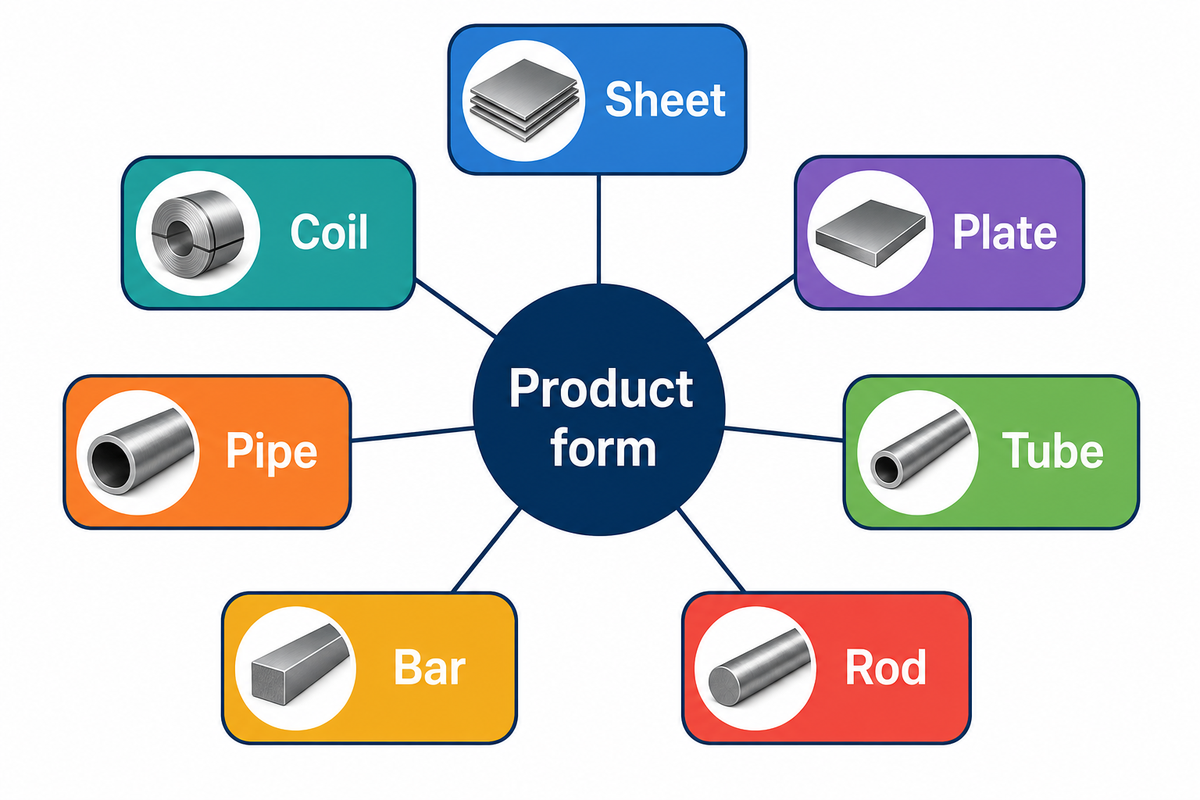
Product pages often promise broad stock, but the wide range of stainless steel only becomes useful after the purchase order names the form. Stainless steel sheet, plate, coil, pipe, tube, bar, and rod do not move through the same production or inspection path. A quote for 304 stainless steel sheet is not the same as a quote for 304L plate, 316L pipe, or 2205 duplex bar.
For flat products, ASTM A240 covers chromium and chromium-nickel stainless steel plate, sheet, and strip for pressure vessels and general applications. For pipe, ASTM A312 covers non-welded, welded, and heavily cold worked austenitic stainless steel pipe for high-temperature and corrosive service. These standards do not make a design decision for you, but they keep the buyer and supplier from speaking in vague catalog language.
Grade-Form-Document Routing Matrix
| Need | First route to check | Document question |
|---|---|---|
| Tank shell, equipment panel, machined blank | Plate or sheet under the right stainless standard | Do you need EN 10204 3.1, 3.2, or project-specific test witnessing? |
| Process line, exchanger, condenser, desalination system | Pipe or tube route, often with corrosion and pressure assumptions | Are heat number, chemistry, mechanicals, PMI, and dimensional tolerance included? |
| Fasteners, shafts, frames, machined parts | Bar, rod, or stainless structural route | Does the certificate match the physical bar or bundle? |
| Repeated blanks, enclosure panels, food service parts | Coil, slit strip, or cut-to-length sheet | Is surface finish, film, burr, camber, and packing defined? |
Grade Choice Starts With Service Conditions
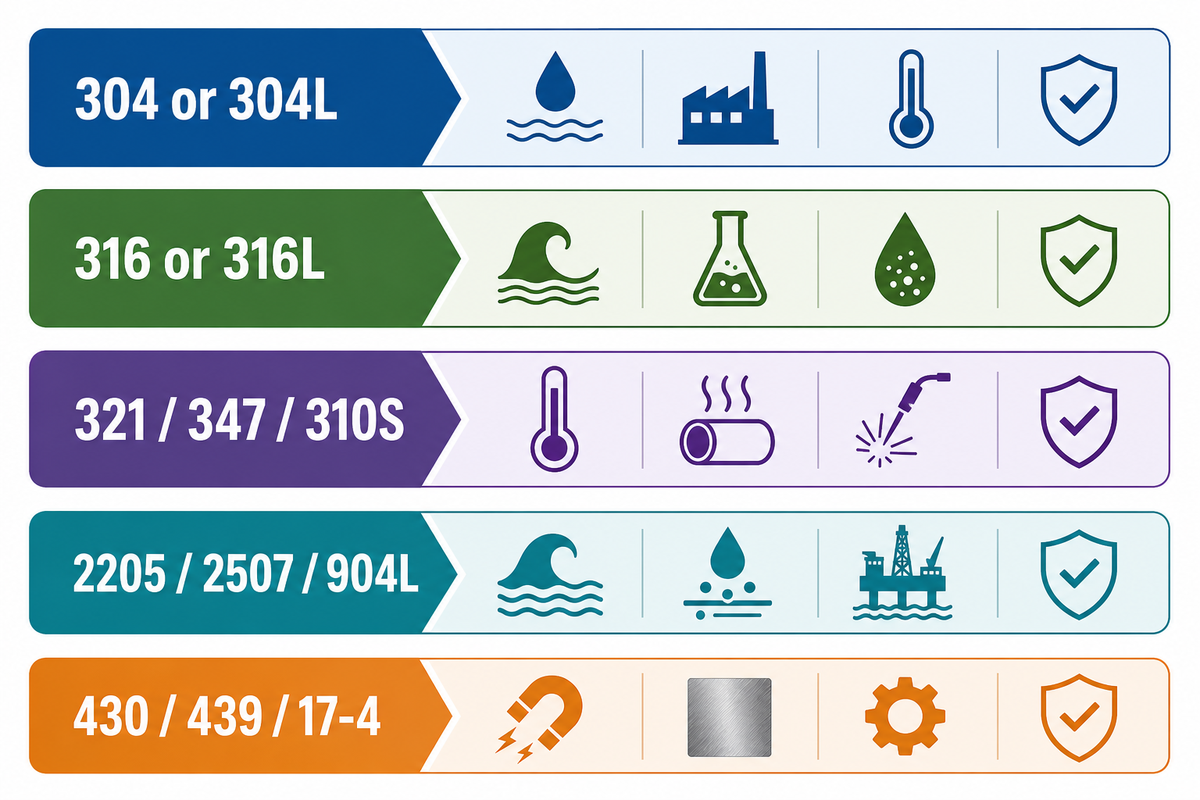
Stainless steel grades should be selected from service conditions, not brand familiarity. Austenitic stainless steel such as 304, 304L, 316, and 316L is common because it combines formability, weldability, toughness, and corrosion resistance for many general duties. That does not make 316L a universal marine answer.
SSINA explains that pitting and crevice corrosion generally occur in the presence of halide ions, typically chloride. It also cautions that pitting resistance numbers do not cover every material and service factor. BSSA’s chloride stress corrosion cracking evidence points in the same direction: chloride, stress, temperature, and geometry can make familiar stainless grades unsuitable.
Use this practical filter:
- Start with 304 or 304L when the duty is general and the environment is mild.
- Consider 316 or 316L when molybdenum-bearing corrosion resistant performance is needed, but still check chloride, crevice, and temperature exposure.
- Ask about 321, 347, 310, 310S, or niobium-stabilized options when weld exposure or higher temperatures matter.
- Review duplex 2205, super duplex 2507, or 904L for highly corrosive environments, but do not use duplex as a high-temperature default without engineering review.
- Treat ferritic grades such as 430 or 439, martensitic grades, 400 series grades, and 17-4 precipitation-hardening material as separate engineering choices, not substitutions for common austenitic grades.
That is the difference between asking for premium stainless steel and asking for the right stainless steel. The second request is easier to inspect, quote, and defend.
For sheet metal, alloy steel-adjacent assembly work, titanium contact parts, pipe for fluid conveyance, machining, high temperature service, and welding work, note whether the drawing names SAE 304 stainless steel, ferritic stainless steel, or another controlled material. The wide range of applications and the variety of industries can look similar in catalogs, but specific strength needs and service exposure still decide the final route.
The Document Chain Is Part of the Product
For specification-driven stainless steel products, paperwork is not filler. It connects steel alloys to heat number, chemistry, mechanical values, standard, product form, and order line. A trusted stainless steel supplier should be able to explain where the certificate originates and what it proves.
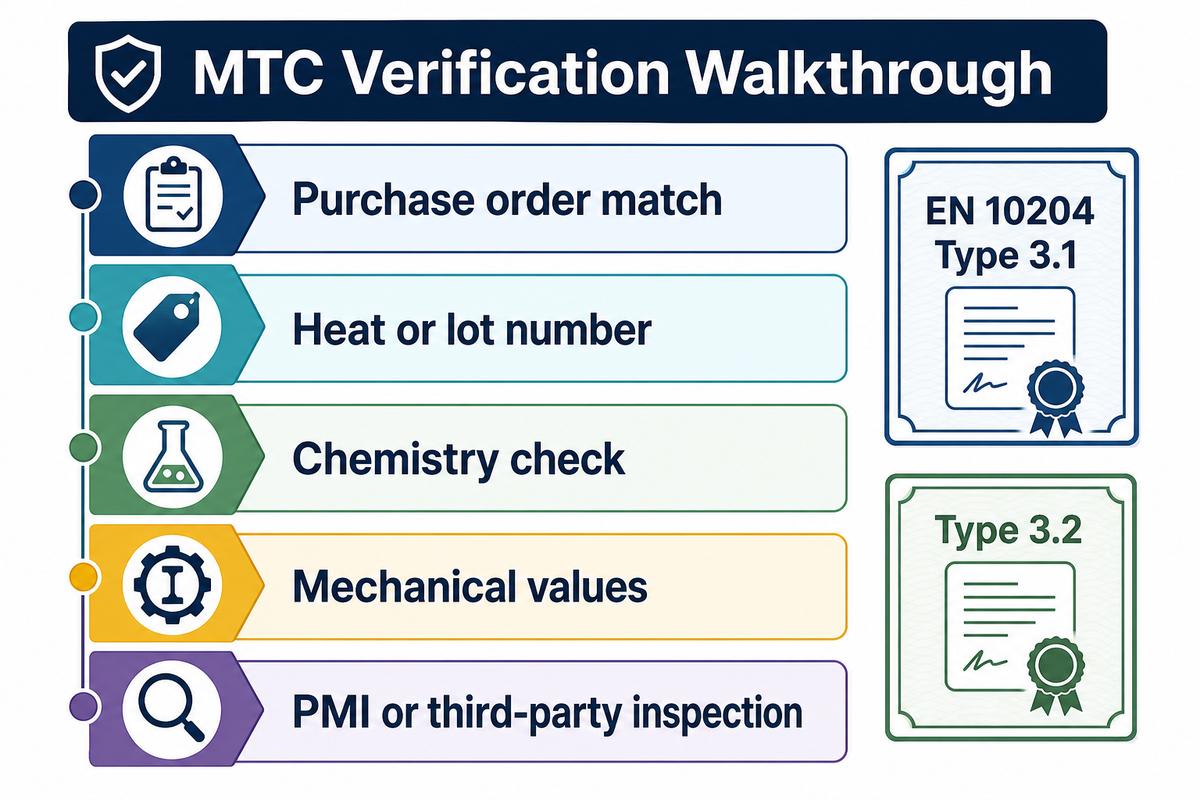
BSSA describes EN 10204 Type 3.1 as manufacturer-specific inspection results signed by a representative independent of manufacturing. Type 3.2 adds independent inspection. That distinction matters because a buyer who needs Type 3.2 should not accept a normal Type 3.1 certificate as equivalent.
“Treat the certificate as part of the product. If 3.2 inspection is required, name the inspector route before production starts.”
MTC Verification Walkthrough
- Match the grade and standard to the purchase order.
- Match heat number, batch number, or lot number to the marking, label, and packing list.
- Check chromium, nickel, molybdenum, carbon, nitrogen, and other chemistry against the agreed grade.
- Check yield strength, tensile strength, elongation, hardness, and any impact or corrosion test required by the project.
- Confirm whether PMI, third-party inspection, or customer witness points are required before shipment.
Forum evidence from machinists is anecdotal, but it shows the practical issue well: certified stainless bar may cost more because the certificate has to match the actual material. That is not bureaucracy. It is how a buyer avoids accepting an untraceable type of steel into a controlled job.
Local Stockholder, Trading Company, or Mill Direct?
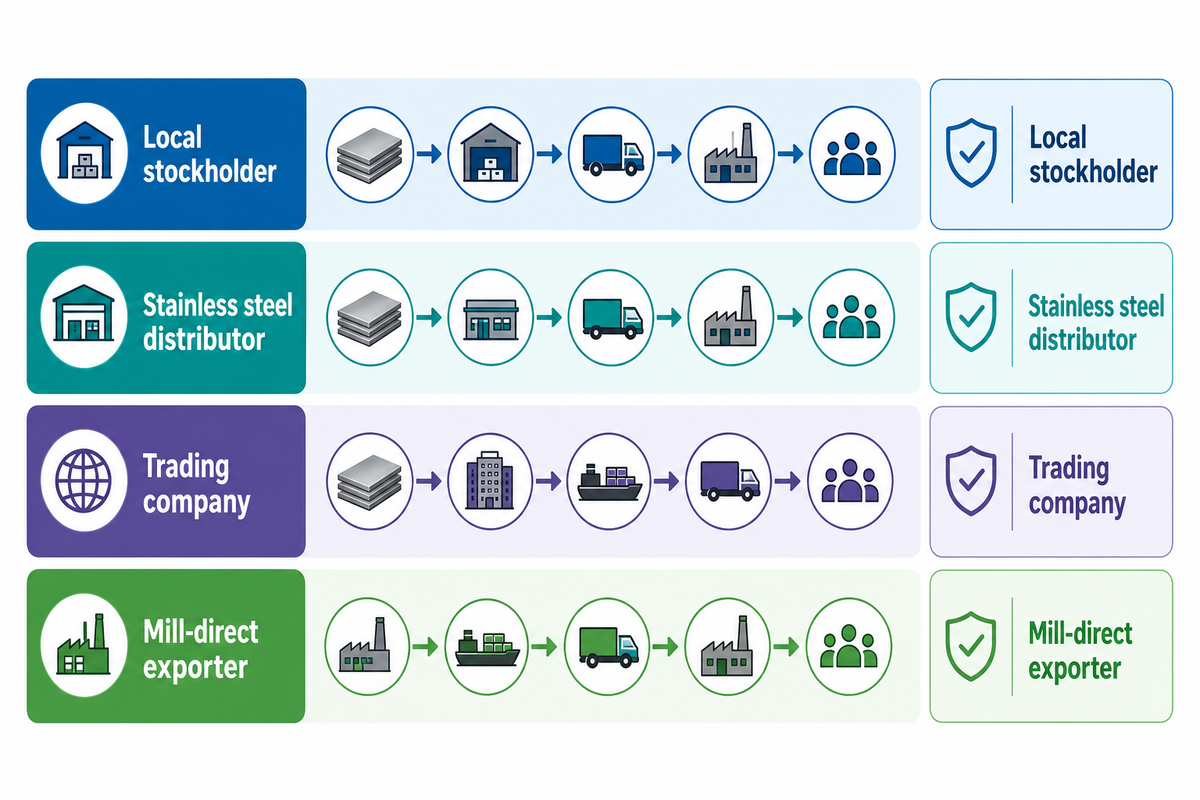
A nationwide stainless steel stockholder often fits urgent commodity replenishment. Mixed small parcels may fit a trading company when traceability risk is lower. Mill-direct steel supply fits planned, specification-driven work where grade, document pack, repeat quantity, inspection, and export coordination matter more than same-day pickup, especially when EN 10204 certificate responsibility must be set before shipment.
| Route | Best fit | Watch point |
|---|---|---|
| Local stockholder | Urgent 304 or 316 replacement, small lot, simple finish, short delivery window. | Confirm certificate availability and heat traceability before assuming stock is acceptable. |
| Stainless steel distributor | Multiple forms, common grades and sizes, fast quoting, local processing. | One phrase can cover very different stock, processing, and document capability. |
| Trading company | Mixed parcels, broad sourcing, price discovery, low-document-risk orders. | Certificate pass-through and source accountability must be clear. |
| Mill-direct exporter | Repeat programs, documented lots, export packing, 3.1/3.2 planning, specification-driven procurement. | Lead time starts from confirmed specification, not from an incomplete inquiry. |
The phrase high-quality stainless steel is only useful when it is tied to grade, standard, finish, inspection, and delivery terms. The same applies to claims like excellent corrosion resistance, highly resistant, high strength, strength-to-weight ratio, or strength and excellent corrosion resistance. They become useful descriptors only after the service conditions are known.
Red Flags That Make Stainless Quotes Non-Comparable
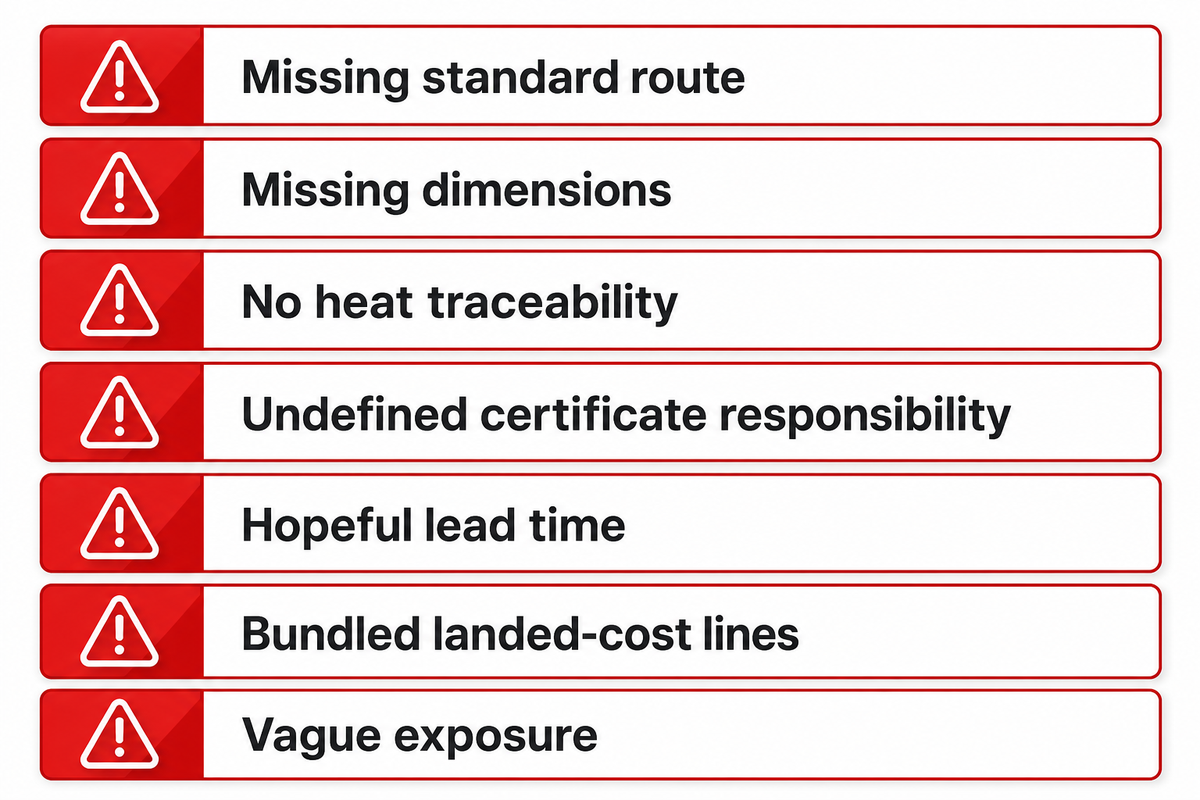
- Quote names 304, 316, or duplex but does not name the standard route.
- Required dimensions such as tolerance, surface finish, edge condition, or cut-to-length condition are missing.
- Supplier cannot confirm whether it supplies stainless material with heat traceability before shipment.
- Certificate wording says MTC, COA, 3.1, or 3.2 without defining inspection responsibility.
- Lead time reads like hope instead of stock status, production slot, inspection release, and shipping lane.
- Landed-cost lines are bundled into one number when the buyer needs freight, insurance, duties, and customs-value assumptions separated.
- Application language says material is used in applications such as chemical processing, marine applications, architectural applications, food processing, enclosures, or processing equipment, but the RFQ never states the actual exposure.
Trend Note – Specialty Stainless Needs Earlier Specification Lock-In
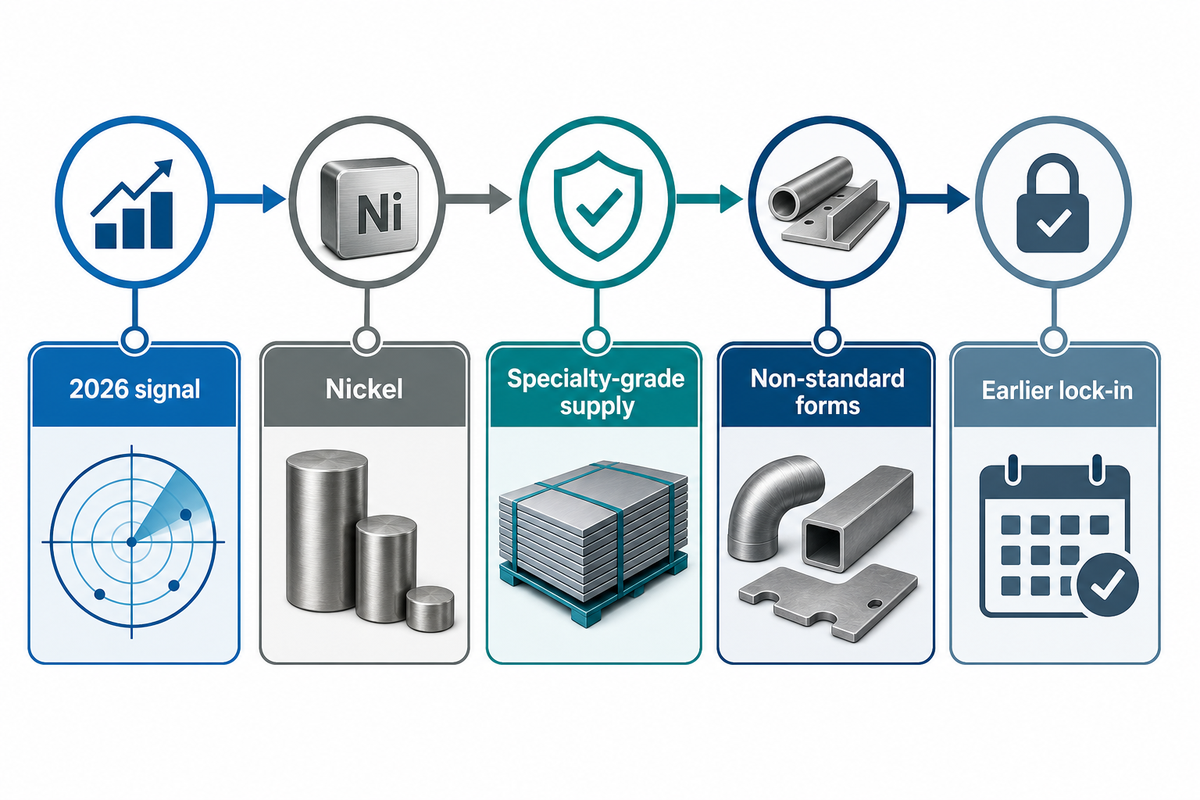
Do not turn market reports into a false promise about one order. Pair market context with current-standard checks such as the ASTM steel standards index, then use the 2026 signal narrowly: stainless pricing and availability can move with nickel and specialty-grade supply, while non-standard forms may need longer planning than common stock. IMARC gives a U.S. stainless market forecast through 2034, and OSS Metals frames 2026 stainless pricing around nickel volatility and longer planning for specialty grades.
Buyer action is straightforward. Lock grade, product form, certificate type, and destination earlier when the job involves 316L, duplex, super duplex, 904L, high-temperature grades, or controlled export documentation. If the job is safety-critical, sour service, aerospace, defense, or pressure-equipment work, add the project standard and inspection authority to the RFQ instead of relying on a general stainless products page.
How TiAlloy Fits the Checklist
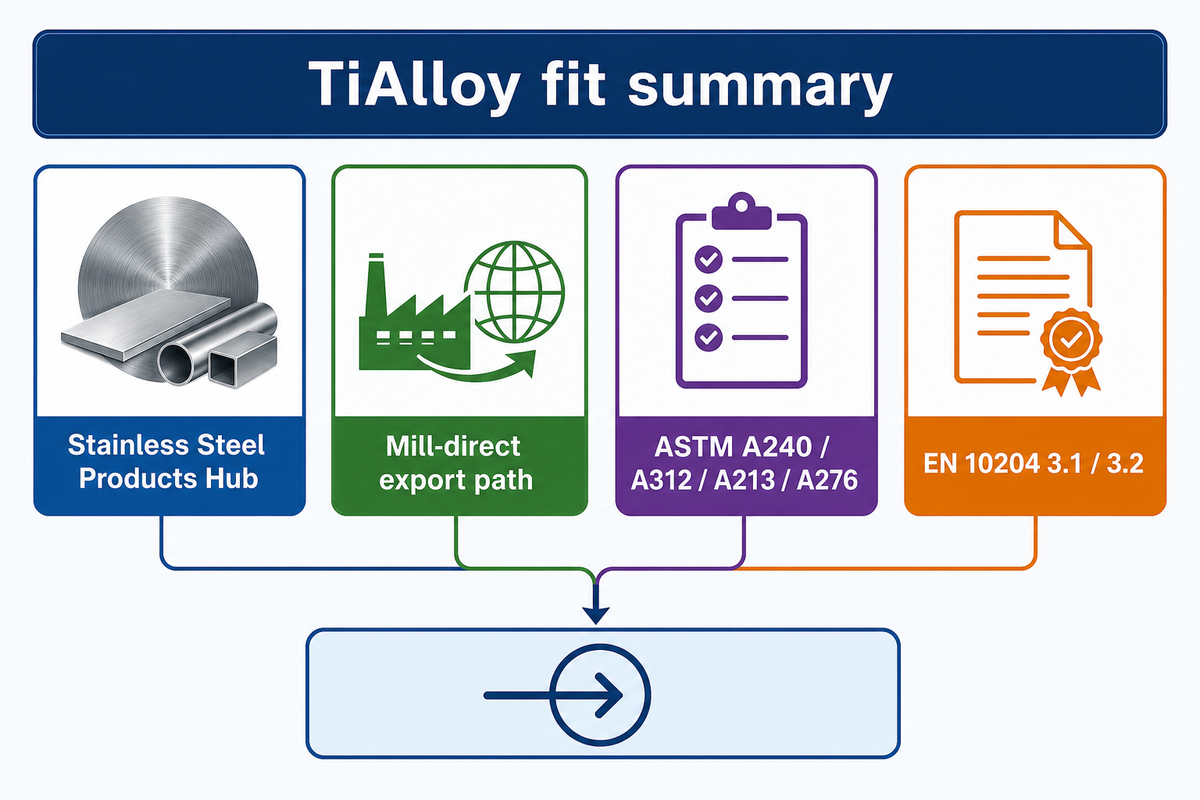
TiAlloy’s Stainless Steel Products Hub is the right internal starting point when the buyer already knows the order is specification-driven and wants a mill-direct export path. The hub lists stainless steel products across plate, coil, sheet, pipe and tube, bar and rod, with stainless grades including 304/304L, 316L, 321, duplex 2205, and super duplex 2507.
Its product route also names ASTM A240, ASTM A312, ASTM A213, ASTM A276, EN 10204 3.1, and EN 10204 3.2 document options. That gives procurement, QA, and engineering a shared starting point for the RFQ gate. It does not replace the buyer’s service conditions. It gives those conditions a structured quote path.
FAQs
What should I look for in a stainless steel supplier?
Look for a supplier that can make the quote comparable before price is discussed. Ask for grade capability, product form, governing standard, certificate type, inspection scope, heat traceability, production slot, packing, and delivery terms. If those fields are different, two quotes are not truly comparing the same stainless steel order. For regulated or export work, also ask who owns third-party inspection, document release, origin data, and packing approval before shipment.
Is a stainless steel distributor different from a stainless steel mill supplier?
Yes. A distributor usually sells from stock and may be faster for urgent commodity forms. A mill supplier is usually better for planned orders that need a defined grade, product form, certificate pack, inspection route, export packing, or repeat release schedule. The right route depends on urgency, quantity, document risk, and service conditions.
Which stainless steel grades are most common for industrial sourcing?
Common starting points include 304/304L for mild general duty, 316L where molybdenum-bearing corrosion resistance is useful, 321 or 347 where stabilized welded assemblies matter, and duplex 2205 or super duplex 2507 for selected chloride and high-strength service. Final selection should still consider chloride level, temperature, crevice risk, stress, weld plan, and inspection scope.
What is the difference between EN 10204 3.1 and 3.2?
Type 3.1 is a manufacturer inspection certificate with specific inspection results and a representative independent of manufacturing. Type 3.2 adds an independent inspector or inspection body. If a project specifies 3.2, confirm that independent inspection is actually arranged; do not treat a normal 3.1 certificate as a substitute. Put the certificate type, witness point, inspection authority, heat-number matching rule, and language requirement on the purchase order so the document package is built before production release.
Why do stainless steel quotes vary so much?
Quotes vary because grade, product form, standard, thickness, width, finish, tolerance, certificate type, inspection scope, quantity, packing, and delivery terms all change cost. A lower price may exclude cut-to-length work, 3.1 documents, third-party inspection, export packing, or the delivery term needed for the project. It may also be quoting a stocked substitute, a different surface condition, a shorter validity window, or a delivery point that shifts freight and customs work back to the buyer.
Can one supplier provide stainless steel plate, pipe, tube, bar, and coil?
Some suppliers can support multiple forms, while others specialize in one route. TiAlloy’s hub lists plate, coil, sheet, pipe and tube, bar and rod, but the buyer should still state the grade, standard, certificate, dimensions, and service conditions so the supplier can confirm the exact scope. Multi-form supply is most useful when one project needs matched documents across several line items, such as plate for equipment, tube for heat exchange, and bar for machined parts.
When should I choose mill-direct stainless supply instead of local stock?
Choose mill-direct supply when the order is planned, traceable, specification-driven, or linked to export documentation, repeat quantities, special grades, controlled inspection, or project-specific certificates. Choose local stock when the material is common, urgent, low-risk, and available with acceptable documents. The route should reflect how much engineering risk the buyer can carry.
A maintenance buyer replacing a simple 3 mm bracket tomorrow may value speed first. A QA manager buying 500 kg of tube, 2 tons of bar, or a 24-ton coil release for pressure equipment, marine hardware, or chemical service may need slower confirmation of chemistry, mechanical values, heat traceability, inspection release, and packing controls. Thickness examples such as 0.5 mm sheet, 6 mm plate, or 25 mm bar should be written into the RFQ with width, length, finish, and tolerance. When those controls matter, mill-direct planning is easier to defend than last-minute spot buying, even if the first reply takes 24 hours longer.
References & Sources
- ASTM International – Steel Standards
- ASTM A240/A240M standard page
- ASTM A312/A312M standard page
- British Stainless Steel Association – EN 10204 test certificates
- ASSDA – Life cycle costing
- U.S. Customs and Border Protection – Duty, Cost, Insurance and Freight
- SSINA – Pitting and Crevice Corrosion
- British Stainless Steel Association – Chloride SCC failure note
- The Fabricator – The potential of instant quoting in metal fabrication
- IMARC Group – United States stainless steel market report
- OSS Metals – Steel Market Outlook 2026
- TiAlloy – Stainless Steel Products Hub
WHY WE PUBLISH
About TiAlloy
TiAlloy supplies titanium, stainless steel, nickel alloy and clad plate for specification-driven industrial orders. Our technical guides are written to help buyers align product form, governing standard, test scope and release documents before a quotation is compared.
01Melt & formPlate, sheet, pipe, tube, bar, wire and forgings
02ProcessHeat treatment, finishing, inspection and export packing
03VerifyEN 10204 Type 3.1 certificate and order documents