Get in Touch with TiAlloy Company


Hastelloy-C22 is a nickel alloy used in corrosive environments that challenge ordinary stainless steels. Broader resistance to oxidizing and reducing media distinguishes Hastelloy-C22. However, the behavior of the finished component can’t be appropriately described with grade names alone. Other factors such as temperature and the chemistry of the solution as well as the conditions of the material and the presence of crevices must be taken into account. The focus of this guide is to describe the alloy, elaborate on published data, and relate them to the service and fabrication of the component.
For the available product forms and an enquiry, see our Hastelloy-C22 products and supply solutions. Knowledge on the material precedes the product choice here.
What Is Hastelloy-C22?
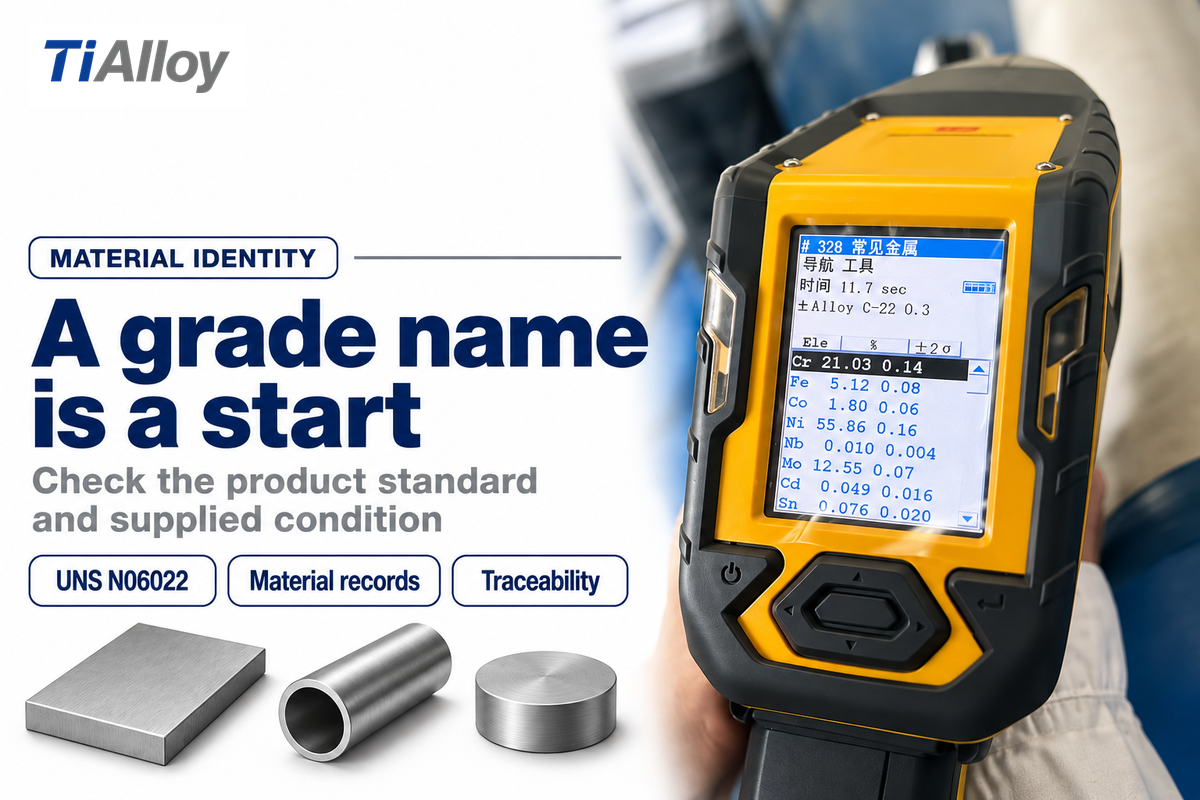
Hastelloy-C22 is a corrosion-resistant nickel-chromium-molybdenum alloy identified as UNS N06022, also associated with material number 2.4602. HASTELLOY is Haynes International’s trademark. The grade combines resistance to oxidizing and reducing environments, while its published properties describe specific material forms and test conditions rather than every finished part.
Names such as C22, C-22 and alloy C-22 appear in technical literature. Haynes uses HASTELLOY® C-22® alloy; Special Metals’ technical bulletin index lists INCONEL alloy 22 under the same UNS designation. Match the grade, product specification and condition supplied when identifying names. A trade name of a producer also identifies provenance of a material, which a generic grade name lacks.
Is Hastelloy a stainless steel?
Hastelloy is a family of nickel alloys, rather than a stainless-steel grade. C22 is part of the nickel-based alloys family used for demanding corrosion exposures. All stainless steels are based on iron. Families using chromium have different compositions and behavior of corrosion, and a familiar application of a stainless steel grade doesn’t justify using C22 in that application.
Start with the environment that justified the material change. A chloride-bearing cleaning solution raises different questions from a continuously immersed process component. Our Hastelloy C-276 material guide addresses another grade among these corrosion-resistant alloys.
Chemical Composition: Why C22 Resists Oxidizing and Reducing Media
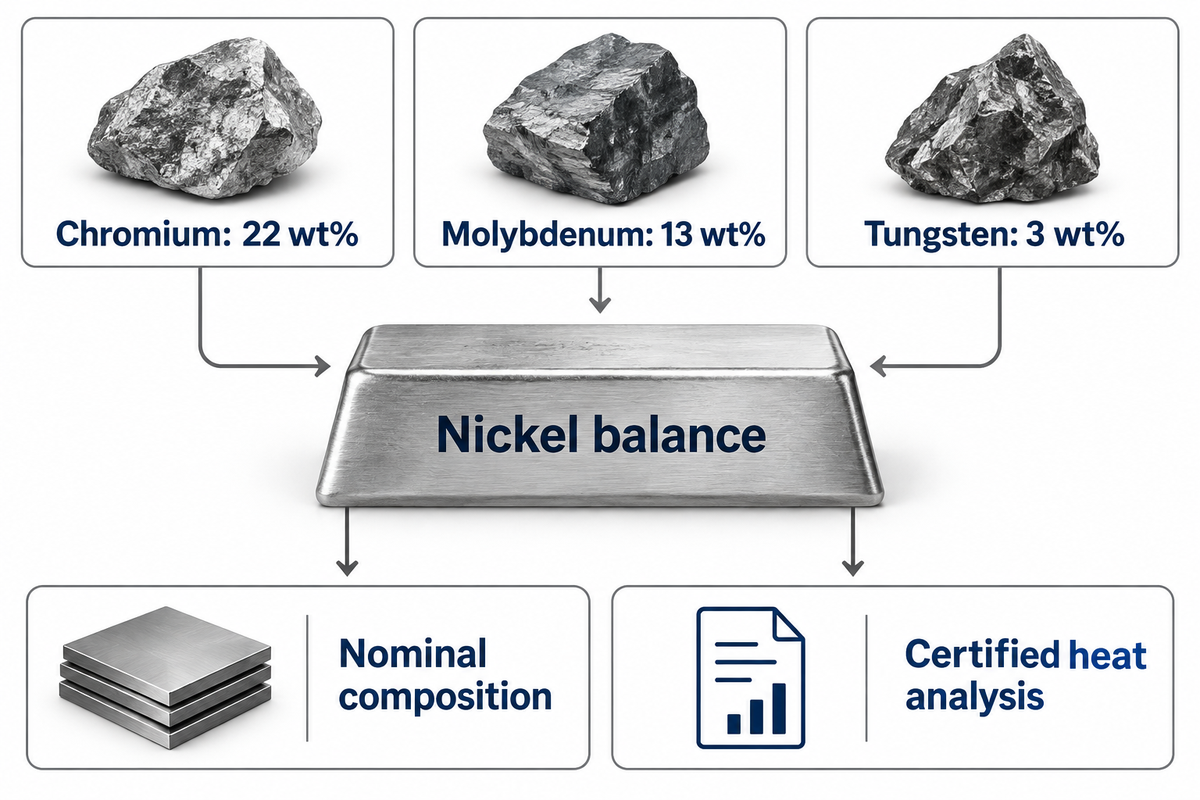
C22’s chemical composition includes nickel and chromium, molybdenum and tungsten. According to Haynes, nominal values for the composition are 22 wt% chromium, 13 wt% molybdenum and 3 wt% tungsten. Chromium provides resistance to oxidizing media and the molybdenum-bearing alloy system provides resistance to reducing environments. Of more importance than the percentage of individual elements is the relationship of the elements to each other.
The Haynes nominal-composition table also shows iron at 3 wt%, nickel at around 56 wt% as the balance, carbon at 0.01 wt% maximum, and silicon at 0.08 wt% maximum. Those values describe nominal targets and maximum values. They aren’t a complete set of acceptance limits for a delivered heat.
A nickel-chromium-molybdenum-tungsten alloy can tolerate chemical environments that challenge a simpler alloy system. Resistance to oxidizing doesn’t mean that every oxidizer is benign at every level. Ferric and cupric ions, dissolved oxygen, and the acid mixture affect the electrochemical environment. Paul Crook in his ASM technical article highlights this often neglected aspect of salt chemistry:
“ferric ions and cupric ions can substantially alter the electrochemistry of acid systems”
When reviewing a specification, separate the nominal composition from the heat analysis to allow the purchaser to define the desired alloy without taking an inexact chemistry table, copied from a general brochure or another product form, as the release record for a specific plate or bar.
Haynes’ 22 wt% chromium and 13 wt% molybdenum describe C22’s alloy balance. A material certificate answers a different question: What was measured for the supplied heat, with respect to what product requirement? Keep both of these documents with their respective purposes, when comparing a data sheet to a purchase specification.
C22 Properties: Typical Values Need Conditions
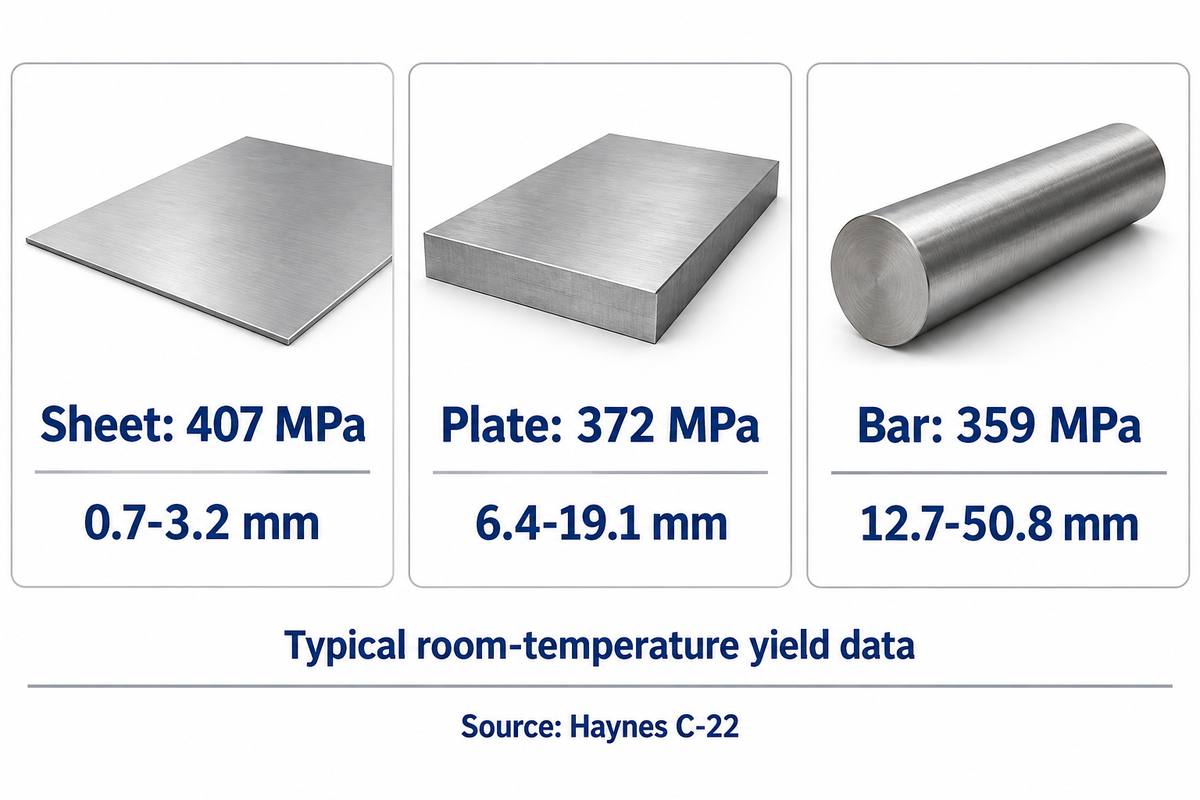
The published properties of C22 are useful when their product form, test temperature and measurement basis travel with the number. Haynes International, Inc. reports averages from multiple tensile tests, with separate rows for sheet, plate and bar. A typical property can help define behavior; the applicable purchase specification and material certificate can determine the requirements for the product delivered.
The property ledger, below, strives to provide these distinctions. It’s valuable when members of the engineering, quality and procurement groups are interpreting various versions of a supplier’s datasheet.
| Property and published value | Condition | What it helps you decide |
|---|---|---|
| Density: 8.69 g/cm3 | Room temperature | Estimate mass from the finished geometry; include machining allowance separately. |
| Sheet yield strength: 407 MPa at 0.2% offset | 0.7–3.2 mm sheet; room temperature | Compare like-for-like typical tensile data, rather than a bar certificate. |
| Sheet ultimate tensile strength: 800 MPa | 0.7–3.2 mm sheet; room temperature | Recognize an average test value; obtain the actual purchase minimum separately. |
| Sheet elongation: 57% | 0.7–3.2 mm sheet; room-temperature tensile tests | Understand ductility; do not turn tensile elongation into an allowable forming strain. |
| Plate yield strength: 372 MPa | 6.4–19.1 mm plate; room temperature | See why the sheet value is not a universal C22 number. |
| Bar yield strength: 359 MPa | 12.7–50.8 mm bar; room temperature | Keep bar and sheet data on their own product routes. |
| Thermal conductivity: 10.1 W/m·°C | 50°C | Use the temperature-specific thermal datum in an engineering review. |
| Specific heat: 414 J/kg·°C | 50°C | Avoid relabelling this commonly copied figure as room-temperature data. |
| Mean thermal expansion: 12.4 µm/m·°C | 24–100°C interval | Retain the interval when checking differential expansion. |
| Dynamic elastic modulus: 206 GPa | Room temperature | Distinguish stiffness from tensile strength and a code allowable. |
| Melting range: 1357–1399°C | Producer physical-property range | Identify the melting interval; determine service limits from the actual duty. |
Source: Haynes C-22 physical and tensile-property tables. These indicative producer values aren’t warranted maxima or minima.
Consider a quality review for a C22 bar order: a sheet average of 407 MPa cannot establish that the bar meets its specified yield requirement, because the product form, applicable standard and reported test results must belong to the bar being accepted rather than the sheet used for comparison. ASTM B575’s public scope, for example, concerns flat products and states their solution-annealed delivery conditions; it does not make a sheet average the requirement for every form.
A second distinction appears in additive manufacturing. Yan and colleagues’ 2022 Alloy 22 study found that post-processing affected ductility. A familiar grade name therefore leaves an important question open: which manufacturing and treatment route produced the material being evaluated?
Haynes lists thermal conductivity of 10.1 W/m·°C at 50°C and 11.1 W/m·°C at 100°C. The temperature is a part of the property entry, just like the sheet thickness is a part of a tensile row. Project this relationship on a heat transfer review and treat a copied number as temperature dependent.
Corrosion Resistance: The 4-Axis C22 Exposure Envelope
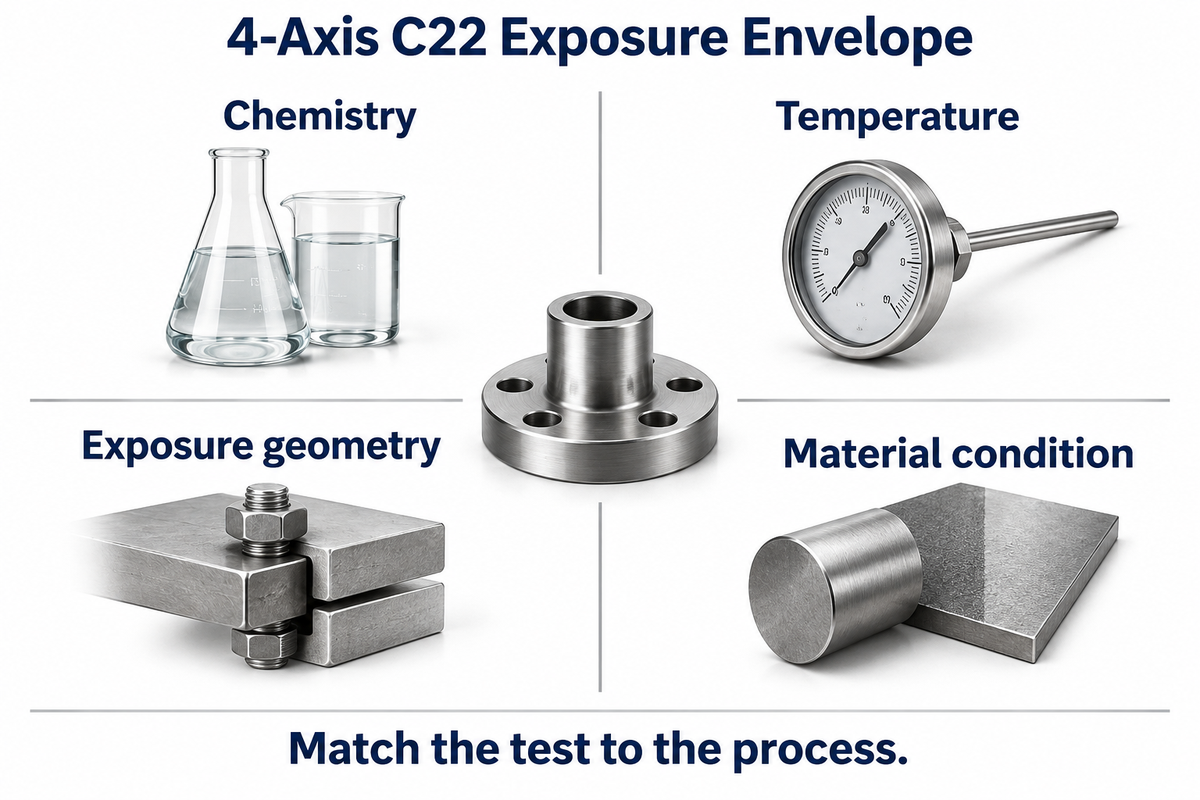
C22 corrosion resistance must be read against chemistry, temperature, exposure geometry and material condition. The 4-Axis C22 Exposure Envelope provides a framework to address these questions and allow published data to be related to a process. It’s an editorial reading framework, rather than a pass/fail standard or a complete component-design methodology.
Is Hastelloy C22 compatible with HCl?
C22 can resist hydrochloric acid, but compatibility changes with concentration, temperature and contaminants. Haynes reports 0.01 mm/y in 10 wt% reagent-grade HCl at 38°C, increasing to 0.98 mm/y at 66°C. Those laboratory results support evaluating the exact exposure; they don’t establish the life of a vessel, pipe or fitting in a mixed process stream.
A process engineer considering an increase in temperature from 38°C to 66°C should consider the two rates associated with the test matrix. Dividing 0.98 by 0.01 represents a 98-fold difference in attack rate. It isn’t a prediction that an installed component would lose 98 times its remaining life.
| Axis and exposure detail | Published evidence or distinction | Next decision |
|---|---|---|
| Chemistry: acid concentration | 10 wt% HCl gives different Haynes rates at 38°C and 66°C. | Record concentration and temperature together before comparing a process change. |
| Chemistry: other ions | The CNEA-archived 90°C study found different inhibition behaviour for carbonate and bicarbonate. | Describe the actual ionic species and proportions; total chloride alone is incomplete. |
| Chemistry: attack mechanism | Haynes’ HF rates cover external attack, with a separate internal-attack caution. | Ask which damage mechanisms the chosen test actually measures. |
| Temperature: localized corrosion | Haynes’ 72-hour acidified 6 wt% ferric-chloride CCT is 80°C. | Read this as test attack initiation, rather than a general operating ceiling. |
| Temperature: time at exposure | The C22 weld-aging study extended to 6000 hours at selected elevated temperatures. | Include duration and thermal history in the review, as well as peak temperature. |
| Geometry: pits versus crevices | The same Haynes comparison gives CPT above 150°C and CCT of 80°C. | Identify crevices and deposits instead of transferring a pitting result to every joint. |
| Geometry: liquid and vapour zones | An immersed acid coupon represents a different location from a condensation or splash zone. | Define the exposure at each component surface; choose representative evidence. |
| Condition: surface history | LLNL’s 60–95°C chloride study distinguished air-aged and freshly polished C22. | Record surface preparation and history with the corrosion result. |
| Condition: cold forming | Haynes flags SCC resistance after cold work and re-annealing at 7% outer-fibre elongation or more. | Review forming strain and the final treatment route before accepting equivalence. |
| Condition: weld or deposited material | Wrought, weld-metal and additively manufactured data describe different material histories. | Use evidence for the final component route, including relevant post-treatment. |
Two findings explain why the matrix goes beyond an acid name. The LLNL crevice-corrosion study showed a surface history effect in high concentrations of chlorides. Separately, Rincón Ortiz and colleagues showed that in their test conditions, carbonate and nitrate inhibited attack while bicarbonate and carbonic acid didn’t. This is a reason for a mixture characterization study rather than a recommendation to dose an inhibitor.
Resistance to pitting and crevice corrosion must be evaluated separately from general corrosion and stress corrosion cracking. The mechanisms of damage described by various forms of corrosion are different. In the comparison of Haynes’ boiling 45% magnesium-chloride U-bend, C22 didn’t show any cracking during the test period of 1008 hours. A result against that chloride-induced mechanism is valuable; it does not erase other cracking mechanisms or the HF internal-attack issue.
There are temperature differences, as well. For example, a 2026 author preprint, which is not yet peer-reviewed, notes that the addition of oxygen changed the way C22 degraded at 750°C in a molten-chloride experiment. Keep that result in its separate molten-salt context. It doesn’t give a replacement limit for an aqueous process.
A practical question raised by wet chlorine is: is the material sufficiently resistant to corrosion in that particular flow stream with its real temperature and contaminants? Resistance to pitting in a ferric-chloride test cannot answer the whole question for a different chlorine-bearing process.
At 80°C, the Haynes ferric-chloride comparison identifies crevice attack initiation within its 72-hour test, so a joint with a crevice deserves its own assessment even when another row reports a much higher pitting threshold for material exposed to the same named test solution. Allowable stresses, pressure design and compatibility of non-metallic components are other engineering problems.
Welding, Forming and Machining C22
C22 can be shaped and welded; however, its work hardening and final condition require attention. Haynes lists gas tungsten arc, gas metal arc, and shielded metal arc welding as possible options. Welding procedure, filler selection, forming strain, post-weld condition, and heat treatment need to be reviewed, considering the component and the chemical environment to which it will be exposed.
How is Hastelloy-C22 formed?
C22 can be hot worked or cold formed into components. Haynes describes various forming routes, including forging and rolling, with re-annealing after hot forming and cold work reaching 7% outer-fibre elongation. The material work hardens more than many of the austenitic stainless steels, and forming may require numerous stages and intermediate anneals.
The producer gives 1121°C solution-annealing guidance for wrought C22. A fabrication team still needs a qualified procedure for the actual section and component. The 57% average tensile elongation of sheet is a test result, rather than permission to cold form a part to that strain without reviewing its condition.
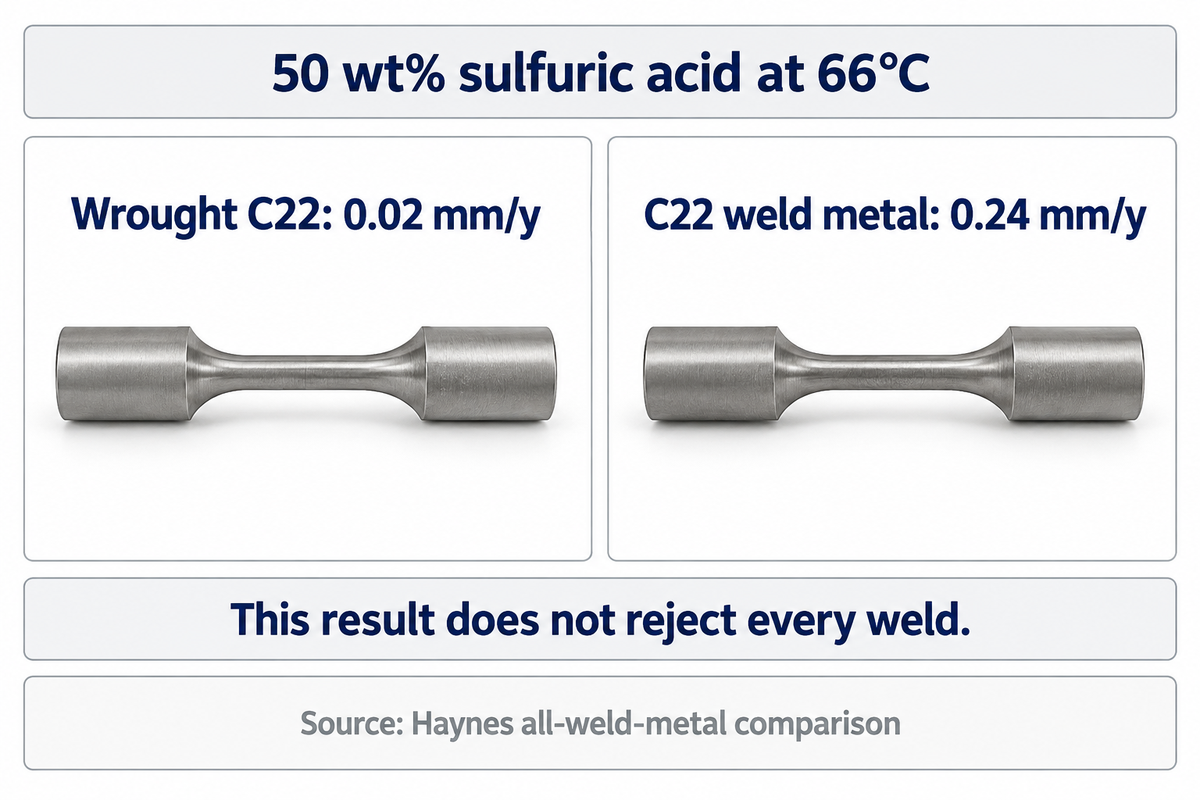
Weldability differs from identical corrosion behavior. Haynes’ all-weld-metal comparison shows how a single environment can separate weld and wrought data:
Wrought C22: 0.02 mm/y
Haynes result in 50 wt% sulfuric acid at 66°C.
C22 weld metal: 0.24 mm/y
Haynes all-weld-metal result in the same stated solution and temperature.
This doesn’t mean that all welds are unacceptable. A 2005 LLNL fabrication report showed no loss of the tested corrosion resistance from various fabrication treatments. Conversely, the C22 weld-aging study found earlier degradation of tested weld properties than base metal during long thermal exposure. Initial weld quality and time-temperature history should be reviewed together.
There are practical issues associated with machining, such as tool wear. Machining adds a practical concern: Tool wear can adversely affect the finish and even the dimensions of a part being machined. During the production of the batch, the tools wear out and at some point the tolerance and finish problems may become evident. In a discussion on Practical Machinist, the OP (Original Poster) for C22 was looking for solutions to problems of production threading, tolerance, and finish. Establish the cutting route with the tool supplier and inspect wear-sensitive features during production. Later posts mixed other alloys, so their cutting speeds are not C22 instructions.
For Haynes’ 50 wt% sulfuric-acid test at 66°C, the distinction is 0.02 mm/y for wrought material versus 0.24 mm/y for weld metal. A buyer assessing a fabricated part needs its relevant condition, rather than a quotation that silently substitutes the base-metal row.
Where C22 Is Used and Where Assumptions Fail
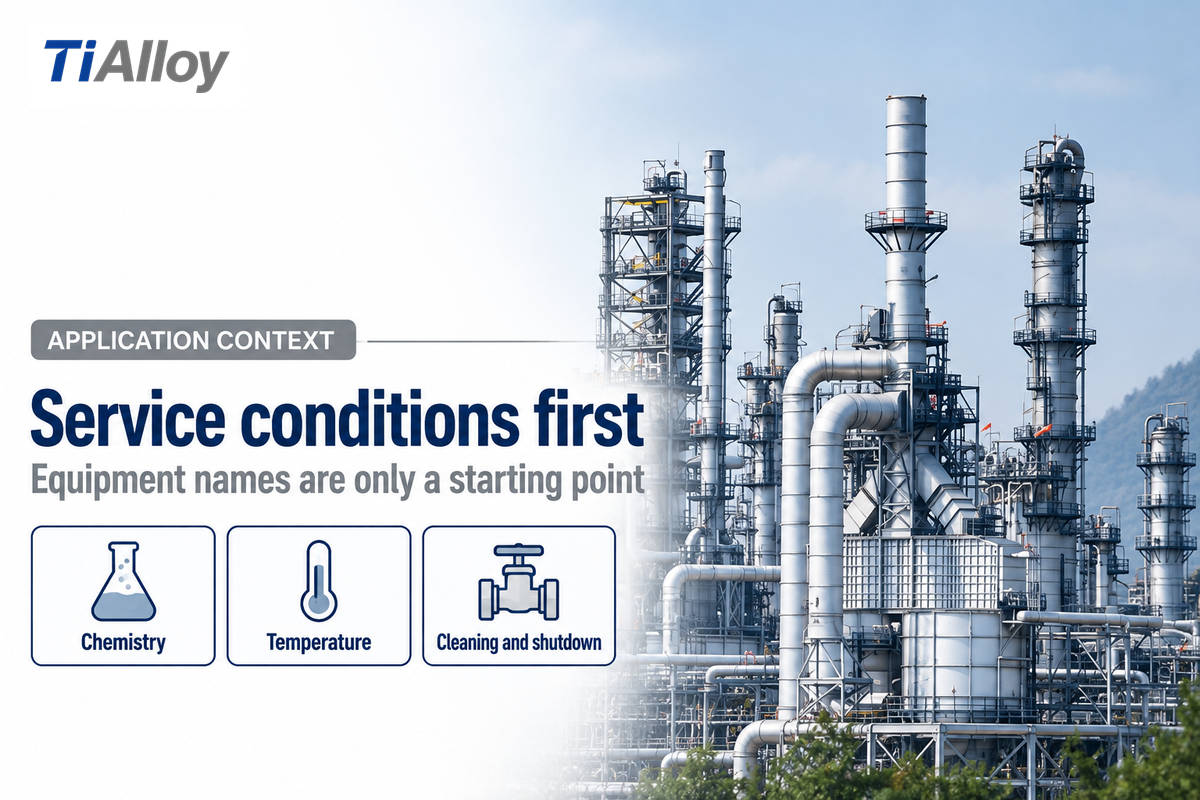
C22 is found in industrial equipment for chemical processing, including reactors, heat exchangers and columns, as well as more challenging pollution control applications. The equipment name is just a starting point. Actual exposure can include materials such as mixed industrial chemicals, oxidizing acids, deposits, cleaners, and shutdown conditions that aren’t on a generic application list.
Haynes references a historical chlorinated organics incinerator quench system where 316 stainless steel/epoxy systems suffered premature failures and required monthly maintenance. C22 was selected after field corrosion evaluation; the producer’s case report described approximately 15 months without maintenance at the time of reporting. The lesson is more about the field-evaluation approach than transferring a maintenance interval.
Heat exchangers are a good example again. The bulk liquid, tube surface and creviced joints may have different exposure conditions. Ask where a reported result applies before selecting a tube, fitting or fastener. Promising immersed coupon test results don’t describe all the locations in an assembly.
Pharmaceutical applications and food processing also suggest questions related to product purity and cleaning. Record the actual cleaning chemistry, concentration, temperature and contact sequence, and process fluid, including any change that introduces a new exposure condition that wasn’t present in the original material assessment, or the laboratory test that supports it. “Pharmaceutical” is an industry term; it doesn’t provide a material approval, a surface finish, or evidence of cleanability.
Haynes’ historical quench-duct example links its approximately 15-month observation to prior field testing. For a plant manager, that sequence is more useful than an unqualified claim of longer life: establish the troublesome exposure, compare representative specimens, then judge the component within its own duty.
C22, C-276 and Other Nickel Alloys: A Shortlist
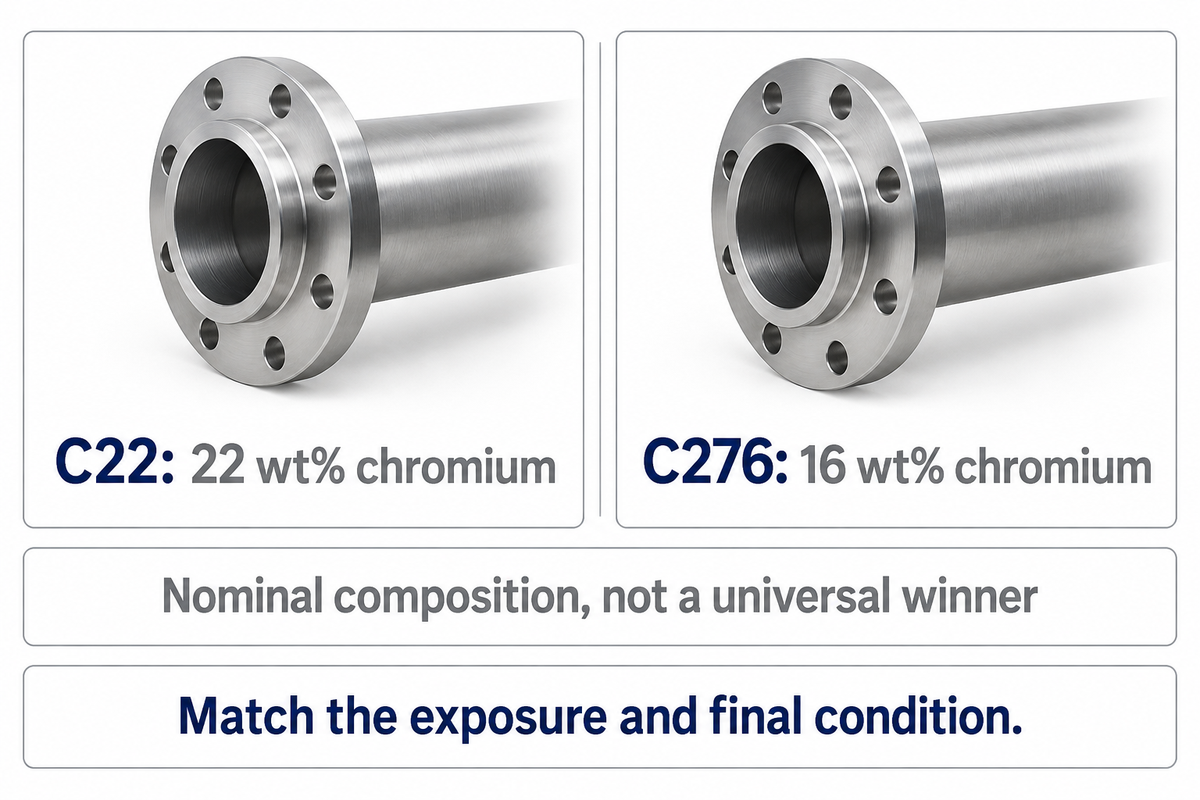
The difference between Hastelloy grades begins with comparison of constituents and environment. C22’s higher chromium content supports resistance to oxidizing environments relative to C-276, while reducing acids and strong reducing agents require their own compatibility review.
What are the key differences between Hastelloy C22 and C276?
Balancing of chromium-molybdenum is different for C22 and C276. Haynes puts nominal chromium at 22 wt% for C22 and 16 wt% for C276. C22 is largely applicable to oxidizing exposures, while a reducing-acid duty would require a direct comparison at its service conditions. The final product and weld condition also apply.
Use our dedicated C276 vs C22 comparison for that two-alloy decision. The Inconel vs Hastelloy guide separates trade names from grade selection. A nickel-molybdenum-chromium alloy (C-276) would likewise deserve its own condition-matched comparison. Compare various alloys to the same exposure before making a final choice.
Price and Lead Time: What Changes the Quote
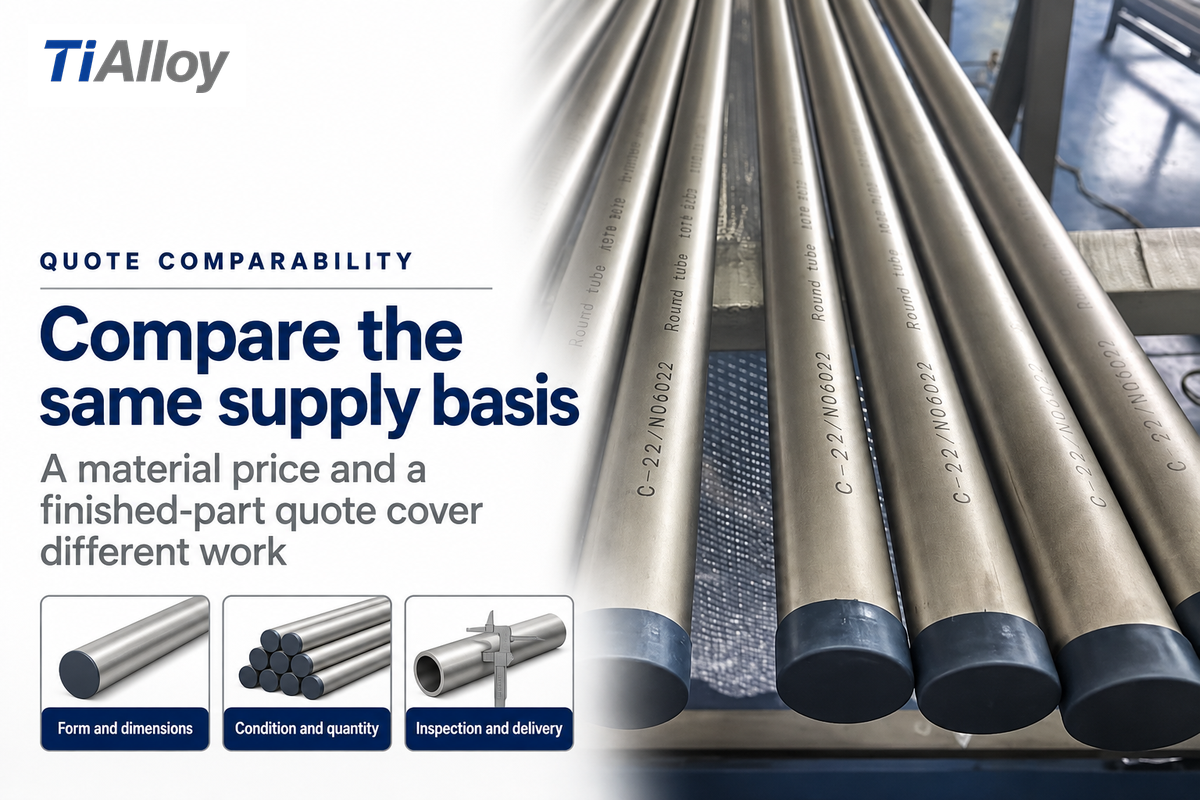
A quotation for C22 would be based on the product form and dimensions, supplied condition, quantity required and inspection requirements. For flat stock, ASTM B575’s public scope describes dimensions and tensile requirements; include the applicable requirements in the quotation basis. Conversion, cutting allowance, machining, packing and delivery terms would affect comparison. Align those inputs before comparing the price per kilogram and delivery promise from the competing supply routes.
Because cost limits can differ for a completed component and the raw stock that makes it, determine whether the quoted mass includes machining allowance, whether testing is included, and which delivery milestone is assured, when comparing a component quote with a material quote that’s ready to be cut and inspected. If your production schedule is tight, distinguish the availability of material from the time it will take to cut, process and inspect it. Our dedicated comparison article provides a quotation-normalization worksheet; this material guide keeps the focus on the inputs that make a C22 quote meaningful.
Forms and Standards: From UNS N06022 to an Order
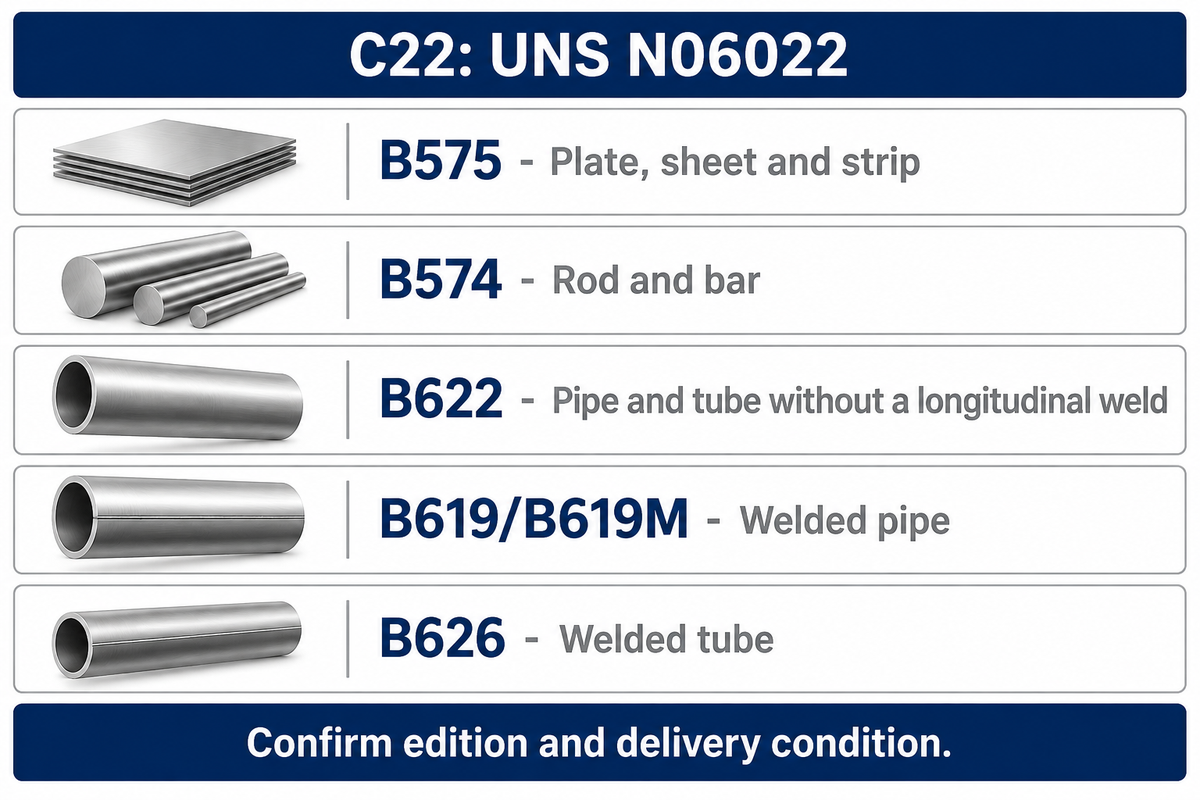
UNS N06022 identifies C22, while a product specification defines the form and associated requirements. ASTM B575 concerns plate, sheet and strip; ASTM B574 addresses rod and bar; B622 covers pipe and tube without a longitudinal weld. Welded pipe is addressed in B619/B619M and welded tube is in B626. Confirm the required edition and delivery condition of the order.
In the ASTM B02.07 active list (checked in October 2026) B575-17(2023), B574-23, B619/B619M-19(2023), B622-26 and B626-26 are cited. The date associated with a standard or specification could be the issue date of a new edition or the date of re-affirmation of the specification. Confirm which edition of a standard is applicable to the work.
The scope of the product is important in practice. B619/B619M’s public scope covers welded pipe and includes N06022. B626-26’s public scope includes N06022 welded tube for heat exchangers, condensers and other stated services. When referring to these two standards simply as “welded pipe”, product distinction is lost before dimensions and inspection are agreed.
In the case of flat product, B575 indicates a solution-annealed delivery condition. For a finished assembly, also specify the drawing, fabrication route, surface condition, relevant test requirements and traceability. A catalogue’s typical tensile result cannot replace the applicable material requirement, and a material standard alone does not approve a pressure-system design.
Review the C22 specifications and product options with the required form in mind. Stating the precise grade and product route in a request allows the response to identify what’s being offered.
The 2026 B626 edition concerns welded tube, while the active B619 pipe edition remains B619/B619M-19(2023) on the checked list; procurement can avoid a basic mismatch by naming the product and edition together, then agreeing dimensions, condition and test records before comparing offers from different sources.
Before Changing Service: What Must Be Rechecked
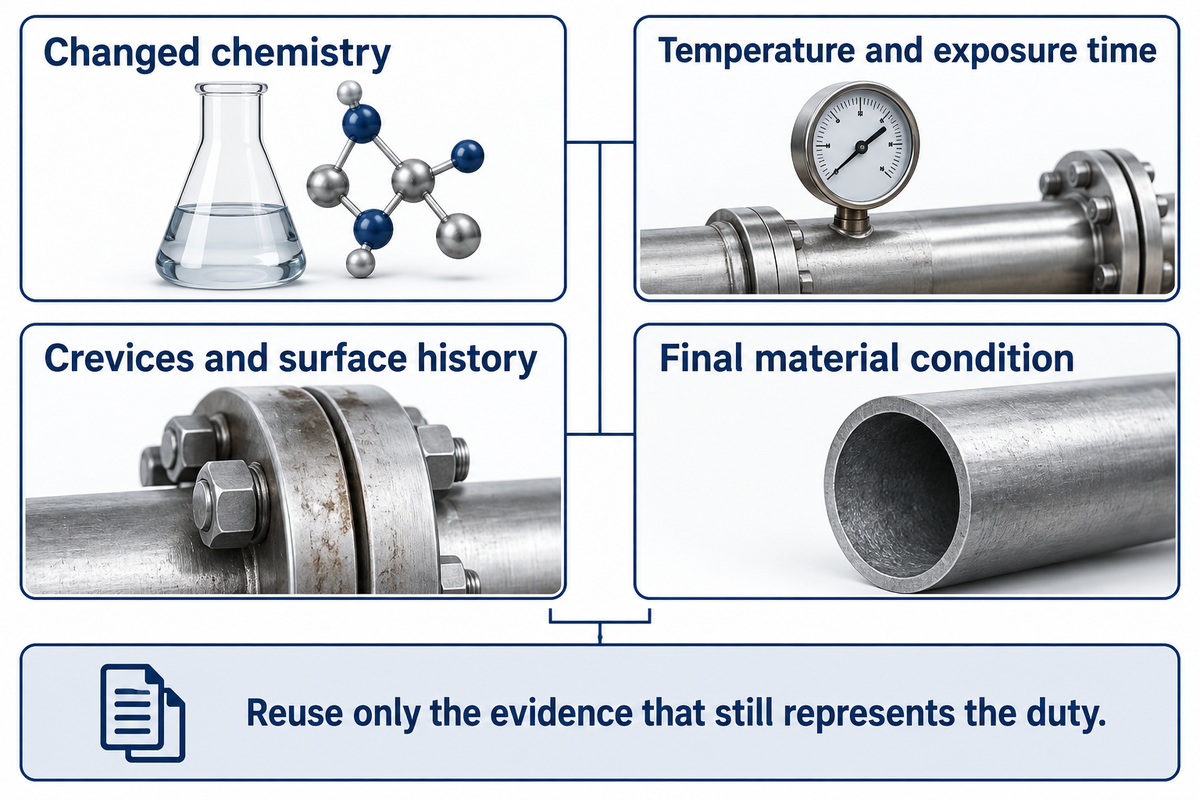
A change in C22 service warrants a new comparison and supporting data. Check revised chemistry, temperatures and exposure times, then review crevices, surface history and final material condition. A previous assessment is pertinent only for that part of the service which it represents.
For an existing line, document what changed (e.g., longer hold time, hotter cleaning, different acids, different deposits, or repaired joint). Comparison of process and maintenance descriptions helps identify locations of altered exposure. Differences from the original assessment will be evident from the 4-Axis C22 Exposure Envelope.
Manufacturing can change the evidence needed too. EOS’s November 2025 C22 article describes additive manufacturing with integrated channels. The 2022 Alloy 22 study separately shows why post-treatment matters for mechanical behaviour. A printed component therefore calls for its own route-specific assessment rather than automatic reuse of wrought sheet data.
Carry the conditions with the number.
A C22 value becomes useful when its chemistry, temperature, geometry and material condition match the question being asked. Keep the source and test basis beside it through engineering review and purchasing.
For a component enquiry, send the product form, drawing and service description with the grade. TiAlloy can use those inputs to discuss a supply route and the requested material records.
Frequently Asked Questions
What is the material equivalent of Hastelloy C22?
UNS N06022 and material number 2.4602 identify the C22 grade; a trade name alone does not approve substitution.
Haynes uses HASTELLOY C-22, and Special Metals lists INCONEL alloy 22 under N06022. Match the actual product standard, heat analysis, supplied condition and required test results when considering an alternative source. A shared designation helps identify the alloy, but it leaves product dimensions, processing history and the requirements of a finished component to be checked against the order.
Can a magnet identify Hastelloy-C22?
A magnet test cannot establish that a piece of material meets the C22 grade specification.
Material identity requires more than a response to a hand magnet. Check the heat number, grade designation and certified chemical analysis against the applicable specification. Product condition and the required mechanical tests also belong to acceptance. For an unidentified piece, arrange a suitable material-identification process rather than treating a magnetic observation as a certificate for UNS N06022.
Is Alloy 20 the same as Hastelloy-C22?
Alloy 20 and C22 have different UNS designations and should be evaluated as different grades.
Special Metals’ original index lists INCOLOY alloy 020 as UNS N08020 and INCONEL alloy 22 as UNS N06022. Those entries describe different alloys, even though both names contain similar digits. For a proposed material change, compare the relevant chemical exposure, product specification and supplied condition. Replacing one name with the other on an order doesn’t establish equivalent performance.
Is C22HS the same as C22?
C22HS is UNS N07022, a distinct grade from C22, UNS N06022.
Haynes describes different strengthening conditions for C22HS, including aging and cold work. Specify the exact grade and condition rather than treating the HS suffix as an interchangeable label.
Does C22’s melting range set its maximum service temperature?
The 1357–1399°C melting range describes melting, rather than an approved continuous-use temperature.
Corrosion, mechanical behaviour, exposure duration and applicable design requirements can become limiting well before melting. Haynes’ acid-corrosion tables show large changes at much lower temperatures, while the welded-material aging study addresses another set of time-temperature conditions. Resistance to oxidation in a high-temperature gas stream also answers a different question from acid immersion. Read each dataset for the question it tested, instead of combining distinct mechanisms into a single operating limit for a fabricated vessel, tube or process component.
Does C22 resist every acid?
C22 resists many acids, but each acid mixture and temperature needs its own assessment.
Haynes publishes separate data for hydrochloric, nitric, sulfuric, phosphoric, formic and acetic acids. Its HF footnote also distinguishes external from internal attack.
References & Sources
- ASTM B575-17(2023), public scope for alloy plate, sheet and strip.
- ASTM B619/B619M-19(2023), welded nickel-alloy pipe.
- ASTM B626-26, welded nickel-alloy tube.
- ASTM B02.07 active standards catalogue, checked October 2026.
- Kehler, Illevbare and Scully, crevice corrosion of alloys 625 and 22, 1999 study abstract.
- Rebak, Localized Corrosion of Alloy 22: Fabrication Effects, LLNL technical report, 2005.
- Rincón Ortiz and colleagues, Oxyanions as inhibitors of chloride-induced crevice corrosion of Alloy 22, 2013, CNEA archive.
- Summers and colleagues, thermal aging of GTAW welds of Alloy N06022, 2002 proceedings; public abstract.
- Yan and colleagues, laser powder bed fusion and post-processing of Alloy 22, Additive Manufacturing, 2022.
- Paul Crook, Corrosion-Resistant Nickel Alloys, Part 3, ASM technical article, 2009; author affiliated with Haynes.
- Li and colleagues, C22 in molten chloride salt, 2026 preprint, not peer reviewed.
How This C22 Guide Was Prepared
Cherry prepared this Hastelloy-C22 guide for TiAlloy from producer data, public standards scopes and original research. The property ledger and exposure matrix organize those sources for material discussions; they contain no private TiAlloy laboratory results. Producer observations remain attributed to their owners. Our TiAlloy company profile explains the business and its mill and supply network.