Get in Touch with TiAlloy Company

UNS R50400 · Commercially Pure Titanium · Industrial Material Supply
Grade 2 Titanium Manufacturer
Commercially pure titanium plate, sheet, tube, pipe, bar, rod, wire and forging for heat transfer, chemical equipment, marine and industrial project supply.
TiAlloy supplies Grade 2 titanium mill products and processed forms for industrial procurement. Common order routes involve plate and sheet, tube and pipe, bar and rod, wire and forging forms. Final availability depends on the product form, applicable specification, dimensions, quantity, condition, testing scope and documentation requirement.
UNS / Material Type
R50400 · Commercially Pure Titanium
Primary Product Forms
Plate · Sheet · Tube · Pipe · Bar · Rod · Wire · Forging
Common Specification Routes
B265 · B338 · B348 · B861 · B862 · B381
Order Review Focus
Form · Size · Condition · Testing · Documentation
Primary Grade 2 routes
Grade 2 Titanium
Industrial RFQ Review
Send the product form, applicable standard, size, quantity and condition. Add testing, documentation and destination where required for a faster technical and commercial review.
Request Grade 2 QuoteGrade 2 Titanium · Product Forms
Grade 2 Titanium Product Forms
Start with the required product form, then confirm the applicable specification, dimensions, condition and inspection scope. Grade 2 titanium is supplied through flat, tubular, long, forged and wire routes.
Product form is the first purchasing decision.
Material route determines the applicable size, manufacturing and specification requirements.
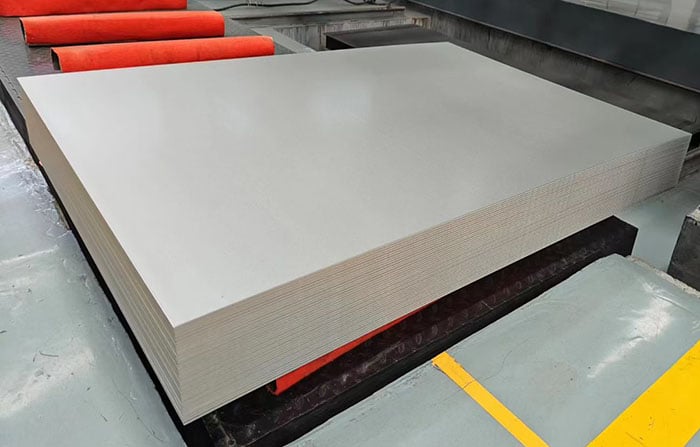
Grade 2 Flat Products
Plate, Sheet, Strip & Coil
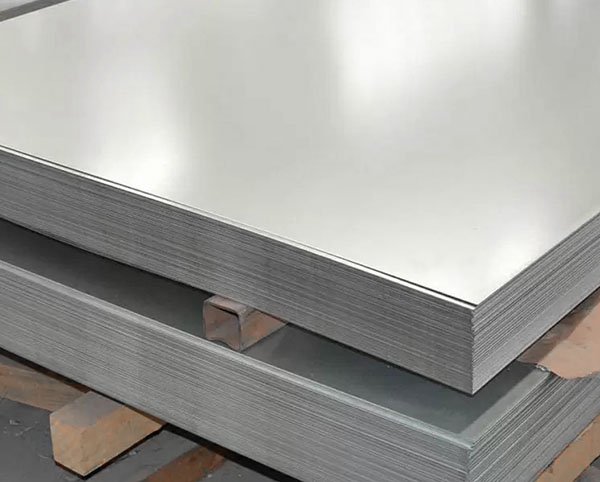
Grade 2 flat products are supplied for fabricated equipment, heat-transfer components, chemical service and general industrial forming. Final supply is confirmed by thickness, width, length or coil requirement, condition and applicable specification.
- Forms
- Plate · Sheet · Strip · Coil · Thin Strip
- Main route
- Flat-product specification selected against the RFQ
- Order language
- Thickness · Width · Length / Coil · Condition · Surface
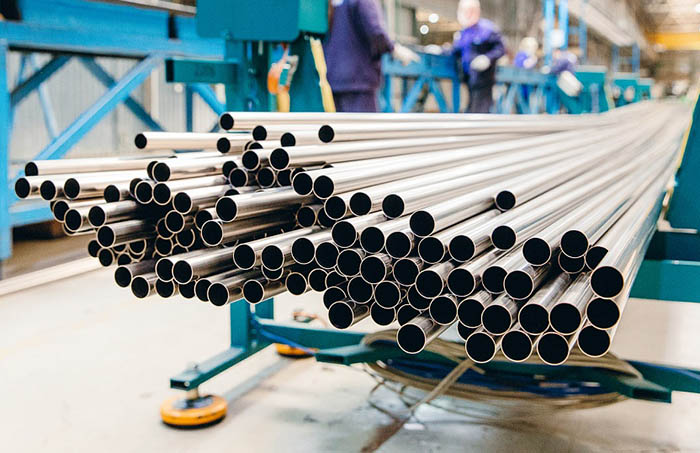
Grade 2 Tubular Products
Tube & Pipe
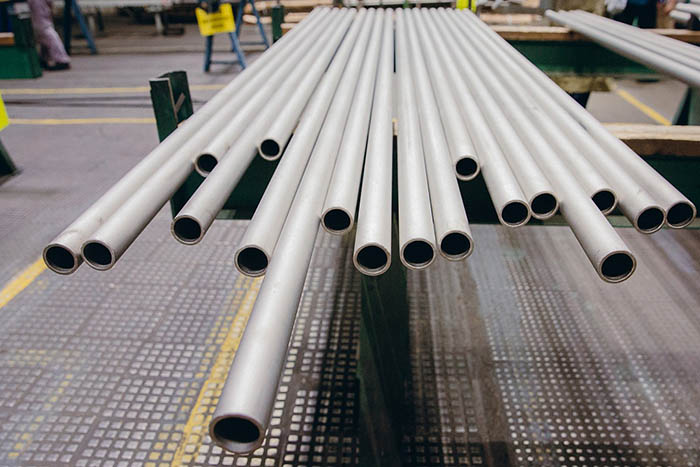
Grade 2 tubular products serve heat-transfer, condenser, seawater, chemical and industrial piping requirements. Heat exchanger tube, seamless pipe and welded pipe follow different specification and manufacturing routes.
- Forms
- HX / Condenser Tube · Seamless Pipe · Welded Pipe
- Route
- Tube and pipe specification confirmed by intended product form
- Order language
- OD · Wall · Length · Manufacturing Route · Testing
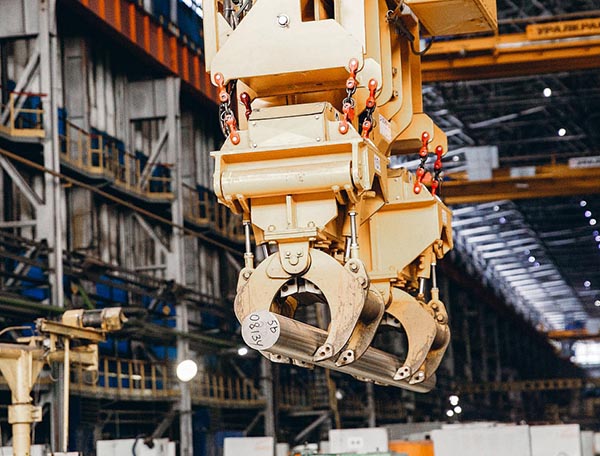
Grade 2 Long Products
Bar, Rod & Billet
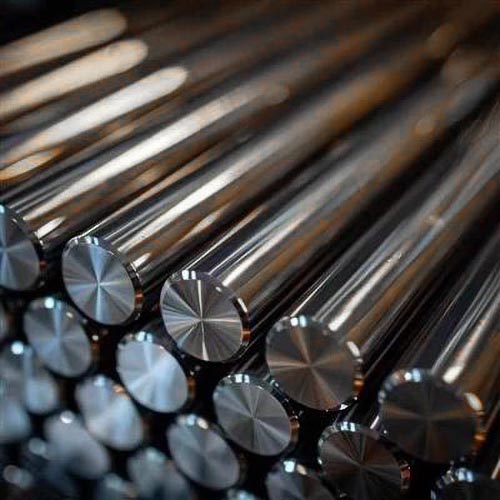
Grade 2 long products are supplied for machining, fabricated components, formed parts and further processing. Diameter, finish, straightness, condition and product specification are confirmed by the required form.
- Forms
- Bar · Rod · Billet
- Supply
- Mill finish · Peeled / Ground where applicable · Cut length
- Order language
- Diameter · Length · Condition · Finish · Quantity
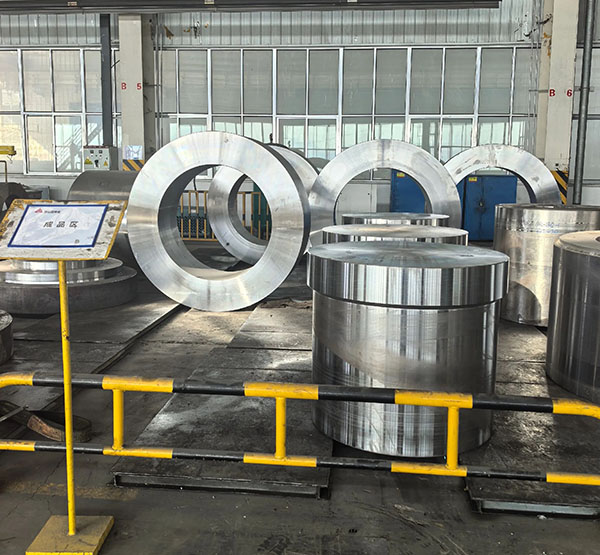
Grade 2 Forged Products
Forgings, Rings & Blanks
Grade 2 forged products are supplied as rings, discs, forged blanks and drawing-based components. The material route, dimensions, machining allowance and inspection requirements are reviewed against the finished-part requirement.
- Forms
- Forging · Ring · Disc · Forged Blank
- Route
- Forged material specification + blank / machining requirement
- Order language
- OD / ID · Thickness · Blank Size · Machining · Inspection
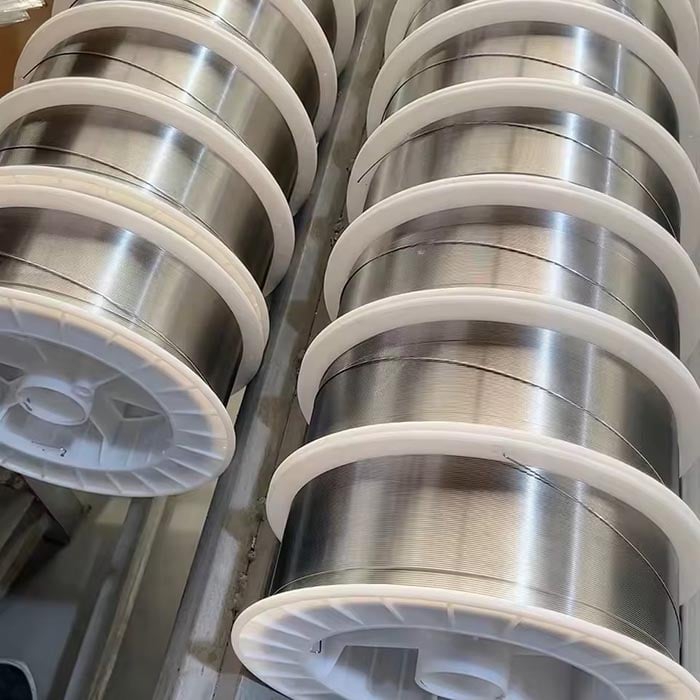
Grade 2 Titanium Wire
Titanium Wire
Grade 2 titanium wire is supplied for industrial fabrication, corrosion-resistant components, mesh, tying, formed parts and further processing. Delivery form, diameter, condition and surface requirement are reviewed together against the RFQ.
- Forms
- Coiled Wire · Straight Wire · Fine Wire
- Supply
- Diameter-based wire route confirmed by application and finish
- Order language
- Diameter · Coil / Straight Length · Condition · Surface · Quantity
Product form comes before final specification.
After selecting the Grade 2 form, confirm the applicable standard,
dimensions, condition and inspection requirement.
5
Product Families
Not sure which Grade 2 route matches the RFQ? Send the required form, dimensions and quantity for supply-route review.
Check Grade 2 AvailabilityGrade 2 Titanium · Supply Review
Supply Range, Availability & Commercial Conditions
Availability is reviewed by product form, requested size, quantity, condition and inspection scope. Stock, regular production, made-to-order supply and custom processing are treated as different commercial routes.
Grade 2 Flat Products
Plate & Sheet Supply Review
Plate and sheet availability is reviewed against the requested thickness, width, length, condition, surface and quantity. Maximum capability is confirmed against the actual order route.
Supply Item
Current Review Basis
RFQ Input
Thickness
Typical and custom range reviewed by RFQ
Required thickness + tolerance
Width
Availability depends on thickness and production route
Required width
Length
Cut length or project length confirmed per order
Required length + quantity
Condition / Surface
Confirmed against applicable flat-product route
Condition + surface requirement
Grade 2 Tubular Products
Tube & Pipe Supply Review
Heat exchanger tube, seamless pipe and welded pipe are reviewed as separate manufacturing and specification routes. OD, wall thickness, length and testing requirements affect availability.
Supply Item
Current Review Basis
RFQ Input
OD
Reviewed by tube or pipe route and requested size
OD or pipe size
Wall Thickness
Availability depends on OD, route and specification
Wall thickness / schedule
Length
Mill, cut or project length confirmed per RFQ
Required length + quantity
Testing
Standard / when specified / when applicable
Inspection + documentation scope
Grade 2 Long Products
Bar & Rod Supply Review
Bar and rod supply is reviewed by diameter, length, condition and finish. Peeled, ground or cut-to-length requirements can change production route, MOQ and lead time.
Supply Item
Current Review Basis
RFQ Input
Diameter
Typical and custom size reviewed by RFQ
Required diameter + tolerance
Length
Mill or cut length confirmed by size and quantity
Required length
Finish
Mill / peeled / ground where applicable
Required finish
Condition
Confirmed against product specification and processing
Condition + quantity
Grade 2 Titanium Wire
Wire Supply Review
Wire availability is reviewed by diameter, delivery form, condition, surface and total quantity. Fine wire and special delivery forms may require a different production route.
Supply Item
Current Review Basis
RFQ Input
Diameter
Reviewed against wire route and quantity
Required diameter + tolerance
Delivery Form
Coil / spool / straight length as applicable
Required delivery form
Surface
Confirmed by wire condition and downstream use
Surface / finish requirement
Quantity
MOQ depends on diameter and production route
Total quantity
Grade 2 Forged Products
Forging Supply Review
Forged rings, discs and blanks are reviewed against starting dimensions, machining allowance, quantity and inspection scope rather than one catalogue size.
Supply Item
Current Review Basis
RFQ Input
Blank Size
Reviewed from finished part or blank requirement
OD / ID / thickness or drawing
Machining
As-forged / rough machined / finished as specified
Machining scope
Quantity
MOQ and production route depend on part size
Total quantity
Inspection
Standard + additional scope when specified
Inspection / documentation requirement
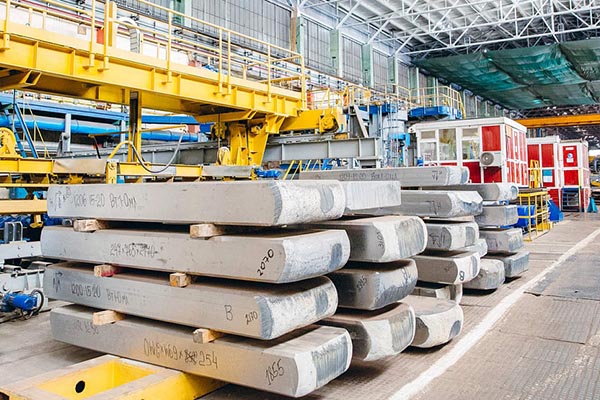
Availability
Ready stock only when the requested size and quantity are confirmed
MOQ
Depends on product form, size and production route
Lead Time
Confirmed after size, quantity, processing and testing review
Price Drivers
Form · Size · Tolerance · Quantity · Processing · Testing · Destination
Send the actual size and quantity. We will confirm the appropriate supply route, availability, MOQ and lead time against the RFQ.
Request Size & AvailabilityGrade 2 Titanium · Specification Routing
Standards by Product Form
Grade 2 / UNS R50400 is not purchased to one universal specification. Select the product form first, then confirm the applicable ASTM, AMS, GB or project standard before dimensions, condition and inspection requirements are finalized.
Product Form
Applicable Specification
Purchase Note
Flat Products
Plate · Sheet · Strip
ASTM B265-25
Grade 2 · UNS R50400
Main ASTM flat-product route. Confirm thickness, width, length, condition and surface against the actual purchase order.
Heat Transfer Tube
Condenser / HX Tube
ASTM B338-17(2026)
Seamless / Welded Tube
Dedicated tube route for surface condensers, evaporators and heat exchangers. It should not be replaced by a general pipe specification.
Long Products
Bar · Billet
ASTM B348/B348M-25
Grade 2 / Grade 2H
Bar and billet route. Diameter, length, condition, finish and mechanical requirements follow the actual ordered form.
Forged Products
Forging · Ring · Disc
ASTM B381-26
Grade F-2 / F-2H
Grade 2 forging route. F-2H is the higher guaranteed tensile-strength order route; additional inspection is specified where required.
Pipe
Seamless Pipe
ASTM B861-24
Grade 2 · UNS R50400
Seamless-pipe procurement route. Keep this specification separate from ASTM B338 heat-exchanger tubing.
Pipe
Welded Pipe
ASTM B862-23
Welded titanium pipe route
Welded-pipe route. Grade, dimensions, condition and testing should be confirmed against the specified edition and PO.
Wire
Titanium Wire
ASTM B863-26
Grade 2 / Grade 2H
Base-metal wire route. ASTM Grade 2 wire and ERTi-2 welding filler are different classifications.
Welding Fittings
Elbow · Tee · Reducer · Stub End
ASTM B363-23
Titanium welding fittings
Fitting route. Starting material may come from plate, bar, pipe or tube, so the base-material specification remains part of the purchase review.
Medical & Aerospace Routes
Special specifications require their own order route
ASTM F67-24
Surgical-implant material route. Ordinary industrial Grade 2 material does not automatically comply with F67.
SAE AMS4902M
Annealed commercially pure titanium sheet / strip / plate route. It is not a universal Grade 2 specification for tube, bar, wire or forging.
Cross-Reference & Material Boundary
Similar grade names do not create automatic equivalence
China / TA2
Review the applicable GB/T chemistry and product-form standard rather than treating TA2 as automatic ASTM substitution.
ASTM B367 Grade C-2
Casting grade UNS R52550. It is not wrought Grade 2 / UNS R50400.
Derived Parts
Tube sheets, discs and machined parts trace back to the starting plate, bar, pipe or forging specification plus drawing and inspection requirements.
Purchase Release
Confirm the standard before the order is released
Specification edition matters. Send the product form, required standard or project code, dimensions, condition and additional inspection requirements.
Confirm Standard Route Open Grade 2 Standard Selector →Grade 2 Titanium · Material Identity
Material Identity & Engineering Data
Grade 2 / UNS R50400 is commercially pure titanium with controlled interstitial and residual elements. Engineering data should be read according to its source: specification requirement, producer reference or actual heat / lot test result.
Commercially Pure Titanium
Grade 2 is the industrial balance point in the CP titanium family.
UNS R50400Grade 2 combines moderate strength with useful ductility, formability, weldability and the corrosion behaviour expected from commercially pure titanium.
Within CP titanium, oxygen, iron and other interstitial or residual elements influence strength. Higher levels generally increase tensile and proof strength while reducing elongation.
Material Logic
Grade 2 should be selected as a CP titanium grade in its own right, not treated as a lower-strength version of Grade 5.
Chemical Composition
Core Grade 2 limits · weight %
Fe
≤ 0.30%
O
≤ 0.25%
C
≤ 0.08%
N
≤ 0.03%
H
≤ 0.015%
Ti
Balance
Mechanical Properties
Common Grade 2 minimum reference
Tensile Strength
345 MPa
minimum reference
Yield Strength
275 MPa
minimum reference
Elongation
20%
minimum reference
Final acceptance values depend on the applicable product specification, form, dimensions, condition and test basis.
Typical Physical Reference
Producer reference values · not MTC acceptance limits
Density
4.51 g/cm³
room-temperature reference
Elastic Modulus
105–120 GPa
typical room-temperature range
Thermal Conductivity
21.79 W/m·K
typical reference
Mean CTE
8.6 × 10⁻⁶ /°C
20–100°C reference
Grade 2 Titanium · Corrosion Service
Corrosion Resistance & Service Envelope
Grade 2 titanium depends on a stable titanium-oxide passive film for corrosion resistance. The material should be reviewed against the actual medium, concentration, temperature, pH, redox condition, flow, crevice geometry and fabrication condition.
Why Grade 2 Works
Grade 2 performs well when the passive film remains stable. Service review begins by asking what supports — or disrupts — that passive condition.
Common selection areas
Common engineering use does not replace condition-specific review.
01
Seawater & Marine Cooling
Commercially pure titanium is widely selected for seawater systems where the oxide film remains stable.
02
Neutral Chloride Media
Many neutral chloride environments are favourable, while temperature, concentration and crevice geometry still matter.
03
Oxidizing Service
Oxidizing conditions generally support formation and maintenance of the protective titanium-oxide film.
04
Wet Chlorine Environments
Moisture-containing chlorine must be distinguished from dry-chlorine service when reviewing titanium suitability.
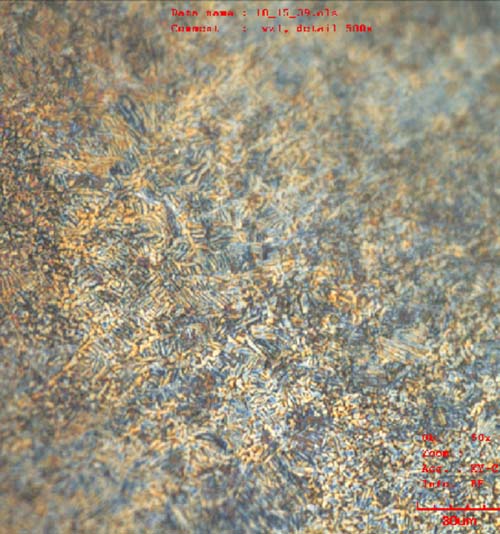
Review Before Release
Conditions that can move Grade 2 outside its comfortable service envelope
These conditions should trigger a service-specific material review before the purchase specification is released.
Reducing Acids
Low-redox or strongly reducing acid conditions can reduce passive-film stability; concentration and temperature matter.
HF / Fluoride
Fluoride-containing environments are a high-risk corrosion route for titanium and require separate evaluation.
Oxygen-Depleted Crevices
Restricted oxygen renewal together with elevated temperature or concentrated chloride can increase crevice-corrosion susceptibility.
Dry Chlorine / Hot Alkali
Dry chlorine and high-temperature concentrated alkali should not be treated as extensions of normal wet-chlorine or seawater service.
For service review, provide: medium · concentration · temperature · pH · oxidizing/reducing state · flow · crevice geometry · weld/fabrication condition
Grade 2 Titanium · Heat Transfer & Seawater
Heat Exchanger, Condenser & Seawater Systems
Grade 2 titanium is widely specified for condenser, heat-exchanger, desalination and seawater-cooling equipment. The procurement route depends on whether the requirement is heat-transfer tube, flat product, general pipe or a drawing-based fabricated component.
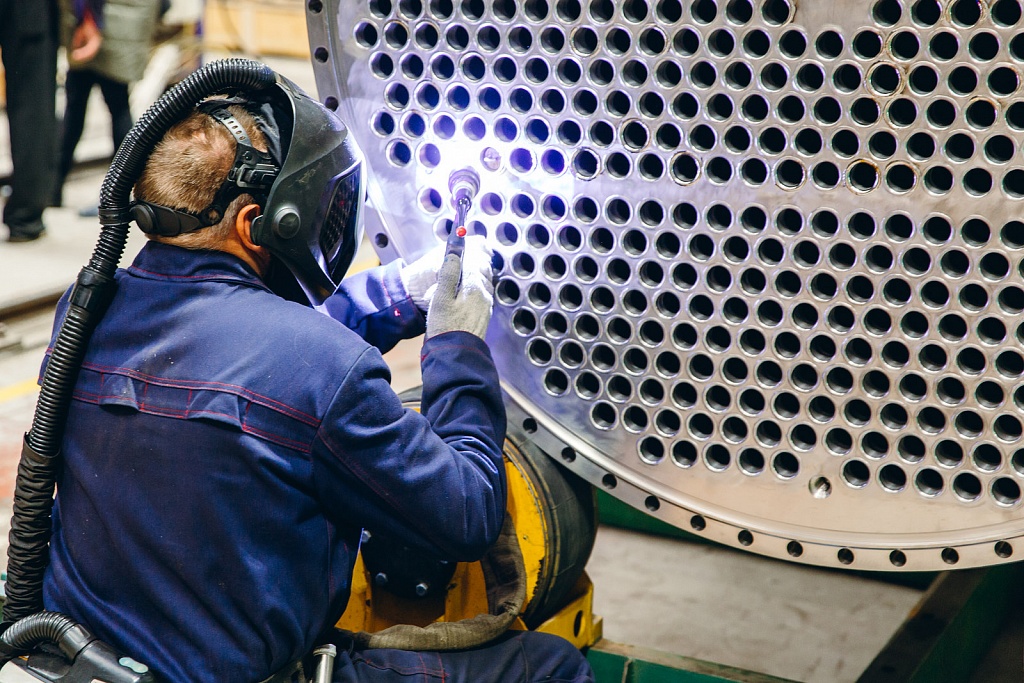
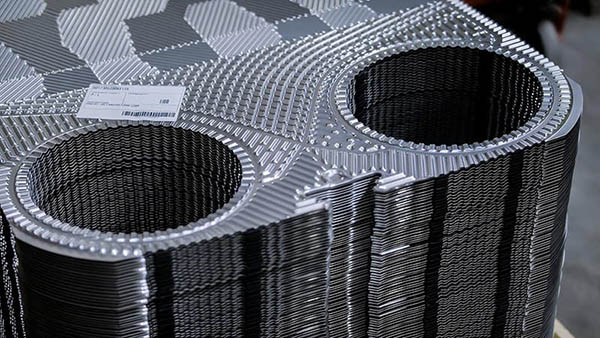

Why Grade 2 enters heat-transfer equipment
The commercial case is not “high thermal conductivity.” Grade 2 is selected because corrosion resistance can support thin-wall heat-transfer construction, seawater service and long equipment life when the product route and operating conditions are correctly specified.
Heat-Transfer Tube
Condenser / Evaporator / HX Tube
ASTM B338Heat-exchanger and condenser tubing follows a dedicated tube route. OD, wall, length, manufacturing route, inspection and documentation should be confirmed as one tube order.
Heat Exchanger Tubes →Flat Product Route
PHE Plate / Fabricated Flat Product
ASTM B265Plate and sheet provide the starting flat-product route for formed heat-transfer plates and other fabricated components. Finished geometry and forming requirements belong to the component drawing.
Titanium Plate & Sheet →Pipe / Fabricated Route
Seawater Pipe & Drawing-Based Parts
B861 / B862 where pipe is specifiedGeneral seamless or welded pipe is a different procurement route from B338 heat-transfer tube. Tube sheets, cut parts and machined pieces must also trace back to the identified base material route.
Titanium Tube & Pipe →
Typical equipment routes
- Surface Condenser
- Evaporator
- Plate Heat Exchanger
- Desalination
- Seawater Cooling
- Marine Heat Transfer
TiAlloy supplies Grade 2 tube, pipe, flat products and drawing-based processed parts against the applicable material route. Complete equipment supply is not implied unless specifically quoted.
Request Tube / Plate QuoteGrade 2 Titanium · Chemical & Pressure Equipment
Chemical, Electrochemical & Pressure Equipment
Grade 2 titanium enters chemical and electrochemical projects at different supply levels. Base material, drawing-based components, titanium substrate, coated functional electrodes and complete process equipment are separate commercial scopes.

Material supply and complete equipment responsibility are reviewed as separate scopes.
TiAlloy Supply Scope
Material first. Component second. Functional equipment only when separately defined.
01
Grade 2 Base Material
Plate, sheet, tube, pipe, bar and forging supplied against the applicable product specification.
02
Fabricated Titanium Component
Tube sheets, fittings, blanks and machined parts can be reviewed from the identified starting material and drawing.
03
Titanium Substrate
Titanium can be supplied as the structural substrate for an electrochemical component when the drawing and processing route are defined.
Scope Boundary
Catalytic coating, electrode activation and complete process equipment are separate scopes and are not implied by Grade 2 base-material supply.
Engineering Routes
The service and project specification determine what comes after the base material.
Pressure Equipment
Grade 2 / Grade 2H
Grade 2H enters only where the applicable product specification or pressure-equipment requirement calls for the H-grade route.
Review Standards →
Electrochemical / Chlor-Alkali
Substrate is not the finished electrode
MMO or other catalytic coating creates a functional electrode beyond the titanium substrate and belongs to a separate supply scope.
Service Escalation
Grade 7 / Grade 12 review
More demanding corrosion conditions can move the material review toward other titanium grades rather than automatically changing the pressure or strength route.
Review Corrosion Envelope →Send the drawing with product form, material specification, service medium, temperature, quantity and inspection scope so the quotation can separate base material, fabrication and additional project responsibility.
Grade 2 Titanium · Fabrication Engineering
Forming, Welding & Machining Grade 2
Grade 2 is workable, but the drawing still needs to account for rolling direction, anisotropy, springback, tool contact, shielding, cleanliness, contamination risk and the final machining route. Fabrication quality comes from process control rather than a generic “easy to fabricate” claim.
Commercially pure titanium can be cold-bent and press-formed. Rolling direction, planar anisotropy, springback and contact friction should be considered in bend radii, die design and repeatability.
- Rolling Direction
- Springback Allowance
- Deep Drawing
- Lubrication
- Galling Control
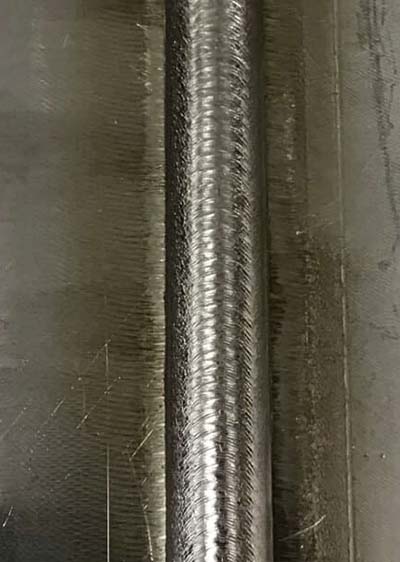
02 · Welding
Clean joint. Controlled inert shielding.
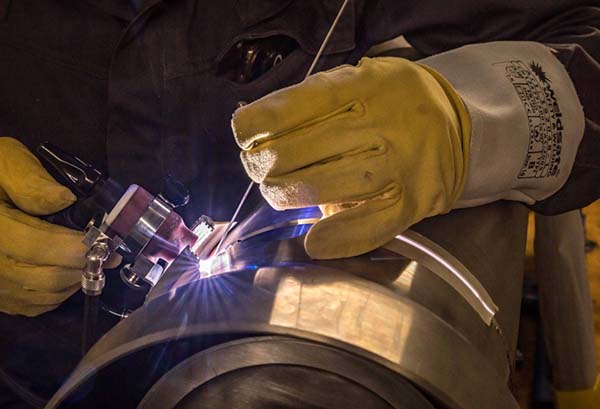
GTAW / TIG and GMAW / MIG are established titanium welding routes. The molten weld, cooling weld metal and root side must receive the shielding appropriate to the joint and process. Clean surfaces, filler and work areas are critical because hot titanium is sensitive to air and moisture contamination.
O / N / H contamination can harden or embrittle titanium. ERTi-2 welding filler and ASTM B863 Grade 2 base-metal wire are separate product classifications.
03 · Machining
Control heat, contact and finished tolerance.
Machining requirements should be quoted together with the starting material form and final tolerance. Stable tooling, positive cutting action, suitable coolant or lubrication and heat control help protect surface condition and tool life.
Cut edges or surfaces affected by thermal processing may need additional finishing before the component is released.
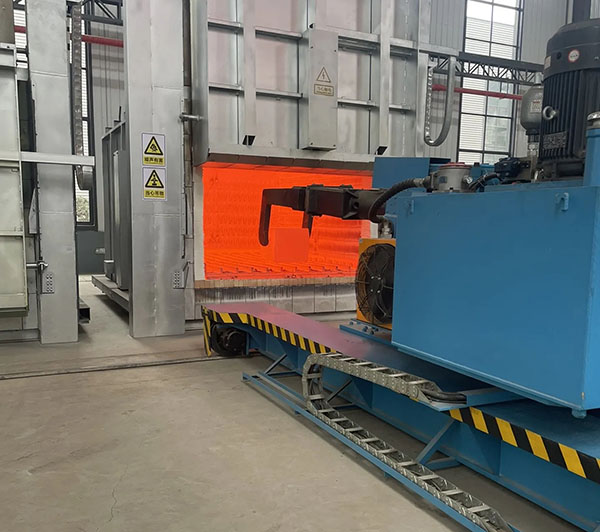
Rolling Direction
Critical bends and formed geometry should retain the required orientation information where direction affects response.
Springback & Tooling
Die allowance and dimensional compensation depend on geometry, thickness, material strength and forming method.
Galling & Lubrication
Titanium can gall against tooling, so tool contact and lubrication should match the forming or machining operation.
Thermal Condition
Annealing or stress relief is not a universal Grade 2 default; use it only when the product route, process or order requires it.
Grade 2 Titanium · Delivery Condition & Surface
Condition, Surface Finish & Secondary Processing
A Grade 2 RFQ should separate material condition, surface finish, roughness and secondary processing. Terms such as annealed, pickled, ground or machined describe different parts of the delivery specification and should not be used interchangeably.
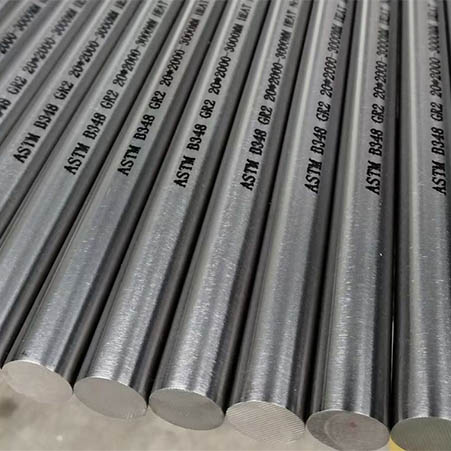
Write the RFQ in separate layers
Condition is not the same thing as surface finish.
Define each requirement separately so the mill route, processing scope and quotation can be compared correctly.
Condition
Annealed · Stress Relieved when applicable · Other specified product condition
Condition follows the product form, specification and actual processing route.
Surface
Descaled · Pickled · Blasted · Peeled · Ground · Polished
ASTM B600 provides cleaning and descaling guidance; it does not make “passivated” a universal Grade 2 delivery state.
Processing
Cut-to-Size · Waterjet · CNC · Chamfering · Drawing-Based Machining
If surface roughness matters, specify the required Ra separately from the finish name.
RFQ Delivery Language
Specify the finish, not just “Grade 2”.
Example structure: Grade 2 / Product Form / Standard / Condition / Surface / Ra if required / Secondary Processing / Dimensions / Quantity
Specify Finish With RFQGrade 2 Titanium · Manufacturing Evidence
Grade 2 Manufacturing & Supply Route
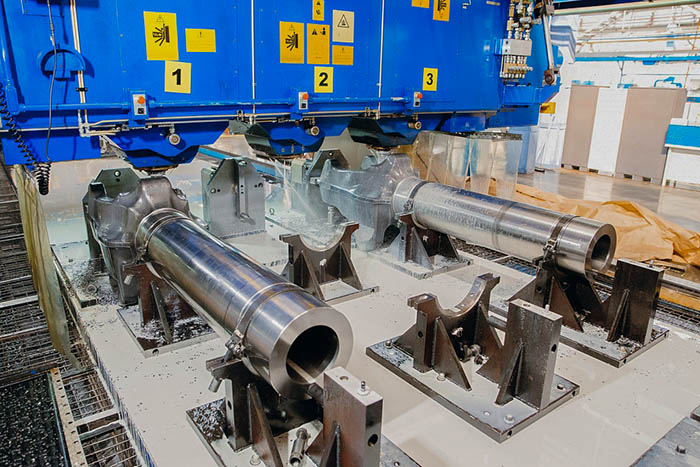
Manufacturing evidence should connect a real process to a real product form and a controlled result. Grade 2 supply may combine documented TiAlloy production, cooperating manufacturing and qualified sourcing according to the product, dimensions, processing and inspection scope.
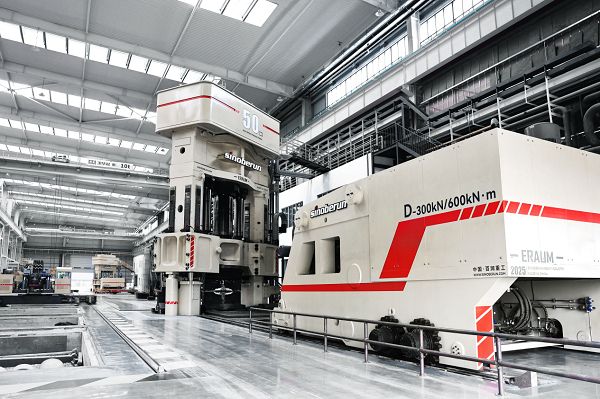
Product form, dimensions, surface, tolerance, inspection and traceability should remain connected through the selected manufacturing route.
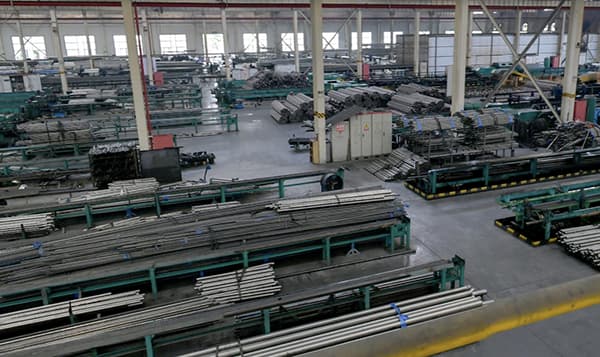
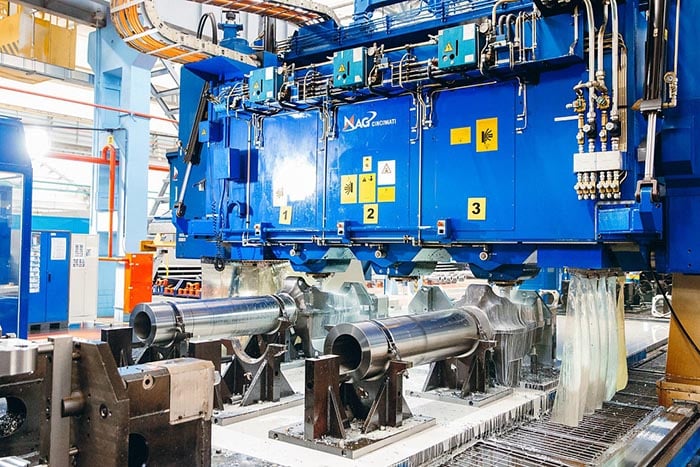
Plate Rolling & Leveling
Product
Plate / Sheet
Control
Thickness · Flatness · Surface · Cut Size
Plate & Sheet →
Tube Cold Work & Sizing
Product
Tube / Heat-Transfer Tube
Control
OD · Wall · Straightness · Test Basis
Tube & Pipe →
Forging Route
Product
Ring / Disc / Forged Blank
Control
Geometry · Allowance · Heat / Lot Traceability
Titanium Forging →
Cutting & Machining
Product
Drawing-Based Component
Control
Dimensions · Tolerance · Edge / Surface
Titanium Supply →
Manufacturing Source Identity
The source route should be stated from evidence — not assumed from the product name.
Own Production
Used where TiAlloy’s documented production equipment, process records and manufacturing responsibility apply to the quoted product.
Cooperating Manufacturing
Used when a defined process or product form is manufactured with a cooperating facility against the order, inspection and traceability requirements.
Qualified Manufacturing Source
Used where a qualified external source supplies the required product form, standard or manufacturing route under the agreed documentation scope.
Manufacturing source, product route, inspection scope and processing responsibility should be confirmed with the quotation for the actual Grade 2 form, dimensions and order requirement.
Discuss Production RequirementGrade 2 Titanium · Inspection Evidence
Inspection, Real Order Evidence & Heat/Lot Traceability
Inspection evidence should connect the supplied Grade 2 product to its heat or lot, test results, product marking, material documentation and shipment identity. The required inspection route depends on the product form, applicable standard and purchase order.
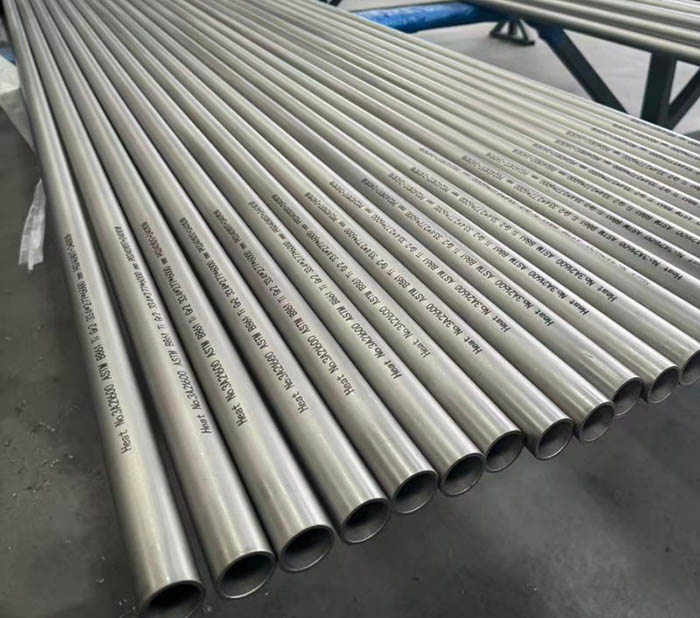
Grade, applicable specification, heat or lot identity and order marking should be reviewed against the actual product and documentation before release.
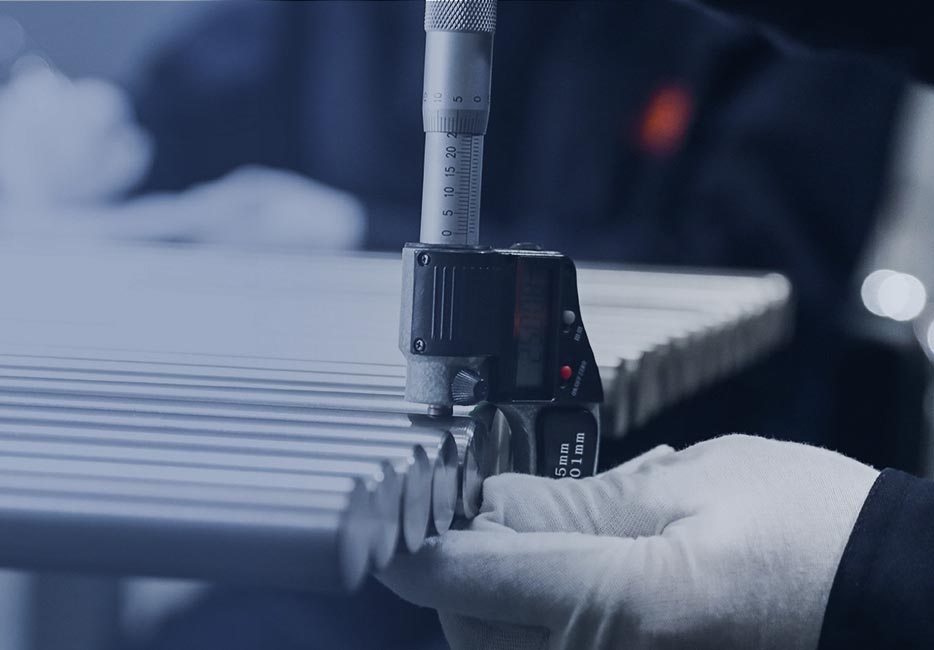

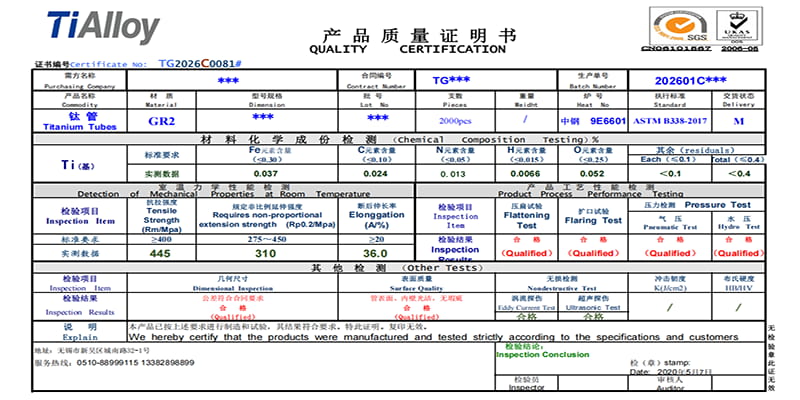
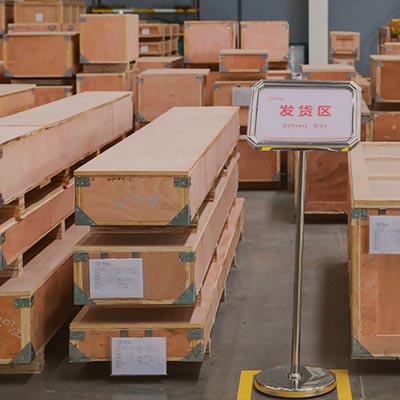
Inspection Release Rule
Not every test belongs to every order.
Standard Requirement
Chemistry, mechanical, dimensional, surface and product-form tests follow the applicable material specification and manufacturing route.
When Applicable / Specified
Tube UT, electromagnetic testing, hydrostatic or pneumatic testing must follow the applicable tube standard, manufacturing route and purchase requirement.
Additional Order Scope
EN 10204 3.1, additional NDT or other documentation should be specified and confirmed with the order; third-party inspection is arranged when requested and agreed.
Traceability Backbone
One material identity should survive every handoff from inspection to shipment.
Heat / Lot
Material identity established for the supplied product.
Test
Applicable results linked to the relevant material identity.
Marking
Product marking carries the identification required by the order.
MTC
Material documentation reports the applicable test record.
Packing / Shipment ID
Labels and packing preserve the final order identity.
Verified TiAlloy Order Evidence
One real order from product specification through packing and shipment identification
Product
[REAL PRODUCT FORM]
Grade / Standard
[REAL GRADE + STANDARD]
Dimensions / Quantity
[REAL SIZE + QTY]
Inspection
[ACTUAL TEST / INSPECTION]
Marking
[ACTUAL MARKING BASIS]
Documentation
[ACTUAL MTC / DOCUMENTS]
Packing
[ACTUAL PACKING]
Shipment Identification
[ACTUAL SHIPMENT ID METHOD]
Submit the product form, standard, dimensions and required inspection scope with the RFQ so testing, documentation, traceability and third-party requirements can be reviewed before order release.
Grade 2 Titanium · RFQ Desk
Grade 2 RFQ Desk & Buyer FAQ
A quote becomes faster and more comparable when the product form, specification, dimensions, condition, inspection scope and commercial quantity are defined together. The items below are the information normally needed to release a Grade 2 quotation.
Buyer FAQ
Six questions that commonly affect quotation release
01 Can you confirm stock or production availability for my Grade 2 size and quantity?
Availability is confirmed against the actual product form, dimensions, quantity, condition and required processing or testing. Ready stock should only be stated after the requested size and quantity are checked.
02 What affects Grade 2 titanium price, MOQ and lead time?
Product form, dimensions, tolerance, quantity, manufacturing route, surface or machining requirements, inspection scope, certification and destination can all affect price, MOQ and production lead time. These values should be confirmed with the actual RFQ rather than treated as fixed catalogue values.
03 What inspection documents and material records can be supplied?
Chemistry, mechanical results, heat or lot traceability and applicable inspection records can be reviewed against the selected product standard and purchase order. EN 10204 3.1, additional testing or third-party inspection should be specified when required and confirmed with the quotation.
04 What is the purchasing difference between Grade 2 and Grade 2H?
Grade 2 and Grade 2H use UNS R50400, but the H-grade route carries a higher specified minimum tensile requirement where the applicable product standard recognizes it. Grade 2H should therefore be ordered and certified through the applicable H-grade requirement rather than inferred from a single tensile result.
05 Can TA2 or JIS Class 2 be substituted directly for ASTM Grade 2?
They may be used as cross-reference designations during material discussion, but they should not be treated as automatic substitutes. The target product standard, chemistry, mechanical requirements, condition and product form should be checked before substitution.
06 Does Grade 2 titanium automatically comply with ASTM F67?
No. Grade 2 identifies a titanium material grade, while ASTM F67 is a specific specification route with its own scope and requirements. F67 must be specified and verified when that compliance route is required.
Grade 2 Titanium RFQ
Send the specification. We will review the material route before quoting.
Product form · standard · dimensions · quantity · condition · surface · inspection · destination
Trending now