Get in Touch with TiAlloy Company

Updated July 2026
Grade 2 titanium is a commercially pure, unalloyed titanium grade (ASTM B265, UNS R50400) valued for its 275 MPa minimum yield strength, excellent corrosion resistance, and full weldability, the standard choice when corrosion performance and fabricability matter more than maximum strength.
It’s the most widely specified grade in the commercially pure (CP) titanium family, and for good reason: it combines moderate mechanical strength with a self-healing oxide layer that resists seawater, industrial acids, and chlorinated environments without coatings, while still welding and forming almost as easily as austenitic stainless steel. This guide walks through its composition and mechanical properties, how it compares to Grade 1, 3, 4, and 5, where its corrosion resistance holds up (and where it doesn’t), available product forms, fabrication practices, and how to decide whether Grade 2, or a different grade entirely, is the right call for your project.
TL;DR, Key Takeaways
- Grade 2 titanium (UNS R50400) is unalloyed CP titanium, no aluminum or vanadium added, governed primarily by ASTM B265.
- Minimum mechanical properties: 275 MPa yield strength, 345 MPa ultimate tensile strength, 20% elongation.
- It resists corrosion better than 316 stainless steel in chloride-rich environments, and, counter-intuitively, also conducts heat better than 316/304 stainless.
- On raw strength, Grade 5 (Ti-6Al-4V) beats Grade 2 by roughly 2.6x, but at the cost of weldability, price, and thermal conductivity.
- Sheet, plate, tube, bar, and pipe forms are all available for Grade 2, each governed by a different ASTM standard.
Quick Specs
| Designation | Grade 2 (commonly called Ti 50A), UNS R50400 |
| Governing Standard | ASTM B265 (sheet/strip/plate); see product-form table below for tube, bar, and pipe |
| Minimum Yield Strength | 275 MPa (40 ksi) |
| Minimum Ultimate Tensile Strength | 345 MPa (50 ksi) |
| Minimum Elongation | 20% |
| Density | ~4.5 g/cm³ |
| Weldability | Excellent — GTAW/GMAW under inert gas shielding |
| Corrosion Resistance | Excellent — self-healing TiO2 passive oxide layer |
| Typical Mill Price | $6.50–$10.00/lb, form- and quantity-dependent (2026) |
What Is Grade 2 Titanium?
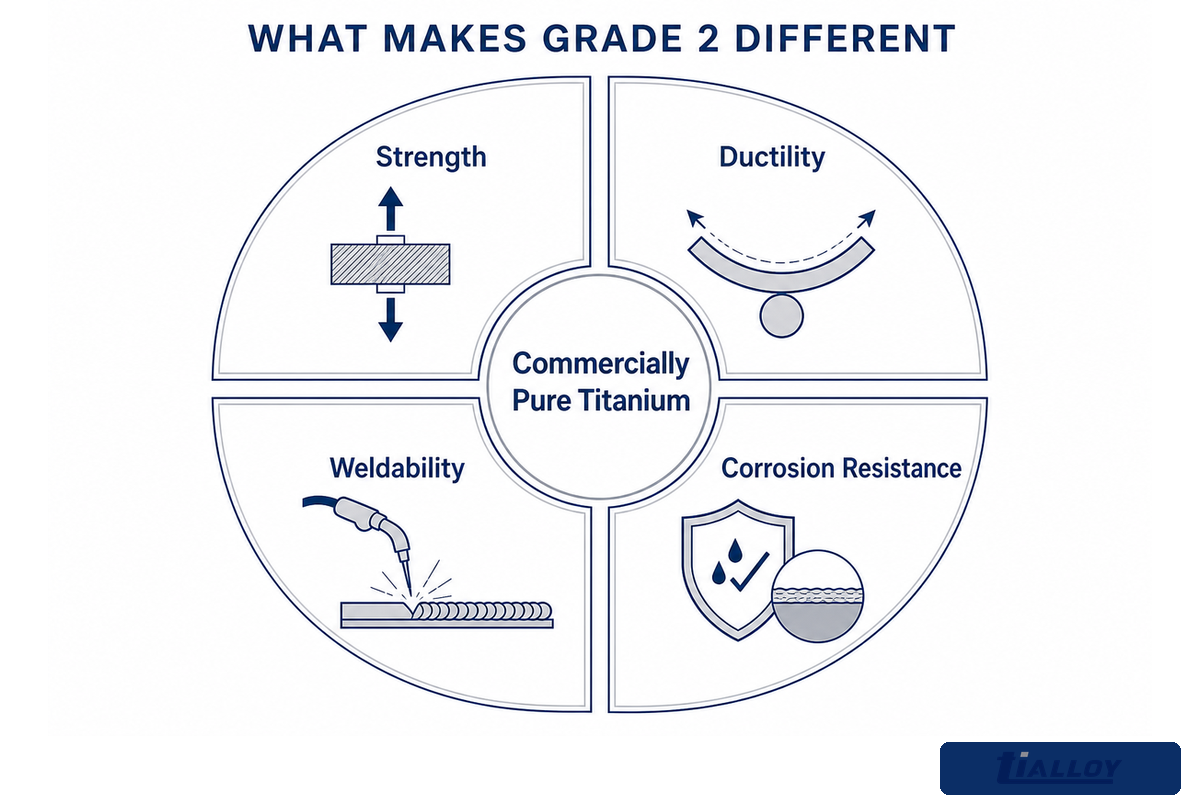
Grade 2 titanium is a commercially pure (CP), unalloyed titanium grade standardized under ASTM B265 and identified by the UNS designation R50400. Buyers and machinists also know it as “Ti 50A” or simply “CP Grade 2.” Unlike alloyed grades such as Grade 5 (Ti-6Al-4V), Grade 2 contains no deliberately added aluminum, vanadium, or other alloying elements.
Only small, tightly controlled traces of oxygen, iron, carbon, nitrogen, and hydrogen occur naturally in refined titanium and are capped by the ASTM specification to keep strength and ductility in balance. Lawrence Berkeley National Laboratory’s own materials reference sheet for CP Titanium Grade 2 lists this same property profile for engineers specifying the material outside a purely commercial context.
That composition is exactly why Grade 2 is the most widely used titanium grade in commercial and industrial service: it delivers moderate strength, excellent corrosion resistance, and weldability close to austenitic stainless steel, without the alloying complexity, cost premium, or fabrication difficulty of the higher-strength grades. If your project needs “some titanium” without a specific reason to reach for Grade 5, Grade 2 is almost always the correct starting point.
Titanium is a popular engineering material precisely because the alpha-to-alpha-beta spectrum spans this wide range of applications so effectively. As a pure alpha titanium, Grade 2’s hexagonal crystal structure is never modified by beta-stabilizing elements the way Grade 5’s is, part of why this single grade offer excellent corrosion resistance and formability in one package.
If you already know your project needs maximum strength-to-weight above everything else, skip ahead to the Grade 2 versus Grade 5 comparison below, Grade 2 is probably not your answer. If corrosion resistance, biocompatibility, or easy on-site welding matter more than raw strength, keep reading: the sections below cover composition, the full CP grade ladder, applications, available forms, fabrication practices, and a decision framework for confirming Grade 2 is the right call before you order.
Chemical Composition and Mechanical Properties
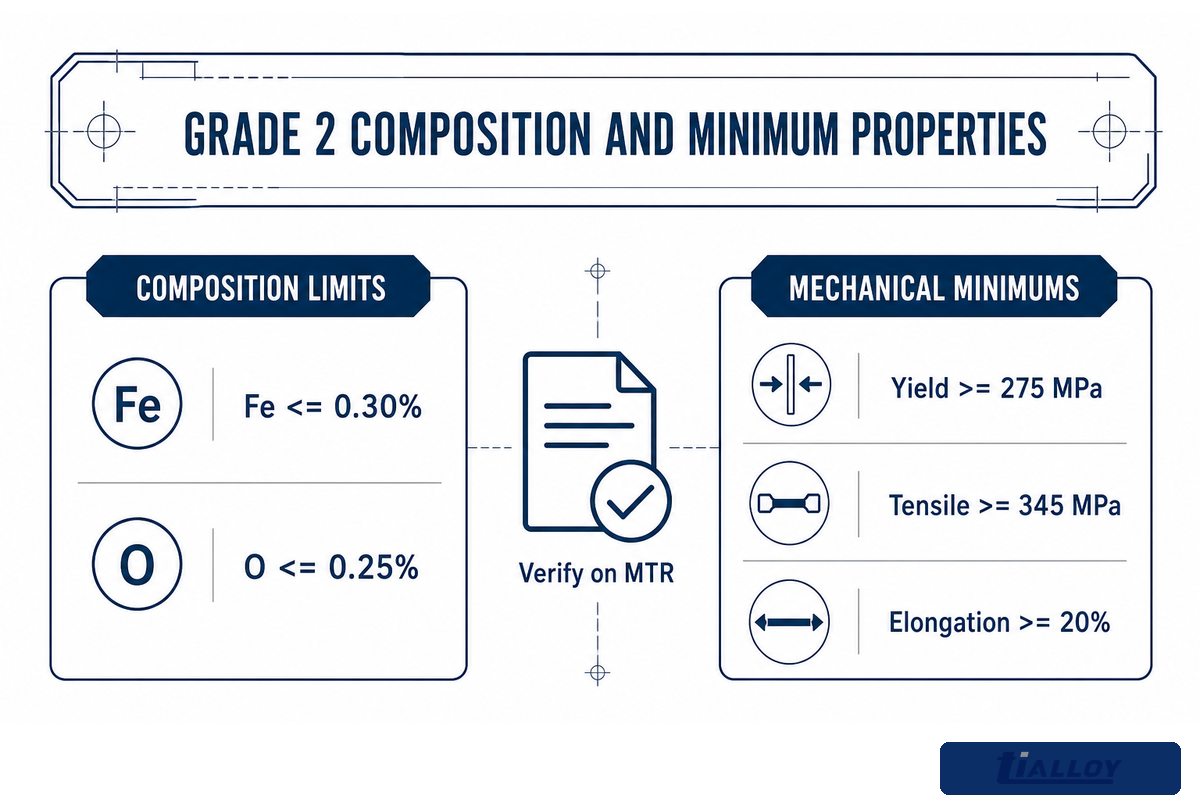
Grade 2’s chemistry is defined by upper limits on interstitial elements, oxygen, iron, carbon, nitrogen, and hydrogen, rather than by a fixed alloy recipe. Because those limits differ slightly across the specific ASTM specification governing each product form (B265 for sheet/plate, B348 for bar, B338 for tube), always verify the exact composition table against the standard covering your product form rather than a single generic percentage, a mill certification quoting the wrong ASTM number is a common paperwork mistake that only surfaces during incoming inspection.
By contrast, mechanical property minimums are consistent and well documented. Per ASTM’s titanium bar and wire specification, Grade 2 must meet:
275 MPa
Min. Yield Strength
345 MPa
Min. Tensile Strength
20%
Min. Elongation
Buyers researching grade 2 titanium strength should treat the ASTM floor as a starting point, not the ceiling. Real mill certifications typically run above these floors, annealed Grade 2 sheet is commonly reported around 340 MPa yield / 430 MPa tensile in practice, giving fabricators a reasonable safety margin above the ASTM minimum. Independent materials-science literature corroborates these mill-certified minimums as consistent with published CP titanium data. Supplied and used typically in the annealed condition, Grade 2 is not a heat-treatable grade in the way steel is, so its properties are governed by mill processing and grain structure rather than a quench-and-temper cycle.
Cold working is the practical lever available to increase strength beyond the annealed minimums above, heavier cold reduction raises hardness and tensile strength at the cost of ductility, which is why fully annealed stock is specified whenever formability matters more than exceptional strength. If your application genuinely needs strength beyond what cold-worked Grade 2 delivers, that’s a signal to move up the CP ladder rather than accept a grade with lower strength than your design requires and try to compensate with heavier wall thickness.
ASTM/UNS Standards and the CP Titanium Grade System (Grade 1 versus 2 versus 3 versus 4)
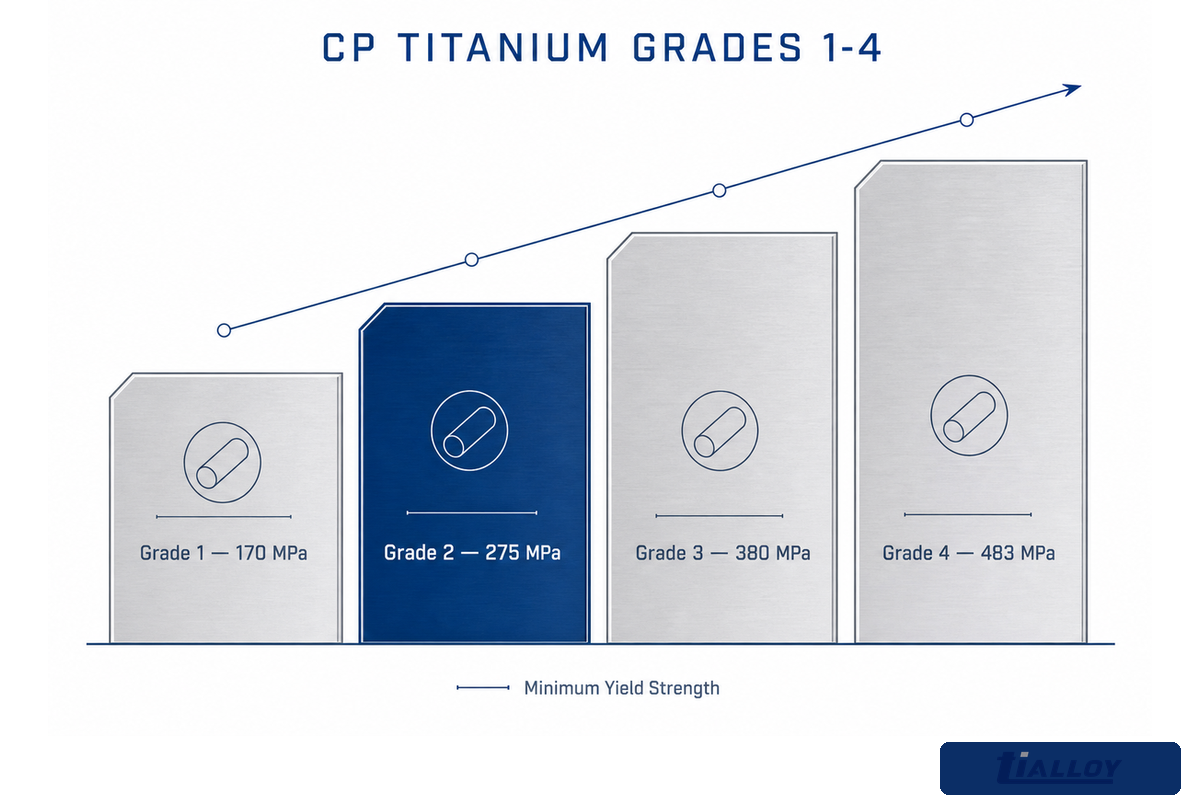
Grade 2 sits in the middle of a four-grade commercially pure titanium family that most buyer research skips past in favor of the Grade 2-vs-Grade 5 comparison. Within CP titanium alone, strength rises in a straight line with oxygen and iron content: Grade 1 is the softest and most formable, Grade 4 is the strongest CP option before you cross into alloyed territory.
| Grade | Min. Yield Strength | Min. Tensile Strength | Relative Formability |
|---|---|---|---|
| Grade 1 | 170 MPa | 240 MPa | Highest — softest, most ductile CP grade |
| Grade 2 | 275 MPa | 345 MPa | High — the general-purpose default |
| Grade 3 | 380 MPa | 450 MPa | Moderate — less common stock item |
| Grade 4 | 483 MPa | 550 MPa | Lowest of the CP family — approaching alloy-grade handling |
Source: published CP titanium mechanical property data, cross-verified against ASTM B265 minimums.
The practical takeaway: if Grade 2’s 275 MPa yield strength is genuinely too low for your design margin, Grade 3 or Grade 4 is worth checking before jumping straight to an alloyed grade, they preserve most of CP titanium’s weldability and corrosion behavior while closing part of the strength gap. Lead times on Grade 3 and 4 stock tend to run longer than Grade 2, since they’re ordered far less frequently. Framed as grade 2 titanium vs grade 4, the gain is real but modest, roughly 75% more yield strength, which is why most buyers who need a bigger jump skip straight to Grade 5 instead of stopping at Grade 4.
All four commercially pure titanium grades share this same alpha crystal structure; only the interstitial content changes as you move up the ladder. Beyond this Grade 1–4 family, ASTM also defines several specialty titanium grades for narrower use cases: Grade 7 adds a small palladium addition for enhanced resistance to reducing acids, a corrosion-resistant titanium alloy patent uses commercially pure Grade 2 and PGM-alloyed Grade 7 as its own performance baselines when comparing corrosion behavior, Grade 9 (Ti-3Al-2.5V) is a lower-alloy option sometimes chosen for aerospace tubing where CP grades fall short on strength, and Grade 23 (ELI Ti-6Al-4V) is the extra-low-interstitial version of Grade 5 used almost exclusively in medical implants. None of these are grades of commercially pure titanium in the sense Grade 1–4 are, each adds deliberate alloying, so if a supplier’s material data sheet lists one of them in place of Grade 2, confirm before substituting.
Grade 2 versus Grade 5 Titanium and Stainless Steel: How to Choose
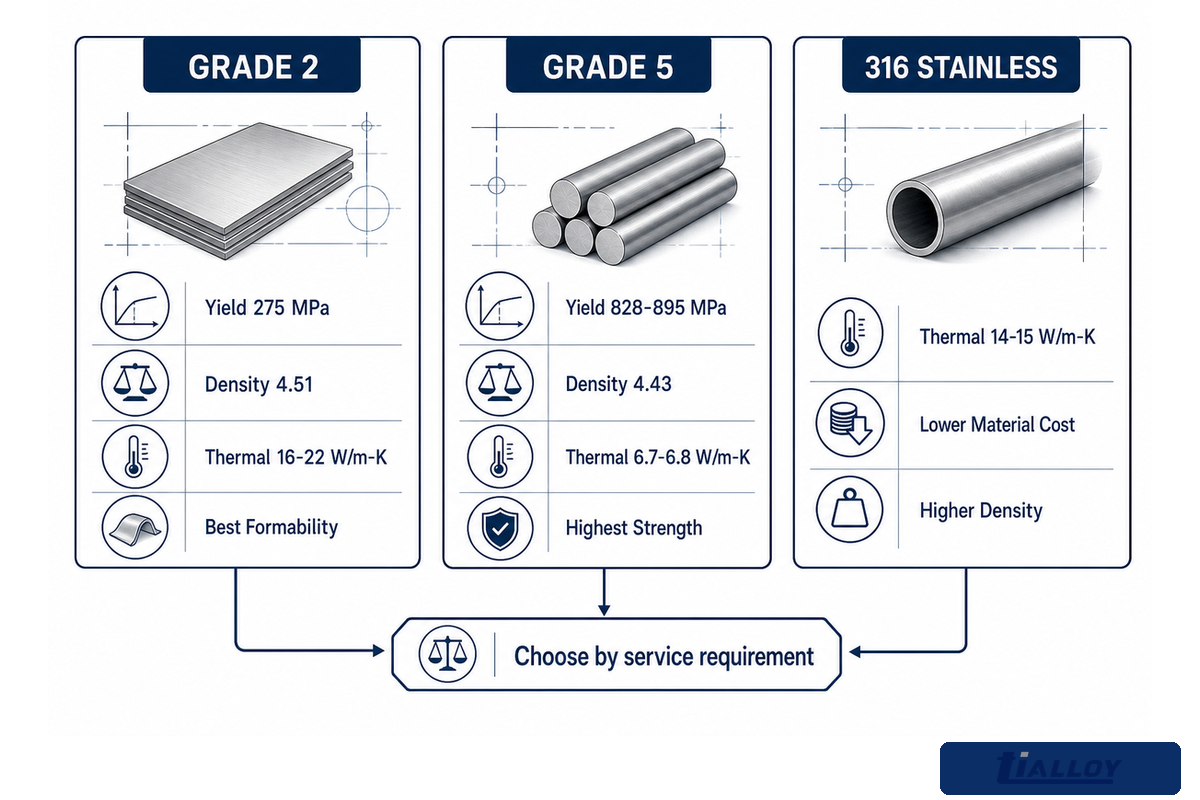
The comparison buyers actually search for isn’t Grade 2 versus Grade 1, it’s Grade 2 versus Grade 5 (Ti-6Al-4V) and Grade 2 versus stainless steel. Both comparisons come down to the same underlying trade-off: strength versus fabricability and corrosion performance.
| Property | Grade 2 Titanium | Grade 5 Titanium | 316 Stainless Steel |
|---|---|---|---|
| Min. Yield Strength | 275 MPa | 828 MPa | 205 MPa (typical annealed) |
| Min. Tensile Strength | 345 MPa | 895 MPa | 515 MPa (typical annealed) |
| Thermal Conductivity | 16.3–21.9 W/m·K | 6.7–6.8 W/m·K | ~14.4–15 W/m·K |
| Weldability | Excellent | Good, alloy-specific procedure required | Excellent |
Is Grade 2 or Grade 5 Titanium Better?
Neither grade is universally better, they serve different jobs. Grade 5 delivers roughly 2.6 times Grade 2’s minimum tensile strength (895 MPa versus 345 MPa), making it the right call for weight-critical structural parts like aerospace fasteners and airframe brackets, where strength-to-weight ratio outweighs everything else. On-site welding, complex-shape forming, or exposure to corrosive process fluids all favor Grade 2, since it welds and machines far more predictably than an alpha-beta alloy and carries a meaningfully lower purchase cost.
Is Grade 2 Titanium Better Than Stainless Steel?
For corrosion resistance in chloride-rich environments, yes: Grade 2’s self-healing TiO2 oxide layer holds up in seawater and many industrial acids where 316 stainless eventually pits. A genuinely counter-intuitive advantage most buyers miss is thermal conductivity: Grade 2 titanium’s 16.3–21.9 W/m·K actually beats 316/304 stainless steel’s roughly 14.4–15 W/m·K, so it isn’t the poor heat-transfer material engineers sometimes assume, that reputation really belongs to alloyed Grade 5.
The trade-off is purchase price: Grade 2 costs materially more per pound than 316 stainless, so the decision usually comes down to whether corrosion life and reduced maintenance offset that upfront premium over the service life of the part.
Titanium isn’t the only answer to chloride attack, though. For pitting, crevice corrosion, and stress corrosion cracking short of titanium’s full performance envelope, super-stainless alloys such as UNS S31254, S44735, and S44660 are sometimes proposed as acceptable alternatives to titanium tubing in less severe chloride service. They’re worth a look when the fluid chemistry sit below titanium’s justification threshold and budget pressure is real; once temperature and chloride concentration climb into the range covered in the corrosion-limits box above, that super-stainless margin narrows and Grade 2 becomes the more defensible specification again.
Corrosion Resistance and Biocompatibility
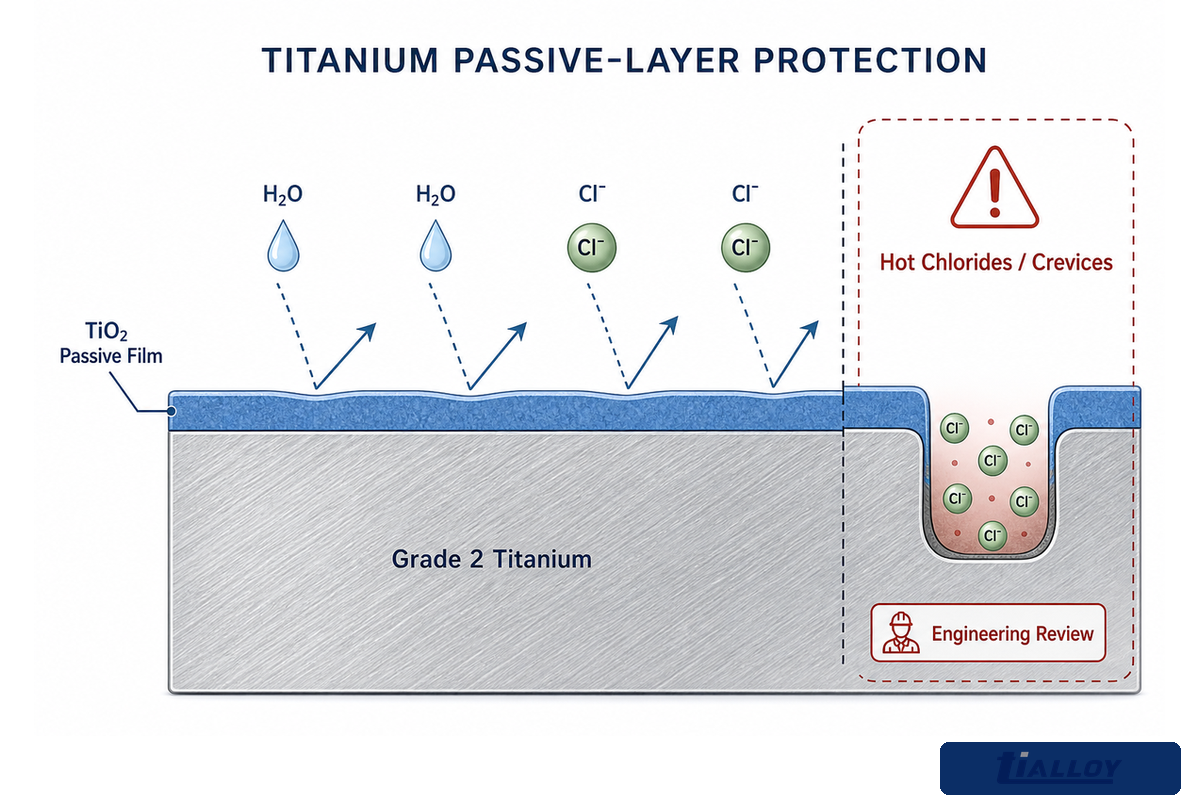
Grade 2’s corrosion resistance is not a coating, it is a self-generated, self-healing titanium dioxide (TiO2) passive oxide layer that forms within microseconds of exposure to oxygen or moisture and instantly re-forms if scratched or abraded. That mechanism is also why titanium performs so well in medical and surgical applications: the same passive layer that resists seawater and industrial acids gives Grade 2 excellent biocompatibility with human tissue, which is why unalloyed titanium is specified under ASTM F67 for surgical implant applications.
⚠️ Important, Corrosion Resistance Has Limits
Titanium’s corrosion resistance is not absolute. Temperature, pH, and flow velocity can alter its behavior significantly, and CP titanium can become susceptible to stress corrosion cracking and crevice corrosion in specific high-temperature, high-chloride environments. Treating “titanium” as immune to corrosion under any condition is a real and costly mistake in high-temperature process design, verify your specific temperature and chloride concentration against engineering data rather than assuming blanket immunity.
That combination of moderate strength and excellent corrosion resistance is exactly why Grade 2 shows up in marine hardware so often. Its resistance to corrosion specifically against chlorides is what suppliers mean when they market excellent resistance to seawater, the oxide layer perform consistently in chloride immersion. The same passive film ties ductility and corrosion resistance together: a grade that stays ductile after minor surface damage can also reheal its protective oxide layer, which is part of why strength and excellent corrosion resistance rarely trade off against each other within the CP family the way they do between CP titanium and the alloyed grades. Put simply, Grade 2’s strength and corrosion resistance profile, not raw strength alone, earns it the default recommendation for wetted, corrosive service.
“Titanium and its alloys exhibit excellent biocompatibility due to the protective surface oxide film that forms on the metal, a key requirement for medical-grade implant use.”
Biocompatibility of Titanium From the Viewpoint of Its Surface, National Institutes of Health (PMC)
Industry Applications: Aerospace, Medical, and Marine/Chemical Processing
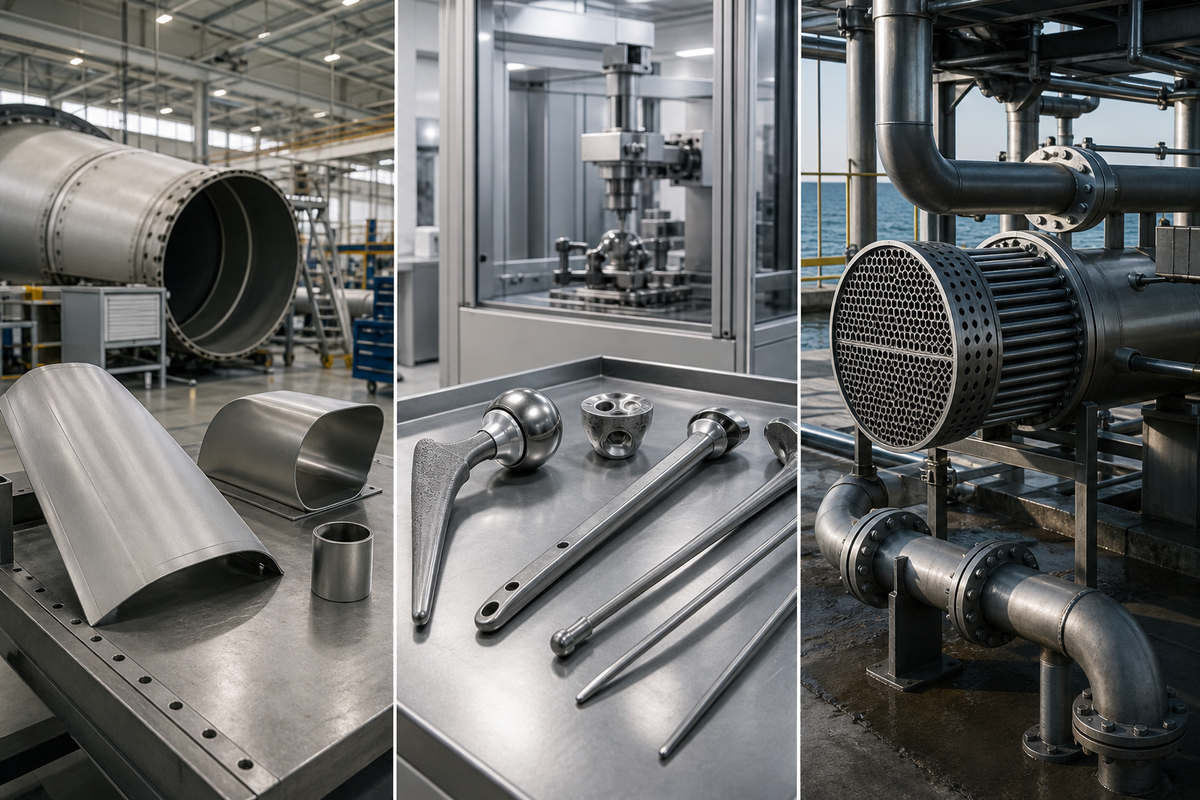
Grade 2’s balance of moderate strength, corrosion resistance, and weldability puts it to work across a wide span of industries rather than one narrow niche:
- ✔ Aerospace: non-structural and semi-structural airframe components, ducting, and fasteners where full Grade 5 strength isn’t required
- ✔ Chemical processing: heat exchangers, pressure vessels, and piping exposed to chlorides, acids, and seawater cooling
- ✔ Marine hardware: fasteners, fittings, and structural components in continuous seawater contact
- ✔ Medical devices: surgical implants and instrument components under ASTM F67, where peer-reviewed biocompatibility research is non-negotiable
- ✔ Consumer products: watch cases and jewelry, where its hypoallergenic, corrosion-resistant surface is a selling point in itself
As a general-purpose titanium material, Grade 2 covers chemical-plant piping systems and tubing or piping systems in marine cooling loops just as readily as it covers the aerospace and medical uses listed above, which is exactly why titanium alloys are used so broadly across process industries, and why Grade 2 in particular has earned its reputation as the widely used titanium alloy for corrosive wetted service.
A common real-world trigger for switching to Grade 2 is a corroded 316 stainless part reaching end of life early, a chemical plant replacing a pitted stainless heat-exchanger shell, or a marine operator swapping fasteners that have started to rust-stain after a few seasons in saltwater. If your application falls into one of the five categories above, Grade 2 should be your starting assumption rather than something that needs justifying from scratch. If it falls outside all five, pure structural load-bearing with no corrosion exposure, for example, that mismatch is itself a signal to look at a different grade, or a different material family altogether, rather than defaulting to titanium out of habit.
Available Forms: Sheet, Plate, Tube, and Pipe
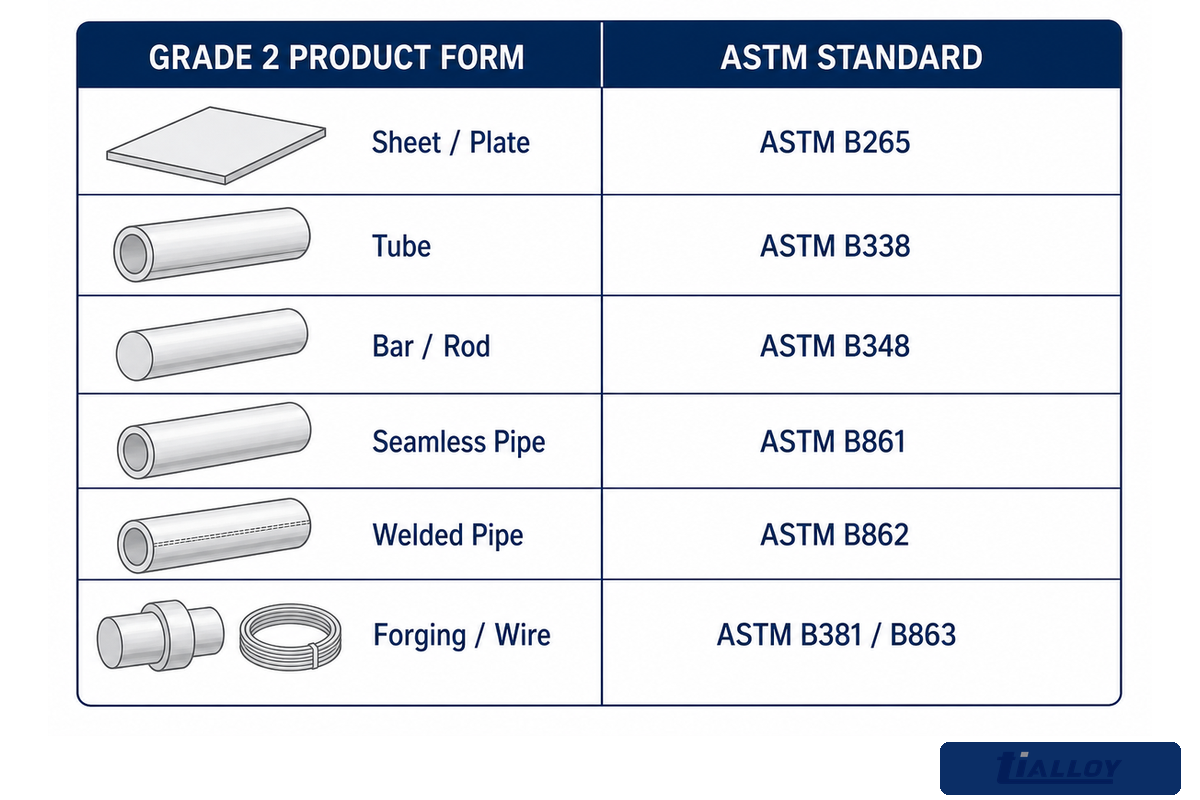
Grade 2 is stocked across nearly every mill product form, but each form is governed by its own ASTM standard, quoting the wrong one on a purchase order is a common paperwork error that can delay receiving inspection. TiAlloy maintains the following standard-to-product-form routing internally. Whether you need titanium sheet for a fabrication job or a different grade of titanium entirely for a niche application, always cross-check the product-form-to-standard mapping below before issuing a purchase order, Grade 2 remains the most requested titanium alloy in all product forms TiAlloy stocks, from sheet through pipe.
| Product Form | Governing ASTM Standard |
|---|---|
| Sheet / Plate / Strip | ASTM B265 |
| Tube | ASTM B338 |
| Bar / Rod | ASTM B348 |
| Unwelded Pipe | ASTM B861 |
| Welded Pipe | ASTM B862 |
| Forgings / Wire | ASTM B381 / B863 |
The sheet, plate, and strip row in that table is governed by ASTM B265, which the ASTM B10 titanium subcommittee revised in 2025, so buyers working from an older printed copy of the standard should confirm they are quoting the current edition before placing an order.
For exact size availability, mill certification options, and current lead times against this routing matrix, see TiAlloy’s Grade 2 titanium plate, tube, and pipe specifications page, which lists stocked sizes for each ASTM standard above.
Welding, Machining, and Surface Finishing
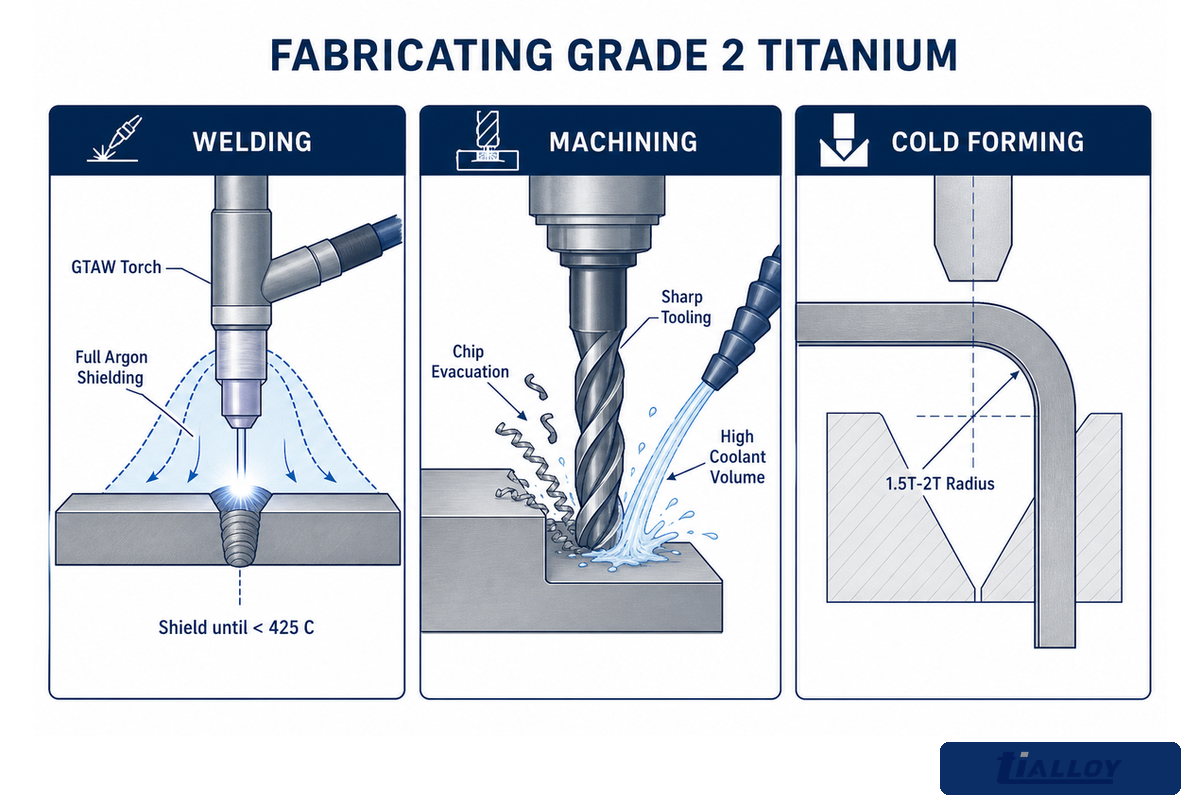
Grade 2 is widely regarded as the easiest titanium grade to fabricate, but “easy for titanium” still means titanium-specific practices, not stainless-steel habits carried over unchanged.
Welding: The welding of grade 2 titanium can be performed using either GTAW or GMAW, provided the weld pool, heat-affected zone, and backside of the joint stay fully shielded with inert gas (typically argon) until the metal cools below roughly 425°C, titanium is highly reactive with atmospheric oxygen and nitrogen while molten, and inadequate trailing-gas shielding is the single most common cause of weld embrittlement. Shops welding titanium structures to a formal spec typically work from AWS D1.9/D1.9M, the Structural Welding Code for Titanium, which sets design and welding requirements for titanium structures outside pressure vessels and fluid-carrying pipelines. Because Grade 2 isn’t a heat-treatable grade, its good weldability is closely tied to skipping a post-weld heat treatment cycle, fabricators don’t need to plan one the way they would with hardenable steel alloys, which simplifies scheduling.
Machining: A frequent and costly assumption is that conventional flood coolant alone will keep cutting temperatures under control the way it does on steel, it won’t, and treating titanium machining like steel machining is a documented cause of tool failure. Titanium’s low thermal conductivity relative to steel concentrates heat at the cutting edge, so sharp tooling, positive rake angles, lower cutting speeds, and adequate coolant volume (not just flow) all matter more than they do in general steel work.
💡 Pro Tip
Cold-forming Grade 2 titanium? The common sheet-metal rule of thumb, a 0.5T to 1T minimum bend radius, does not reliably apply across titanium grades. A 1.5T to 2T minimum bend radius is often needed for Grade 2 to avoid orange-peel surface texture or outright cracking, contradicting the generic rule most shops default to.
Finishing: Grade 2 can be anodized for color and additional surface protection, though anodizing is primarily cosmetic on titanium, the base corrosion resistance comes from the natural oxide layer discussed above, not from the anodized finish itself.
How to Choose the Right Titanium Grade: A Buyer’s Decision Framework
The 4-Path Grade Selector, a decision framework that routes your titanium grade choice by whichever single factor matters most for your project (strength, corrosion resistance, budget, or fabrication method), cuts through the ASTM grade lineup faster than reading every datasheet side by side. Whichever path you land on, confirm the final pick against the governing ASTM standard for that product form before issuing a purchase order, not just the grade number alone.
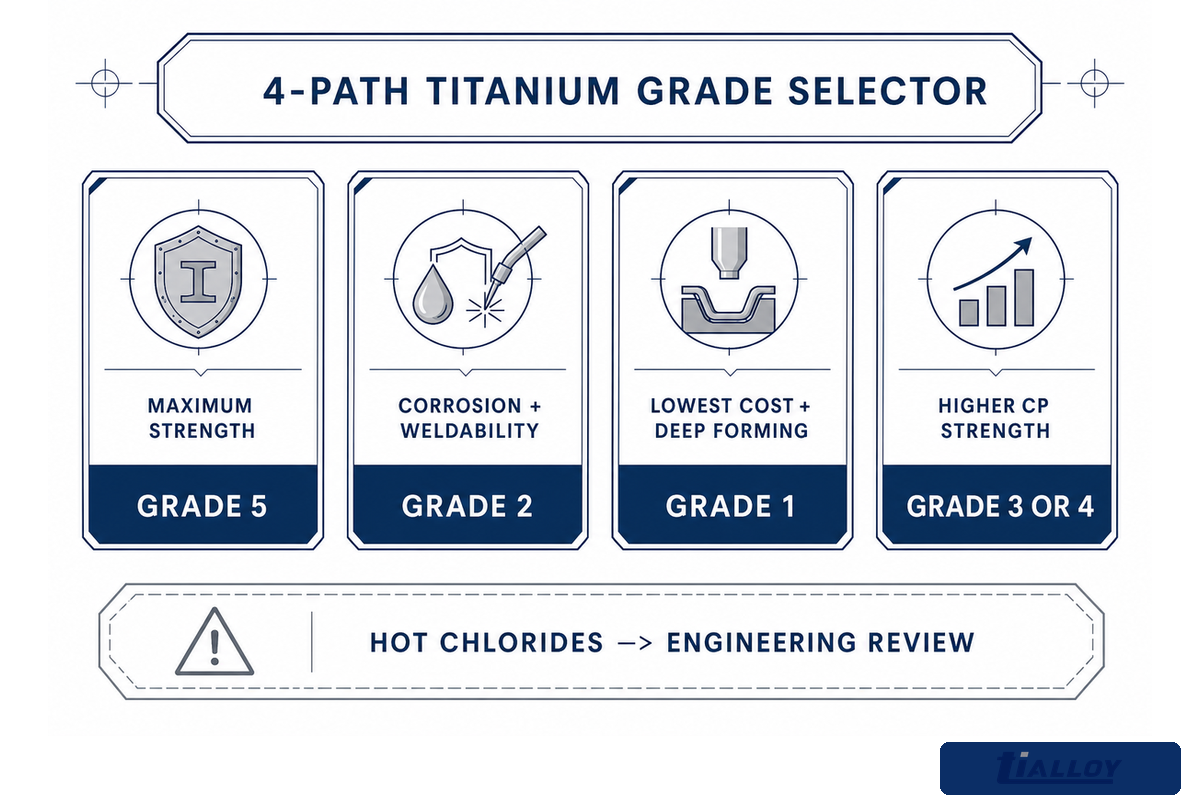
| Priority | Recommended Grade | Why | Limitations |
|---|---|---|---|
| Maximum strength, weight-critical | Grade 5 | ~2.6x Grade 2’s tensile strength | Harder to weld/form; several times Grade 2’s cost |
| Corrosion resistance + full weldability | Grade 2 | Self-healing oxide layer, easiest CP grade to weld | Not suited to high-stress structural loads |
| Lowest cost, thin-gauge forming | Grade 1 | Softest, most formable CP grade | Lowest strength; dents/marks easily |
| Strength above Grade 2, still CP-weldable | Grade 3 | 380 MPa yield without alloying | Less common stock; longer lead times |
| Maximum CP strength before alloying | Grade 4 | 483 MPa yield, still unalloyed | Reduced ductility versus Grade 1/2 |
| Surgical implant / medical device | Grade 2 (ASTM F67) | Proven biocompatibility, passive oxide layer | Confirm implant-grade certification — not all Grade 2 mill stock qualifies |
| Deep-draw / complex cold forming | Grade 1 or Grade 2 | Ductility to survive aggressive forming | Grade 5 will crack under equivalent forming |
| Heavy on-site structural welding | Grade 2 | Predictable, repeatable weld behavior | Still requires full inert-gas shielding — not “weld like steel” |
| High-temperature, high-chloride process fluid | Escalate beyond CP grades / add process controls | CP titanium’s crevice-corrosion resistance narrows in this envelope | Requires case-by-case engineering review — see corrosion section above |
| Cheapest price-per-pound, no engineering review | Not recommended as a decision basis | Ignores total fabrication and service-life cost | A leading cause of costly mid-project grade changes |
⚠️ When Grade 2 Titanium Is Not the Right Choice
Grade 2 is the wrong call in a few specific, recurring situations. If your design margin genuinely requires strength above roughly 345 MPa ultimate tensile, common in weight-critical airframe structure, Grade 2 will fall short and Grade 5 (or another alloyed grade) is the honest answer, even though it costs more and welds less forgivingly. A less obvious mistake is finding Grade 2’s 275 MPa yield “too low” and jumping straight to Grade 5 without first checking whether Grade 3 or Grade 4 close the gap, an incorrect shortcut that adds alloy cost and fabrication difficulty the project may not actually need. And for process equipment running hot, chloride-rich fluids continuously, Grade 2’s crevice-corrosion resistance narrows outside its comfort zone, so that application deserves a dedicated corrosion engineering review rather than a default grade pick.
When weighing alloys like Grade 5 against Grade 2, remember that ductility is Grade 2’s core advantage. It avoids the alpha-beta phase mixture that stiffens Grade 5, and in every scenario above where Grade 2 offers excellent all-around performance, that ductility is doing the real work behind the recommendation. Striking that balance of strength, corrosion resistance, and fabricability is the entire point of the 4-Path Grade Selector above.
RFQ checklist — copy these into your quote request:
| Parameter | Recommended range | Why it matters | How to verify |
|---|---|---|---|
| Governing ASTM standard | B265 / B338 / B348 / B861 / B862 by form | Wrong standard on the PO delays receiving inspection | Mill certification (MTR) cross-check |
| Minimum yield strength | ≥275 MPa (40 ksi) | Confirms Grade 2 versus an off-spec substitute | Tensile test report on MTR |
| Minimum elongation | ≥20% | Predicts forming/bending behavior | Tensile test report on MTR |
| Product form certification | Mill test report (MTR) traceable to heat lot | Required for aerospace/medical acceptance | Request MTR copy before order confirmation |
| Implant-grade certification (if medical) | ASTM F67 compliance statement | Not all Grade 2 mill stock is implant-certified | Written compliance statement from supplier |
| Weld procedure compatibility | GTAW/GMAW, argon-shielded, matched filler | Mismatched filler or shielding causes embrittlement | Confirm WPS with fabricator before cutting |
Industry Outlook: What’s Driving Demand for Grade 2
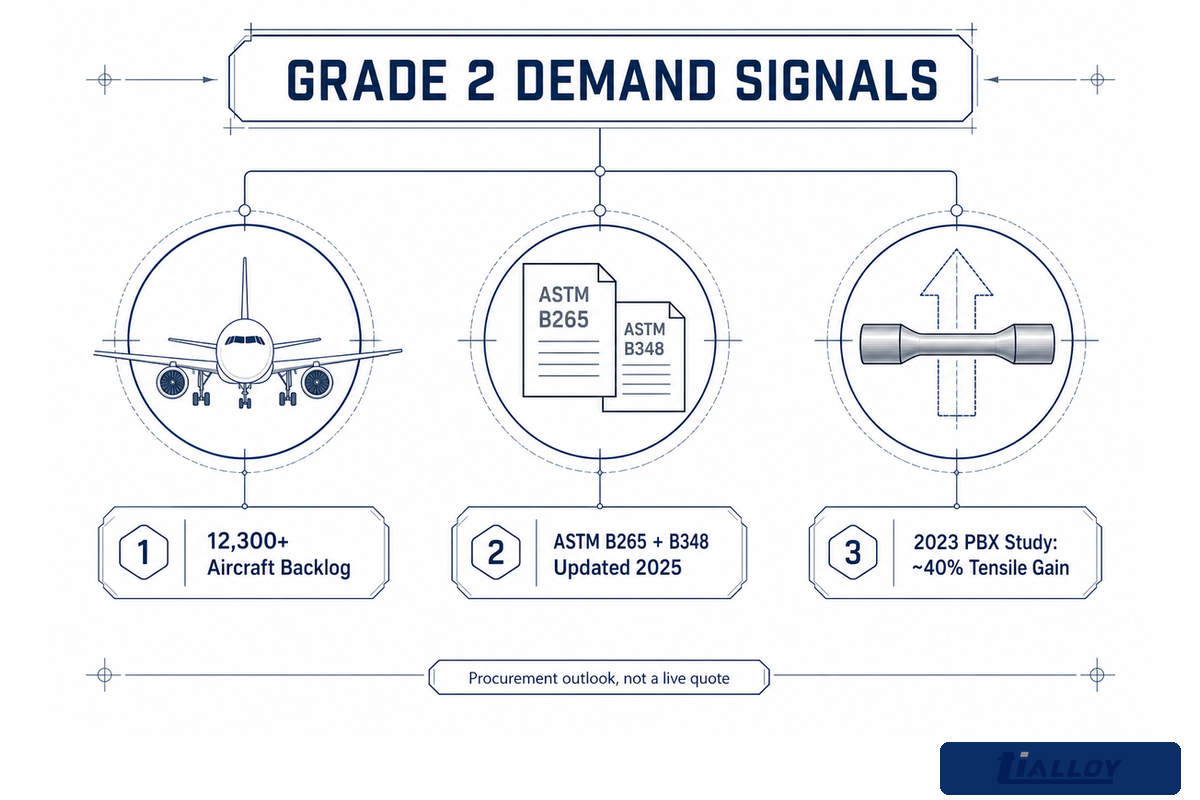
The clearest driver behind current demand is not a vague “materials megatrend” — it is a concrete order backlog. Commercial aircraft manufacturers are sitting on a combined backlog exceeding 12,300 units between the Boeing 737 program (4,888 outstanding commitments) and the Airbus A320neo family (7,461 outstanding orders), per monthly OEM order and delivery reporting as of mid-2026, and that backlog is pulling mill-product titanium procurement forward across the supply chain well ahead of final assembly. Standards are moving in parallel: ASTM revised both B265 and B348 in the same year, 2025, tracked through work items WK90877 and WK94841 at the ASTM B10 titanium subcommittee. That kind of simultaneous double revision across the two most-cited Grade 2 specifications, rather than a static, decades-old document, signals more active industry attention than a single routine update would.
On the processing side, one development worth watching is explosive hardening (PBX): a 2023 peer-reviewed study found the technique can raise Grade 2’s tensile strength by roughly 40% over standard mill-annealed stock. It is still not a mainstream mill-order option, but it is a signal that CP titanium’s usable strength ceiling is not fixed at the annealed ASTM minimums covered earlier in this guide, and it is worth asking a fabricator about if your project is close to needing Grade 3 or 4 purely for strength.
As supporting market color rather than the headline: the aerospace titanium market is projected to grow from roughly $3.22 billion in 2025 to $3.46 billion in 2026, a 7.5% compound annual growth rate. That figure is useful context for budgeting purchasing lead time, but the order-backlog and standards-revision signals above are the more actionable indicators of near-term supply tightness for buyers planning Grade 2 procurement in the next 12–18 months.
Pricing and Cost Considerations
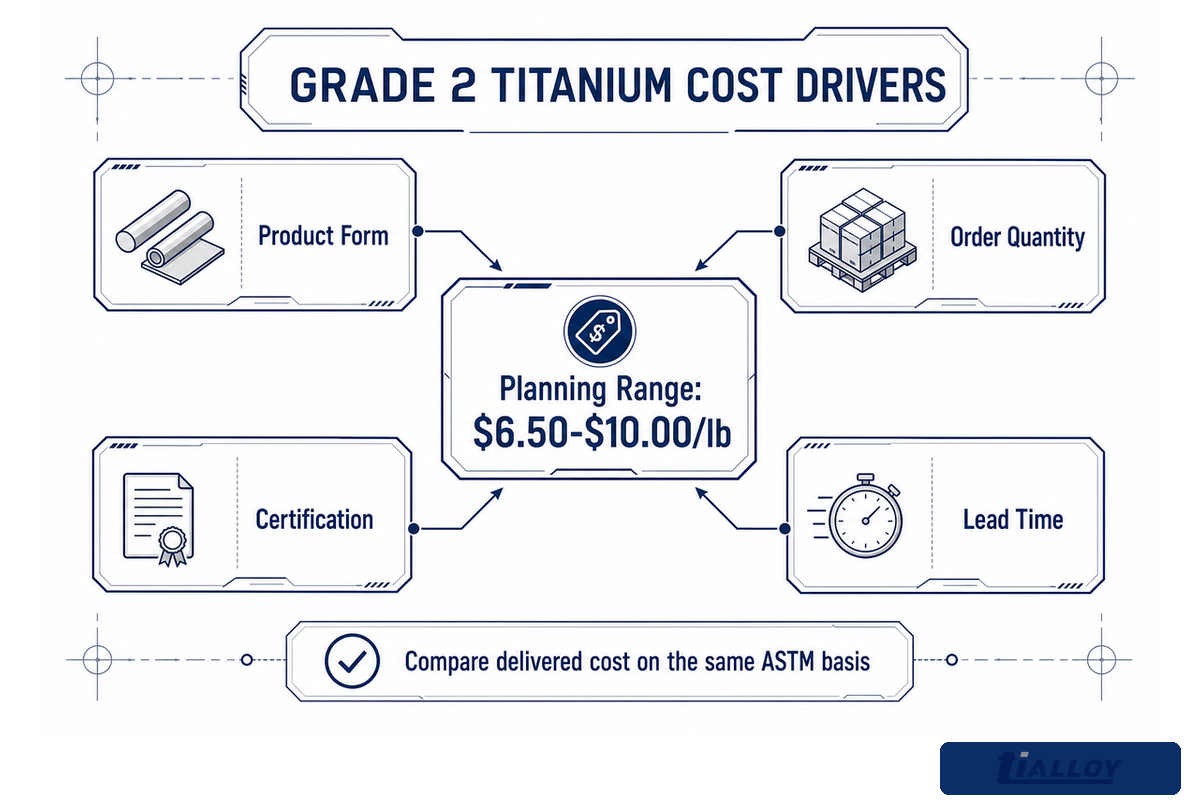
Grade 2 mill products aren’t sold off a fixed public price list, actual quotes move with form, size, order quantity, and certification requirements. As a planning framework rather than a real-time quote, current market pricing runs roughly $6.50 to $10.00 per pound for standard mill product, with some sources citing a wider $6–$15 range once size and certification tier are factored in.
How Much Is Grade 2 Titanium Per Pound?
Budget roughly $6.50 to $10.00 per pound for standard Grade 2 mill product as a starting planning range, though the final number depends heavily on form (sheet versus bar versus tube), order size, and whether you need aerospace- or implant-grade certification paperwork.
Small quantities and non-standard sizes typically price toward the top of that range or above it, while larger, standard-size orders have more room to negotiate. Rather than shopping on price per pound alone, compare total delivered cost, including certification, cut-to-size charges, and lead time, across suppliers quoting against the same ASTM standard and mechanical property minimums.
For a firm, form-specific quote against the ASTM standards and mechanical properties covered in this guide, request a Grade 2 titanium quote directly from TiAlloy.
Frequently Asked Questions
Q: Is grade 2 titanium pure titanium?
Grade 2 is commercially pure (CP) titanium, unalloyed, with no deliberately added aluminum or vanadium; only small, tightly controlled traces of oxygen, iron, carbon, nitrogen, and hydrogen occur naturally and are capped by ASTM B265 to balance strength and ductility.
Small, tightly controlled traces of oxygen, iron, carbon, nitrogen, and hydrogen occur naturally and are capped by ASTM B265 to control strength and ductility, but there is no intentional alloying, that’s what separates Grade 2 (UNS R50400) from alloyed grades like Grade 5 (Ti-6Al-4V). Because those interstitial limits vary slightly by product form, always check the composition table in the specific ASTM standard covering your sheet, bar, or tube order rather than assuming one generic percentage applies across the board.
Q: What gives Titanium Grade 2 its excellent corrosion resistance?
A thin, self-healing titanium dioxide (TiO2) passive oxide layer forms instantly on contact with oxygen or moisture and re-forms immediately if scratched, letting Grade 2 resist seawater, chlorinated water, and many industrial acids without coatings.
This layer re-forms immediately if scratched, which is why Grade 2 resists corrosion in seawater, chlorinated water, and many industrial acids without coatings, though the same layer can be compromised in specific high-temperature, high-chloride crevice conditions. The same self-healing chemistry is also why unalloyed titanium is specified for surgical implants under ASTM F67: a protective oxide film that reforms in the body is just as valuable as one that reforms in seawater.
Q: Is Titanium Grade 2 easy to fabricate and weld?
Yes: Grade 2 is generally the easiest titanium grade to machine and weld, close to austenitic stainless steel in difficulty, though it still needs titanium-specific inert-gas shielding and heat management rather than standard steel shop practices.
It welds well with GTAW or GMAW under inert gas shielding, but it still requires titanium-specific heat management and shielding practices, treating it exactly like stainless steel in the shop is a common and costly mistake. Machining calls for the same care: sharp tooling, lower cutting speeds, and real coolant volume matter more than they do on steel, since titanium’s low thermal conductivity concentrates heat right at the cutting edge instead of carrying it away.
Q: What temperature range can Titanium Grade 2 safely handle?
Grade 2 performs reliably from cryogenic conditions through moderately high service temperatures, but the exact rated limit depends on the applicable code, not a single number.
Continuous-service temperature ratings vary by ASTM product form and by the governing design code (ASME/ASTM) for pressure vessels or piping, so always verify against the specific code for your product form rather than a generic figure. In practice, stress corrosion cracking in hot, chloride-rich environments, not general oxidation or mechanical softening, is typically the limiting factor for Grade 2 at high operating temperature, which is why the corrosion boundaries covered earlier in this guide matter as much as a raw temperature number when planning hot service.
Q: Is grade 2 titanium good for watches?
Yes: it’s a common watch-case material because it’s hypoallergenic, lightweight, and corrosion-resistant to sweat and moisture; the trade-off is that Grade 2 shows more scuffing over time than harder Grade 5 in daily wear.
It will show more scuffing over time than Grade 5 in daily wear, since Grade 2 is the softer of the two grades, but for comfort and skin compatibility it’s a strong choice.
Q: Is grade 2 titanium expensive?
Grade 2 mill product typically runs about $6.50 to $10.00 per pound, more than stainless steel but usually less than Grade 5; exact pricing depends on form, size, and order quantity rather than a single fixed rate.
Exact numbers depend on form, size, and order quantity. For budget-sensitive projects, compare total cost of ownership, reduced weight, lower maintenance, and longer service life in corrosive environments, rather than judging purely on the per-pound sticker price.
✔ Advantages
- Excellent, self-healing corrosion resistance
- Weldability close to austenitic stainless steel
- Biocompatible, approved for surgical implant use under ASTM F67
- Better thermal conductivity than Grade 5 or 316/304 stainless
⚠ Limitations
- Strength ceiling well below alloyed grades like Grade 5
- Crevice-corrosion resistance narrows in hot, high-chloride service
- Costs materially more per pound than common stainless steel
- Bend radius rules of thumb from steel don’t transfer directly
Request a Grade 2 Titanium Quote →
References & Sources
- ASTM B348 Standard Specification for Titanium and Titanium Alloy Bars, Billets, and Wire for Welding ASTM International
- ASTM F67 Standard Specification for Unalloyed Titanium for Surgical Implant Applications ASTM International
- ASTM B265 Revision Work Item WK90877 (Titanium and Titanium Alloy Strip, Sheet, and Plate) ASTM International
- Airbus and Boeing Report June 2026 Commercial Aircraft Orders and Deliveries Forecast International
- Corrosion Behavior of Titanium in Simulated Body Solutions With the Addition of Biomolecules National Institutes of Health (PMC)
- Biocompatibility of Titanium From the Viewpoint of Its Surface National Institutes of Health (PMC)
- PMC9959428, Titanium Mechanical Property Reference National Institutes of Health (PMC)
- PMC9866531, Explosive Hardening Effects on Titanium Tensile Strength National Institutes of Health (PMC)
- Acceptable Alternatives to Titanium Tubing POWER Magazine
About This Analysis
This guide draws on ASTM B265/B348 specification data, peer-reviewed corrosion and biocompatibility research, and TiAlloy’s own product-form-to-standard routing matrix for Grade 2 titanium plate, tube, bar, and pipe. Where pricing or market-growth figures come from third-party industry reporting rather than lab-verified testing, we say so directly rather than presenting estimates as certainties. Reviewed by the TiAlloy technical team.