Get in Touch with TiAlloy Company


Quick Specs
| UNS Designation | N07718 |
| Class | Precipitation-hardenable Ni-Cr-Fe superalloy |
| 0.2% Yield Strength (aged) | ~150 ksi (1,034 MPa) |
| Ultimate Tensile Strength (aged) | up to 185 ksi (1,276 MPa) |
| Density | 8.19-8.22 g/cm³ |
| Hardness | 24-26 HRC annealed → 36-40 HRC fully aged |
| Continuous Service Temp. | up to ~1,300°F (704°C) |
Inconel 718 is a precipitation-hardenable nickel-chromium-iron superalloy that reaches roughly 150 ksi yield strength in the aged condition through a controlled heat-treatment cycle, not through composition alone. The same aging chemistry that produces that strength also governs how the alloy machines, welds, and prints, which is why buyers who treat “Inconel 718” as one interchangeable material tend to over-spec, under-spec, or hit avoidable fabrication problems.
Key Takeaways
- The alloy name and the UNS number don’t tell a buyer what condition, product form, or spec they’re getting — that has to be specified separately.
- Strength comes from an aging step (gamma-double-prime precipitation), so “solution treated” and “solution treated and aged” material aren’t interchangeable.
- Machining and welding difficulty are real, quantifiable, and manageable with the right parameters — not just “hard to work with.”
- Additive manufacturing of Inconel 718 has its own ASTM specification (F3055-14a) — it is not the same qualification path as wrought material.
- The alloy is genuinely overkill for some applications where a cheaper alloy would meet the actual service requirement.
Inconel 718 (Alloy 718, UNS N07718) shows up on more bills of material than almost any other nickel superalloy, and the reasons for that are specific rather than generic. This guide covers Inconel 718 properties and the metallurgy behind the strength, what buyers actually get wrong when specifying it, Inconel 718 welding behavior and why machinists treat it differently from stainless steel, how Inconel 718 density compares in an Inconel 718 vs 625 matchup, where additive manufacturing changes the picture, and where a cheaper alloy is the better call. For full stock sizes, current standards documentation, and an RFQ path, TiAlloy’s Inconel 718 product and specification page covers that ground in detail — this article is the buyer-education layer underneath it.
What “Inconel 718” Actually Means

Inconel 718 is the trade name for UNS N07718, but the UNS number alone does not establish compliance with any ASTM, SAE AMS, or customer specification. ASTM E527, the practice that defines the UNS system, dates to 1983 and exists purely for cross-referencing — it sets no requirements for product form, heat-treatment condition, or quality.
A supplier quoting “Inconel 718” round bar and a supplier quoting “AMS 5663 solution-treated-and-aged Inconel 718 round bar” may be quoting two materials with meaningfully different mechanical properties, even though both are honestly describing UNS N07718.
“Inconel” itself is a registered trademark (Special Metals Corporation) — often written as Inconel® 718 in supplier literature — and INCONEL 718 was developed in the 1960s during work on Inconel 625, originally aimed at steam-line piping before its strength-to-temperature profile made it the aerospace and energy workhorse it’s today. The metric or dimensional equivalent is Werkstoff 2.4668. None of the naming variants — Inconel 718, Inconel Alloy 718, Alloy 718, IN718, 2.4668, N07718 — change what has to happen next: a buyer still has to name a product-form specification and a heat-treat condition before a mill can actually process the order.
Key Factors to Consider Before You Write “Inconel 718” on a PO
- Product form (bar, plate/sheet, tube/pipe, forging) — each has its own governing spec.
- Condition (annealed vs. solution-treated-and-aged) — this changes mechanical properties, not just hardness.
- Certification level (mill test certificate vs. EN 10204 3.1) — required for traceable/aerospace work.
The Metallurgy Behind the Strength: How Precipitation Hardening Actually Works

Inconel 718 gets the majority of its age-hardened strength (a process also called age hardening) from gamma-double-prime (γ″) precipitates — coherent, disc-shaped particles of Ni3Nb that form inside the alloy’s face-centered-cubic matrix during a controlled aging heat treatment, not from the base composition alone. That distinction matters for buyers: two bars of identically-certified UNS N07718 chemistry can have dramatically different strength depending on whether they were only solution-annealed or fully double-aged.
Here’s what actually happens during the standard heat treating (heat-treat) cycle. The mill first solution-anneals the material around 1,750-1,800°F — an annealing step that dissolves existing precipitates into a supersaturated solid solution and leaves the alloy soft (roughly 24-26 HRC) and ductile. It then ages in two stages: 1,325°F (718°C) for about 8 hours, furnace-cooled at roughly 100°F per hour down to 1,150°F (621°C), then held another 8 hours before air cooling — total aging time across both stages runs about 16 hours, not counting the initial solution anneal. The first stage nucleates fine, coherent γ″ particles roughly 20-30 nanometers across; the second stage grows them to the size that interacts most effectively with dislocation motion. Skip the second aging stage and hardness lands around 30-32 HRC instead of the full 36-40 HRC — both stages are doing real, independent work, not just adding redundant heat.
The Precipitation Penalty: every property that make Inconel 718 valuable — the strength, the specific temperature ceiling, the way it work-hardens under a cutting tool — traces back to this same aging chemistry. That’s also why the alloy cost more to process than a simple solid-solution alloy like Inconel 625: the aging cycle is a mandatory extra manufacturing step, not an optional upgrade, and it shows up again later in this guide when we get to machining, welding, and additive manufacturing. It is also exactly why Inconel 718 behaves like a genuine superalloy rather than a simple corrosion-resistant steel — the strength is engineered in through processing, not just alloyed in through composition.
⚠️ Two Phases That Work Against You
Over-age the alloy above roughly 1,400°F (760°C) and γ″ transforms into incoherent delta (δ) phase (also Ni3Nb, but orthorhombic and non-strengthening) — a loss of γ″ that is also linked to increased susceptibility to hot cracking. A related but distinct problem, Laves phase, can form above ~1,000°C in weld fusion zones; because it is richer in niobium than the strengthening phases, its formation depletes the matrix of the niobium that would otherwise become γ″, and Laves itself is brittle enough to act as a crack-nucleation site. Both come back in the welding section below.
Composition, Mechanical and Physical Properties in Detail

Inconel 718’s composition is tightly banded because small shifts in niobium, titanium, or aluminum content directly change how much γ″ and γ′ can form, and therefore the final mechanical properties after aging. Full composition ranges, tolerances, and specification cross-references are maintained on TiAlloy’s Inconel 718 specification page for order purposes; the numbers below are for engineering context, not a substitute for the governing spec sheet.
| Element | Typical Range | Primary Role |
|---|---|---|
| Nickel | 50-55% | FCC matrix base |
| Chromium | 17-21% | Cr₂O₃ oxide layer — oxidation/corrosion resistance |
| Niobium (+Ta) | 4.75-5.50% | γ″ precipitate former — the primary strengthener |
| Molybdenum | 2.80-3.30% | Solid-solution strengthening, raises creep resistance |
| Titanium / Aluminum | 0.65-1.15% / 0.20-0.80% | γ′ precipitate formers, balance strengthening response |
Understanding the composition of Inconel 718 in isolation is not enough — the chemical composition of Inconel 718 only becomes meaningful once paired with the heat-treat condition, which is why the mechanical property ranges below always specify condition explicitly rather than quoting the composition of Inconel 718 alone. That chromium content is also what gives the alloy meaningful resistance to oxidation and corrosion (a redox-driven degradation mechanism) in service, separate from the aging-driven mechanical strength this guide otherwise focuses on. Like most nickel-based superalloys, Inconel 718 also has meaningfully lower thermal conductivity than carbon or stainless steel, which is part of why heat generated during machining concentrates at the cutting edge instead of dissipating into the workpiece — a factor covered later in this guide’s machining section.
On mechanical properties: solution-treated material and fully aged material don’t share the same numbers, so a spec sheet that just says “Inconel 718 mechanical properties” without stating the condition is incomplete. In the fully aged condition, yield strength runs around 150 ksi (1,034 MPa) and ultimate tensile strength up to 185 ksi (1,276 MPa); density is 8.19-8.22 g/cm³ depending on condition, cross-confirmed independently across two supplier data sheets. By comparison, Hastelloy C-276 is roughly 8.5% denser (8.89 g/cm³) due to its higher molybdenum content, so two turbine discs machined to identical geometry and spun at an identical RPM would put meaningfully more centrifugal stress on the C-276 part than the 718 part. The alloy also retains usable toughness down to cryogenic temperatures near -423°F, a property that matters for cryogenics and liquid-hydrogen fuel-system hardware as well as hot-section turbine parts — the same microstructure that resists creep at 1,300°F doesn’t become brittle at the opposite end of the temperature range. That same aging chemistry that delivers strength at elevated temperatures also holds up at the opposite extreme — meaningful resistance at temperatures well below freezing is part of why the alloy shows up in cryogenic and low temperature liquid-hydrogen hardware, not just hot-section parts.
Getting the Spec Right: AMS 5662 vs. AMS 5663 (and the Mistake Buyers Actually Make)

AMS 5662 and AMS 5663 are the two SAE specifications that most often get confused on a purchase order for Inconel 718 bar, forging, and ring stock, and the difference is condition, not chemistry. AMS 5662 covers the alloy generally for corrosion- and heat-resistant bar, forgings, and rings; AMS 5663 specifically calls out the higher-strength, solution-treated-and-aged condition. Writing “AMS 5662” on a PO when the application actually needs the guaranteed aged-condition mechanical properties of AMS 5663 is a real, recurring buyer error — the material can be technically compliant with what was ordered and still fail the application’s strength requirement. ASTM B637 is the parallel ASTM-side specification covering the same bar/forging product forms.
Is UNS N07718 the Same as Inconel 718?
Yes — UNS N07718 is the Unified Numbering System identifier for the alloy marketed as Inconel 718 or Alloy 718; the numbering system was established under ASTM E527 in 1983 purely to give the alloy one consistent cross-reference code across specifications and suppliers.
Where buyers get tripped up is assuming the UNS number alone tells them everything they need: it does not specify product form, heat-treat condition, or which AMS/ASTM spec applies, so “N07718” on a certificate still has to be paired with the actual governing specification and condition before it means anything for procurement.
The AMS Mixup Checklist — copy these into your quote request:
| Parameter | Recommended Range | Why It Matters | How to Verify |
|---|---|---|---|
| Governing spec | AMS 5662 / AMS 5663 / ASTM B637 (bar-forging); AMS 5596/5597 (sheet-plate); AMS 5589/5590 (tube-pipe) | Each product form has a different governing document — naming the wrong one voids the intended comparison | Confirm spec number appears on the mill test certificate |
| Condition | Solution-annealed OR solution-treated-and-aged (STA) | Changes YS from ~105-150 ksi depending on form/condition | Hardness test result on the cert should read 24-26 HRC (annealed) or 36-40 HRC (aged) |
| Heat number traceability | Required for aerospace/critical service | Links the physical part back to its melt chemistry and heat-treat lot | Heat number stamped or tagged on material, cross-referenced on MTC |
| Certification level | Mill Test Certificate (MTC) or EN 10204 3.1 | 3.1 certs carry independent inspector sign-off, required for many aerospace/pressure applications | Confirm 3.1 wording explicitly on the certificate, not just “MTC” |
| Product-form dimensional spec | Diameter/thickness tolerance per governing ASTM/AMS spec | Machining allowance planning depends on certified tolerance band, not nominal size | Cross-check certified dimensions against drawing tolerance stack-up |
Inconel 718 vs. 625, X-750, 725 — and When Titanium Wins Instead

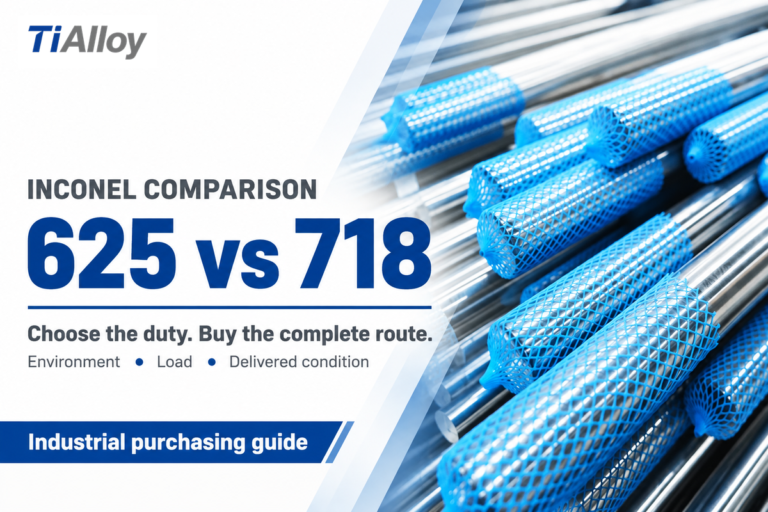
Inconel 718 and Inconel 625 solve different problems even though both are marketed under the same trade name: 718 is precipitation-hardenable and built for maximum mechanical strength, while 625 is solid-solution-strengthened and built for maximum corrosion resistance and weldability, with no meaningful aging response of its own. Getting the AMS spec number right on the PO, as the checklist above covers, only matters once you have confirmed 718 is the right alloy for the job in the first place. That’s a real, sourced correction to how these two alloys often get talked about interchangeably just because they share a brand name — picking between them by strength alone or by corrosion resistance alone both miss the point of why each exists.
“Inconel 718 is a precipitation-hardened nickel-based superalloy designed for extreme environments requiring high strength, thermal stability, and corrosion resistance… though it remains difficult to machine because of rapid work hardening and high cutting forces.”
Dr. Mahder Tewolde, materials science reviewer credited on Xometry’s Inconel 718 technical resource
For a quick Inconel 625 vs 718 gut-check: reach for Alloy 625 first when corrosion dominates the failure risk, and reach for 718 first when temperature-rated mechanical strength does. Inconel X-750 is also age-hardenable, but through a different precipitate balance — it retains useful strength better than 718 in the 1,300-1,500°F band, while 718 dominates for maximum strength at ambient-to-moderate elevated temperatures. Alloy 725 adds corrosion resistance closer to 625’s territory while keeping some age-hardening response, making it a middle-ground option when both strength and aggressive-environment corrosion resistance matter. None of these are drop-in substitutes for one another, and none are drop-in substitutes for 718.
What’s the Difference Between Inconel 625 and Inconel 718?
Inconel 625 is a solid-solution-strengthened alloy that gets its performance mainly from molybdenum and niobium in solution, has no significant precipitation-hardening response, and is chosen primarily for corrosion resistance and weldability; Inconel 718 is precipitation-hardened through gamma-double-prime formation during aging and is chosen primarily for mechanical strength.
In practice this means 625 is the better call for aggressive chemical or marine corrosion service where welded fabrication is unavoidable, and 718 is the better call where the part needs to carry real mechanical load at temperature — turbine discs, high-strength fasteners, shafts. Where a supplier promises broad oxidation and corrosion resistance without qualifying which alloy achieves it, that is usually a 625 conversation, not a 718 one — 718’s own resistance to corrosion and oxidation is real but secondary to its strength case.
| Selection Criterion | Inconel 718 | Inconel 625 | Inconel X-750 | 17-4PH / Ti-6Al-4V |
|---|---|---|---|---|
| Peak useful temperature | ~1,300°F continuous | Cryogenic to ~1,800°F, lower strength ceiling | 1,300-1,500°F, better than 718 in this band | 17-4PH: ~600°F / Ti-6Al-4V: ~600°F |
| Strengthening mechanism | γ″ precipitation (age-hardened) | Solid-solution (no significant aging) | γ′ precipitation (age-hardened) | 17-4PH: precipitation / Ti-6Al-4V: alpha-beta |
| Weldability | Good but filler-metal-dependent (see next section) | Excellent, minimal cracking risk | More strain-age-cracking prone than 718 | Generally good for both |
| Machinability | Difficult, rapid work-hardening | Difficult, gummy | Difficult | Moderate (both easier than nickel superalloys) |
| AM-readiness | Standardized (ASTM F3055) | Widely printed, mature process data | Less common in AM | Ti-6Al-4V: very mature AM material |
| Corrosion service | Good, not the top pick for aggressive chemical service | Excellent — purpose-built for this | Good, moderate | Ti-6Al-4V: excellent in chlorides / 17-4PH: moderate |
| Relative cost tier | High | High | High | Lower (both) |
| Typical failure mode if misapplied | Delta/Laves-phase embrittlement if over-aged or badly welded | Underperforms 718 on pure mechanical strength | Strain-age weld cracking | Insufficient strength/temperature margin above ~600°F |
| Typical certification path | AMS 5662/5663, ASTM B637 | AMS 5666 family | AMS 5667 family | Ti-6Al-4V: AMS 4928/4967 family |
| Not suitable for | Sustained use above ~1,400°F (over-ages, loses strength) | Applications needing maximum mechanical strength | Budget-constrained welded assemblies | Any application above ~600°F service temperature |
For applications where weight matters more than absolute temperature ceiling — structural brackets, airframe components below the hot section — Ti-6Al-4V often wins outright: it delivers a strong strength-to-weight ratio at roughly half the density of any nickel superalloy, at the cost of a much lower usable temperature ceiling (~600°F vs. 718’s ~1,300°F). TiAlloy also stocks Inconel 625 for the corrosion-first side of this decision.
Why Machinists Dread It: The Work-Hardening and Tool-Wear Problem

Inconel 718 work-hardens rapidly during cutting, and practitioners consistently rate it among the hardest common alloys to machine — one veteran machinist with 30-plus years of experience on public record calls it “the worst material I’ve encountered,” citing roughly ten times the tooling consumption of typical materials.
Machining Inconel 718 successfully comes down to managing heat and work-hardening together, not just picking aggressive parameters. A materials-supplier data sheet separately quantifies cutting forces at 2-3 times what austenitic stainless steel demands. These are two different measurements — tooling-consumption rate versus instantaneous cutting force — and they shouldn’t be read as contradicting each other; they’re simply describing different symptoms of the same underlying work-hardening behavior, where hard carbide-particle inclusions abrade the cutting edge while the workpiece surface hardens ahead of the tool.
The field-tested combination that experienced shops report: low surface speed and steady feed for turning (“low SFM, reasonable feed, and pray,” in one machinist’s own words); roughly 40 SFM for milling, which trades cycle time for tool life; AlTiN-coated, positive-rake tooling; and coolant delivered directly to the cutting edge rather than flood-only. Some shops route Inconel 718 features to wire or sinker EDM entirely rather than fight conventional cutting on the hardest geometries — a legitimate process decision, not a workaround for bad machining practice.
💡 Pro Tip
If a quote for Inconel 718 machining comes back close to stainless-steel pricing, ask what tooling strategy the shop is actually planning — a quote that does not account for elevated tool consumption is either underpriced or is going to run into schedule problems on the shop floor.
Machining, welding, and additive manufacturing produce different-looking problems, but every one of them traces back to the same root behavior: this alloy’s response to heat and mechanical stress is more sensitive than a plain stainless steel’s. The table below clusters the failure modes covered across this guide by process type, so a buyer or process engineer can see the pattern rather than treating each one as an isolated surprise.
| Process Type | Failure Mode | Root Cause | How It’s Detected | How It’s Avoided |
|---|---|---|---|---|
| Machining | Rapid work-hardening | Carbide-particle abrasion plus FCC-matrix hardening ahead of the tool | Rising cutting force / accelerating tool wear rate | Low SFM, AlTiN coating, positive rake |
| Machining | Built-up edge / edge chipping | Elevated tool-chip interface temperature | Surface finish degradation, edge inspection | Direct coolant delivery to the cutting edge |
| Machining | Workpiece growth/movement | Residual stress relief during material removal | Dimensional drift mid-cut | Separate roughing/finishing passes, rigid fixturing |
| Welding | Delta-phase hot cracking | Slow cooling through the 700-1,000°C delta-formation window | Post-weld liquid-penetrant / radiographic inspection | Controlled heat input, appropriate post-weld heat treatment |
| Welding | Laves-phase embrittlement | Niobium segregation during rapid weld solidification | Metallographic cross-section of the fusion zone | Filler-metal selection (ERNiCrMo-4 vs. ERNiCr-3), lower heat input |
| Welding | Strain-age cracking in the HAZ | Rapid post-weld aging response in the heat-affected zone | Heat-affected-zone crack inspection | Pre-weld solution anneal, controlled PWHT ramp rate |
| Additive Manufacturing | Build-orientation-dependent fatigue life | Anisotropic microstructure from layer-by-layer solidification | Fatigue testing per build orientation | HIP plus post-build heat treatment per ASTM F3055 |
| Additive Manufacturing | Porosity / lack-of-fusion defects | Insufficient laser/beam energy density or powder-lot variance | CT scanning, HIP-response testing | Qualified process parameters, controlled powder lots |
| Additive Manufacturing | As-built vs. wrought property gap | Different thermal history than forging or rolling | Comparative mechanical testing against a wrought baseline | Do not assume interchangeability — qualify per application |
Welding Inconel 718 Without Cracking the Weld Zone

Weldability outcomes in Inconel 718 depend on filler-metal choice, not just on the base alloy’s general reputation for being “weldable” — a claim that competitor marketing pages frequently state without qualification. Peer-reviewed multi-pass welding research on 718 plates found that ERNiCrMo-4 filler produced better tensile properties in the finished weld, while ERNiCr-3 filler produced better impact toughness — the two properties trade off against each other by filler selection, not by welder skill alone. That tensile and impact strength trade-off is exactly why filler selection is a deliberate engineering choice: a filler chosen purely to maximize impact strength can leave tensile properties short of spec, and vice versa. Base-metal grain size, prior precipitate state, niobium segregation from the original casting, heat input, and pre-weld heat-treatment condition all influence cracking susceptibility as well — filler metal is one controllable variable among several, not the sole explanation for a good or bad weld.
The specific failure mode to design around is Laves-phase and delta-phase formation in the weld fusion zone and heat-affected zone. Because niobium partitions preferentially into these phases during rapid weld solidification, the weld metal can end up locally depleted of the niobium needed to form strengthening γ″ during any subsequent aging treatment — which is also why a weld that look sound as-deposited can still under-perform the base metal’s aged properties if post-weld heat treatment is skipped or mis-timed.
Inconel 718 in Additive Manufacturing: What LPBF Changes

Yes, Inconel 718 can be 3D printed, and it is standardized enough that ASTM has published an alloy-specific specification for it: ASTM F3055-14a(2021) covers additively manufactured UNS N07718 components made by full-melt powder bed fusion (electron beam or laser melting), specifying feedstock, thermal processing, chemistry, microstructure, mechanical properties, hot isostatic pressing, and certification requirements. That is a materially different qualification path than buying wrought bar to AMS 5662/5663 — a printed part passing F3055 is not automatically interchangeable with a forged part passing AMS 5663, even though both are legitimately “Inconel 718.”
The academic literature on AM Inconel 718 is substantial and still actively growing: a 2019 review paper alone synthesized findings from more than 170 publications on the mechanical response of additively manufactured 718 across different AM processes and post-process conditions, and multiple new peer-reviewed studies on LPBF, DED-LB, and wire-arc AM of this specific alloy have continued to publish through 2025. This is a genuinely active engineering problem, not a solved checkbox — build orientation, post-build heat treatment, and hot isostatic pressing all still measurably affect the fatigue life and creep behavior of printed 718 relative to wrought material, and a part specification that just says “AM Inconel 718, ASTM F3055” without also pinning down heat-treat condition and HIP status leaves real performance variation unaddressed. Because AM Inconel 718 and the wrought alloy have different as-built microstructures until proven otherwise, treating a printed part as a drop-in replacement for a wrought alloy component is one of the most common AM-adoption mistakes covered in this guide.
⚠️ Important: Don’t Assume AM 718 Behaves Like Wrought 718
Material-level standardization (ASTM F3055), manufacturing-process qualification, and specific-component airworthiness certification are three separate evidence layers. A printed part meeting F3055’s minimum requirements has cleared the material-level bar; it has not automatically inherited a specific aerospace program’s part-level certification, and vice versa. Treat these as three questions to ask separately, not one.
Is Inconel 718 Hard to Machine?
Yes, and the difficulty is well-documented rather than anecdotal: rapid work-hardening during cutting drives cutting forces reported at 2-3 times austenitic stainless steel, and field practitioners report tooling consumption on the order of multiples higher than typical materials, which is why low-SFM parameters, AlTiN-coated positive-rake tooling, and direct coolant delivery are the field-tested standard approach rather than optional refinements.
Where Inconel 718 Is Actually Used — and Where It’s Overkill

Inconel 718’s core application footprint is aerospace turbine engines — turbine discs, compressor airfoils, casings, and high-strength fasteners operating in the 1,000°F-plus hot section, where the alloy’s combination of yield strength, fatigue resistance, and creep resistance at that specific temperature band is genuinely difficult to substitute. Those applications are worth the machining and fabrication difficulty covered above precisely because nothing else delivers the same strength-at-temperature.
Outside aerospace, the alloy show up in power-generation steam and gas-turbine engine hardware, petrochemical fasteners and valve components, and select oil-and-gas downhole tooling where both strength and moderate corrosion resistance are required simultaneously. Within the aerospace industry specifically, jet engines and other turbine engine components account for the bulk of Inconel 718 tonnage; outside aerospace, the oil and gas industry is the next-largest consumer for downhole and valve-train hardware. Applications requiring high strength at temperature are where 718 earns its price premium; outside that specific combination of strength and resistance to heat and corrosion, a cheaper alloy usually wins.
✔ Where It Fits
- Turbine discs and hot-section aerospace hardware (1,000-1,300°F service)
- High-strength fasteners under sustained load at elevated temperature
- Applications needing both real mechanical strength and moderate corrosion resistance
- Parts where the AMS 5662/5663 or ASTM F3055 (AM) certification chain is already required by the program
⚠ Where It’s Overkill
- Sustained service above ~1,400°F — the alloy over-ages and loses its strengthening phase
- Primary corrosion-resistance applications — Inconel 625 usually outperforms it there for less fabrication difficulty
- Weight-critical structural parts below ~600°F service — titanium alloys deliver comparable strength at roughly half the density
- Budget-constrained welded assemblies where 718’s filler-metal-dependent weldability adds unnecessary process risk
Common Mistakes When Specifying Inconel 718
The most frequent buyer mistake is treating “Inconel 718” and the specific product-form specification as interchangeable — ordering by alloy name alone without pinning down AMS 5662 vs. 5663, condition, and certification level, then discovering the delivered material doesn’t meet the application’s actual strength requirement. A second common mistake is reflexively specifying 718 for any high-temperature, high-strength application without checking whether a lower-cost alloy — 17-4PH stainless for moderate temperatures, Inconel 625 where corrosion dominates, titanium where weight dominates — would actually satisfy the real service condition. Not every “needs to be strong and hot” application needs the specific property combination that 718’s aging chemistry provides, and that combination come with a real cost and fabrication-difficulty premium.
What Actually Drives Inconel 718 Price

Raw material cost is only the floor, not the ceiling, of what Inconel 718 costs delivered: nickel and niobium market pricing set a baseline, but the process route — how much forging, machining, heat treatment, and testing happens between raw material and finished part — typically dominates the final number. For the removal-operation portion of a project, custom CNC machining enquiries with Zhenling should identify Alloy 718, its supplied condition, drawing and acceptance requirements, with machining feasibility confirmed before comparing a finished-part quote against the stock price.
Bar and plate stock in mill condition costs meaningfully less than the same alloy after forging, full double-age heat treatment, precision machining, and aerospace-traceable certification — the “Precipitation Penalty” described earlier in this guide (the mandatory two-stage aging cycle) is one of several process steps that separates a commodity-priced bar from a certified, application-ready component.
Three factors worth asking a supplier about directly, beyond the headline $/kg number: whether the quoted price includes the full double-age heat treatment or only solution-annealed stock; whether mechanical testing and EN 10204 3.1 certification are included or billed separately; and whether the quantity supports mill-direct pricing or is being quoted through a distributor markup. For current stock sizes, certification options, and a direct quote, see TiAlloy’s Inconel 718 product page, which covers the full RFQ information checklist.
Outlook: Why Additive Manufacturing Is Reshaping Demand for 718

The clearest forward-looking driver for Inconel 718 is standardization of its additive-manufacturing qualification path, not a generic “the market is growing” narrative. ASTM published an alloy-specific AM standard for this exact material (F3055-14a, most recently reaffirmed in 2021), and the volume of peer-reviewed research on AM 718 — more than 170 publications synthesized in a single 2019 review, with continuing publication activity through 2025 on LPBF, DED-LB, and wire-arc processes — signals genuine, ongoing engineering investment rather than a settled, static technology. Aerospace OEMs are separately qualifying additively-manufactured metal parts under updated, AM-specific certification frameworks: GE Aerospace’s Catalyst turboprop, for example, is reported to have received FAA certification for its engine architecture with a meaningful share of its internal parts additively manufactured, under a certification basis that specifically had to account for AM processes — by public reporting, a notable milestone for a turboprop engine of its kind, though TiAlloy has not independently verified the underlying FAA certification record beyond secondary reporting. That certification-framework shift is general aerospace-AM-adoption context, not a claim about which specific alloy that particular engine’s parts are made from — but it is real evidence that the regulatory and qualification infrastructure for AM metal parts, including AM Inconel 718 under F3055, is actively maturing rather than stalled.
What this means for a 2026 buyer: if your application is a candidate for part consolidation or complex internal geometry, AM Inconel 718 under ASTM F3055 is now a genuinely qualifiable path, not an experimental one — but the qualification chain (material spec, process qualification, and part-level certification) still has to be built out explicitly, the same way it does for any new manufacturing route on a proven alloy.
Frequently Asked Questions
Q: Is Inconel 718 stronger than steel?
Inconel 718 substantially exceeds common structural and stainless steels on tensile strength in its aged condition, reaching up to 185 ksi versus roughly 73 ksi for annealed 304 stainless steel — more than double.
That strength advantage holds at elevated temperature too, which is the real reason the comparison matters in practice: many steels lose usable strength well before 1,000°F, while Inconel 718 retains meaningful strength to roughly 1,300°F. The comparison is less favorable against high-strength precipitation-hardening steels like 17-4PH at room temperature, but those steels drop off in the 500-600°F range where 718 is still working. These mechanical properties of Inconel 718 are why the alloy costs more than simpler stainless grades in the first place.
Q: How much does Inconel 718 cost?
Cost varies widely by product form, condition, quantity, and certification level, and is dominated more by processing route than by raw nickel/niobium market price alone.
Mill-condition bar or plate costs meaningfully less than forged, fully double-aged, precision-machined, aerospace-certified material — ask a supplier explicitly whether a quote includes the full heat-treat cycle and 3.1 certification before comparing numbers across suppliers. See the “What Actually Drives Inconel 718 Price” section above for the full breakdown, or request a current quote directly.
Q: Will a magnet stick to Inconel 718?
No, a standard magnet will not meaningfully stick to Inconel 718 in normal service condition, because its face-centered-cubic (austenitic) crystal structure does not support ferromagnetism the way a martensitic or ferritic steel does.
This is the same structural reason austenitic stainless steels like 304 and 316 are non-magnetic: the FCC lattice arrangement of nickel, chromium, and iron atoms does not align into the magnetic domains that produce strong ferromagnetism. That property holds across both the solution-annealed and fully aged conditions of 718, since precipitation hardening changes the amount and type of second-phase particles inside the matrix, not the underlying FCC crystal structure itself. In practice, a weak magnetic response can sometimes be measured with a sensitive gauss meter due to minor cold-work or localized phase variation, but a hand magnet test should not show any noticeable pull — and a strong magnetic attraction on material sold as 718 is a legitimate reason to question whether the certification matches the part.
Q: What are the downsides of Inconel 718?
The real downsides are fabrication difficulty (machining and welding both require specific parameters and filler choices to avoid problems), a hard temperature ceiling around 1,300-1,400°F above which it over-ages and loses strength, and a meaningful cost premium over simpler alloys.
See “Where Inconel 718 Is Actually Used — and Where It’s Overkill” above for the specific service conditions where those downsides outweigh the alloy’s advantages and a different material is the better choice.
Q: Is UNS N07718 the same as Inconel 718?
Yes, UNS N07718 and Inconel 718 (Alloy 718) refer to the exact same alloy composition, but the UNS number alone is not a purchasing specification and never establishes compliance on its own.
See “Getting the Spec Right” above — a buyer still needs to name the governing AMS/ASTM spec, product form, and heat-treat condition separately.
Q: What is Inconel 718 mainly used for?
Inconel 718 is used mainly in aerospace turbine engine hot sections — turbine discs, compressor airfoils, and high-strength fasteners — plus power generation, petrochemical, and select oil-and-gas applications needing its specific strength-at-temperature combination.
See “Where Inconel 718 Is Actually Used” above for the full application breakdown and the applications where a different, lower-cost alloy is actually the better fit.
Why We Write This
TiAlloy processes nickel alloys, titanium, and stainless steel in-house across melting, forging, rolling, machining, and export documentation, so questions about how Inconel 718 behaves under a cutting tool or a welding torch come up directly from customers placing orders, not just from theory.
This guide reflects what buyers actually get wrong when specifying AMS 5662 versus 5663, and what the peer-reviewed metallurgical literature says about precipitation hardening, weld cracking, and additive manufacturing for this specific alloy — separate from the product and pricing information already covered on our Inconel 718 specification page.
Reviewed by the TiAlloy technical team.
References & Sources
- Inconel 718 Wikipedia, citing 13 peer-reviewed sources on composition, microstructure, and applications
- Crystal Plasticity Modeling of Strain Hardening Induced by Coherent Precipitates in Inconel 718 Superalloy PMC/National Institutes of Health
- Delta Phase Precipitation in Inconel 718 Azadian, Wei & Warren, Materials Characterization, 2004
- Influence of Filler Metals in the Control of Deleterious Phases During the Multi-pass Welding of Inconel 718 Plates Devendranath Ramkumar et al., Acta Metallurgica Sinica (English Letters), 2015
- An Overview on Welding of Inconel 718 Alloy, Effect of Welding Processes on Microstructural Evolution and Mechanical Properties of Joints ScienceDirect
- A Review of Mechanical Properties of Additively Manufactured Inconel 718 Hosseini & Popovich, Additive Manufacturing, 2019
- ASTM F3055-14a(2021) — Standard Specification for Additive Manufacturing Nickel Alloy (UNS N07718) with Powder Bed Fusion ANSI / ASTM International
- WK82166, Revision of ASTM B637-18 ASTM International, Subcommittee B02.07
- AMS 5662, Nickel Alloy, Corrosion and Heat-Resistant, Bars, Forgings, and Rings SAE International
- Evaluation of Cyclic Behavior of Aircraft Turbine Disk Alloys NASA Technical Reports Server
Related Articles
- Inconel 718 specification page, stock sizes, standards, and RFQ checklist
- Inconel 625 product page, the corrosion-first alternative to 718
- TiAlloy’s full nickel alloy range
- Ti-6Al-4V product page, the weight-critical alternative below ~600°F
- 316L Stainless Steel Guide, how PREN screens corrosion resistance in stainless grades (a different screening framework than the alloy-selection criteria used here)