Get in Touch with TiAlloy Company

What is Duplex Stainless Steel? Structure to Specification

What’s Duplex Stainless Steel? It’s a family of stainless steels with ferrite and austenite in the same microstructure. With this combination, an element can provide a greater level of strength and corrosion resistance than a conventional austenitic grade, and can also modify the way an element is formed, welded, and checked.
Quick specs
Structure: ferritic-austenitic. Common grades: lean 2101/2304, standard 2205, super 2507/S32760. Selection inputs: medium, temperature, stress and fabrication route. Product specification and test requirements belong on the purchase order.
Duplex stainless steel has a combination of ferritic and austenitic phases, and can help with designs that require lighter weight elements. Its strength can support lighter designs, but wall thickness still needs engineering approval. Select the right grade for the service environment, and check the finished fabrication to approve its use.
Key points
- A cheaper price per kilogram can produce a more expensive finished part.
- 2205 and super duplex are different specifications; welding filler names are different again.
- PREN screens composition. Crevices, surface condition and weld quality still affect performance.
- Higher yield strength creates a design option, rather than an automatic instruction to halve the wall.
By XCX · Updated October 2026
What Is Duplex Stainless Steel?
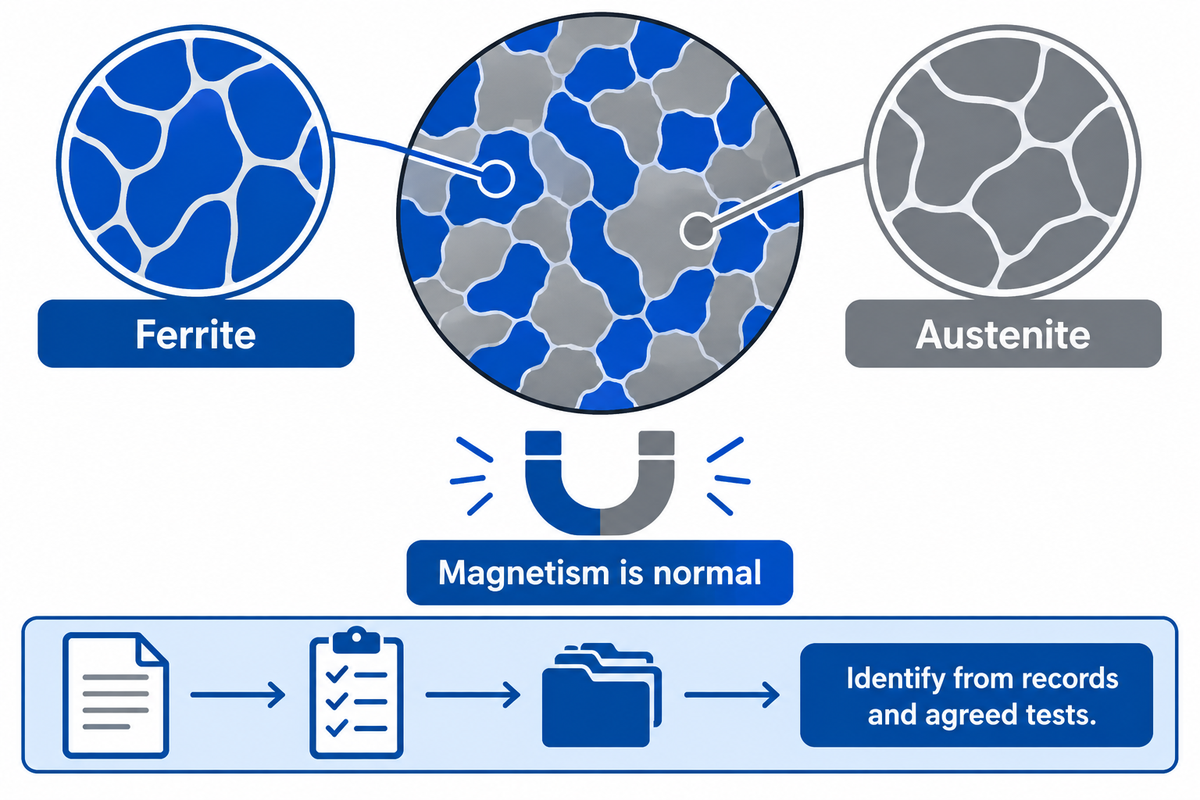
Duplex stainless steel is a combination of roughly equally balanced ferrite and austenite, and can provide useful mechanical properties. Chromium provides support for the protective passive film, and nickel and nitrogen help to control the duplex structure. Thermal history plays a role with the composition, and these must work together to produce a useable element.
World Stainless classifies stainless steel families by their metallurgical structure. Austenitic steel, ferritic stainless steel and martensitic grades have different structures than duplex steel. Duplex is neither two sheets bonded together, nor a surface coating. In comparison with austenitic or ferritic stainless alone, the two-phase material brings a different combination of mechanical and corrosion-resistant properties. Buying a grade name alone leaves the condition of processing undefined.
Is duplex stainless steel magnetic?
Yes, duplex stainless steel is magnetic because its ferritic phase responds to a magnet. Magnetic attraction is normal for a sound duplex microstructure, including 2205. Receiving inspection should therefore identify the grade and heat from traceable material records and the agreed tests, rather than reject a delivery for magnetic attraction.
A magnet also attracts carbon steel and many ferritic grades, and cold working can make some austenitic grades magnetic. The test is useful for quick observation, but it doesn’t determine the ferritic fraction or establish chemical composition. For a disputed shipment, reconcile the heat markings with the mill test report and select an appropriate identification test.
Duplex Stainless Steel Grades: Lean, Standard and Super
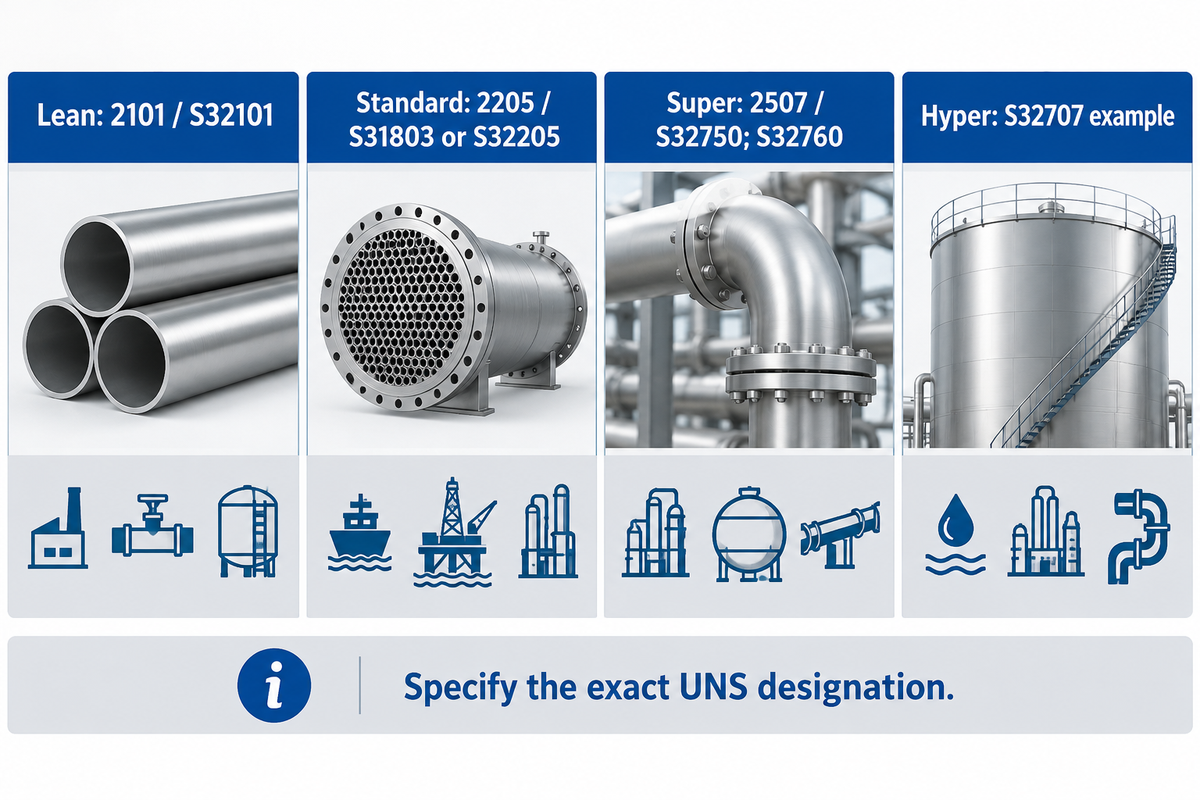
Lean, standard and super duplex grades offer different combinations of corrosion resistance and strength. Lean grades favor alloy economy; standard duplex 2205 is a common process-industry choice; super duplex serves more demanding applications. Exact UNS designations keep these families separate when a drawing, stock list, or quotation uses a shortened trade name.
| Family | Examples | Decision before ordering |
|---|---|---|
| Lean duplex | 2101 / S32101; 2304 / S32304 | Check the specific grade against the exposure; lean grades are not interchangeable. |
| Standard duplex | 2205 / S31803 or S32205 | State the required designation and product specification. |
| Super duplex | 2507 / S32750; S32760 | Match the grade, fabrication route and inspection requirements. |
| Hyper duplex | S32707 is one example | Use grade-specific producer data and qualification. |
Outokumpu’s Forta range documents commercial grade distinctions. The Francis and Byrne review also discusses super duplex and hyper duplex. S32760 aligns with super duplex stainless steels; it isn’t a synonym for hyper duplex grades. Compared to standard duplex, super grades raise alloy content to improve localized corrosion resistance. The history of duplex stainless steel includes lean alloys and more highly alloyed grades, rather than one universal recipe.
Is UNS S31803 a duplex or super duplex steel?
UNS S31803 is the standard duplex stainless steel, and is commonly associated with 2205, rather than super duplex. S32205 is another 2205 designation, with a tighter composition. An order naming S31803 shouldn’t silently become S32205, S32750 or S32760; the required designation and any dual certification belong in the agreed material specification.
Another naming trap exists with welding consumables. For instance, according to Jeff Heagey’s trade article on duplex alloys , the filler metal 2209 is associated with 2205 and 2509 is associated with 2507 welding. A filler metal designation doesn’t indicate the stock plate grade. Separate the base metal and consumable lines in your fabrication documents.
Outokumpu provides Nominal 2205 Chemistry of 22.4 wt% Cr, 3.1 wt% Mo and 0.17 wt% nitrogen. The composition of duplex stainless steel varies by grade; the ordered UNS designation and applicable product standard establish acceptance requirements. A quotation for lean duplex stainless steel requires its own designation rather than a copied 2205 composition.
Mechanical Properties: Strength Is Only One Design Constraint
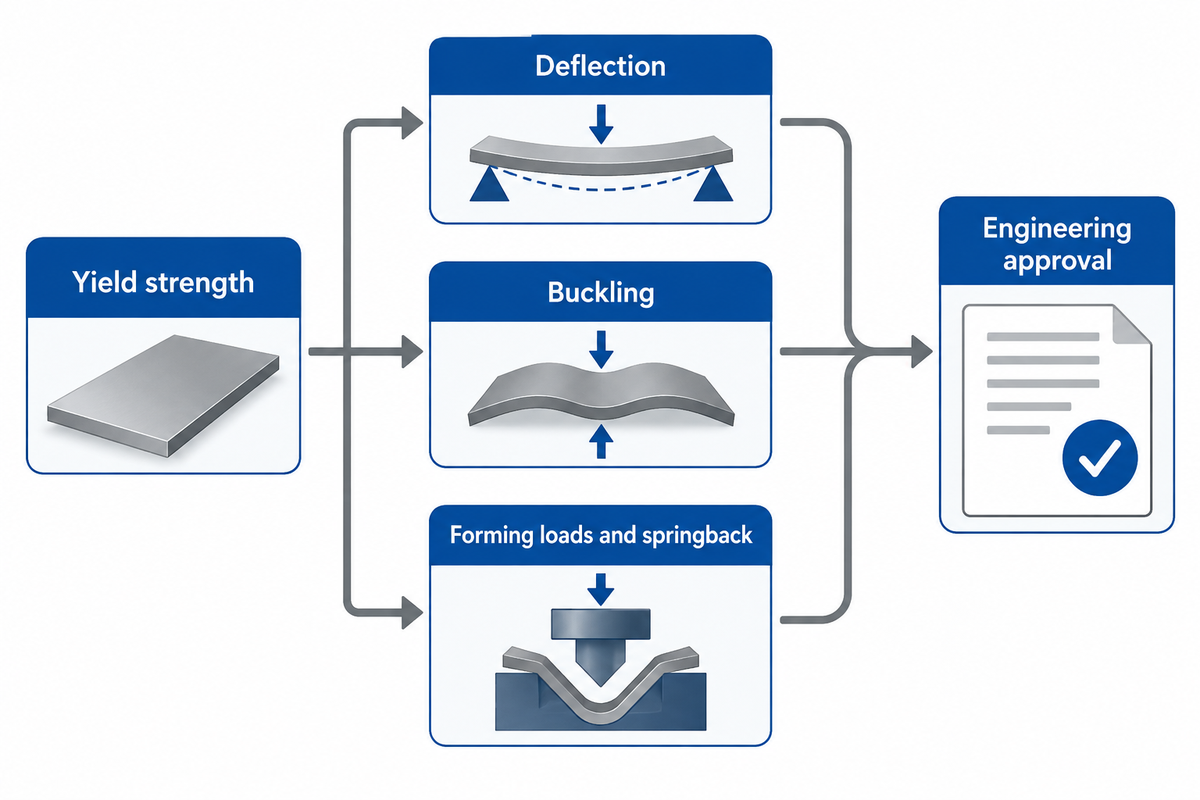
When designing using Duplex, yield strength needs to be considered along with stiffness, buckling, fatigue and corrosion. A stronger material doesn’t always allow for a thinner design. The strength of duplex also increases forming loads, so a component made from a less costly material may actually be more expensive to fabricate.
For EN 10088-2 cold-rolled coil, Outokumpu’s Forta datasheet, Table 5, lists S32205 minimum 0.2% proof strength of 500 MPa. Its Supra Table 5 lists 240 MPa for cold-rolled 316L/4404 under the same standard at 20 °C. These are product form values and not allowable design stresses.
Suppose the designer swaps out a 316L panel with 2205. Yielding can be less restrictive, but the panel still needs to pass its deflection and buckling checks. Forta gives a 2205 elastic modulus of 200 GPa at 20 °C; high proof strength doesn’t multiply that stiffness. The fabrication shop needs to form the approved section anyways. IMOA Shop Sheet 102 discusses the higher loads and springback. The better purchasing question is if the approved weight reduction survives the other design and process constraints. Compare a quotation for the existing drawing with a separate quotation for the approved section, so procurement can see which saving requires a design change.
Cold-rolled S32205 at 500 MPa and cold-rolled 316L at 240 MPa provide a matched strength comparison. The same Forta table lists 460 MPa for hot-rolled S32205 coil and quarto plate. A buyer comparing steel plates with coil data can therefore exaggerate the margin before any design calculation starts.
Corrosion Resistance: Where PREN Helps and Stops
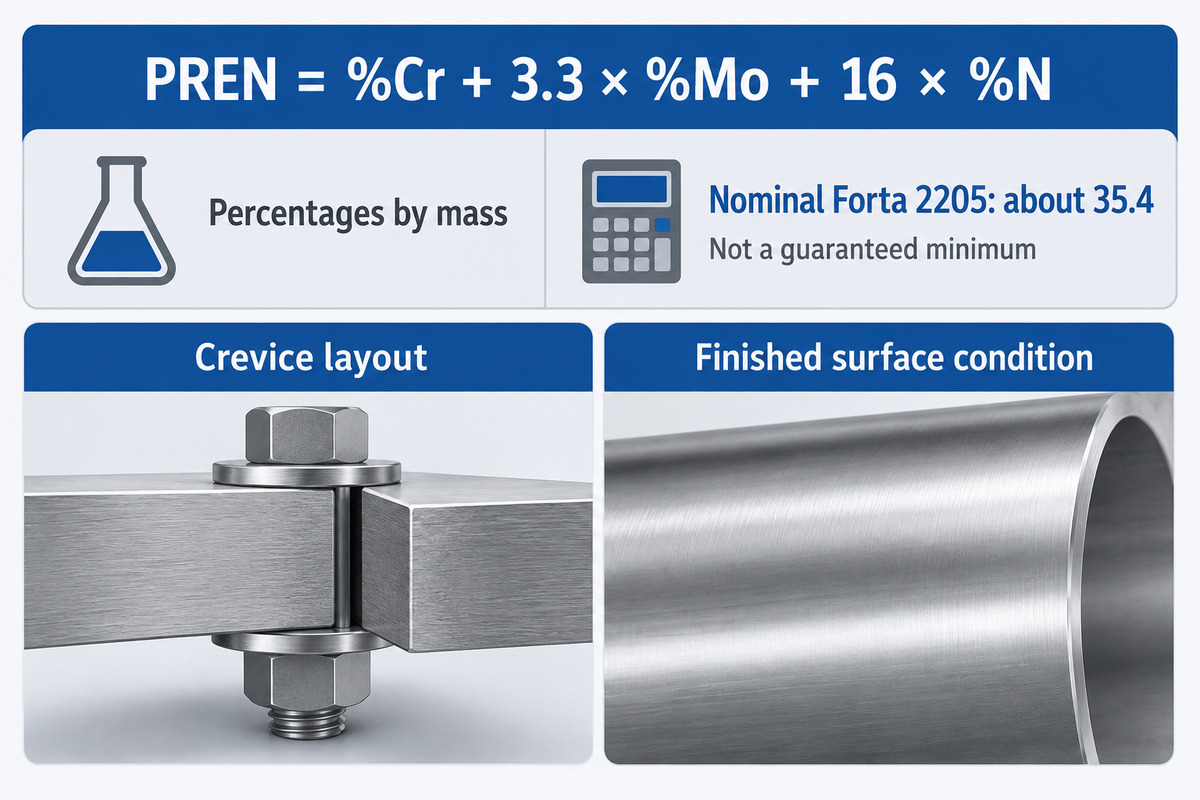
PREN is a composition based screening index for resistance to localized corrosion. Chromium and nitrogen raise the number, but that doesn’t consider crevice geometry, surface condition, or fabrication imperfections. Use PREN to compare candidate compositions, and then assess pitting and crevice corrosion under the proposed operation and cleaning conditions.
The pitting resistance equivalent number is usually formed according to the equation PREN = %Cr + 3.3 × %Mo + 16 × %N. All percentages are by mass. For the nominal Forta 2205, we calculate 22.4 + 3.3 × 3.1 + 16 × 0.17 = 35.35, or about 35.4. This is a nominal chemistry calculation, rather than a guaranteed minimum for every 2205 heat.
Picture a buyer reviewing a chloride-bearing process line. A higher index makes 2205 worthy of consideration against austenitic stainless, but a gasket crevice can concentrate the solution and hinder repassivation. A weld with heat tint adds a local condition. Raising the composition score doesn’t eliminate either condition. The next decision is whether the finished joint and crevice arrangement are qualified for that medium at its maximum temperature, including shutdowns and cleaning cycles. The IMOA welding guidance discusses why thermal history affects corrosion resistance and mechanical properties. Simultaneously document the service envelope and the joint arrangement. The shop will assemble the equipment that way.
Duplex generally enhances resistance to chloride stress corrosion cracking compared to austenitic stainless grades like 316L, but a different mechanism can still lead to failure. A TWI/BP investigation of cracked S32760 subsea hubs identified hydrogen-assisted cracking under cathodic protection, with stress and microstructure contributing. To claim duplex is immune to cracking is misleading.
A nominal PREN of 35.4 is assigned to 22.4 wt% Cr, 3.1 wt% Mo and 0.17 wt% N. The arithmetic provides a composition answer. Acceptance for a chloride-bearing assembly also needs the service temperature, crevice layout and finished surface condition; specifying a larger number alone leaves those failure paths open.
When Does Duplex Beat 316L Stainless Steel?
2205 is worth assessing where strength or chloride exposure makes 316L a poor choice. Superior corrosion resistance is worth assessing where it addresses the governing failure mechanism. Retain 316L when its performance is adequate and its easier forming or established fabrication route provides the better finished component. Compare alternatives against the same service duty.
Evaluate 2205
- Strength limits the present design.
- Chloride exposure challenges 316L.
- The shop has a qualified duplex route.
Retain 316L
- The existing section meets its duty.
- Service experience supports the grade.
- Formability drives the component cost.
Is 2205 stainless better than 316?
2205 is better for many strength-limited or chloride-stressed components, while 316 or 316L can be the better purchase for less aggressive service and demanding forming. Compare against failure mechanism and finished cost. A stronger tensile result or lower nickel content alone doesn’t rule the comparison.
IMOA Shop Sheet 103 describes machining of 2205 and 2507. It also notes that lean S32101 can machine better than 316. The performance of duplex stainless steel therefore requires a grade-specific comparison, rather than a generalization about every duplex alloy.
At 20 °C, the cited cold-rolled 316L minimum proof strength is 240 MPa, compared with 500 MPa for S32205. Those figures help explain an engineering opportunity. They don’t select the cheaper finished assembly, because forming, welding and inspection can change the cost ranking even before a redesign saves material.
Applications: Match the Service Before the Grade
Chemical storage, marine equipment and structural work are common applications of duplex stainless steels because different grades address different constraints. Demanding industrial applications need the service defined before the grade and fabrication route. A published application identifies a useful candidate; the actual fluid, load history and manufacturing process determine whether it fits the next project.
The application examples in Outokumpu’s Forta data underpin this map. The final column connects those uses with fabrication concerns documented by IMOA and the TWI failure investigation. It is a selection aid for plant engineers, quality teams and buyers, rather than a list of automatic material approvals.
| Application | Candidate from published use | Question that changes selection | Decision owner |
|---|---|---|---|
| Chemical tanker cargo tanks | 2205 | Which cargo and cleaning exposures govern? | Process engineer |
| Mild-service storage tanks | Lean 2101 | Does the lower-alloy grade fit the stored medium? | Plant engineer |
| Pulp digesters | 2205 | What chemistry and thermal cycle reach the welds? | Process engineer |
| Oil and gas tubular equipment | 2205 or 2507 | Which sour-service or hydrogen conditions apply? | Materials engineer |
| Desalination equipment | 2507 or S32760 | What crevice, temperature and shutdown conditions govern? | Corrosion engineer |
| Flue-gas scrubbers | 2507 | Where do deposits concentrate the aggressive solution? | Plant engineer |
| Bridges and structural members | 2101 or 2205 | Do buckling, fatigue or deflection control the section? | Structural engineer |
| Floodgates | 2101 or 2404 | Which water exposure and weld details need qualification? | Design and quality teams |
| Pressed plate heat exchangers | Qualified formable duplex grade | Can the selected sheet and die complete the forming trial? | Fabricator and buyer |
A Heat Exchanger World article by Outokumpu practitioners discusses 0.6 mm 2205 forming trials and a LANPEC project. The article shows the importance of evaluating forming and corrosion together for duplex stainless steel sheets. These are third-party examples, not TiAlloy production trials or customer projects.
A 0.6 mm heat-exchanger sheet already puts formability constraints on the purchaser before corrosion benefits are realized. A suitable fluid-handling material may still demand a different die or forming route. For a plate-exchanger project, pair the material selection with the fabricator’s sheet-and-tool trial rather than transfer a flat-plate recommendation unchanged.
Welding and Fabrication Can Change the Outcome
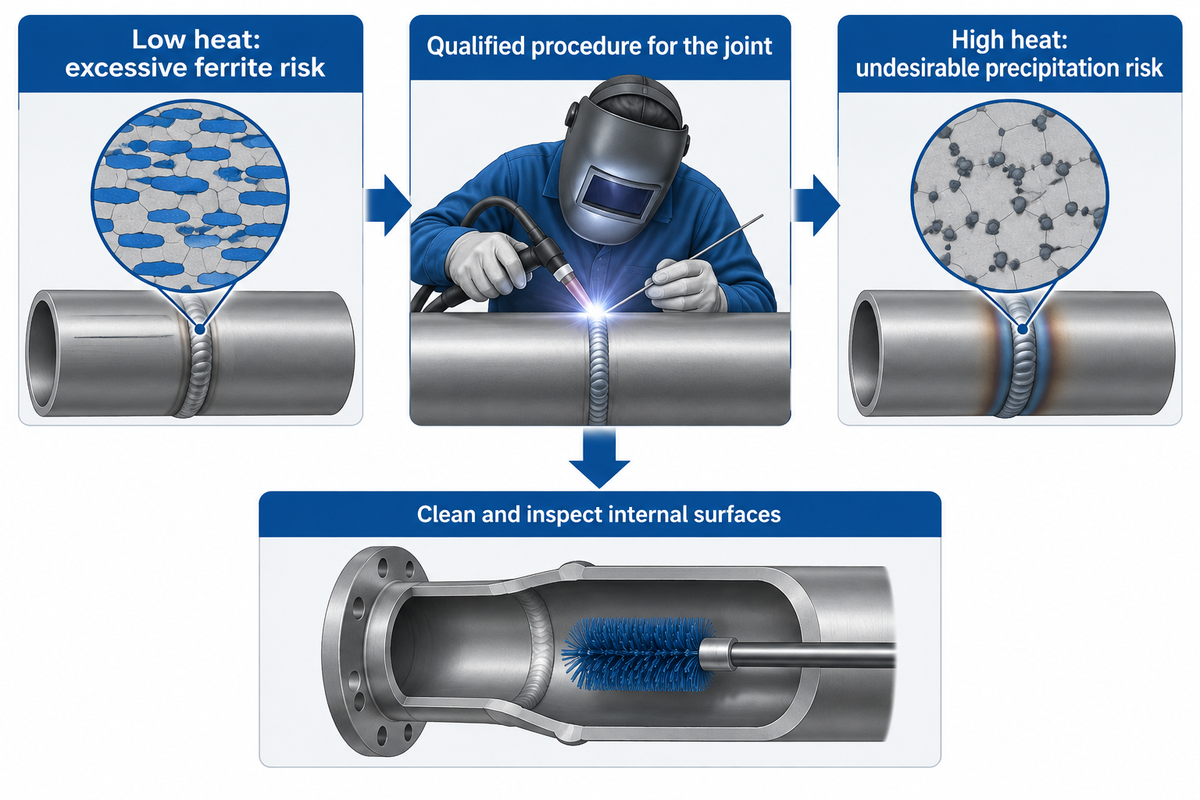
Fabrication changes the performance of duplex by affecting phase balance, surface conditions and residual stress. Insufficient or excessive welding heat input causes issues. The preferred route is qualified procedures for the exact base metal, thickness and joint, followed by cleaning and the required inspection.
“Exceedingly high heat input increases the danger of forming intermetallic phases.”
Very low heat input can cause excessive ferrite to form due to rapid cooling. Excessive heat input can cause undesirable precipitation to occur. The corrosion resistance properties of the joint follow that metallurgical history. A shop can’t improve the resistance of duplex stainless steel simply by turning the heat setting down. Stainless steels like 304 and 316 don’t use the same duplex phase-balance control. Routine stress relief below solution-annealing temperatures can also cause damage to the duplex microstructure.
Can duplex stainless steel be welded easily?
Yes, duplex stainless steel can be welded with qualified procedures, appropriate consumables and controlled thermal cycles. More process control is needed than with a casual substitution for 304 or 316. The procedure must maintain the intended phase balance and finished corrosion performance, rather than merely produce a visually acceptable bead.
In a published Eng-Tips discussion, a participant asked about heat tint on 2205 welds. Internal access in the procurement: specify how internal surfaces will be cleaned and inspected prior to the assembly sealing the access. Forum experience defines the question; IMOA guidance and the project procedure define the technical response.
Temperature control continues in service. Tucker, Miller and Young’s 2015 study examined thermal aging over 1–10,000 h. Exposure duration and the required toughness belong beside temperature in the design review. Treatment of duplex stainless steel and long-term operating limits are separate decisions.
Compare the Quote, the Producer and the Inspection Package
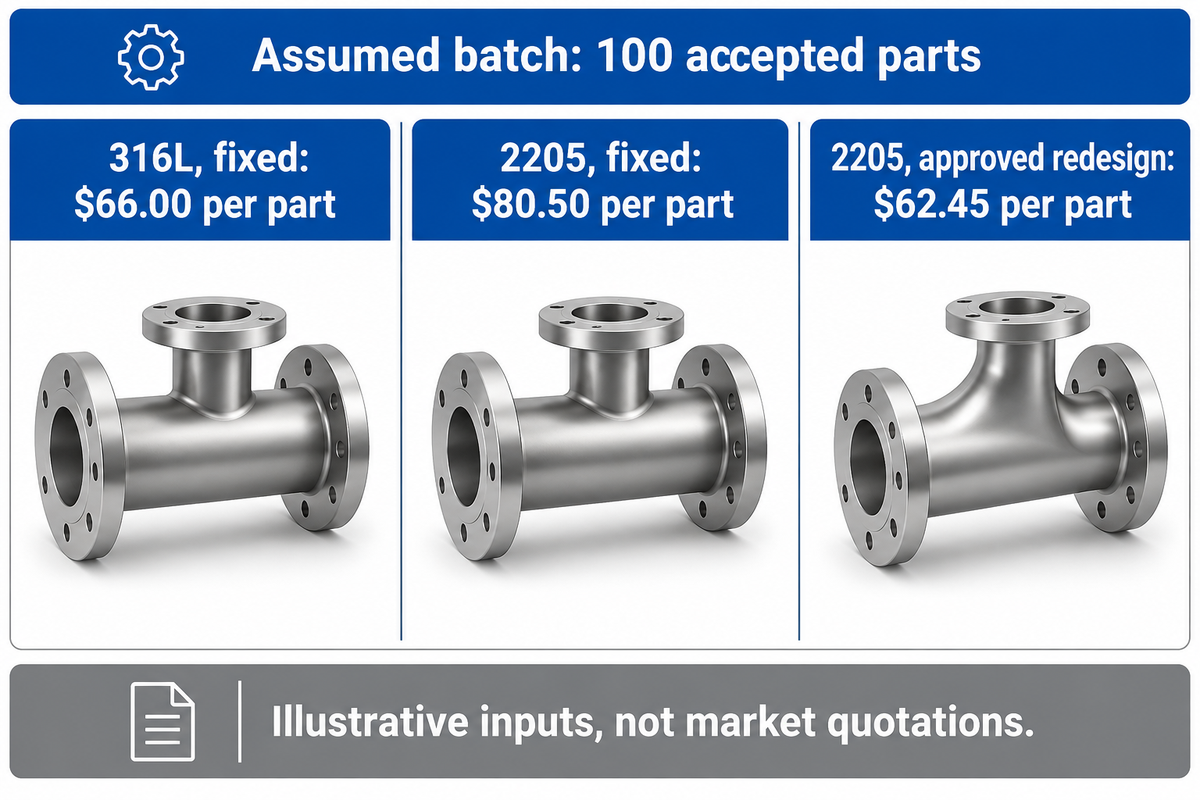
Compare duplex quotes on cost per accepted component, with the same drawing and acceptance scope. Then quote the redesign as the second basis. Material cost savings can be eroded by forming, welding and testing costs, and an approved lighter section can impact the result. The two comparisons respond to different questions in purchasing.
2-Basis Duplex Cost Ladder
The 2-Basis Duplex Cost Ladder compares finished cost on an unchanged drawing first and then on an approved lighter design.
This example presumes 100 accepted parts in each batch. Every quantity and price is an illustrative input in US dollars, not a market quotation or a TiAlloy test. The 700 kg column assumes a separately engineer-approved design; its weight isn’t calculated by dividing yield strengths. Qualification contains an assumed allowance for the design change.
| Cost item, USD/batch | 316L, fixed | 2205, fixed | 2205, approved redesign |
|---|---|---|---|
| Material | 1,000 kg × $4.00/kg = $4,000 | 1,000 kg × $3.60/kg = $3,600 | 700 kg × $3.60/kg = $2,520 |
| Forming | $800 | $1,100 | $900 |
| Welding | $600 | $900 | $650 |
| Machining | $300 | $500 | $350 |
| Surface cleanup | $250 | $350 | $300 |
| Inspection | $300 | $500 | $500 |
| Qualification and change allowance | $0 | $600 | $600 |
| Consumables | $150 | $250 | $200 |
| Packing and freight | $200 | $250 | $225 |
| Total | $6,600 | $8,050 | $6,245 |
| Cost per accepted part | $66.00 | $80.50 | $62.45 |
The fixed-geometry 2205 batch costs $8,050 ÷ 100 = $80.50 per part, despite the lower $3.60/kg input. The approved redesign gives $6,245 ÷ 100 = $62.45. A buyer can reproduce the comparison by replacing each line with quotations for the same accepted quantity. Keep rejection allowances or expected rework visible if those costs differ. IMOA’s forming and machining guidance explains why the process lines deserve their own prices. The finance reviewer can then separate a purchasing saving from an engineering saving: the first comparison retains the drawing, while the second requires the approved change and its qualification allowance before its lower total becomes relevant.
A useful procurement handoff specifies the UNS grade, product form, dimensions in mm, ordered quantity in kg or pieces, service envelope, finishing and inspection scope. Name the producing mill and the party responsible for conversion. ASTM A240/A240M-26 covers plate, sheet and strip; it is not a universal specification for every tubular or forged product.
For detrimental-phase testing, ASTM A923-25 applies to its listed duplex alloys, while ASTM A1084-15a(2022) addresses listed lean duplex alloys with different procedures. A1084 Method A is supplemental, not an acceptance or rejection criterion. Specify applicable methods and representative sample location/orientation, including the slowest-cooled region where relevant. Chemical and mechanical compliance alone does not settle harmful-phase assessment.
For 100 accepted parts, the assumed $3.60/kg 2205 input yields either $80.50 or $62.45 per finished part under the two design bases. Quotation comparisons become useful when material, conversion and inspection share one acceptance basis. A lower price per kilogram settles only the first line of that comparison.
Industry Outlook: Buy to the Actual Specification
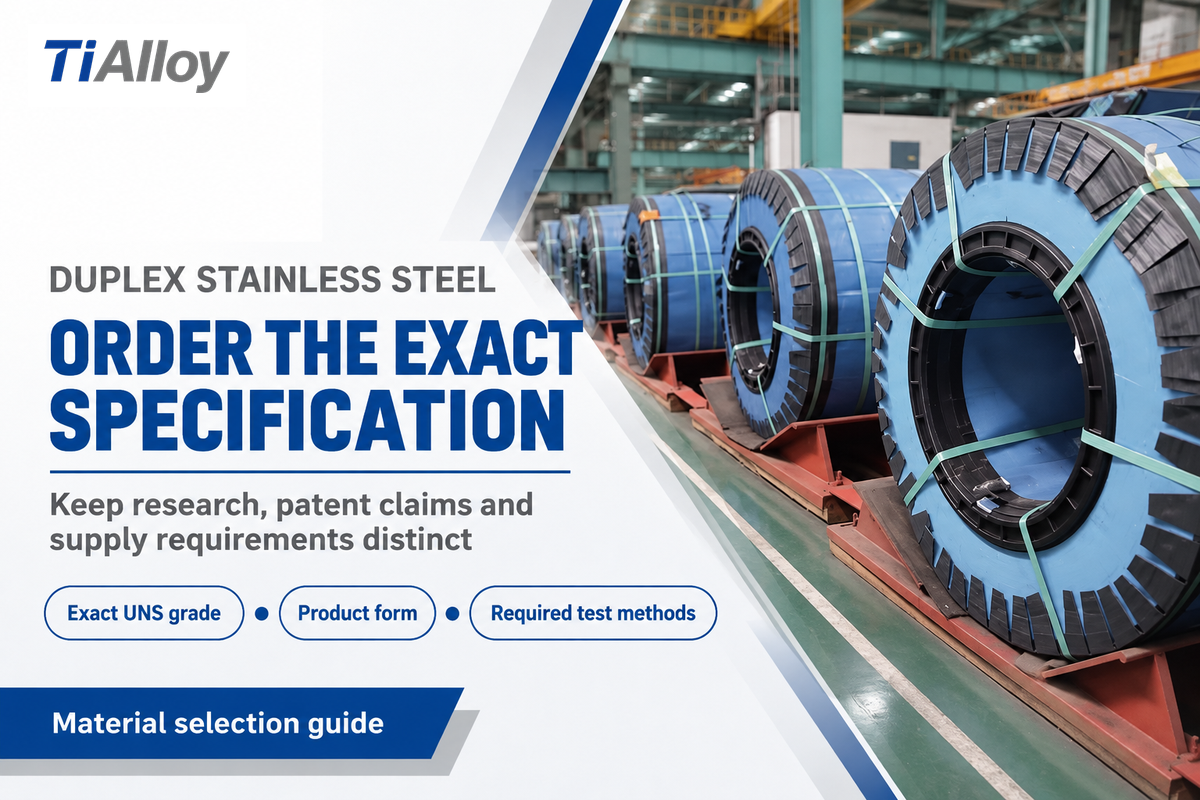
Production of duplex stainless steel demands control of fabricated properties, as lean alloys and highly alloyed grades proliferate. Parties should distinguish new research, patent claims and established supply specifications. A novel composition is only relevant to a project when a qualified fabrication route is integrated with the required service duty.
An August 2025 study of lean duplex S32001 analyzed mechanical behavior and considered cold forming, welding and life-cycle costs. The abstract alludes to alloy economy in less corrosive structural applications. It doesn’t demonstrate that lean duplex grades replace standard duplex stainless steels in every chloride exposure. For structural applications, the implication is to evaluate the proposed section and connection, rather than compare alloy labels alone.
A different US patent application published on April 30, 2026 relates to duplex sheets and identifies Nippon Steel Stainless Steel Corporation as the assignee. Its phase and composition claims pertaining to the application are invention-specific. They are neither a generic duplex acceptance rule nor TiAlloy intellectual property. A patent publication doesn’t mean a product is currently manufactured to a standard and supplied.
For 2026 requests, list the edition of the product specification and the separately required test methods on the order. The active A240/A240M-26 product specification and A923-25 test methods provide examples of why those references are required to be explicit. A revision number by itself isn’t a grade substitution; the design authority and purchase requirements determine which edition is controlling. At that point, procurement can evaluate suppliers based on the same conditions.
Similarly, research on thermal stability cautions against a single temperature label. The 2015 aging study tested 2003 and 2205 between 260 °C and 482 °C for 1–10,000 h, with toughness assessment. The study’s time-dependent findings suggest that rather than adopt a single maximum temperature, the following should be done: indicate the exposure duration and the required toughness in a review of a high temperature material.
Key takeaway
Buy duplex on an exact grade, an approved design and a defined acceptance scope. Compare the unchanged drawing first; price an approved redesign separately.
Frequently Asked Questions
What are the four types of stainless steel?
The four commonly taught families are austenitic, ferritic, martensitic and duplex stainless steel.
The family names describe the metallurgical structure and help explain differences in magnetism, forming and hardening behavior. Austenitic and ferritic stainless steels each have a different primary structure; duplex combines the two. Precipitation-hardening stainless grades are also recognized in broader classifications. For a purchase, use the exact grade and product specification rather than rely on the teaching category alone.
Does duplex 2205 rust?
Yes, 2205 can corrode or develop rust staining under unsuitable conditions.
Chloride attack, contamination by carbon steel, poor surface cleanup or fabrication damage can defeat the expected corrosion performance. The resistance of duplex reflects both composition and condition. Identify whether a mark is transferred contamination, localized attack or a weld-related problem before changing grades. More highly alloyed material won’t correct a contaminated fabrication route or an inaccessible uncleaned joint.
What is the ASTM standard for duplex stainless steel?
There is no single ASTM standard covering every duplex product and test.
A240/A240M is one product specification for plate, sheet and strip, including relevant stainless steel grades. Other product forms use their applicable specifications. A923 and A1084 are separate test-method standards with different alloy scopes and procedures; they don’t replace the product specification. State the product form, exact UNS grade, governing edition and additional tests together so that a supplier can quote the required condition.
Is duplex stainless steel expensive?
Its finished cost can be higher or lower than 316L, even when the material price per kilogram is lower.
Compare the same accepted component, with conversion and inspection included. An approved lighter design creates a second cost basis.
What are the main limitations of duplex stainless steel?
Duplex demands control of fabrication, thermal exposure and the exact service environment.
Higher forming forces and springback can restrict a shop’s existing tooling. Machining some grades increases tool wear. Welding must preserve suitable phase balance, and cleaning must leave an appropriate surface. Long-term heat exposure can reduce toughness, while hydrogen-assisted cracking remains relevant to particular cathodically protected components. These limits vary across standard duplex, super duplex and lean grades. For critical applications, establish the governing failure mechanism before choosing the alloy. The advantages of duplex are strongest when its strength and corrosion-resistant properties solve the actual design constraint and the fabricator can deliver that condition consistently.
Compare a duplex option for your next order
Send the grade, drawing and service conditions to TiAlloy. Start with the duplex 2205 product range or super duplex options, then request a material quotation on a defined supply and inspection basis.
Technical scope: published producer data, standards-body public scope pages and attributed research support this family guide. An example of batch cost analysis is provided, which assumes certain conditions. No customer test results, proprietary process trials or patent ownership are claimed for TiAlloy.
References & Sources
- World Stainless: categories, grades and product forms
- IMOA shop sheets: forming, machining and welding
- ASTM public scope pages: A240/A240M-26, A923-25 and A1084-15a(2022)
- Francis and Byrne, duplex stainless steel review, 2021
- TWI/BP: superduplex hydrogen-assisted cracking investigation
- Tucker, Miller and Young: thermal embrittlement, 2015
- S32001 comparative mechanical-property study, 2025
- US20260117354A1, third-party patent application, 2026
- Heat Exchanger World: formable duplex sheet
- The Welder: duplex alloys and welding consumables
WHY WE PUBLISH
About TiAlloy
TiAlloy supplies titanium, stainless steel, nickel alloy and clad plate for specification-driven industrial orders. Our technical guides are written to help buyers align product form, governing standard, test scope and release documents before a quotation is compared.
01Melt & formPlate, sheet, pipe, tube, bar, wire and forgings
02ProcessHeat treatment, finishing, inspection and export packing
03VerifyEN 10204 Type 3.1 certificate and order documents