Get in Touch with TiAlloy Company


By Cherry, Titanium Alloy Co., Ltd. technical team · Updated November 2026
A titanium heat exchanger tube material is typically ASTM B338 Grade 2 (UNS R50400) up to 80 °C (176 °F). Hotter chlorides or reducing acids require Grade 12, 16, or palladium-stabilized Grade 7.
Leaks starting from open clean metal surfaces are rare. Most leaks occur under salt deposits, inside rolled tubesheet crevices or at mixed metal joints that are exposed to cathodic hydrogen. Specifying the alloy grade together with wall tolerance, inspection route and tubesheet metallurgy aids in preventing untimely bundle replacements. This engineering design guide incorporates the trade offs for each ASTM B338 grade, failure boundary, thermal efficiencies and procurement into a streamlined specification process.
Key takeaways
- Start with ASTM B338 Grade 2 tubing for seawater, brine, and oxidizing streams up to 80 °C wall temperature.
- Step up to Grade 12 at >80–150 °C in hot brines, or Grade 16 and Grade 7 at >150–260 °C.
- Offset lower thermal conductivity with 0.5 mm to 0.9 mm thin-wall gauges and zero corrosion allowance.
- Pair ASTM B338 tubes with solid ASTM B265 or ASTM B898 titanium clad tubesheet designs on every RFQ.
Titanium Heat Exchanger Tube Material Selection Under ASTM B338
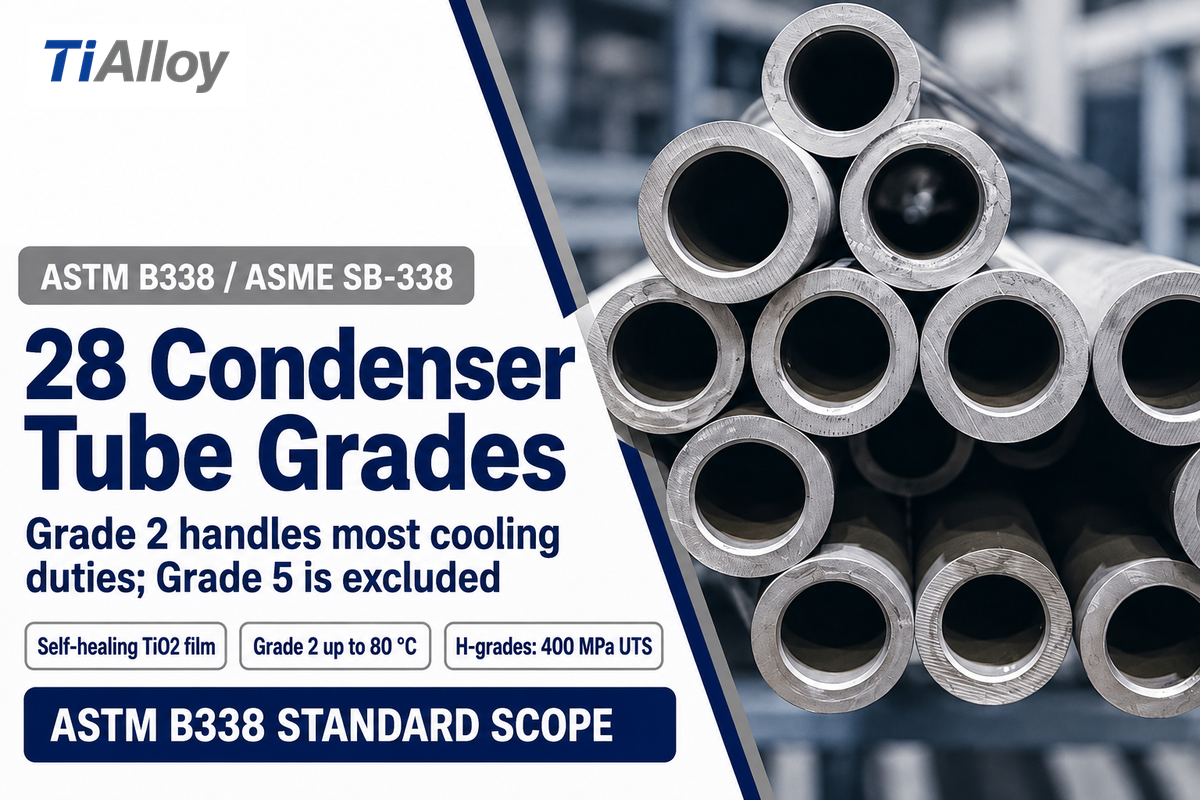
ASTM B338 / ASME SB-338 governs titanium heat exchanger tube material for surface condensers, evaporators, and shell-and-tube heat exchangers. Unalloyed titanium grade 2 handles roughly four out of five industrial cooling duties. Its passive oxide film is self-healing in aqueous streams containing trace moisture or oxygen.
“This specification covers 28 grades of seamless and welded titanium alloy tubes for surface condensers, evaporators, and heat exchangers.”
The surface barrier is primarily TiO2. It reforms within milliseconds when exposed to mechanical scratching or fluid shear. Unlike austenitic stainless steels, unalloyed titanium is resistant to chloride pitting and chloride stress corrosion cracking in seawater and brine duties. Power plant condensers, which use unalloyed titanium, have operated in coastal cooling waters for almost 40 years without a single reported corrosion leak. Similar unplanned outages across industrial use of titanium in desalination and chemical processes have also been considerably reduced.
28 GradesCovered under reapproved ASTM B338-17(2026)
≤ 80 °C (176 °F)Safe Grade 2 chloride crevice ceiling
58 ksi (400 MPa)Minimum UTS on pressure-vessel H grades
Is titanium good for high heat in shell-and-tube heat exchangers, and why is Grade 2 preferred over Grade 5?
Yes, unalloyed Grade 2 serves ASME Section VIII Division 1 exchangers up to 315 °C (600 °F). Grade 5 (Ti-6Al-4V) is excluded from all 28 ASTM B338 condenser tube grades. High aluminum and vanadium levels cause cracking during cold pilgering, roller tube expansion, and autogenous seal welding.
High working pressure duties sometimes require higher allowable stress than unalloyed titanium provides. For those shells, ASTM B338 lists Grade 9 (3% aluminum, 2.5% vanadium) and pressure-vessel H-variants like Grade 2H, Grade 7H, and Grade 16H at 58 ksi (400 MPa) minimum UTS. Buyers comparing unalloyed Grade 2 against Ti-6Al-4V Grade 5 reserve Grade 5 for bars, fasteners, and forgings rather than tubular bundles.
ASTM B338 Escalation Ladder: Grade 1, Grade 2, Grade 7, Grade 9, Grade 12, and Grade 16
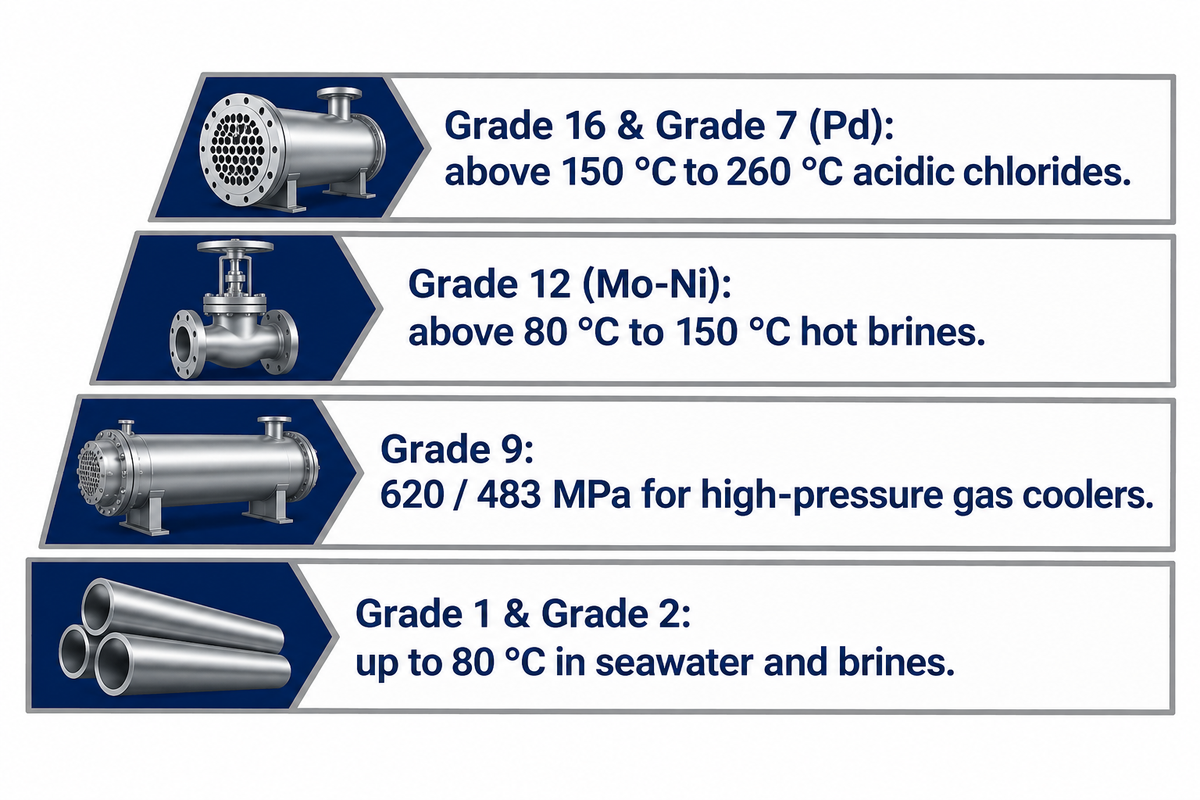
Grade selection follows maximum tube-wall skin temperature, brine pH, and design hoop stress. Our ASTM B338 Escalation Ladder divides the six core exchanger grades into non-overlapping chloride crevice temperature bands. Process engineers avoid paying precious metal premiums whenever unalloyed tubing sits safely inside its thermal envelope.
Under the ASTM B338 grade chemistry tables, titanium grade 1 has the lowest limits of oxygen and iron for maximum cold ductility. Grade 2 balances bendability with higher yield strengths for straight and U-bend condenser bundles. Above 80 °C under salt scale or tight chloride crevices, oxygen deprivation acidifies the brine.
| ASTM B338 Grade (UNS) | Nominal Alloy Chemistry | Min UTS / Yield (MPa) | Chloride Crevice Window | Primary Exchanger Duty |
|---|---|---|---|---|
| Grade 1 (R50250) | Unalloyed CP Ti (low O/Fe) | 240 / 170 | ≤80 °C at neutral pH | Tight-radius U-tubes and deep-drawn plates |
| Grade 2 (R50400) | Unalloyed CP Ti workhorse | 345 / 275 | ≤80 °C (pH ≥ 3.5) | Seawater condensers, desalination, nitric acid coolers |
| Grade 2H (R50400) | Unalloyed CP Ti (58 ksi UTS) | 400 / 275 | ≤80 °C (pH ≥ 3.5) | ASME pressure vessels needing higher tensile margin |
| Grade 9 (R56320) | 3% Al, 2.5% V | 620 / 483 | ≤80 °C in clean chlorides | High-pressure offshore gas coolers |
| Grade 12 (R53400) | 0.3% Mo, 0.8% Ni | 483 / 345 | >80 °C to 150 °C | Hot brine evaporators and refinery overheads |
| Grade 16 (R52402) | 0.04–0.08% Pd | 345 / 275 | >150 °C to 250 °C | Lean-palladium hot chloride crevices |
| Grade 16H (R52402) | 0.04–0.08% Pd | 400 / 275 | >150 °C to 250 °C | Pressure-vessel hot halide condensers |
| Grade 7 (R52400) | 0.12–0.25% Pd | 345 / 275 | >150 °C to 260 °C (pH ≥ 1) | Severe acidic chlorides and hot reducing condensers |
| Grade 11 (R52250) | CP Grade 1 + 0.12–0.25% Pd | 240 / 170 | >150 °C to 260 °C (pH ≥ 1) | Severe crevices needing maximum cold formability |
| Grade 26 (R52404) | 0.08–0.14% Ru | 345 / 275 | >150 °C to 250 °C | Ruthenium-modified alternative to lean-Pd grades |
When should you upgrade from ASTM B338 Grade 2 titanium tubing to Grade 7, Grade 12, or Grade 16 in hot chloride or reducing acid service?
Step up from Grade 2 to Grade 12 when chloride brine skin temperatures sit at >80 °C to 150 °C. Select Grade 16 or Grade 7 for temperatures above 150 °C to 260 °C, or if reducing acidic condensates push the pH below 3. Molybdenum and nickel in Grade 12 increase the allowable mechanical stress.
Palladium additions shift titanium’s polarization curve into the passive region even in hot acidic solutions. Crevice thresholds change with dissolved oxygen, pH, and salt scale thickness. Thus, duties located in the 75 °C to 85 °C transition zone must be selected with peak wall skin temperature rather than bulk fluid outlet temperature.
Thermal Transfer, Thin-Wall Gauges, and Velocity Limits vs 316L, Duplex, and 90/10 Cu-Ni
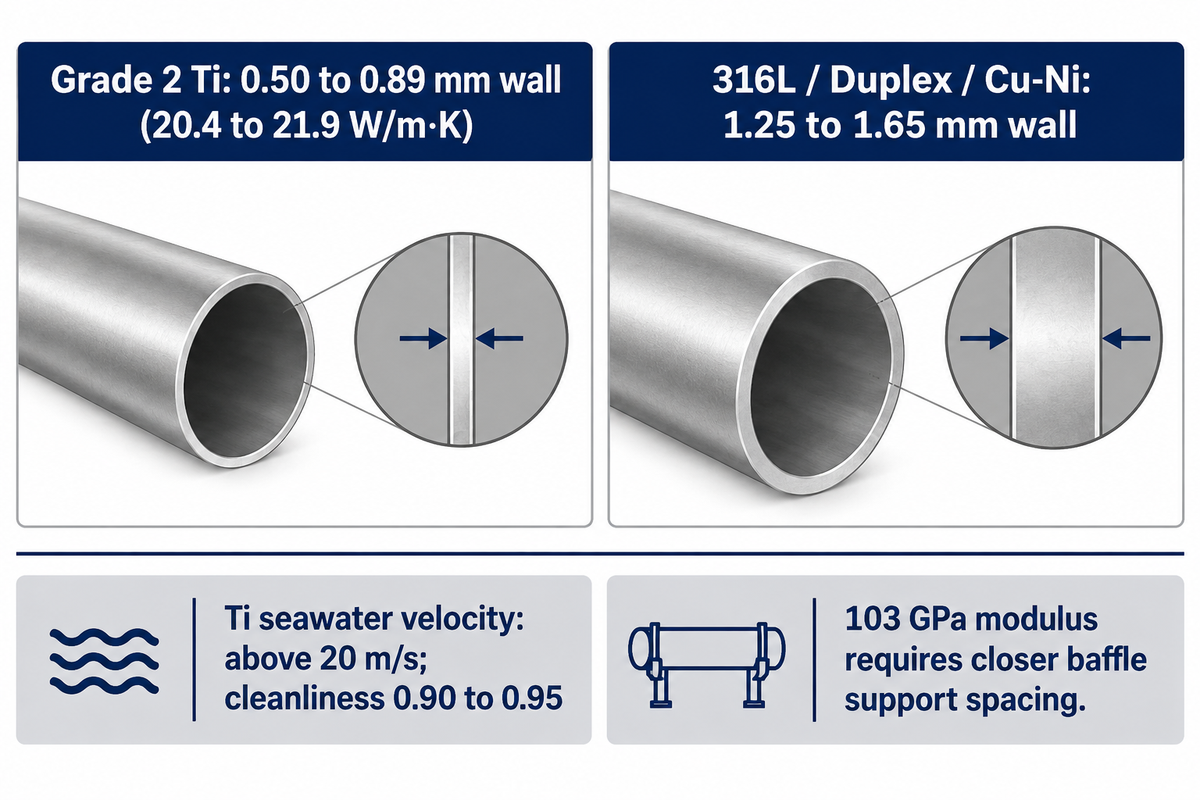
Once the ASTM B338 grade is chosen, thin-wall Grade 2 tubes match or beat thicker copper-nickel and stainless bundles in overall heat transfer. Zero corrosion allowance lets designers specify 0.5 mm to 0.9 mm walls. Clean oxide surfaces sustain high cleanliness factors in turbulent fluids despite bulk conductivity near 20.4 to 21.9 W/(m·K).
A 2025 Scientific Reports study on titanium heat-transfer tube joints shows that hybrid welding and controlled roller expansion retain mechanical integrity over repeated duty cycles. Field marine heat exchanger comparisons confirm that clean low-velocity workboat coolers with maintained zinc anodes remain cost effective in 90/10 copper-nickel. Harbor silt, sulfide slime, or high velocities tilt lifecycle economics toward titanium.
| Property / Design Limit | ASTM B338 Gr 2 Ti | 316L Stainless Steel | 2205 Duplex SS | 90/10 Cu-Ni (C70600) |
|---|---|---|---|---|
| Thermal conductivity (W/m·K) | 20.4 to 21.9 | 16.2 | 19.0 | 45.0 |
| Typical seawater wall (mm) | 0.50 to 0.89 (25–20 BWG) | 1.25 to 1.65 (18–16 BWG) | 1.25 to 1.65 (18–16 BWG) | 1.25 to 1.65 (18–16 BWG) |
| Density (g/cm³) | 4.51 | 8.00 | 7.80 | 8.94 |
| Elastic modulus (GPa) | 103 | 193 | 200 | 135 |
| Seawater velocity ceiling | > 20 m/s (erosion resistant) | Stagnation pits < 1.5 m/s | ~ 4 to 6 m/s | ~ 2.4 to 3.0 m/s (8–10 fps) |
| TEMA cleanliness factor | 0.90 to 0.95 | 0.85 | 0.85 | 0.80 to 0.85 |
Worked wall-resistance comparison. Assumed inputs: compare a 25.4 mm OD Grade 2 tube at 22 BWG (0.711 mm wall, k = 20.4 W/m·K) with 90/10 Cu-Ni at 18 BWG (1.245 mm wall, k = 45.0 W/m·K). Planar conductive wall resistance is equal to t/k. The Grade 2 wall gives 0.000711 / 20.4 = 3.49 × 10⁻⁵ m²·K/W. The thicker Cu-Ni wall gives 0.001245 / 45.0 = 2.77 × 10⁻⁵ m²·K/W. Water-side film and fouling resistances exceed 2.5 × 10⁻⁴ m²·K/W in brackish service. That tiny 0.72 × 10⁻⁵ m²·K/W metal difference shifts overall heat transfer by under 3 percent. Higher allowable tube side velocity and a 0.90 cleanliness factor would offset this difference.
What are the advantages and trade-offs of using titanium tubes in heat exchangers compared to 316L stainless steel, duplex, and 90/10 copper-nickel?
Grade 2 titanium stops under-deposit seawater pitting, chloride stress cracking, and sand erosion-corrosion above 3 m/s. Bundle weight drops nearly in half at 4.51 g/cm³. Major trade-offs are higher initial tube cost, zero copper biofouling toxicity, and a 103 GPa modulus needing closer baffle support.
Coastal outage scenario. A refinery trim cooler tubed in 316L leaked repeatedly during summer low-flow turndowns. River tides pushed brackish chlorides past 2,500 ppm while silt settled inside horizontal tubes. In 18 months, under-deposit pitting perforated the bundle. Retubing with 0.889 mm (20 BWG) Grade 2 eliminated both stagnation pitting and sand impingement in flowing cooling water. Continuous chlorination eliminated marine slime.
Corrosion Envelope, Hydriding Above 80 °C, and Chemical Exclusions
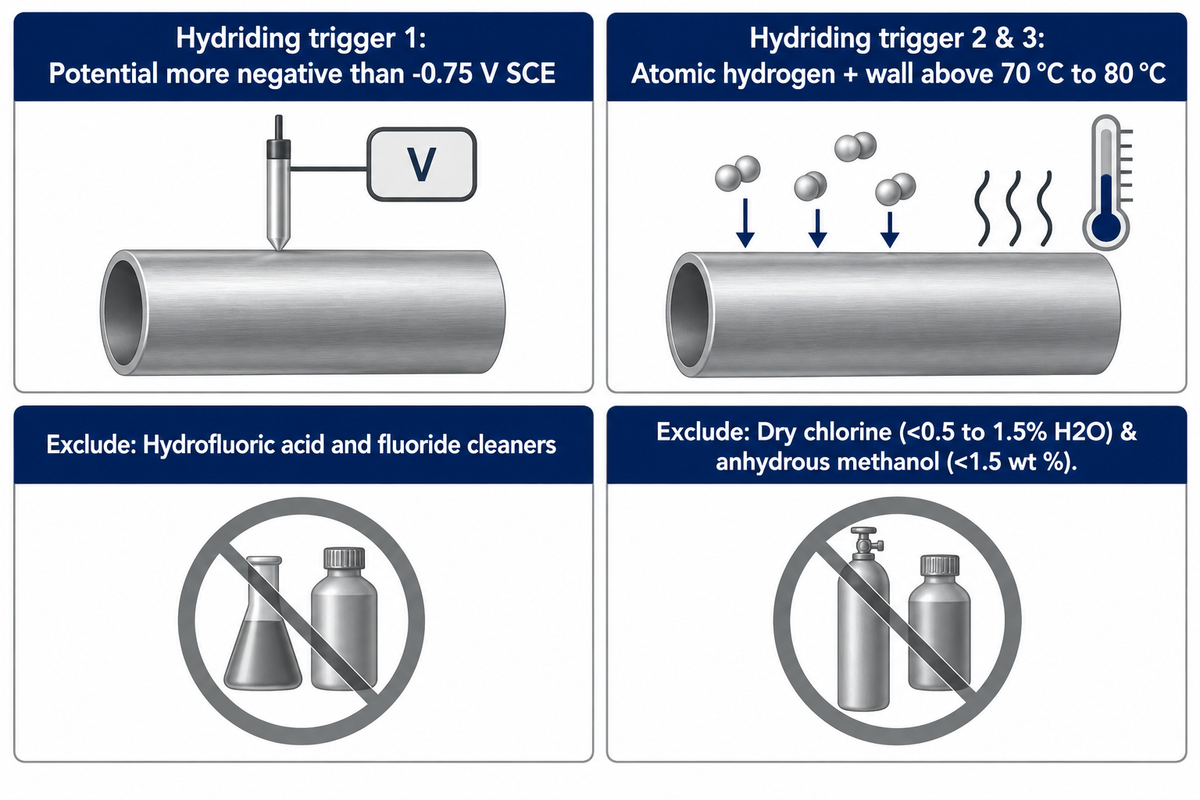
Titanium is compatible with oxidizing chlorides, wet chlorine gas, and nitric acid. However, hydrofluoric acid, acidic fluorides, dry chlorine gas, and anhydrous methanol rapidly attack the oxide barrier. At metal wall temperatures above 80 °C (176 °F), atomic hydrogen diffuses into the metal and reacts with it to form brittle hydrides.
According to the U.S. Nuclear Regulatory Commission’s archived titanium corrosion reference (ADAMS ML993210187), hydrofluoric acid attacks titanium rapidly even at trace fluoride levels, and the protective oxide dissolves. Dry chlorine gas with less than 0.5 to 1.5 percent moisture triggers pyrophoric titanium ignition, whereas wet chlorine keeps titanium passive. Highly oxidizing nitric acid condensers stabilize the oxide barrier across chemical process plants.
The International Titanium Association hydriding study by James Grauman defines three simultaneous triggers for hydrogen embrittlement. Surface potential must drop more negative than -0.75 V SCE (or suffer active acid attack). Nascent atomic hydrogen must form on the metal wall, and wall temperature must exceed ~70 °C to 80 °C. Below 80 °C, hydride films remain shallow surface layers. Check chemical media limits for unalloyed Grade 2 before changing process or descaling recipes.
Four Mandatory Chemical Exclusions for Titanium Tubing: Never expose ASTM B338 titanium grades to hydrofluoric acid or fluoride cleaners. Exclude dry chlorine gas lacking water stabilization, anhydrous methanol below 1.5 wt % moisture, and uninhibited hot concentrated reducing acids.
Tube-to-Tubesheet Galvanic Pairing Guide: Solid vs Titanium-Clad Steel
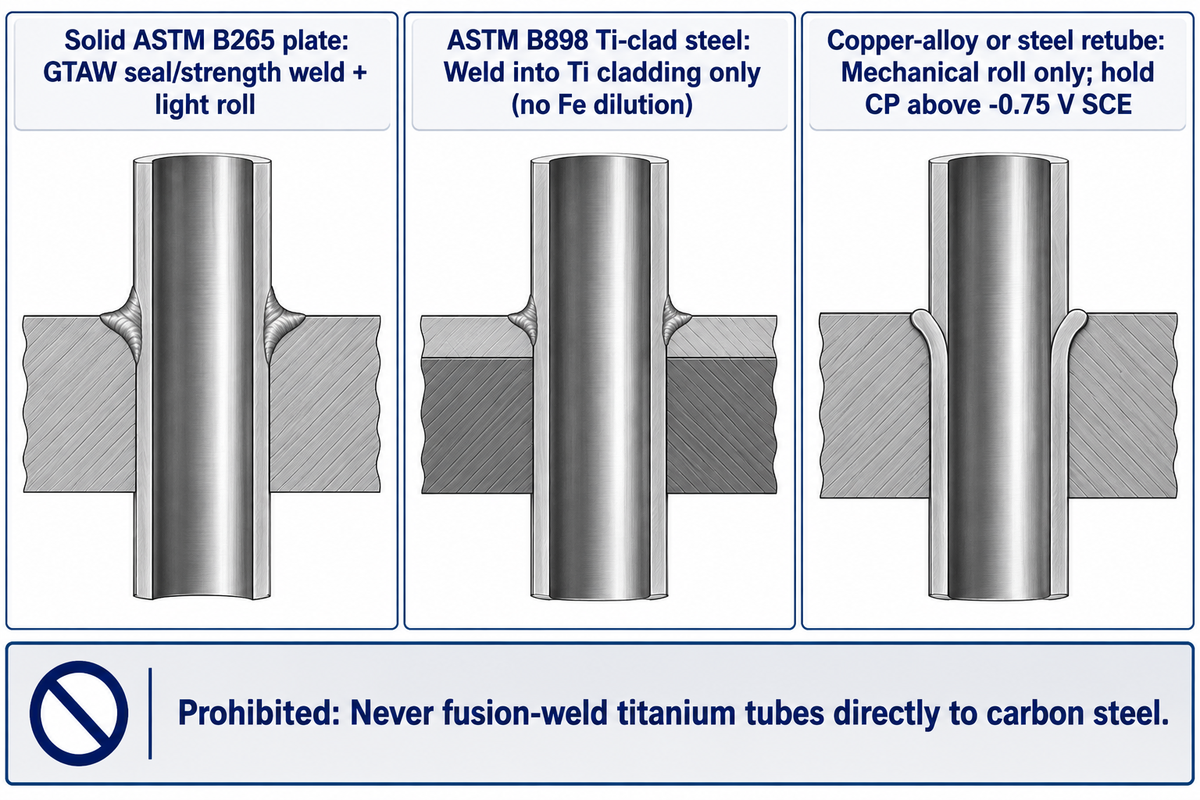
Titanium behaves as a noble cathode in seawater and conductive brines. It promotes anodic wastage on carbon steel, naval brass, or active stainless tubesheets, unless joints are matched. Fusion-welding titanium tubes is prohibited on steel tubesheets because TiFe intermetallics crack during cooling.
High-pressure or lethal process units pair tubes with solid ASTM B265 titanium plate and sheet requirements or explosion-bonded ASTM B898 titanium clad tubesheet construction over SA-516 carbon steel. Where specialized titanium sheets or bundle repairs are required, joint designs like U.S. Patent US4943001A eliminate crevices while Patent CN112570979B guides fixed-tubesheet shell-sectioning tube replacement.
| Tubesheet Configuration | Permitted Joint Method | Galvanic / Hydriding Risk | Mandatory Engineering Control |
|---|---|---|---|
| Solid ASTM B265 Gr 2 plate | GTAW seal/strength weld + light roll | Zero dissimilar couple at face | Inert argon purge + ASTM B600 solvent/pickling clean |
| Solid ASTM B265 Gr 7 / Gr 12 | Matched ERTi-7 or ERTi-12 GTAW weld | Zero crevice mismatch above 80 °C | Never weld Pd/Mo tubes with unalloyed ERTi-2 filler |
| ASTM B898 Ti-clad carbon steel | Face GTAW weld into Ti cladding only | Iron dilution cracks weld if penetrated | Keep substantial Ti cladding thickness; zero arc into steel |
| Naval brass (Muntz / C46400) | Controlled mechanical roller/hydraulic roll | Noble Ti accelerates brass dealloying | Coat face or regulate CP potential above -0.75 V SCE |
| 90/10 or 70/30 Cu-Ni sheet | Hydraulic or multi-roller grooved roll | Moderate anodic loss on Cu-Ni face | Serrated TEMA grooves + epoxy waterbox lining check |
| Aluminum bronze (C61400 / C63000) | Qualified mechanical expansion | Low-to-moderate couple in clean seawater | Verify pull-out load on thin-wall 22 BWG mock-up block |
| Epoxy-coated carbon steel | Mechanical roll + holiday-free lining | Severe deep pitting at coating pinholes | Never coat cathode alone; pair coating with regulated CP |
| Uncoated carbon steel + zinc anodes | Mechanical roll (below 70 °C only) | Active zinc drives H pickup >80 °C | Replace zinc with potentiostatic CP held above -0.75 V SCE |
| 2205 Duplex or 6Mo stainless | Mechanical hydraulic/roller expansion | Compatible while SS stays passive | Confirm crevice temperature stays below SS CCT rating |
How do you match titanium heat exchanger tubes with solid or titanium-clad steel tubesheets during fabrication or condenser retubing?
For lethal service, seal-weld ASTM B338 tubes to solid ASTM B265 plates of the same grade. Explosion-clad ASTM B898 steel tubesheets are preferred for high pressure applications where solid titanium plates would prove overly thick and expensive. For copper-alloy condenser retubing, use controlled mechanical expansion without fusion-welding.
Retubing hydriding scenario. A coastal power station retubed a naval brass condenser with thin-wall Grade 2 tubes. Maintenance left an impressed-current rectifier running uncalibrated below -0.75 V SCE. Near the hot turbine exhaust neck, local metal temperatures crossed 82 °C and tube ends cracked from hydriding. Legacy copper-alloy retubing always demands separate baffle stiffness checks and regulated cathodic potentials rather than copying copper-tube settings.
Cold-Pilgered Unwelded vs Welded ASTM B338 Tubing Routes, Tolerances, and Wall Gauges
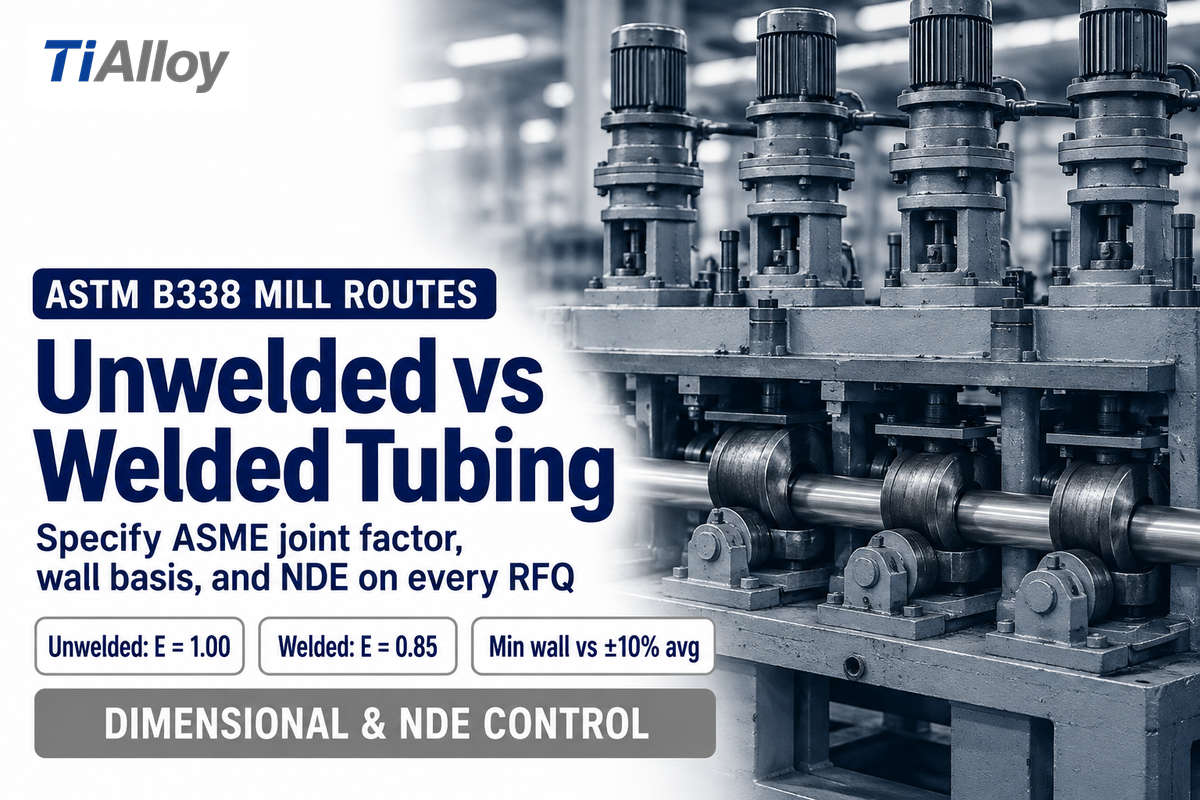
ASTM B338 qualifies both unwelded cold-reduced tubing and welded cold-worked tubing to identical chemical and tensile tables. However, the two mill routes differ in wall concentricity, ASME weld joint efficiency, and thin-wall lead times. Stating wall basis and nondestructive tests upfront prevents mill re-quotes.
Under ASTM B338 welded tube test provisions, welded tube starts from flat-rolled strip. It is automatic-arc welded without filler, cold-worked, annealed, and checked by a reverse flattening test per Supplement II of A 370. Precision strip gives welded tubing tight concentricity at 0.5 mm to 0.9 mm walls. ASME Section VIII assigns welded B338 tube a joint factor of E = 0.85, whereas unwelded cold-pilgered tube carries E = 1.00.
What ASTM B338 tubing route tolerances, wall gauges, and non-destructive tests belong in a titanium heat exchanger tube RFQ?
Request unwelded or welded construction, specifying the metric OD and wall thickness with BWG, along with average wall (±10 percent) versus minimum wall. Include cut-length requirements (+3.2 mm / -0 mm, up to 7.3 m) along with eddy current (ASTM E426), ultrasonic, and hydrostatic or pneumatic testing.
RFQ tolerance scenario. A shop ordered 19.05 mm OD × 22 BWG (0.711 mm) Grade 2 tubes without specifying minimum wall. The mill supplied standard average-wall tubing under the ±10 percent band, leaving local spots at 0.640 mm. That lot failed the inspector’s ASME minimum-wall audit. Check outside diameter and wall-gauge ordering tables before releasing drawings. U-bend stress-relief cycles and container length limits depend on OD-to-wall ratio, so mark bend radii and NDE routes on the drawing.
Packaged Saltwater Pool Units vs ASME Process Shell-and-Tube Exchangers
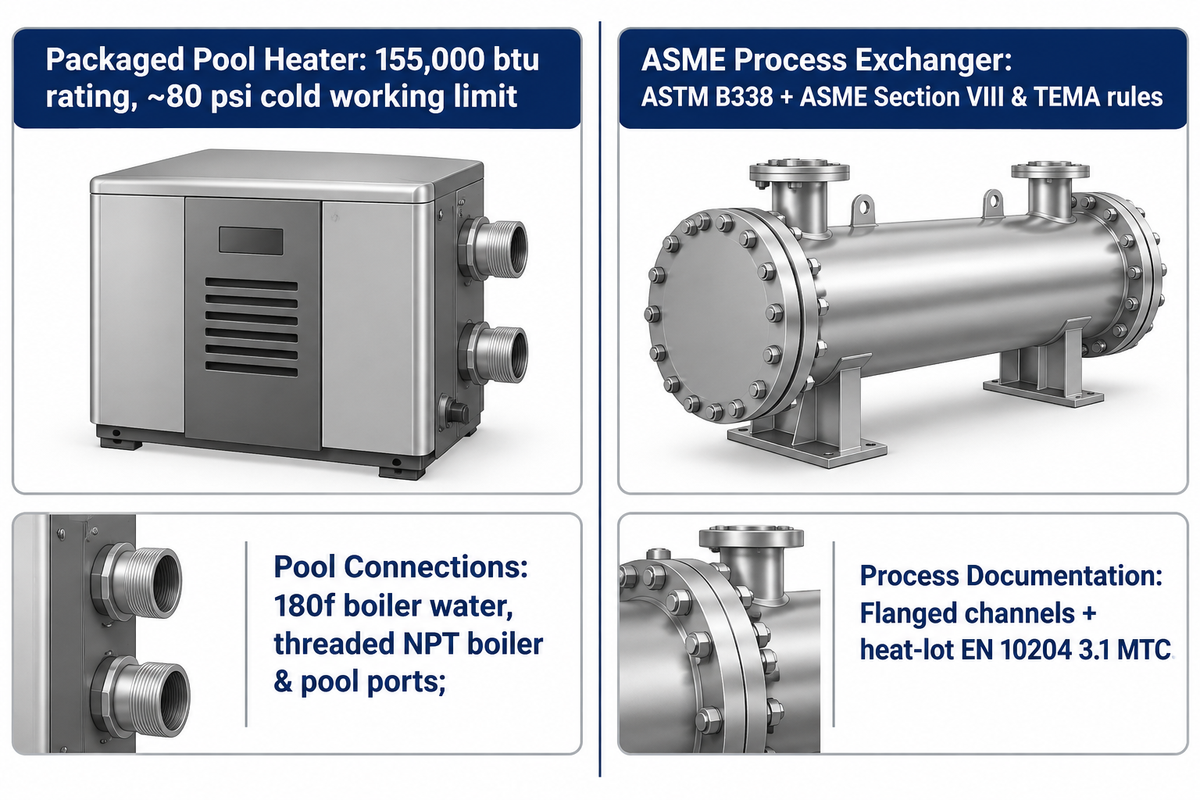
Catalog listings for titanium exchangers mix residential aquatic heaters with heavy ASME process bundles. Completely different codes, port connections, and documentation rules govern these two classes of equipment. Separating packaged pool heaters from custom ASTM B338 bundles prevents misapplication in pressurized chemical plants.
The space-efficient catalog tube and shell heat exchanger, which is also sold as the 155,000 btu titanium tube and shell heater, uses light stamped housings. Installers opting for a shell heat exchanger for saltwater aquaculture or a heat exchanger for saltwater pools check cold-side limitations first. Most aquatic units limit cold working pressure around 80 psi to match a residential pool water pump and PVC pool pipe work. Vendor sheets of a titanium tube and shell heat unit state capacity as btu rated with 180f boiler water entering threaded npt boiler ports and side ports.
Selection of aquatic units with pool ports is restricted by fixed port sizes and port to port dimensions. Datasheets correlate gpm boiler side and gpm pool side flow rates with psi drop hot and psi drop cold curves across pool ports. Compact spa heat exchangers are constructed with a titanium shell and grade 2 tubes, or constructed with a titanium coil. Consequently, all fluids in contact with chlorinated brine touch oxide-protected metal.
Industrial process exchangers instead follow ASTM B338 condenser and heat exchanger tube rules plus ASME Section VIII and TEMA standards. Process shell-and-tube heat exchangers engineer the exact number of tubes, flanged carbon steel or titanium shell channels, and baffled shell and titanium hydraulics. Every bundle tracks design psi, corrosive process fluid velocities, and heat-lot EN 10204 3.1 certificates.
Mill Test Verification and RFQ Specification Checklist for Titanium Bundles
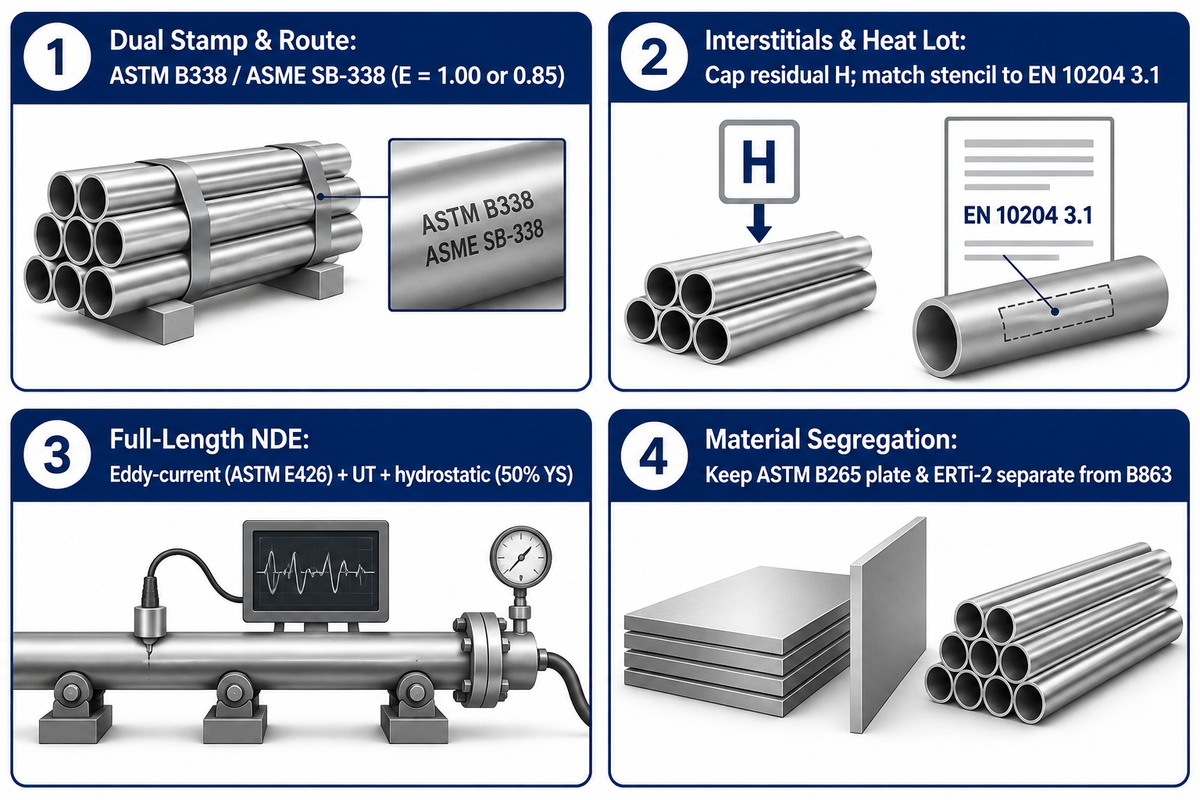
Reviewing EN 10204 3.1 Mill Test Certificates before bundle assembly blocks off-spec chemistry, unannealed cold work, or missed NDE scans. Quality engineers review chemical analyses for ladle and product, tensile elongation, flaring and flattening coupons, and calibration logs for every heat lot.
Per U.S. NRC condenser tubing quality assurance findings, residual hydrogen in delivered Grade 2 tubing must stay capped so internal hydrogen never narrows service margins. Oxygen and iron must also be of equal concern on the certificate. Lean oxygen can miss ASME tensile minimums, whereas high iron in hot acidic brines promotes weld-zone attack.
| RFQ Line Item | What to Specify on Purchase Order | MTC / Release Check |
|---|---|---|
| Standard & Grade | ASTM B338 / ASME SB-338, exact Grade (Gr 2 UNS R50400) | Confirm dual ASTM/ASME stamp for code vessels |
| Manufacturing Route | Cold-pilgered unwelded (E = 1.00) or welded cold-worked (E = 0.85) | Verify reverse-flattening test per A 370 on welded lots |
| Dimensions & Wall Basis | OD × wall in mm (plus BWG), average (±10 percent) vs minimum wall | Check micrometer and ultrasonic wall logs on tube ends |
| Interstitial Chemistry | Hydrogen, oxygen, nitrogen, carbon, iron, plus Pd/Mo/Ni on alloys | Match stenciled heat number on tube to EN 10204 3.1 MTC |
| NDE & Pressure Proof | Full-length eddy-current (ASTM E426) + UT + hydrostatic (50 percent YS) | Verify reference notch standard and hydrostatic hold log |
| Tubesheet & Filler Match | Paired ASTM B265 plate or B898 clad + ERTi-2 welding filler | Keep ERTi-2 filler separate from ASTM B863 base wire |
How can industrial buyers evaluate a titanium heat exchanger tube supplier when sourcing ASTM B338 tubes and ASTM B265 tubesheet plates?
Audit heat-traceable EN 10204 3.1 certificates and associated eddy-current and ultrasonic calibration logs and matched ASTM B265 plate. Verify they segregate ASTM B338 exchanger tube orders from ASTM B861 and B862 pipe lines, and distinguish ERTi-2 filler from ASTM B863 wire.
Since 2010, Titanium Alloy Co., Ltd. has supplied titanium products backed by 30,000+ m² of manufacturing and processing facilities. We supply custom titanium heat exchanger tubes, matched ASTM B265 plate, and agreed third-party witness testing.
Evaluate Titanium Alloy Co., Ltd.’s batch traceability and testing scope during vendor qualification. Price and delivery timeframes depend on the unwelded vs welded route, lot size, and witness inspection scope, so request a quote against your drawing.
Decision Matrix: Selecting the Right Titanium Tubing Grade and Supply Form
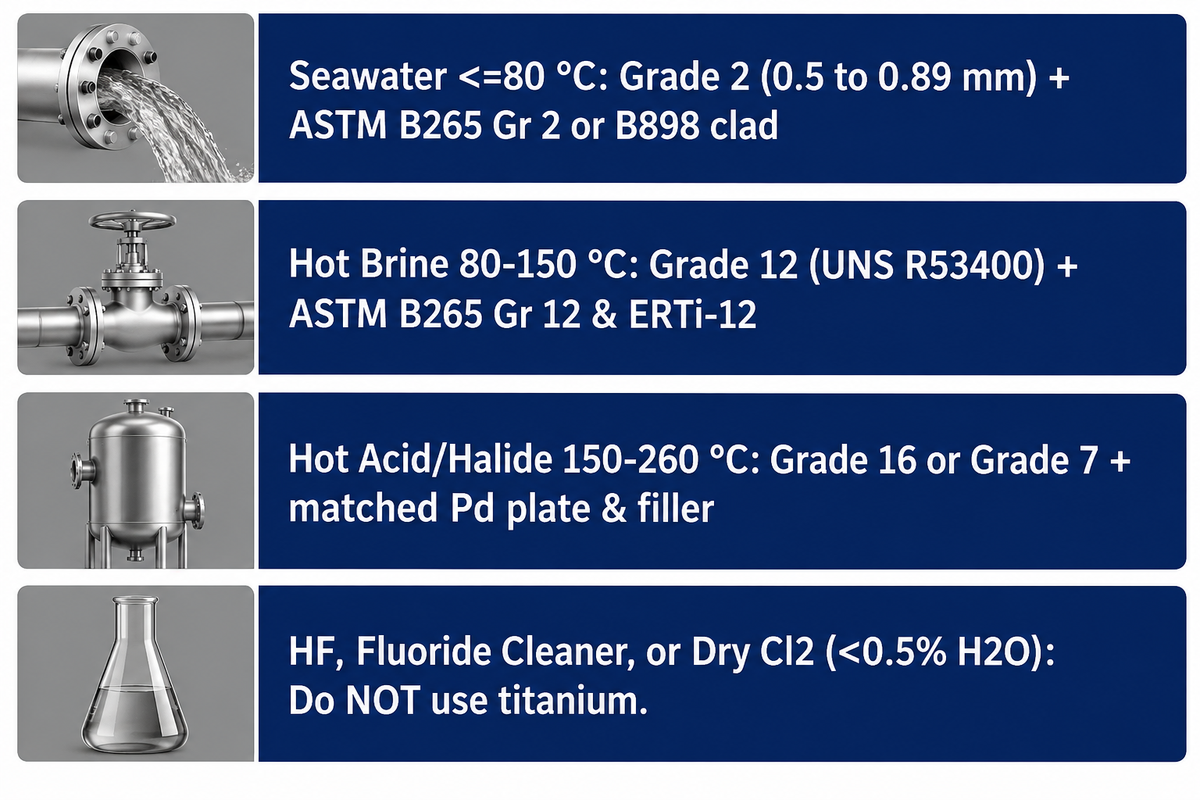
Aligning one ASTM B338 tubing designation with fluid chemistry, peak tube-wall temperature, and shell pressure prevents crevice leaks and excessive alloy spend across seawater, hot brine, and acid duties. Use this nine-row matrix to finalize your materials and care specification prior to issuing tender drawings.
| Process / Cooling Duty | Recommended B338 Grade | Route & Wall Guidance | Matched Tubesheet |
|---|---|---|---|
| Coastal power condenser (≤80 °C seawater) | Grade 2 (UNS R50400) | Welded B338, 0.5 to 0.7 mm (25–22 BWG) | ASTM B265 Gr 2 or B898 clad |
| Polluted brackish cooler with sand silt | Grade 2 (UNS R50400) | Welded or unwelded, 0.89 mm (20 BWG) | ASTM B265 Gr 2 solid plate |
| Tight-radius U-bend evaporator (≤80 °C) | Grade 1 (UNS R50250) | Cold-pilgered unwelded + U-bend anneal | ASTM B265 Gr 1 or Gr 2 |
| Hot brine / salt crystallizer (>80–150 °C) | Grade 12 (UNS R53400) | Unwelded or welded, 0.89 to 1.25 mm | ASTM B265 Gr 12 + ERTi-12 |
| Hot halide crevice (>150–250 °C, mild acid) | Grade 16 (UNS R52402) | Unwelded or welded min-wall order | ASTM B265 Gr 16 / Gr 7 clad |
| Hot reducing acid condensate (pH 1–3, ≤260 °C) | Grade 7 (UNS R52400) | Cold-pilgered unwelded min-wall (E = 1.00) | Solid ASTM B265 Gr 7 + ERTi-7 |
| High-pressure offshore gas cooler | Grade 9 (UNS R56320) | Heavy-wall cold-pilgered unwelded | ASTM B265 Gr 9 or forged Ti |
| Oxidizing nitric acid condenser | Grade 2 (low-Fe lot) | Unwelded B338, 1.25 to 1.65 mm wall | Solid ASTM B265 Gr 2 |
| HF, fluoride cleaner, or dry Cl2 (<0.5% H2O) | Do NOT use titanium | Switch to Ni-Cr-Mo alloy or fluoropolymer | Non-titanium wetted system |
Ready to specify your exchanger tube and tubesheet package? Review our ASTM B338 and B265 Grade 2 titanium mill forms, then send your bundle drawing and process conditions for a technical quote supported by EN 10204 3.1 certification.
Frequently Asked Questions
Can caustic cleaning or hydrochloric acid descaling damage titanium condenser tubes?
Yes, uninhibited hydrochloric acid above 5 wt % strips titanium’s passive film. Concentrated caustic above 80 °C also causes corrosion and hydrogen pickup.
Remove all fluoride salts such as ammonium bifluoride from cleaning solutions immediately. For carbonate scale, circulate dilute inhibited hydrochloric acid below 40 °C with ferric passivating inhibitors, or choose citric and sulfamic descalers approved for ASTM B338 bundles.
What causes hydrogen pickup and hydride brittle cracking in titanium bundles?
Hydride cracking starts when three triggers overlap. Surface potential drops below -0.75 V SCE, atomic hydrogen forms on the tube, and wall temperature exceeds 80 °C (176 °F).
Typical plant causes include zinc anodes in hot waterboxes, uncalibrated impressed-current rectifiers after retubing, active steel galvanic couples in sour condensates, or embedded iron smear left unpickled during fabrication.
Does seawater biofouling occur inside titanium cooling tubes without chlorination?
Yes, titanium dioxide is non-toxic to marine life. Barnacles, mussels, and slime colonize slow seawater tubes below 1.5 m/s unless treated.
Keeping continuous tube-side flow above 2.0 to 2.5 m/s prevents macro-fouling settlement without eroding titanium walls. Coastal plants pair steady velocity with 0.5 to 1.0 ppm sodium hypochlorite dosing or automatic sponge-ball cleaning.
What is the 10-13-rule in thermal exchanger layout?
Practical TEMA tube-pitch ratios sit near 1.25 to 1.33 times tube OD to preserve ligament strength and cleaning clearance.
Check exact pitch and roller-expander tool clearances against TEMA Class R, C, or B tables.
Why do thin-wall titanium tubes require closer baffle support spacing during vibration checks?
Grade 2 titanium carries a 103 GPa elastic modulus, roughly half the 193 GPa stiffness of 316L stainless steel. Seawater retrofits also step wall gauges down from 1.245 mm to 0.711 mm or 0.508 mm.
Lower bending stiffness reduces natural frequency and raises vortex-shedding or fluid-elastic vibration risk. Retubing a shell built for copper-nickel or steel requires adding support rods or stake strips and running a TEMA vibration check before assembly.
Can titanium tubes carry dry chlorine gas safely?
No, dry chlorine gas below 0.5 to 1.5 wt % moisture reacts violently with titanium and triggers rapid ignition.
Only wet chlorine gas with adequate water vapor maintains a protective TiO2 film.
How should U-bend titanium exchanger tubes be stress-relieved after cold bending?
Tight-radius cold-bent U-tubes undergo work hardening and residual tensile stress. Mills thermally stress-relieve tight bends around 480 °C to 595 °C inside vacuum or inert argon furnaces.
Every tube surface must be degreased per ASTM B600 before heating. Residual drawing oils, fingerprints, or shop dust baked onto hot titanium form brittle oxygen-rich alpha case and nucleate cracks along U-bend tangents.
References & Sources
- ASTM International, ASTM B338-17(2026): Standard Specification for Seamless and Welded Titanium and Titanium Alloy Tubes for Condensers and Heat Exchangers.
- U.S. Nuclear Regulatory Commission Archive (ADAMS ML993210187), Corrosion Resistance of Titanium (Condenser Tubing Hydriding and Chemical Compatibility Reference).
- International Titanium Association (James S. Grauman), Hydriding of Titanium: An Overview (Industrial Process Service).
- Scientific Reports (Nature Portfolio, 2025), Investigation of Mechanical and Metallurgical Properties of Commercially Pure Titanium Grade 2 Tube-to-Tubesheet Joints (Experimental Thermal Transfer Study).
- United States Patent US4943001A, Tube-Type Vessel Having Crevice-Free Joints and Method for Manufacturing the Same (Heat Exchanger Tube Sheets Without Crevice Corrosion).
- Patent CN112570979B, Repair Method of Fixed Tube-Sheet Heat Exchanger (Internal-Bore Tube-to-Tubesheet Welding Process).
- Marine Heat Exchanger Engineering Reference, Titanium vs 90/10 Copper-Nickel in Seawater Cooling Service.