Get in Touch with TiAlloy Company


By Cherry · Updated November 2026
In titanium vs stainless steel corrosion comparisons, Grade 2 is a reliable seawater candidate, while 316L can be the more economical choice for less hostile service. That choice can be altered by acids, crevices and mixed-metal joints.
A titanium tube can stay intact even though the stainless steel tube sheet is corroding. That means the wetted assembly and its joints and deposits are the correct unit of comparison. This guide compares commercially pure titanium to common stainless steel grades and turns those differences into a specification a buyer can use.
Key takeaways
- Choose by the worst operating, cleaning and shutdown conditions.
- Compare Grade 2 with a named stainless grade; Grade 5 titanium answers a different strength question.
- Check tubesheets, fasteners and cathodic protection when changing the tube material.
- Compare installed scope and replacement risk before deciding on material cost.
Titanium vs stainless steel corrosion at a glance
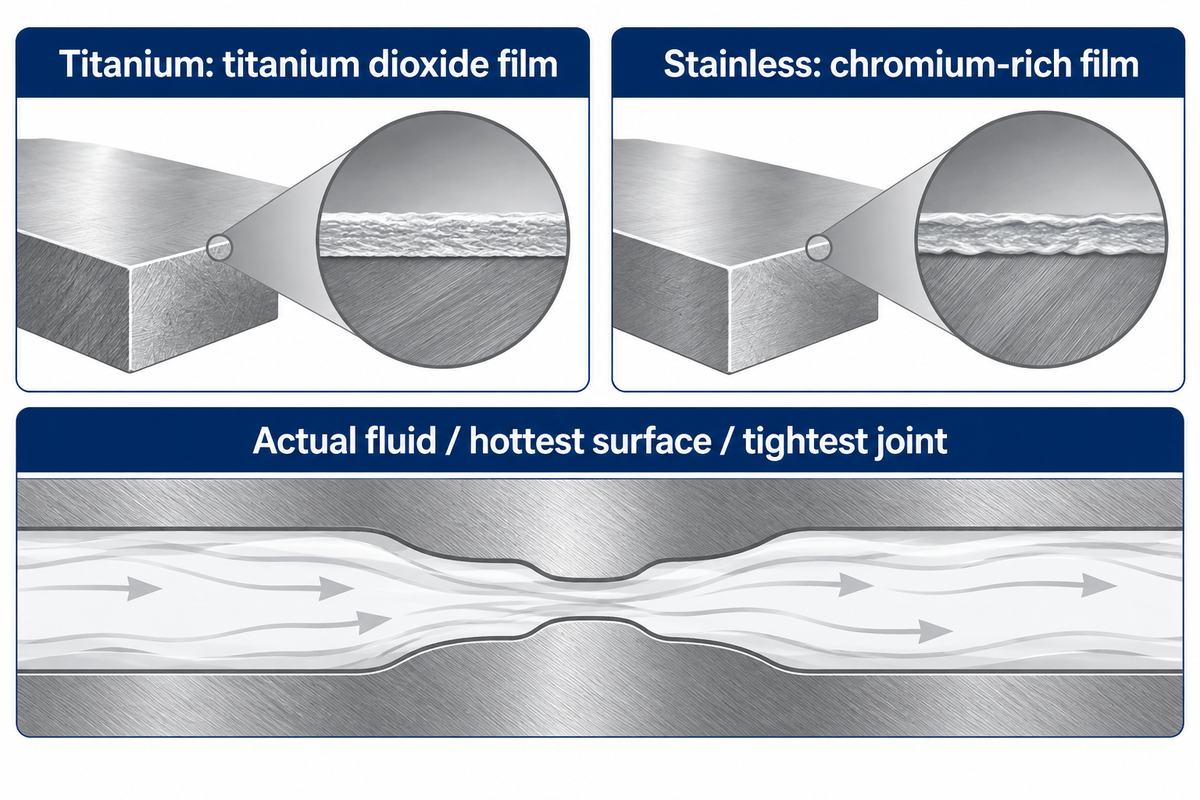
Grade 2 titanium offers exceptional corrosion resistance in many seawater applications because its titanium dioxide surface film remains protective. The International Titanium Association explains this protective oxide film and its ability to repair in the presence of oxygen or water. Stainless steel’s chromium-rich passive film behaves differently across alloy compositions. For a buyer, the useful question is which film stays protective in the actual fluid, at the hottest surface and inside the tightest joint.
Compared to stainless steel with recurring chloride attack, Grade 2 offers a corrosion control alternative. The corrosion resistance of titanium depends on its surface condition and does not imply immunity to all chemicals. Neither metal needs widespread corrosion to suffer a damaging leak.
General corrosion resistance tells only part of the story; compare types of corrosion before price per kilogram.
Start with Grade 2 titanium
Consider Grade 2 titanium when seawater is the main concern, chloride deposits recur, or a stainless component has failed from localized chloride corrosion. Review the entire wetted assembly and the cleaning process.
Keep stainless steel in the comparison
Keep stainless steel among the candidates when it has a good operating history in the same service, access to fabrication services matters, or a suitable duplex grade could address the identified failure mechanism.
Our Corrosion Choice Matrix below separates those decisions out by service condition. It also provides a rational basis for procurement to question a substitution: a superior tube material isn’t going to correct an incompatible joint.
Which grades are being compared?
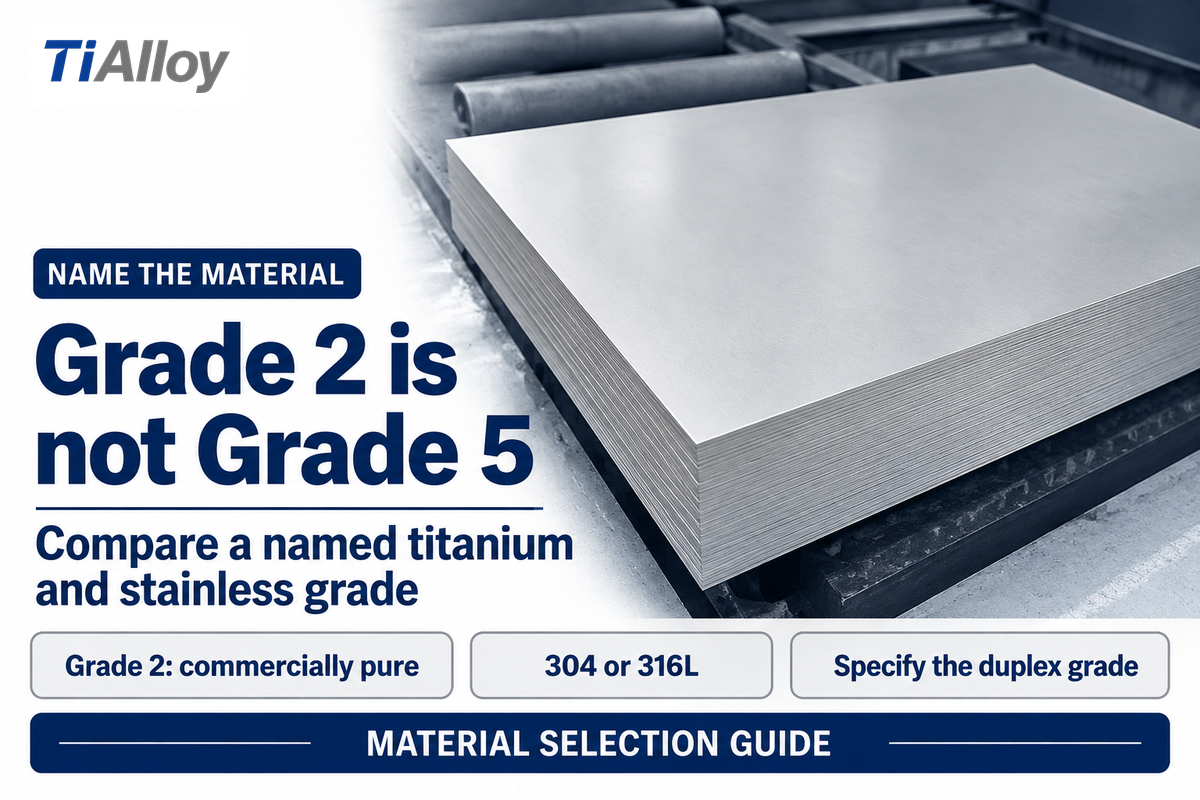
The comparison is commercially pure titanium Grade 2 versus austenitic stainless steel—304 or 316L—or a specified duplex grade. Selecting a titanium alloy vs stainless steel requires more detail: Grade 5 titanium is a strength-focused alloy, while Grade 2 is widely considered for corrosion-resistant process equipment. Titanium alloy and stainless steel applications overlap in process equipment, but stainless steel alloys differ in composition, weld response and resistance to local attack.
ASTM B338-17(2026) covers 28 grades of titanium and titanium alloy tubing for condensers, evaporators and heat exchangers. Its scope identifies Grade 2 as unalloyed titanium, UNS R50400. Grade 7 contains 0.12–0.25% palladium; Grade 12 contains 0.3% molybdenum and 0.8% nickel. These are two separate material options, not alternate names for titanium tube. Titanium alloys demonstrate different behavior in reducing acids because their alloying additions change passivity.
For common stainless steel applications, molybdenum-bearing 316L is considered before 304 when chloride attack is a concern. The low-carbon designation addresses weld-related sensitization; it doesn’t make 316L immune to pitting. Our 304 and 316 comparison explains that narrower grade choice.
Duplex stainless steels bring another option. Replacing underspecified 316L with 2205 duplex material in a refinery’s condenser is documented in a Heat Exchanger World article by Claes Tigerstrand and Jan Li of Outokumpu. Such stainless steel alternatives deserve investigation when the failure mechanism is known. Product standards set the material identity and requirements for delivery; suitability for service is defined by fluid and design.
Seawater and chloride corrosion
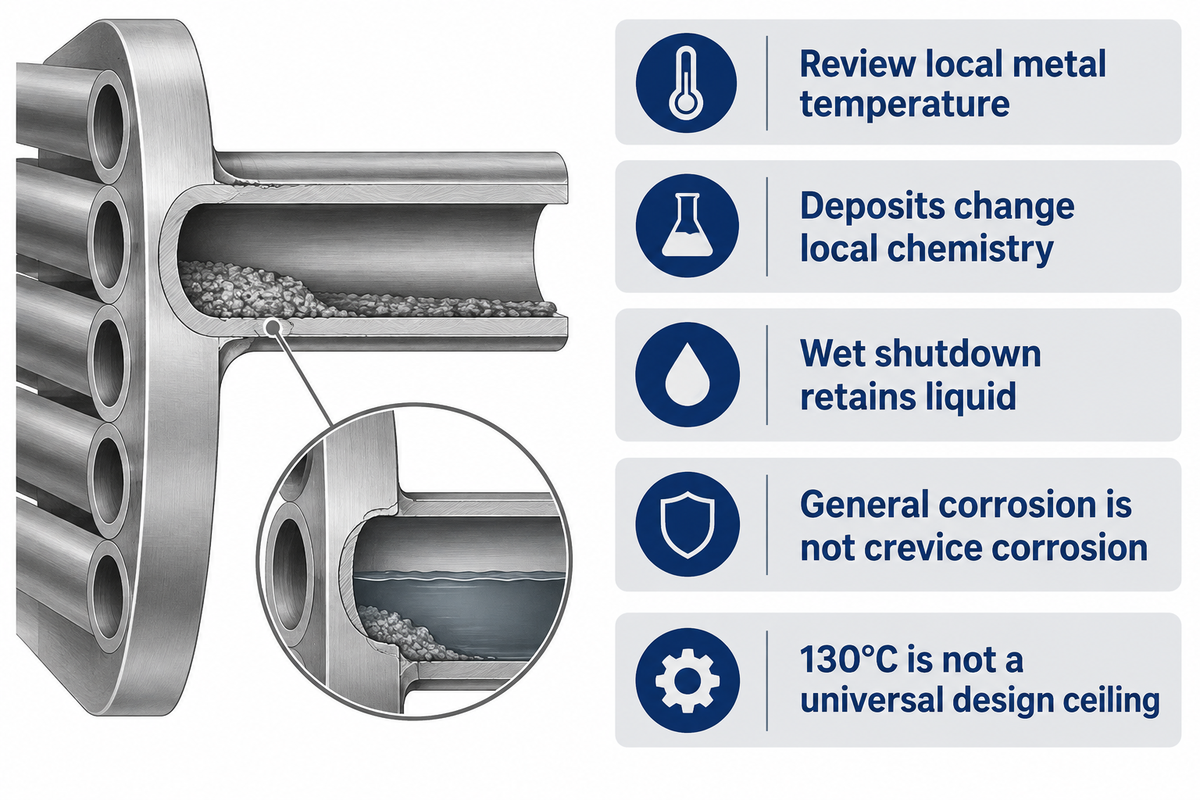
Commercially pure titanium has a strong seawater history, but general corrosion and crevice corrosion need separate assessments.
The International Titanium Association describes resistance to general seawater corrosion up to 130°C, while giving different crevice conditions. For a seawater heat exchanger, combine the crevice evaluation with local temperature and water treatment when contrasting titanium and stainless steel.
In Rob Henson’s association article on seawater service, commercially pure grades resist crevice corrosion in aerated seawater to at least 70°C; the article reports 94°C for deaerated seawater. Those figures describe different environments, so the 130°C general-corrosion figure isn’t a universal design ceiling for a gasketed or deposit-covered assembly.
Oxygen enables the damaged oxide film on titanium to heal. Stainless steel relies on passivity; however, chloride level, hot surfaces, and sheltered areas can all compromise that. Concentrated liquid beneath a deposit may behave differently from the bulk water sample taken at the inlet. Review the maximum local metal temperature alongside the normal fluid temperature.
Shutdown condition. Imagine a coastal cooling unit which runs cleanly during operation but stays wet over a weekend. Debris has been left at the tube entrance and a gasket protects another pocket of water.
When the unit is brought back on line, the operator notices normal inlet chemistry and assumes that the tube material has been protected. A comparison of titanium and steel should also examine the retained liquid, deposits and drainability.
Grade 2 may address the tube’s chloride exposure, but leaving an active stainless tubesheet or damaged lining in place can move the next failure to the joint. Include the shutdown and flushing in the substitution request with photos of the failed site.
On that same decision’s titanium-specific side, see Grade 2 corrosion behavior.
Pitting, crevices and stress corrosion cracking
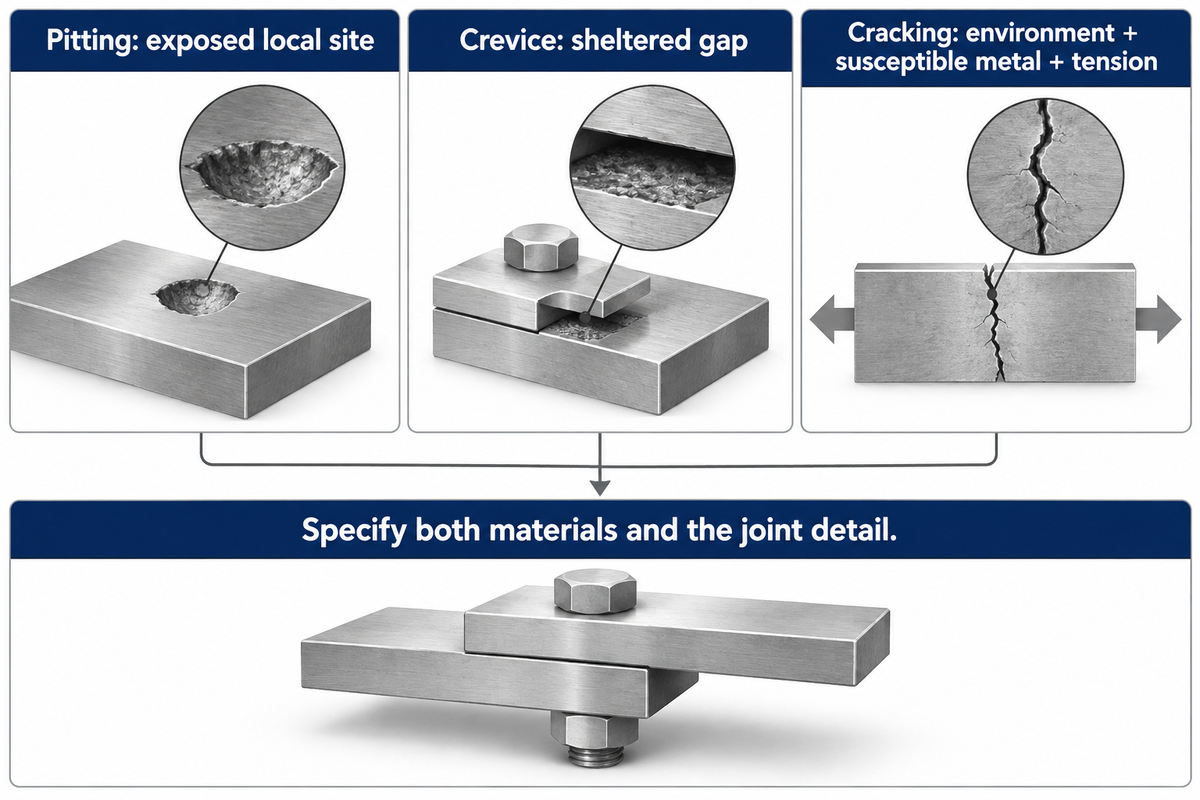
Pitting causes localized attack on an exposed site. Crevice corrosion occurs in a sheltered gap, while stress corrosion cracking requires a susceptible material under tensile stress in a particular environment. Titanium alloys and stainless steel exhibit varying susceptibilities to these modes of failure, so each requires a different solution.
Replacement of 304 with 316L improves performance in some chloride applications, but a persistent crevice or a chloride stress-cracking environment may require a substantial material or design change.
The Geo-Heat Center heat-exchanger chapter records a concrete failure: 316 stainless steel plates serving the Oregon Institute of Technology swimming pool failed from localized corrosion in less than 2 years. The combination of chlorides and oxygen mattered. A clean-looking plate elsewhere in the pack wouldn’t have established the condition of the leaking location.
Resistance to stress corrosion cracking deserves its own entry in the material review. A stainless grade chosen solely by means of a general corrosion table may overlook the impact of tensile stress at a weld or formed part. Titanium’s seawater performance, fatigue resistance and susceptibility to hydrogen damage require separate assessments.
The cause of failure should be identified before treating a stronger alloy as a remedy.
| Location or condition | Hidden problem | Buyer action |
|---|---|---|
| Tube entrance | Deposits shelter a local chemistry change | Include deposit removal and inlet inspection |
| Tube-to-tubesheet joint | Crevice and dissimilar wetted surfaces | Specify both materials and the joint detail |
| Gasket seat | Trapped liquid differs from bulk fluid | Review gasket geometry and drainability |
| Stainless weld area | Surface condition or metallurgical change | State weld treatment and acceptance criteria |
| Coated steel waterbox | Coating defect exposes a small active area | Define lining inspection and repair access |
| Mixed-metal fastener | Electrical contact remains through the bolt | Check sleeves, washers and the full connection |
| Chlorination point | Local treatment concentration exceeds the normal sample | Give dosing location and excursion chemistry |
| Cathodically protected system | Polarization can promote titanium hydrogen uptake | Review protection settings with the materials change |
| Wet shutdown | Stagnation leaves deposits and retained liquid | Write the drain, flush and restart procedure |
| Cleaning circuit | Cleaner compatibility differs from process-fluid compatibility | Specify cleaner composition and temperature |
Compare stainless steels across the same failure conditions, not just the name. If the purchase request reads only “better corrosion resistance,” send it back with the failed location indicated. Our guide to why stainless steel can rust helps to separate stain from more serious attack.
Acids, cleaning chemicals and titanium limits
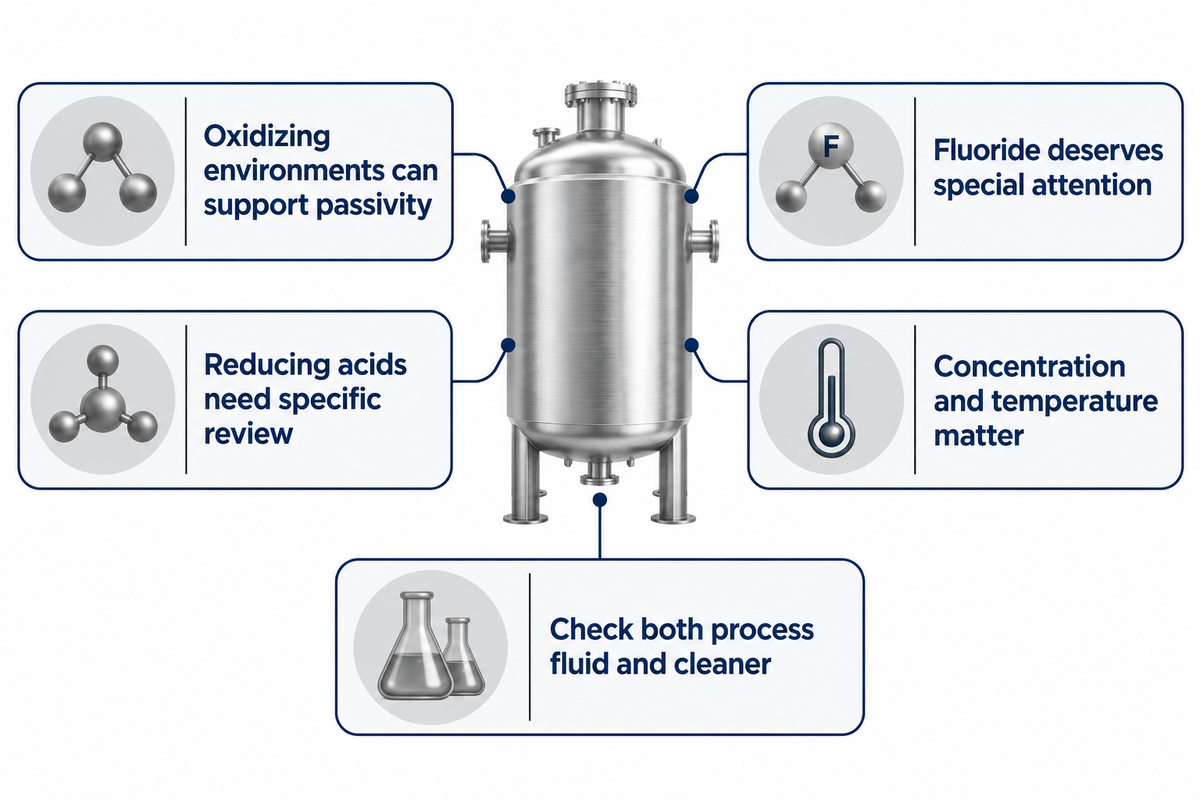
Titanium isn’t the automatic winner in acids. Oxidising environments can sustain the passive film of titanium, while reducing acids and fluoride-containing chemicals can challenge it. Stainless steel has its own acid limits. Select the grade using acid identity, concentration, temperature and contaminants, then repeat the assessment for the cleaning solution rather than assuming one material choice covers both.
The ASM Handbook discussion of titanium corrosion distinguishes oxidizing environments from reducing-acid conditions and explains why palladium-bearing grades can extend the useful range. A proposed Grade 7 substitution needs a reason tied to the chemistry. Titanium alloys offer corrosion resistance in specific environments; simply asking for a “higher grade” is an incomplete specification.
Chemical attack in contaminant-laden electrolyte. Ravi Shankar and colleagues investigated titanium heater tubes and stainless steel exchanger welds after 10,000 h in a nitric-acid loop. The heater received 6 M acid and discharged it at 380 K. Iron-rich corrosion products from stainless steel deposited on the titanium, and the investigation linked the titanium damage to galvanic effects and hydrogen-induced cracking.
The stainless weld areas also suffered localized attack associated with deposits. The investigation proposed surface heaters instead of immersion heaters, periodic inspection and frequent removal of corrosion products. This study highlights the unexpected failure of a chemically compatible base metal within a contaminated alloy assembly; it isn’t a report of the performance in normal seawater.
Read the failure investigation.
Thermal history can matter too. A study of titanium heat exchangers in pH 1.6 hot-spring water associated severe heat cycling with greater corrosion. For a replacement inquiry, provide the heat-up and cooldown pattern, not just a steady operating temperature. Titanium processing and the supplied surface condition belong in the investigation when nominally similar exchangers behave differently.
Never take a stainless cleaning formula over to titanium without compatibility assessment. Fluoride deserves special attention. Provide the cleaning contractor with actual wetted materials prior to selection of the cleaner and extend the review to include retained cleaner in dead legs.
Galvanic corrosion when the metals touch
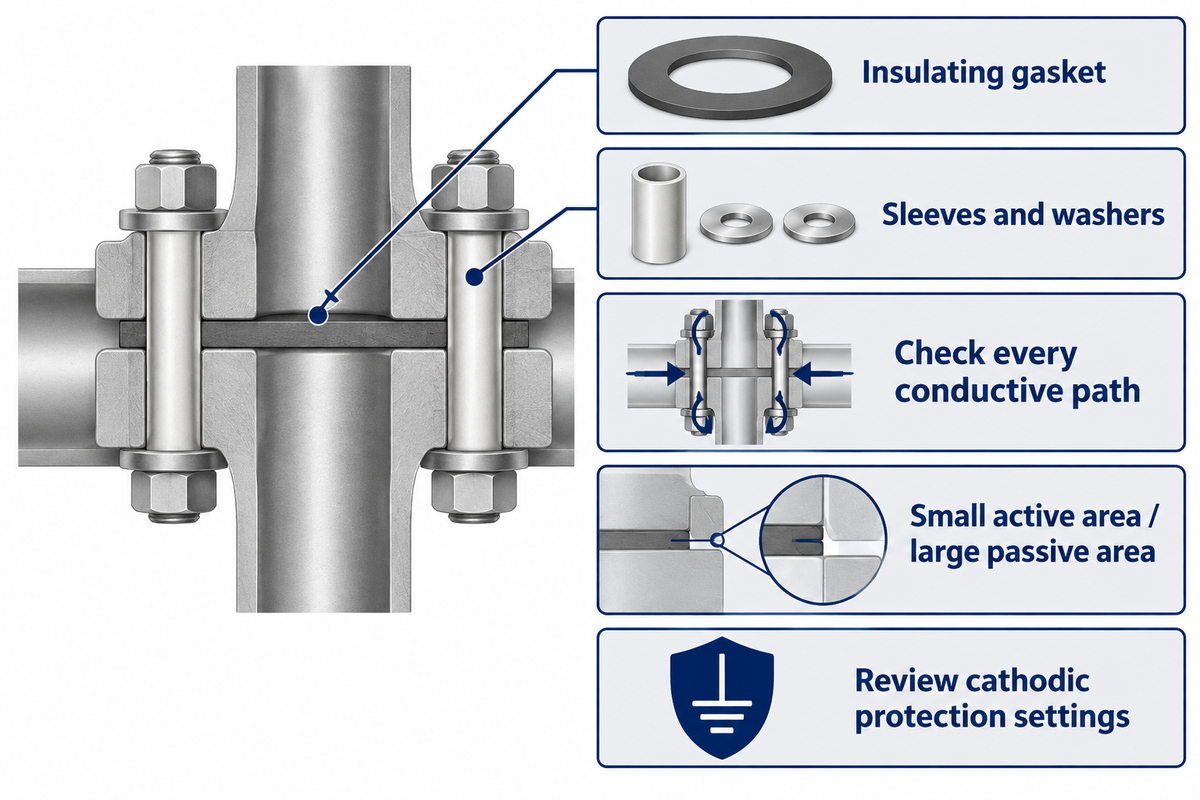
Titanium and stainless steel can share an assembly but a conductive liquid and electrical contact can also create a galvanic couple. Electrical insulation of the connection, coupling with a more compatible metal or a system built in 100-percent titanium can prevent galvanic corrosion. Risk depends on whether each surface remains passive, the exposed area ratio and the local chemistry. One small active stainless area linking to a much larger passive titanium surface warrants more scrutiny than dry mechanical contact.
“the difference of potential in an electrochemical cell alone is not a good indicator of the actual risk of galvanic corrosion.”
What two metals should not be used together?
There is no universal forbidden pair. Avoid a combination that leaves a small active metal surface electrically connected to a large noble surface in the service liquid.
Passive stainless steel connected to titanium presents a different condition from the same stainless steel after local film breakdown.
Isolation must be complete. An insulating gasket won’t isolate a flange if metal bolts are still bridging it. Check sleeves, washers and any other parallel conductive path.
Coating only the active metal can concentrate damage at the coating defect, so consider the exposed area after damage in your protection scheme.
Cathodic protection adds another variable. Murai and colleagues measured hydrogen absorption under cathodic polarization in artificial seawater flowing at 2.0 m/sec. Flow, deaeration, sand and the passive film affected uptake. That’s a reason to review a protection system when adding titanium, rather than carrying over its existing settings unchanged.
Grade 2 titanium or 316L for heat exchangers?
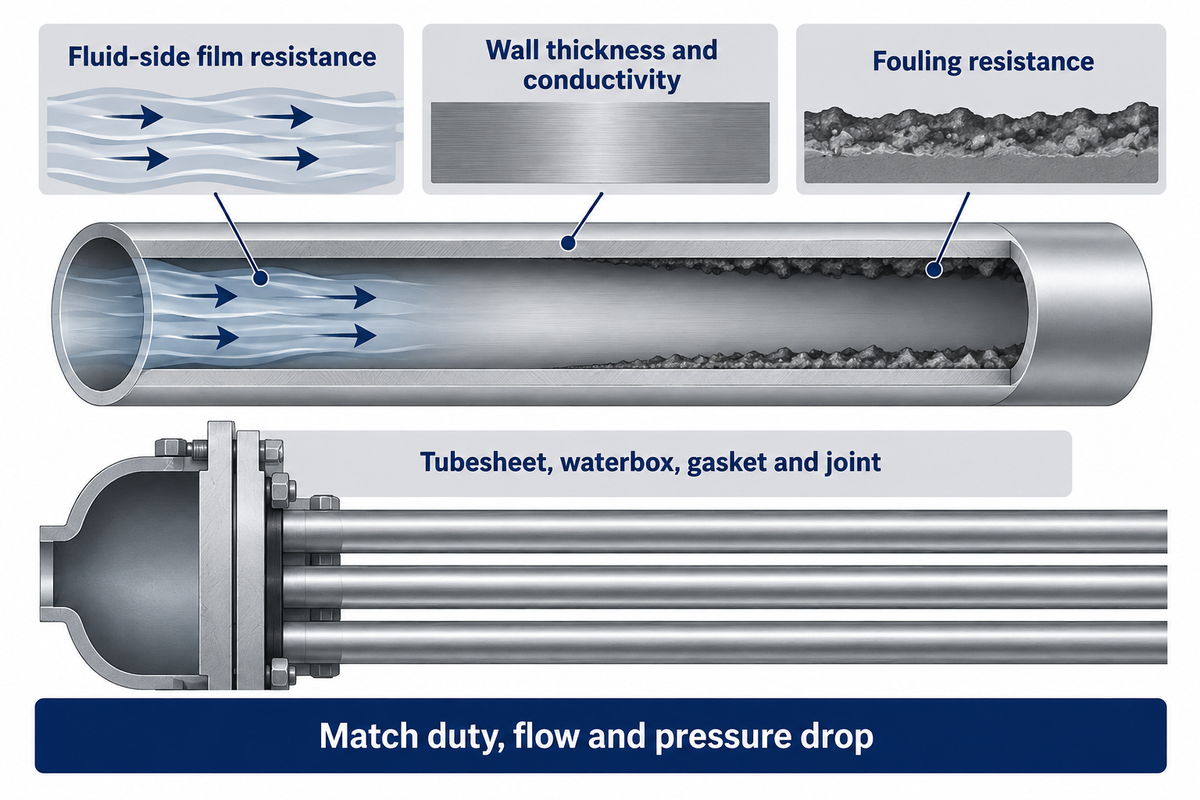
Grade 2 titanium is a strong candidate where seawater-side corrosion drives exchanger replacement, and 316L remains worth comparing in less severe service with a good operating record. In comparing titanium for an exchanger, the comparison of hot- and cold-sides should be made separately. Titanium components typically share an assembly with other materials; therefore, the tubesheet, waterbox, gasket and joint are part of the comparison.
Pressure drop and fouling are part of the operating cost.
What is the difference in thermal conductivity between stainless steel and titanium?
In their comparative analysis of titanium vs stainless steel, Skiba and colleagues reported thermal conductivities of 20.38 W/(m·K) for Grade 2 titanium and 16.24 W/(m·K) for 316L in their as-received specimens. Their 2018 heat-transfer study, Table 3, provides a concrete material-state comparison. After the second hydrostatic-extrusion pass in that study, the maximum conductivity decrease was 12% in Grade 2 and 13% in 316L, which is reason enough to include processing condition in the calculation.
The wall properties of titanium that matter are thickness and conductivity; a thinner wall or greater conductivity decreases the resistance of the wall. There’s also fluid-side film resistance and fouling resistance in the complete exchanger, and hence the relative comparison of materials doesn’t give an equivalent percentage increase to the exchanger efficiency. Use the properties at design-temperature for the final sizing calculation.
An engineer receives a proposal to replace a leaking 316L bundle with Grade 2 tube. The proposal retains the shell and advertises improved heat transfer. Before he signs off, he compares wall thickness, tube numbers, velocity, pressure drop and fouling allowance with the original duty.
A thinner titanium wall might help the thermal design, but changed tube dimensions could alter flow and support requirements. The procurement department then checks whether the quote covers the tubesheet and joint work. The useful result is a replacement bundle that meets the duty and handles the seawater-side corrosion mechanism, with all required interface work included in the price.
Ask for the thermal calculation on a common basis. A low-pressure-drop design may cost more initially while reducing pumping demand; a cheap bundle with excessive pressure drop moves cost into operation. Compare that trade off to the corrosion evaluation.
Fabrication, cleaning and maintenance trade-offs
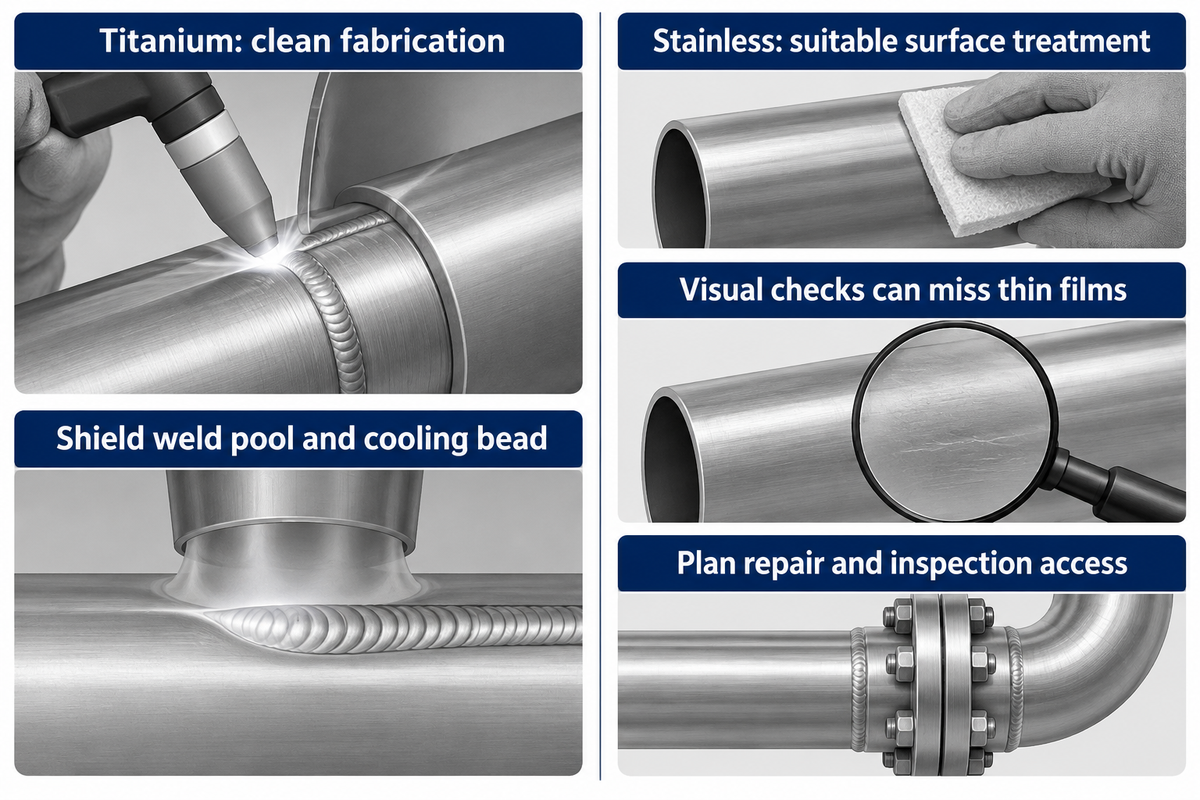
Titanium needs clean fabrication and effective shielding around hot weld metal; stainless steel needs appropriate weld and surface treatment for its service. Both types may lose corrosion resistance through poor workmanship. A titanium alloy versus stainless steel fabrication comparison should include the procedure, cleanliness controls and inspection access, especially for repairs at an operating plant.
TWI’s titanium welding guidance notes its strong affinity for oxygen, nitrogen and hydrogen above 500°C. Shielding must protect the weld pool, heat-affected zone and cooling bead. Tube welding also needs protection on the underside. Iron particles introduced by shared tooling can create corrosion-prone sites, which is why clean handling and separation from steel fabrication matter.
When comparing the surface properties of stainless steel components, ASTM A380/A380M-25 provides cleaning, descaling and passivation guidance. A visual check can miss a thin film of oil or chemicals. Confirm the cleaning process and the acceptance verification – don’t take “looking clean” as all that is needed.
Cleaning in service deserves its own procedure – the scope of this practice does not include equipment already in service.
Maintenance access should be considered in the drawing review. Can a technician reach the tube entrance, remove deposits and inspect the liner without dismantling unrelated equipment? If the only qualified repair route requires off-site work, include that outage in the commercial comparison.
Cost: compare the installed scope and replacement risk
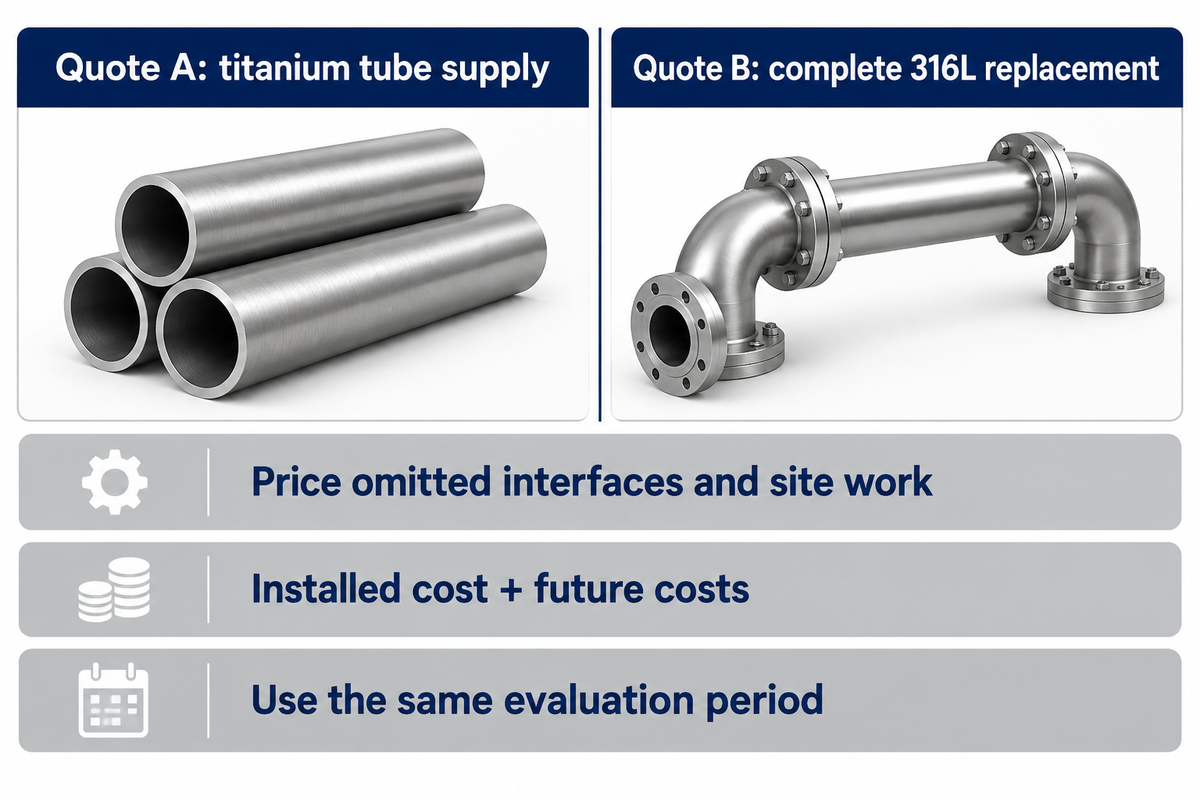
Compare the installed package, not the raw material prices alone. A change in the stainless steel market is a reason to refresh a quotation, not to assume a different corrosion performance. A cost analysis of titanium should credit a credible reduction in replacement or outage risk.
Stainless steel often remains the economical purchase in compatible service. Material cost, fabrication, interfaces, inspection and downtime need the same boundaries in both quotations before a financial comparison is meaningful.
The Geo-Heat Center chapter gives a historical titanium plate premium of approximately 50%, alongside cost figures expressed in 1996 dollars. Figure 11.5 reports plate heat exchanger costs in 1996 dollars per square foot of heat transfer area. That’s a plate-level historical comparison, not a current whole-exchanger price multiplier. Request current quotations against the same scope; our titanium pricing guide explains the ordering variables behind a material quote.
| Scope item | Quote A: titanium tube supply | Quote B: complete 316L replacement | Normalize before deciding |
|---|---|---|---|
| Heat-transfer material | Grade 2 tube | 316L bundle | Same duty and acceptance basis |
| Tubesheet and joints | Not included | Included in assembly | Add compatible interface work to A |
| Waterbox or lining work | Retained equipment | Defined replacement scope | Inspect retained surfaces and price repairs |
| Fabrication and testing | Tube-level documents | Assembly-level tests | Add assembly fabrication and tests to A |
| Removal and installation | Site contractor required | Quoted installation scope | Use the same site labor boundary |
| Outage and future replacement | Owner estimates from the work plan | Owner estimates from the work plan | Compare credible failure and repair scenarios |
In this example, no estimated market price exists. Its result is a concrete purchasing action: get the omitted work priced before declaring Quote A cheaper. Procurement can then compare the installed cost plus expected inspection, maintenance, replacement and lost-production costs over the same evaluation period.
When the failure mechanism remains unresolved, devote the engineering effort to the failed part and deposits first. A more expensive replacement with the same weak joint can preserve the original outage risk. Stainless steel offers the practical advantage that known site repair procedures cut outage time.
Choose by service condition
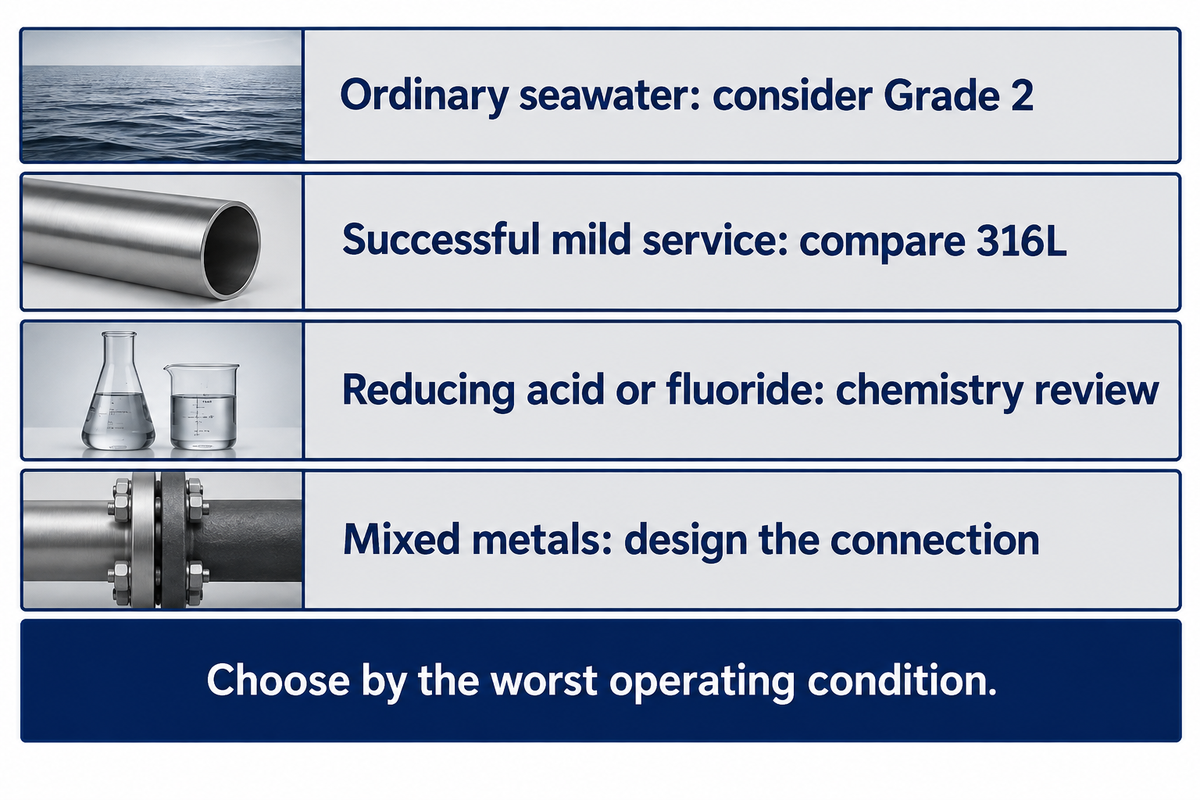
Apply the Corrosion Choice Matrix to reduce the comparison before requesting a price. It isolates seawater exposure, acid chemistry, mixed-metal contact and fabrication limitations because each alters the sourcing issue. Pick the row that incorporates the worst case condition throughout the entire operating cycle.
| Service condition | Material direction | Why | What closes the decision |
|---|---|---|---|
| Ordinary seawater heat transfer | Consider Grade 2 titanium | Strong seawater corrosion performance | Local temperature, crevices and assembly compatibility |
| Mild service with successful 316L history | Retain 316L in the comparison | Existing service evidence and familiar fabrication | Confirm chemistry and duty have not changed |
| Recurring 304 chloride pitting | Compare 316L, duplex and titanium | A grade upgrade may help, but the mechanism sets its size | Deposits, temperature and failed surface examination |
| Persistent hot chloride crevices | Assess alloyed titanium or a more resistant stainless grade | General-corrosion data misses sheltered attack | Specific chemistry and crevice performance |
| Chloride stress corrosion cracking | Review duplex or titanium alternatives | Susceptibility differs by alloy family | Stress, weld condition and environment |
| Oxidizing acid process | Compare named grades using acid-specific data | Concentration and contaminants change behavior | Process and cleaning envelope |
| Reducing acid or fluoride cleaner | Do a dedicated compatibility selection | Titanium passivity can be challenged | Exact chemistry, concentration and temperature |
| Titanium joined to existing steel | Design the connection as part of the upgrade | Galvanic effects can move the failure location | Area ratio, insulation and active surfaces |
| Cathodically protected seawater system | Review titanium hydrogen uptake conditions | Protection changes the electrochemical environment | Protection design and operating conditions |
| Site welding with limited clean access | Price a controlled fabrication route | Titanium weld quality depends on shielding and cleanliness | Procedure, repair access and inspection plan |
Specialized stainless grades need a grade-specific comparison. Labels such as advanced stainless steel formulations leave the buyer without the composition needed to assess the service. Proposed stainless steel equivalents should identify the grade and product condition. Our duplex stainless steel guide helps narrow that option. For a recurring failure, retain the removed component and its deposits for examination before cleaning away the evidence.
- Describe the worst condition — include startup, wet shutdown and cleaning excursions.
- Identify the vulnerable location — distinguish tube wall, weld, gasket, coating and mixed-metal joint.
- Compare a complete replacement scope — choose the material and its fabrication, interfaces and inspection together.
What to specify before requesting a quote
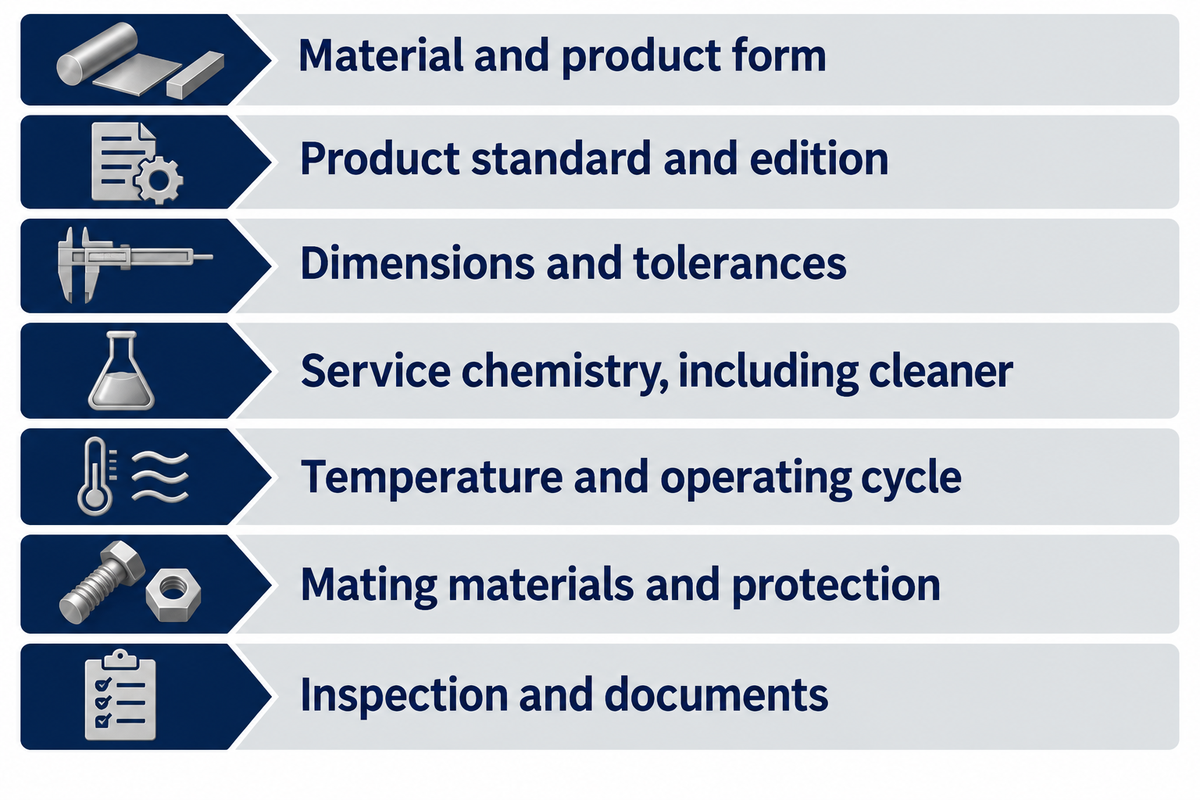
Send the service description and the product specification at the same time. Grade, dimensions and quantity tell the supplier what to supply; chemistry, temperatures and the connection details tell them why. For a replacement, send the existing drawing and failure location so the quote covers the assembly change instead of repeating the dimensions of the failed part.
At TiAlloy, we supply Grade 2 plate and sheet, tube and pipe, bar and rod, wire and forgings, with drawing-based requirements agreed for the order. We coordinate the relevant production and inspection steps using our own resources and those of approved partners. Inquire which titanium production and inspection steps are included in the quoted route.
Heat identification, material documentation, marking and packing belong in the agreed order scope.
| Parameter | Recommended range or entry | Why it matters | How to verify |
|---|---|---|---|
| Material and product form | Grade 2; tube, sheet, bar or specified form | Sets the supply and fabrication route | Drawing and purchase specification |
| Product standard | Applicable edition; B338 when appropriate for exchanger tubing | Defines ordered product requirements | Order review and material certificate |
| Dimensions and tolerances | Outside diameter, wall, length and tolerances from the design | Controls fit, duty and joint compatibility | Approved drawing and inspection report |
| Service chemistry | Normal and excursion composition, including cleaner | Supports corrosion selection | Process data and water analysis |
| Temperature and operation | Normal, maximum local temperature and thermal cycle | Identifies hot spots and shutdown exposure | Operating record and design conditions |
| Mating materials | Tubesheet, fasteners, gaskets and protection system | Exposes assembly-level compatibility issues | Assembly drawing and protection review |
| Inspection and documents | Agreed tests, heat traceability and certificate requirements | Matches acceptance to the supplied scope | Approved inspection and document list |
For dimensional planning, use our Grade 2 tube size guide. State any EN 10204 3.1 certificate or additional inspection requirement at inquiry stage so it can be agreed before production. A tube certificate and a completed exchanger acceptance test answer different questions.
Review our Grade 2 titanium supply options, then send your drawing and service conditions. We can prepare the material and documentation scope for your comparison.
Frequently asked questions
Is titanium or stainless steel more corrosion resistant?
Grade 2 titanium is generally the stronger candidate for ordinary seawater exposure than common 304 or 316L stainless steel. Reducing acids, fluoride-containing cleaners, elevated temperatures and tight crevices can change the result. Start with the actual grade, chemistry and operating conditions, then compare the evidence for each material rather than relying on a general corrosion-resistant label.
What is the downside of titanium?
Titanium can require a higher initial investment and a different fabrication route from familiar stainless steel components. Its corrosion resistance also doesn’t settle questions about stiffness, wear or joint design. For a replacement project, check the process fluid, cleaning chemicals, mating materials and inspection requirements together. A material that survives the process may still create difficulties during fabrication or maintenance, so the purchase decision needs more than a comparison of raw material prices.
Can you weld titanium and stainless steel to each other?
Use a qualified transition or mechanical joint for titanium-to-stainless assemblies; ordinary matching-metal fusion-welding procedures don’t establish a suitable dissimilar joint. These are different material systems, and the joint needs a qualified engineering route. For a mixed-metal exchanger, ask the equipment designer to specify the transition or mechanical joint and its inspection requirements. Selecting the tube material alone doesn’t qualify the completed assembly.
Is titanium a stainless steel?
No. Titanium and stainless steel are different material families. Grade 2 is commercially pure titanium; stainless steel is an iron-based alloy whose chromium-containing passive surface provides corrosion resistance.
What is the strength comparison between titanium and stainless steel (specifically 316L)?
In Skiba and colleagues’ initial specimens, Grade 2 had a tensile strength of 543 MPa versus 593 MPa for 316L, but its yield strength was higher: 399 MPa versus 311 MPa. These are the study’s measured values, not purchase-standard minimums. Comparing titanium alloys and stainless steel therefore requires both the property and material condition. An analysis of titanium alloys vs stainless steel also needs the exact alloy designation, since Grade 2 and Grade 5 have different compositions. Commercially pure titanium and Ti-6Al-4V are different grades; annealed 316L also differs from cold-worked stock. Use specified minimum properties when comparing quotations, with the study’s Table 1 as an example of why tensile and yield rankings can differ. Alloy compositions and heat treatments affect the result, so a typical datasheet value belongs to that material and condition. Titanium and stainless steel alloys need separate checks for strength, stiffness, hardness, wear and corrosion. Titanium is lighter than stainless steel by volume, but a component may need a different wall thickness or support arrangement. A corrosion-resistant tube can also require a joint redesign. For an actual substitution, give the designer the governing product standard, certified mechanical results and service conditions. Compare the finished component under the same requirements instead of treating a generic tensile-strength table as permission to exchange the two metals.
References & Sources
- ASTM B338-17(2026): titanium tubing scope and grades.
- Tigerstrand and Li (Outokumpu), Heat Exchanger World: formable duplex grades for plate heat exchangers.
- ASM International: titanium corrosion mechanisms.
- International Titanium Association: Rob Henson on titanium in seawater service. The author identifies a titanium-industry commercial affiliation.
- Euro Inox: Stainless Steel in Contact with Other Metallic Materials, 2009.
- Rafferty and Culver, Geo-Heat Center: Heat Exchangers, Chapter 11. Historical cost and service examples.
- Ravi Shankar et al.: failure analysis in a nitric-acid loop.
- Murai et al.: hydrogen absorption under cathodic polarization, 1977.
- Iino et al.: titanium heat exchangers in acidic hot-spring water, 2014.
- TWI: weldability of titanium and titanium alloys.
- ASTM A380/A380M-25: stainless steel cleaning and passivation scope.
- Skiba et al.: hydrostatic extrusion and thermal properties of Grade 2 and 316L, 2018.