Get in Touch with TiAlloy Company

Grade 2 Titanium Tube Sizes: Dimensions, Standards, and How to Specify Them

Grade 2 Titanium Sizing Guide
A buyer’s request for Grade 2 titanium tube often starts with a single size, such as “1 inch tube” or “25 mm tube.” That, by itself, is not sufficient for a mill or distributor to come up with a quote. A useful callout identifies outside diameter (OD), wall thickness, length, tolerance, delivery condition, applicable ASTM specification, and records required with the heat. The inside diameter (ID) is calculated from OD and wall rather than taken from a stainless-steel schedule.
Which dimensions belong on a Grade 2 titanium tube RFQ?
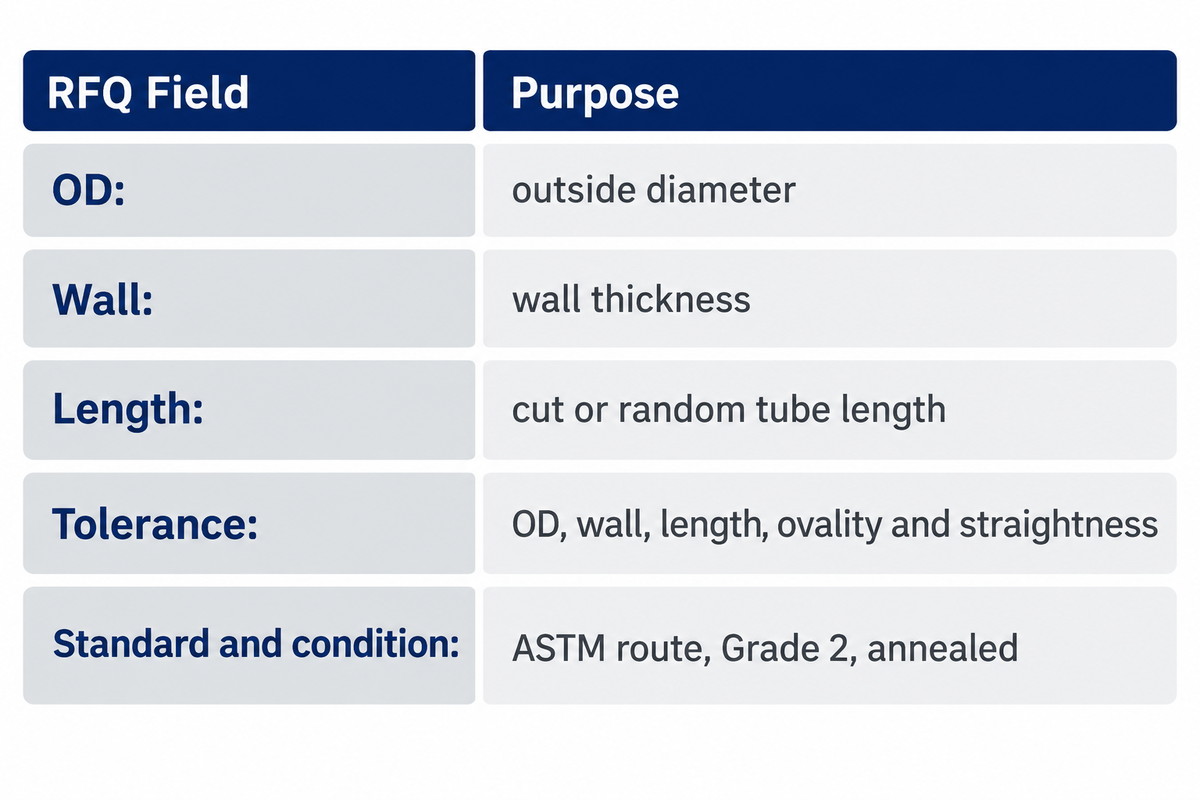
Use the 5-Field Tube Size Record to provide the information before asking for a quote: Record dimensions and units together, specify the wall basis, and identify the applicable product standard. Ask suppliers to echo each field so offers can be compared against the same drawing and acceptance requirements.
| Field | What to write | Why it matters |
|---|---|---|
| OD | 25.40 mm (1.000 in) | Fit, tooling, bundle spacing |
| Wall | 1.00 mm or 0.049 in | ID, flow area, handling, mass |
| Length | Cut or random tube length | Yield, packing, freight |
| Tolerance | OD, wall, length, ovality, straightness | Acceptance limits |
| Standard / condition | ASTM route, Grade 2, annealed | Chemistry, tests, documents |
Also state whether the order needs welded or non-welded tube, end preparation, surface finish, eddy-current or hydrostatic testing, and a heat-number-linked mill test report. This information allows the supplier to differentiate a catalog size, a converted size and a size which requires a new production run.
For a round tube, specify whether the wall is ordered on a minimum or average basis. This choice affects the bore available to an expander or fitting. Elliott Tool explains that a nominally suitable expander can lack clearance at the thick end of a minimum-wall range. Measure the actual inside diameter before ordering tooling and agree the acceptance limits with the tubing manufacturer. As a general tooling reference, Elliott Tool cites industry tolerances of ±10% on wall thickness, a total variation of up to 20%; check them against the ordered standard’s own wall tolerance. Elliott Tool wall-basis guidance
Grade 2 titanium tube size chart: how to read OD, ID, and wall
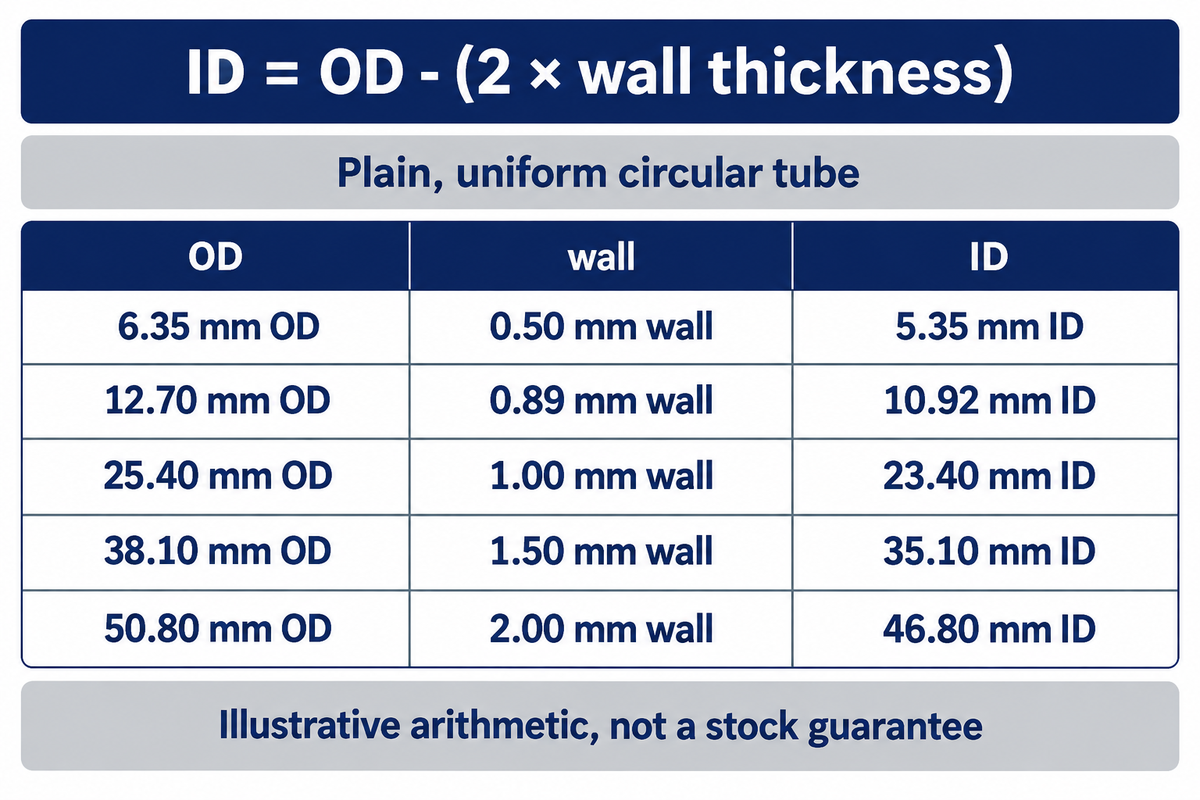
For a plain, uniform circular tube, ID = OD – (2 × wall thickness).
These are arithmetic examples, not a stock list.
| OD | Illustrative wall | Calculated ID |
|---|---|---|
| 6.35 mm (0.250 in) | 0.50 mm | 5.35 mm |
| 12.70 mm (0.500 in) | 0.89 mm | 10.92 mm |
| 25.40 mm (1.000 in) | 1.00 mm | 23.40 mm |
| 38.10 mm (1.500 in) | 1.50 mm | 35.10 mm |
| 50.80 mm (2.000 in) | 2.00 mm | 46.80 mm |
One inch equals 25.4 mm exactly. Keep both units when providing a request for quote (RFQ) when a drawing uses inch hardware and a mill quotes in metric units. Do not copy a stainless nominal schedule into a titanium tube order: nominal size, actual OD, and wall definitions can differ by product family.
Published Grade 2 titanium tubing catalogs show discrete combinations. Tricor Metals lists seamless titanium tube with a 0.500-inch OD and wall thicknesses of 0.028, 0.035, 0.049 and 0.065 inch. Its 1.000-inch OD row lists wall thicknesses of 0.035, 0.049 and 0.065 inch. The welded table has a different set of pairings. Ask a stockist to confirm the exact construction, quantity and released lot for the combination you need. These examples come from Tricor’s public catalog. TiAlloy confirms availability for the size combination in your enquiry. Published Grade 2 size combinations
Which ASTM specification controls the size and test requirements?
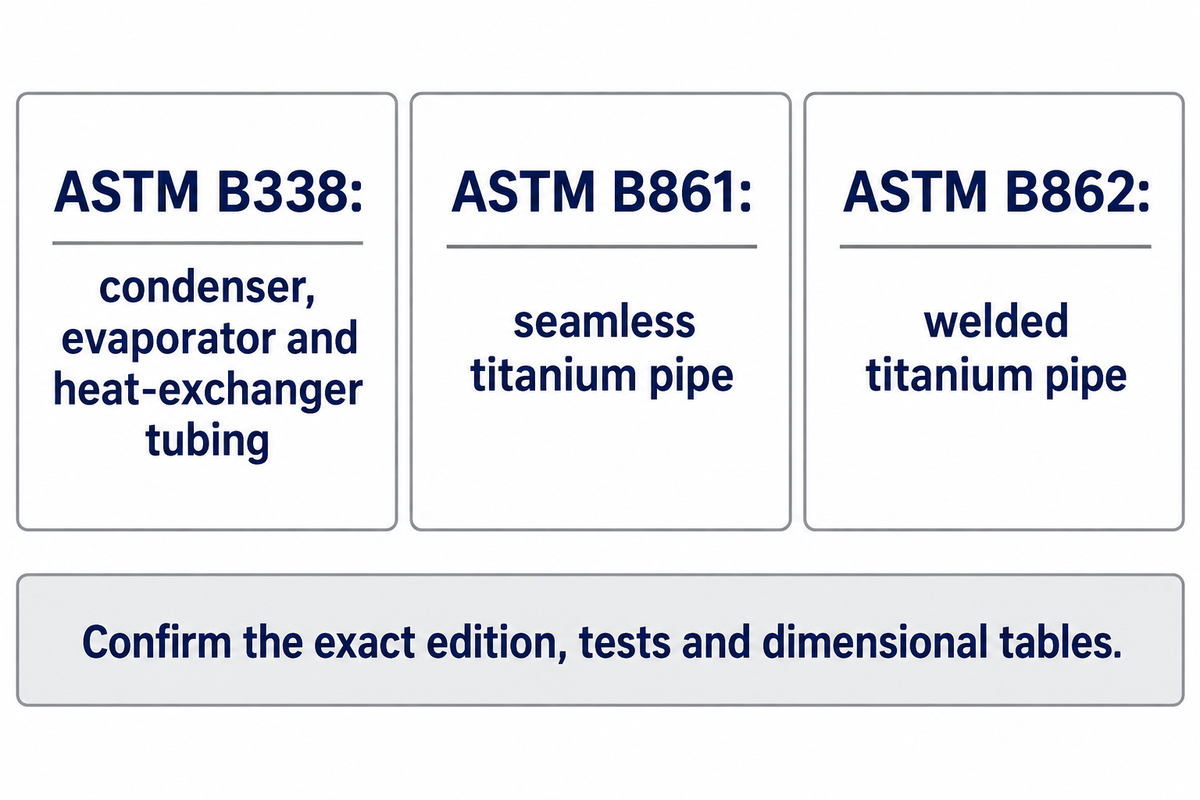
ASTM B338 covers titanium and titanium-alloy tubes intended for surface condensers, evaporators, and heat exchangers. ASTM B861 covers seamless titanium pipe, and ASTM B862 covers welded titanium pipe. See the publisher scopes for ASTM B861 seamless pipe and ASTM B862 welded pipe. Check the exact scope, grade list, heat treatment, tests, and dimensional tables in the edition named on the purchase order.
B338 covers both seamless and welded tubing. State the manufacturing route when ordering so the supplier can apply the corresponding test requirements. Compare offers against the exact standard and revision specified. For welded tube, the public abstract calls for a reverse flattening test plus both an electromagnetic and an ultrasonic test, so list the required tests on the order rather than accepting a general promise of tested material. ASTM B338 scope
Ask the supplier to identify the selected route explicitly as seamless tubing or welded tube. A seamless tube is produced without the longitudinal weld used in welded construction. The grade of titanium and the manufacturing route are separate order fields. For pipe inquiries, retain the distinction between seamless pipes and welded pipe in the purchase description. Agreement on a grade alone leaves the product form unresolved.
“Grade 2, 1 inch” is incomplete. A defensible line also states UNS R50400, the standard, delivery condition, OD, wall, length, tolerances, inspection tests, and document level. TiAlloy’s Grade 2 titanium supply page shows common routes as B265, B338, B348, B861, B862, and B381. Its company profile describes inspection records, dimensional checks and batch traceability that can support each order.
How to choose wall thickness for heat transfer, flow, and fabrication
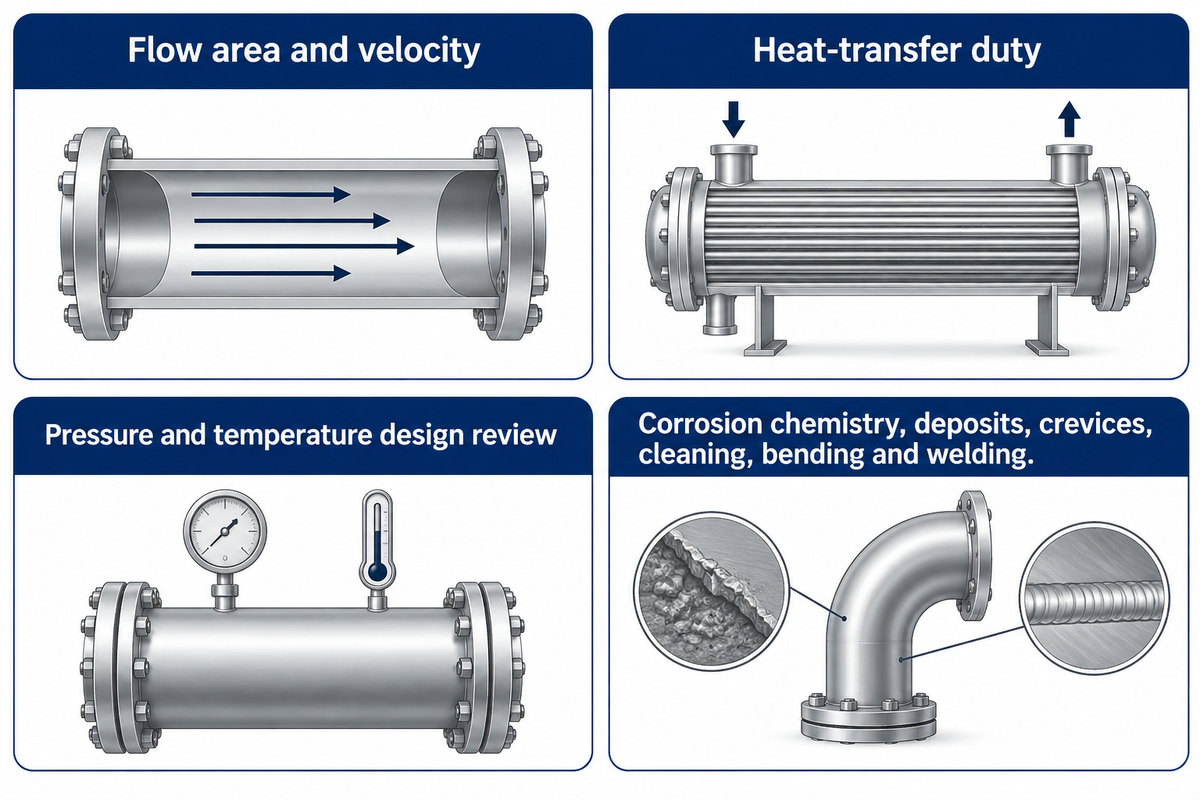
Wall selection is a decision problem, not a lookup from OD only. Check flow area and heat-transfer duty, then complete the responsible design-code review for pressure and temperature. Separately review corrosion chemistry, deposits, velocity, crevices, cleaning, bending, welding, and handling. A size chart can’t provide a universal pressure rating.
| Check | Question |
|---|---|
| Flow / heat transfer | What ID and surface area meet the process target? |
| Design review | What code, temperature, pressure, supports, and transients govern? |
| Service envelope | What chemistry, velocity, deposits, and cleaning method apply? |
| Fabrication | Can the wall be bent, welded, cleaned, and inspected at the required length? |
Grade 2 forms a protective oxide film in many oxidizing aqueous environments. However, its resistance is dependent upon the operating chemistry and surface state. It’s inappropriate to generalize that property to a broad service approval.
Titanium Grade 2 is an unalloyed, commercially pure grade. Specify the commercially pure titanium grade, product form and delivery condition together when ordering. Alleima’s Grade 2 datasheet describes moderate strength, formability and weldability, with corrosion resistance depending on the environment. These properties help guide material selection, while determining the allowable working pressure requires a separate design calculation. Compare the tensile strength and yield strength reported on the lot certificate with the requirements in the ordered specification. For Grade 2, ASTM B338 sets minimums of 345 MPa ultimate strength and 275 MPa yield strength; the permitted tube wall comes from the design calculation, not a strength-to-weight ratio comparison. Grade 2 material and fabrication data
Descriptions of excellent corrosion resistance need the operating chemistry attached to them. Good weldability also depends on an appropriate procedure and clean handling. Evaluate ductility when bending changes the tube geometry, and confirm the resulting dimensions after fabrication. When comparing alloyed grades, ask what requirement justifies a substitution. For transport or support estimates, request tubing weight per unit length for the actual ordered dimensions.
How to verify Grade 2 titanium tube sizes before purchase
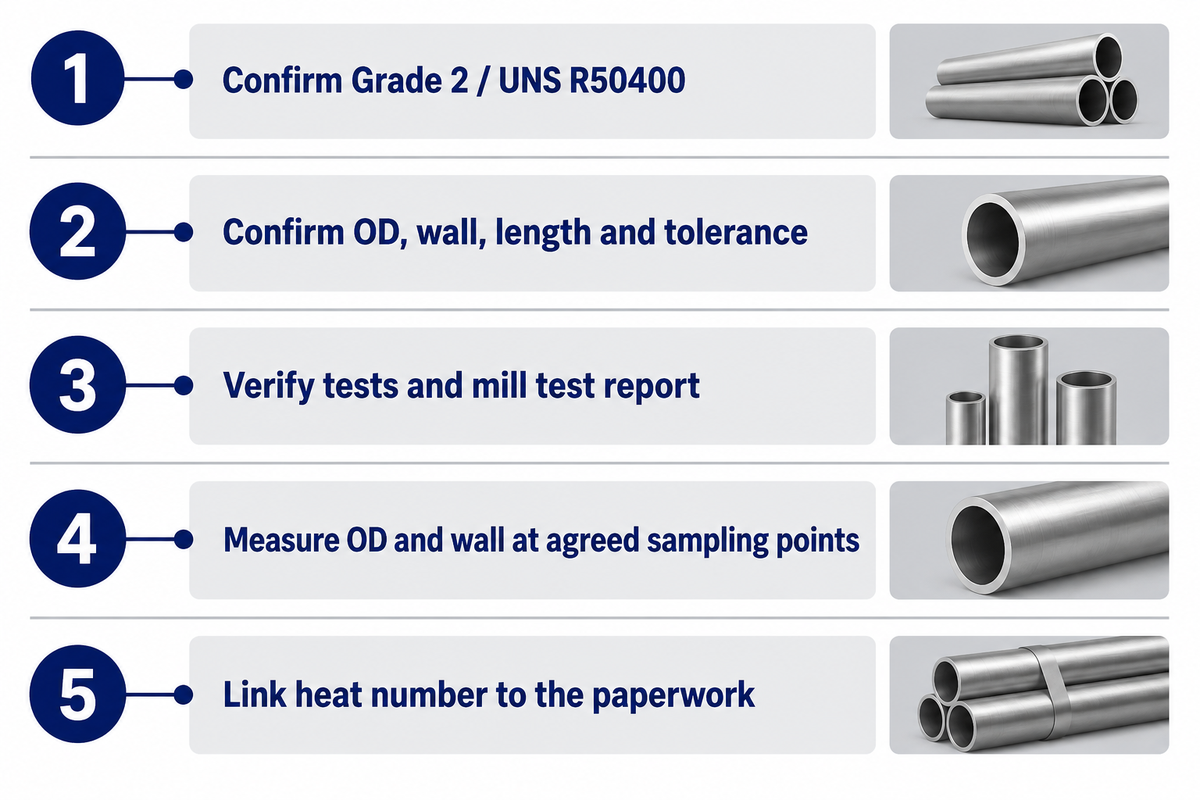
- Identity: Grade 2 / UNS R50400, heat number, and named ASTM route.
- Dimensions: OD, wall, calculated ID, length, tolerances, ovality, and straightness.
- Condition: annealed or specified condition, surface finish, ends, and weld condition.
- Testing: chemistry, tensile or flattening requirements where applicable, eddy-current or hydrostatic testing.
- Documents: heat-linked MTR, test results, packing list, and the revision used for acceptance.
Handheld XRF can screen alloy identity, but it does not replace the certificate for interstitial elements, mechanical results, dimensional acceptance, or traceability. Measure OD and wall with calibrated equipment at agreed sampling points.
Before acceptance, ask the manufacturer and supplier to connect the order line, bundle marking and material report. Record which dimensions were measured, which instrument was used and which sampling agreement applies. Compare any proposed substitute with the interface drawing and the specified product form. For broader construction choices, see the titanium tube and pipe guide. Send the completed size record through TiAlloy’s enquiry form so the quotation can address the requested dimensions and documentation together.
Grade 2 titanium tube sizes for common industrial applications
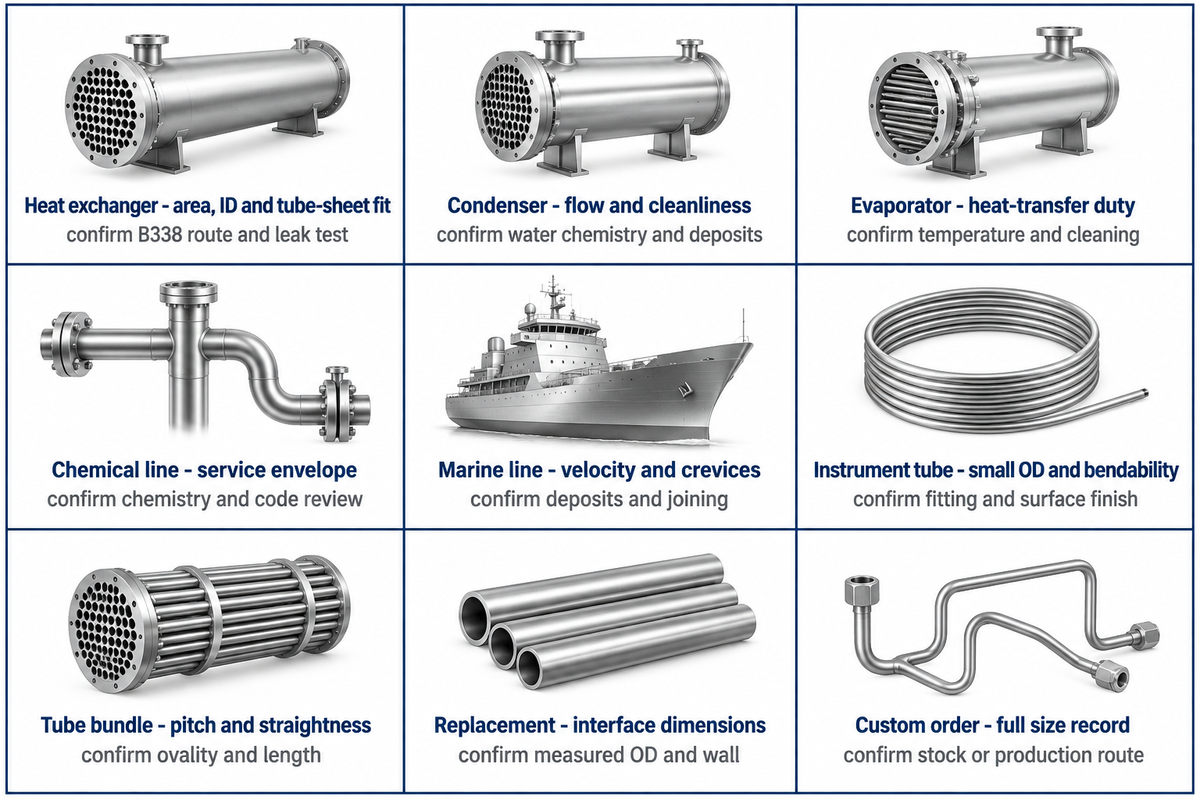
Heat exchangers and condensers may prioritize tube-sheet fit, heat-transfer area, cleanliness, and leak testing. Marine service still requires checks for temperature, velocity, deposits, and crevices. Instrument tubing may prioritize small OD, bendability, surface condition, and fitting compatibility. Match the tube to the duty and standard; a stainless nominal schedule isn’t a Grade 2 acceptance document.
In chemical processing, record the process fluid and cleaning conditions alongside tube dimensions. Petrochemical coolers and pulp and paper equipment can expose material to different chemical mixtures. Power generation buyers should identify the cooling-water duty and exchanger configuration. For tubing or piping systems supplied across several assemblies, keep each item tied to its own specification. These questions turn a broad application label into a quotable duty. Alleima Grade 2 application guidance
| Type | Sizing priority | Confirm before release |
|---|---|---|
| Heat exchanger | Area, ID, tube-sheet fit | B338 route and leak test |
| Condenser | Flow and cleanliness | Water chemistry and deposits |
| Evaporator | Heat-transfer duty | Temperature and cleaning |
| Chemical line | Service envelope | Chemistry and code review |
| Marine line | Velocity and crevices | Deposits and joining |
| Instrument tube | Small OD and bendability | Fitting and surface finish |
| Tube bundle | Pitch and straightness | Ovality and length |
| Replacement | Interface dimensions | Measured OD and wall |
| Custom order | Full size record | Stock or production route |
FAQ: Grade 2 titanium tube sizes
Buyer note: size, standard, condition, and inspection form one decision. A diameter alone is not a purchase specification.
What are common Grade 2 titanium tube diameters?
Purchasing discussions often include 6.35, 12.70, 25.40, 38.10, and 50.80 mm. They are reference diameters only; confirm OD, wall, length, tolerance, and ASTM route together. A supplier may offer a nearby size with a different wall, or may need to produce the requested combination, so the quote should echo every field.
How do I calculate the inside diameter?
Subtract twice the wall from the OD. For 25.40 mm OD and 1.00 mm wall, the arithmetic ID is 23.40 mm. Use the standard’s tolerances when checking the working ID. If a fitting or tube sheet depends on that ID, check the minimum and maximum condition rather than relying only on the nominal arithmetic result.
Which standard belongs on the order?
Use the route matching the product form and service. Specify B338 for plain condenser, evaporator, or heat-exchanger tubing, B861 for seamless titanium pipe, and B862 for welded titanium pipe. State edition, Grade 2 / UNS R50400, condition, dimensions, tests, and documents. The standard and referenced drawing control acceptance, including the interface and assembly requirements.
Are Grade 2 sizes interchangeable with stainless sizes?
No. A stainless nominal designation can hide different actual OD, wall, tolerance, and product-form rules. Use the measured interface dimension and the titanium standard’s acceptance limits. When replacing a stainless component, have engineering confirm the new material, joining method, cleaning method, and design calculation as one package.
References & Sources
WHY WE PUBLISH
About TiAlloy
TiAlloy supplies titanium, stainless steel, nickel alloy and clad plate for specification-driven industrial orders. Our technical guides are written to help buyers align product form, governing standard, test scope and release documents before a quotation is compared.
01Melt & formPlate, sheet, pipe, tube, bar, wire and forgings
02ProcessHeat treatment, finishing, inspection and export packing
03VerifyEN 10204 Type 3.1 certificate and order documents