Get in Touch with TiAlloy Company

Grade 2 Titanium vs Grade 5: Properties, Cost, Fabrication, and Buyer Selection Guide

The choice in grade 2 titanium vs grade 5 is usually between easier forming with good aqueous corrosion resistance and much higher strength. Grade 2 is a commercially pure titanium grade. The Grade 5 designation identifies the Ti-6Al-4V alloy containing nominally 6% aluminum and 4% vanadium. Choose Grade 2 when forming and aqueous corrosion govern, or evaluate Grade 5 when the design needs higher strength.
Understanding titanium means separating its mechanical properties from its behavior in the working environment. Heat-exchanging tube components and compact load-bearing brackets require different properties from commonly used titanium materials. Use the Service-Shape-Cost Check: define the service environment and load, verify that the shape can be manufactured in the condition of interest and finally, review the cost of the part. Usually, this sequence makes grade selection a wise purchasing decision.
Grade 2 Titanium vs Grade 5: Core Metallurgical and Mechanical Differences
Grade 2 titanium, having an alpha structure, provides moderate strength and useful ductility. Titanium Grade 5, an alpha-beta alloy with a different heat treatment response, has higher strength than CP titanium. These types of titanium have close densities, so equal-sized parts have similar mass; the larger weight-saving opportunity comes from a design that can use a smaller section.
ASTM B265-25’s grade definitions identify Grade 2 as UNS R50400 and Grade 5 as UNS R56400. Commercially pure does not mean chemically perfect titanium. Controlled interstitial elements are part of the specification. There are other commercially pure titanium grades that exhibit different strength and formability, and oxygen content is one reason. Grades 1 through 4 belong to the same family of commercially pure materials.
| Property or decision | Grade 2 | Grade 5 | Buyer implication |
|---|---|---|---|
| Material family | Commercially pure alpha titanium | Alpha-beta Ti-6Al-4V | Order the grade and material condition together |
| UNS designation | R50400 | R56400 | Cross-check drawing and certificate identifiers |
| Nominal alloy additions | Unalloyed | 6% aluminum, 4% vanadium | A grade number alone is not a chemistry report |
| Density | 4.51 g/cm³ | 4.43 g/cm³ | Small equal-volume mass difference |
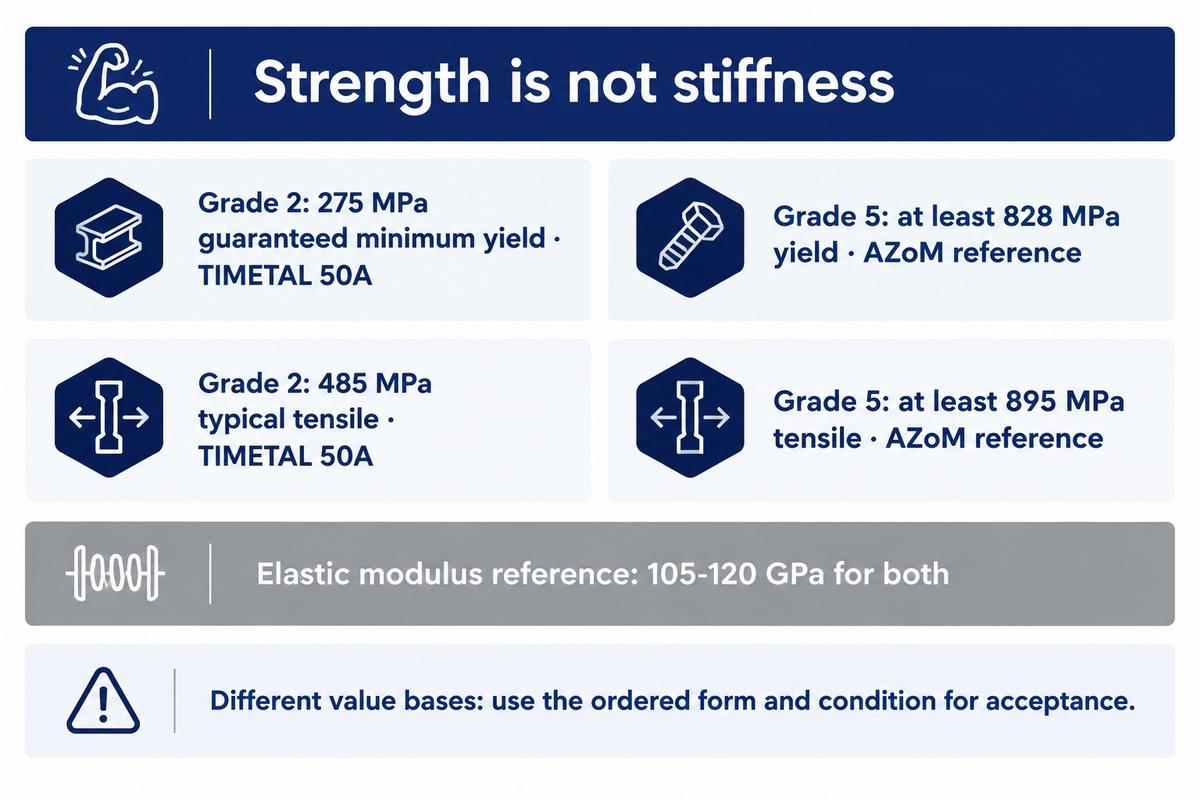
| Published yield reference | 275 MPa guaranteed minimum in TIMET’s TIMETAL 50A (Grade 2) datasheet | ≥828 MPa in the AZoM reference | Check the actual product-form acceptance limits |
| Typical Grade 2 yield | 345 MPa in that datasheet’s separate typical-property table | Not a matched typical-value comparison | Do not substitute a typical result for a minimum |
| Published tensile strength | 485 MPa typical in the Grade 2 datasheet | ≥895 MPa in the AZoM reference | These columns have different value bases |
| Elastic modulus reference | 105–120 GPa | 105–120 GPa | Higher yield strength does not mean proportionally greater stiffness |
| Cold forming | Good formability | Limited cold-forming capability | Review bends before choosing stock |
| Heat treatment | Annealing and stress-relief routes | Can be heat treated to increase strength | State the delivery condition and final requirements |
| Common selection priority | Aqueous corrosion resistance and fabrication | Strength-to-weight ratio | Compare against the actual limiting requirement |
The Grade 5 figures above are listed in AZoM’s Grade 5 property reference. TIMET’s TIMETAL 50A datasheet supplies the Grade 2 minimum and typical values. Use this table to understand the difference between grade 2 and grade 5, and use the referenced standard, thickness and delivery condition for purchase acceptance. A higher typical test result doesn’t change the minimum yield strength written on an order. Specify hardness separately if it affects acceptance of the component.
Why is Grade 5 titanium stronger than Grade 2?
Aluminum and vanadium modify the phase structure and strengthening response of the alloy. Therefore, the strength of Grade 5 exceeds the strength of Grade 2 in commonly supplied conditions. Superior strength doesn’t imply a proportional increase in stiffness. A bracket can resist yielding yet deflect too far. For a thin panel or long arm, check deflection as well as yield strength before reducing thickness to exploit the stronger alloy.
In a weight-sensitive bracket, the equal-volume comparison answers only the density question. A redesigned Grade 5 bracket may remove more material, but the allowable section will also depend on the stiffness, fatigue loading and connections. If procurement receives two quotes for different drawings, separate the mass saving caused by geometry from the much smaller density difference.
Corrosion Resistance vs Structural Load: When Grade 2 Is Enough and When Grade 5 Is Required
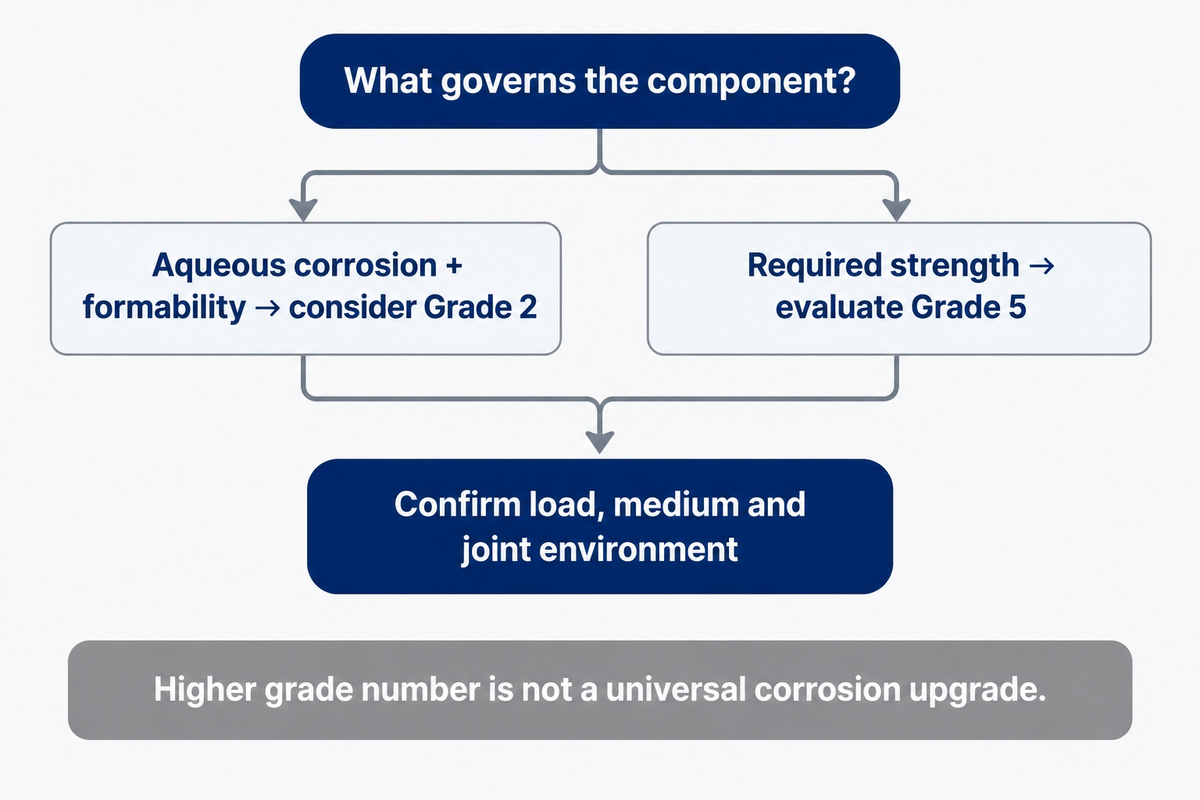
Choose Grade 2 when aqueous corrosion resistance and formability govern and the design meets its load requirements with that grade. Use Grade 5 when the required strength justifies the use of the alloy and its associated fabrication. A higher grade number of alloy doesn’t mean it has better corrosion resistance, a longer service life or greater fatigue resistance in every case.
Process-equipment material selection covers liquid composition, concentration, operating temperature, deposits and the cleaning cycle. The protective oxide layer explains much of titanium’s excellent corrosion resistance, but very tight joints can make a different local environment from the fluid being moved. Total Materia describes these crevice-corrosion conditions. The Grade 2 corrosion guide aids in the organization of the service review.
Visualize the buyer replacing a seawater heat exchanger bundle. In the drawing, the supplier of the Grade 2 tube offers a stronger upgrade of Grade 5. Strength doesn’t always win the argument for substitution. The joining details, the tube dimensions, the tubing standard, and the service condition all need to be considered. A stronger bar alloy cannot simply replace a qualified tube specification on the strength of its tensile number. Keep the established tube grade while checking the documented reason for the change. The reason could be that the joints are corroding. If the problem is a corroding joint, investigate the joint environment before paying for a higher-strength alloy.
There are reversed priorities in the construction of a compact part. Commercially pure Grade 2 may meet the corrosion requirement but fail the permitted stress or size envelope. The higher yield strength explains why Grade 5 performs better under that constraint. Specify strength and fatigue resistance separately. The Ti-6Al-4V material guide covers that alloy family in more detail. A fatigue-critical drawing still needs its own loading, surface condition and inspection requirements.
Shop-Floor Fabrication Trade-offs: Cold Forming, Welding, and CNC Machinability
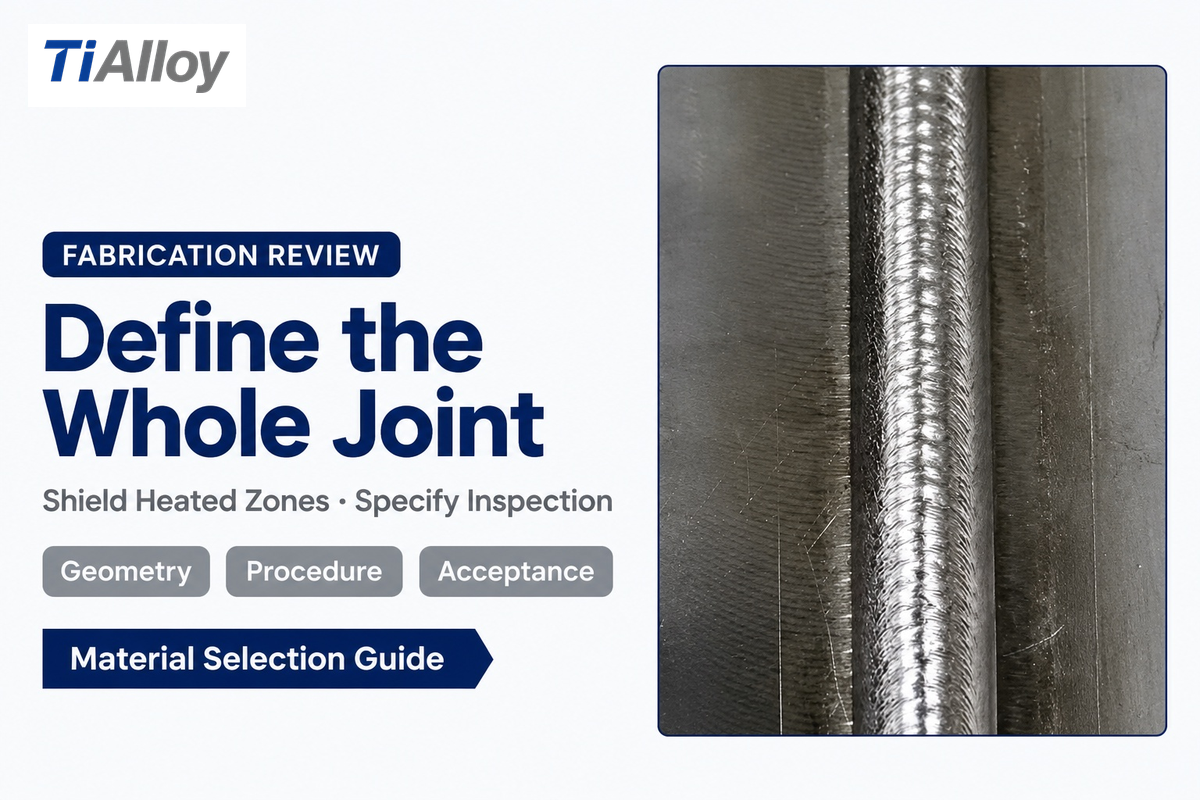
Generally, Grade 2 allows more forgiving forming, while Grade 5 offers limited cold-forming. Both can be welded and machined, but the procedure must be defined for the alloy, condition and geometry. Price the more onerous operations, e.g. deep-holes, tight bends, and thin walls, explicitly. The stock price may not be controlling.
To cold-form a sheet component means to take into account the bend radius, thickness, the direction of the bend and the final tolerances on the drawing. The diameter of a test mandrel and the inside radius of a bend are different dimensions. For Grade 5, reviewing hot-working and/or machining, early on, can help prevent the purchase of unsuitable stock for cold-forming.
Is Grade 5 titanium harder to machine and form than Grade 2?
Grade 5 is harder to cold form, and its higher strength changes machining demands. Although Grade 2 is softer, softness alone does not guarantee trouble-free cutting. Rigid workholding, a sharp tool, a controlled chip load and adequate coolant all play a role in machining titanium materials. Seek cutting recommendations for the tool being used and the operation being performed. Compare the supplier’s estimated machining time with that of competitors.
Weldability also entails more than effecting a joint. Contamination of the molten metal and adjacent heated zones by foreign material should be avoided and the welding process, the type of filler and the methods of inspection should be indicated. AZoM’s Grade 5 fabrication overview includes welding and machining guidance. For a dissimilar Grade 2-to-Grade 5 joint, the properties of the joint should be reviewed separately from the parent metals.
A quote for the machining of a high-performance component should include stock allowance, roughing and finishing passes and deep-hole machining, work-holding and inspection. Maintain consistency of the above requirements between the suppliers. If one supplier quotes a near-net blank and the other assumes starting with a large bar, the difference in price may reflect a difference in purchased geometry rather than titanium grade.
Raw Material Price vs Total Fabricated Part Cost
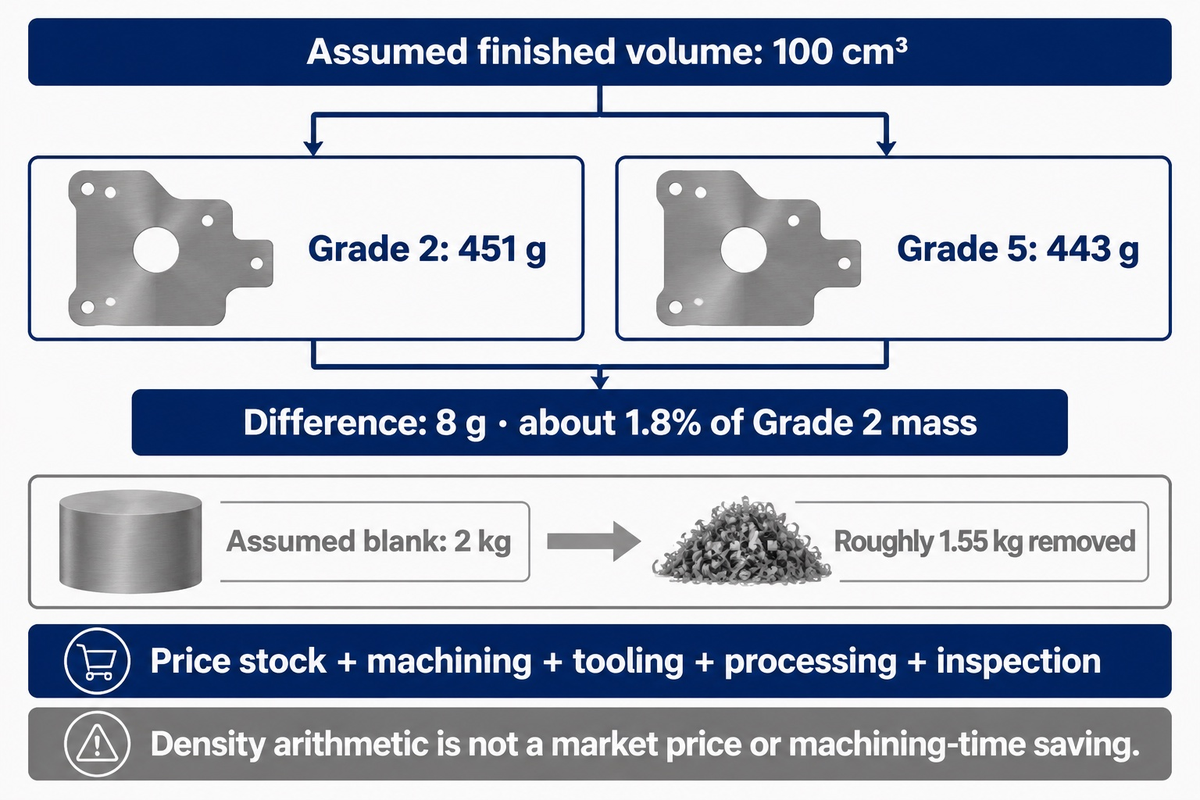
Compare Grade 2 and Grade 5 titanium by the cost of a conforming finished part. A kilogram price omits machining time, stock removed, tooling and inspection. A design can benefit from Grade 5’s strength, while a complex fabrication route can consume that benefit through a higher cost. Ask for the same drawing revision and acceptance scope before comparing quotes.
The cost of a finished part equals purchased stock + machining + tooling allocation + secondary processing + inspection. For a batch, divide shared setup and qualification costs by the accepted quantity. This is a quotation worksheet, so use the supplier’s figures for each term. Don’t infer a fixed Grade 5 premium from the alloy chemistry or assume that only alloy titanium undergoes multiple melting steps.
Consider an assumed design with 100 cm³ of finished metal. Using mass = density × volume, Grade 2 weighs 451 g and Grade 5 weighs 443 g. The difference is 8 g, about 1.8% of the Grade 2 mass. Now suppose either route starts from a 2 kg blank: roughly 1.55 kg must be removed. Procurement pays for removal of that stock, not just the finished metal’s mass. Ask the supplier to price a closer-sized blank against the original route, with the same final drawing. Apply its quoted material and machining rates to the cost equation; the density calculation alone gives no market price or machining-time saving.
This worksheet offers procurement and finance an important question: which quoted line can the drawing or stock choice actually change? Grade 5 machining guidance identifies cutting and coolant control as process considerations; the worksheet prices the actual proposed route. Engineering may prefer a stronger material; the machine shop may prefer a simpler shape; quality may require further testing. A lower cost quotation is comparable only when the grade, dimensions, condition and acceptance criteria agree.
Service Limits and Adjacent Grades: When to Step Up to Grade 7, Grade 12, or Grade 23 ELI
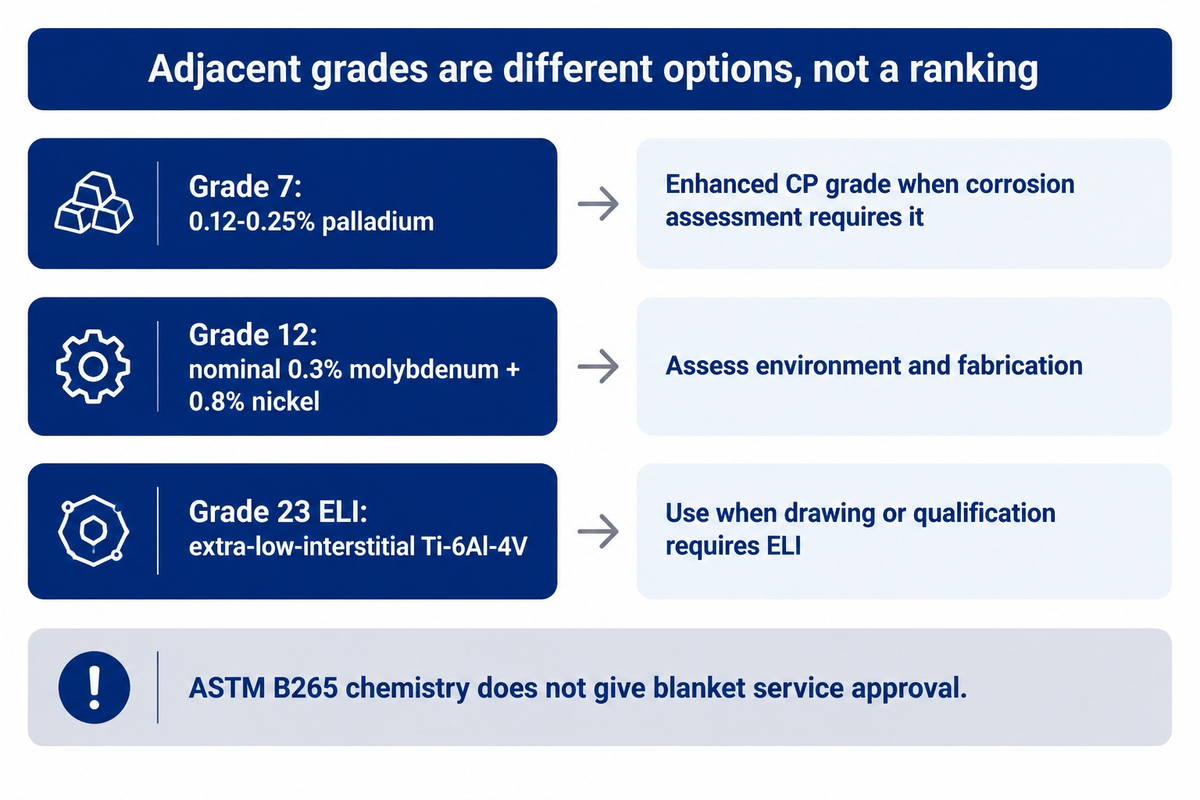
Consider Grades 7 and 12 when the service assessment calls for enhanced crevice-corrosion resistance, or Grade 23 when the drawing requires extra-low-interstitial Ti-6Al-4V. Required properties govern the alternative. These are different material options, not a ladder where each higher number is a better grade for each application.
Total Materia’s corrosion review mentions a Ti-6Al-4V case of crevice corrosion that allegedly happened at 50°C in a 300 g/L saturated sodium chloride solution at pH 4. Those conditions matter: the case contradicts treating 80°C as a universal safe cutoff. The crevice’s shape and local chemistry, along with temperature, should be considered when selecting a material.
- Grade 7: commercially pure titanium with 0.12–0.25% palladium. Consider it when the corrosion assessment requires the use of an enhanced CP grade.
- Grade 12: nominally 0.3% molybdenum and 0.8% nickel. Assess its environmental performance and fabrication requirements.
- Grade 23 ELI: Ti-6Al-4V with extra-low interstitial elements. Specify it when the drawing or material qualification calls for ELI chemistry and properties, with the required strength and toughness stated separately.
Consider the working fluid and the chemicals used for cleaning as a single package. Approval for a chloride service doesn’t mean approval for a reducing acid service or a cleaning solution containing fluoride. When a buyer receives a substitution request, the buyer should ask for the material designation and the service basis for the proposed alternative and attach the request to the purchase order.
Industry Application Matrix: Chemical Processing, Marine, Aerospace, and Energy
Seawater piping, reactor vessels and heat exchangers commonly use Grade 2. AZoM lists aerospace, marine, offshore and power-generation applications for Grade 5. Industry names narrow the discussion, but component loads and manufacturing details select the material. Use the matrix below to identify the primary engineering concern.
| Component or scenario | Starting point | What must decide the order? |
|---|---|---|
| Heat-exchanger tubing | Grade 2 application | Tube specification, joining details and service chemistry |
| Seawater piping | Grade 2 application | Pressure design, joints, deposits and operating conditions |
| Reactor vessel | Grade 2 application | Process medium, cleaning exposure and design-code requirements |
| Formed process liner | Grade 2 selection scenario | Forming geometry and the environment contacting the liner |
| Compact aerospace bracket | Grade 5 selection scenario | Specified strength, fatigue assessment and approved material condition |
| Marine load-bearing hardware | Grade 5 selection scenario | Mechanical load plus local corrosion exposure |
| Offshore machined component | Compare both grades | Whether strength or aqueous corrosion governs the actual part |
| Power-generation equipment part | Compare both grades | Component-specific temperature, stress and qualification |
| Thin-wall machined housing | Fabrication-led comparison | Deflection, workholding and final dimensional inspection |
| Hot-brine crevice location | Review adjacent grades | Concentration, pH, joint geometry and documented corrosion assessment |
A stock buyer also uses the same distinction when selecting tube, pipe or bar. The titanium tube and pipe guide addresses hollow products; the bar and rod specification guide addresses machining stock. Familiar grade names, including those widely used in aerospace, are only one line of each specification.
A Buyer’s 7-Gate Selection Checklist Before Specifying Grade 2 or Grade 5
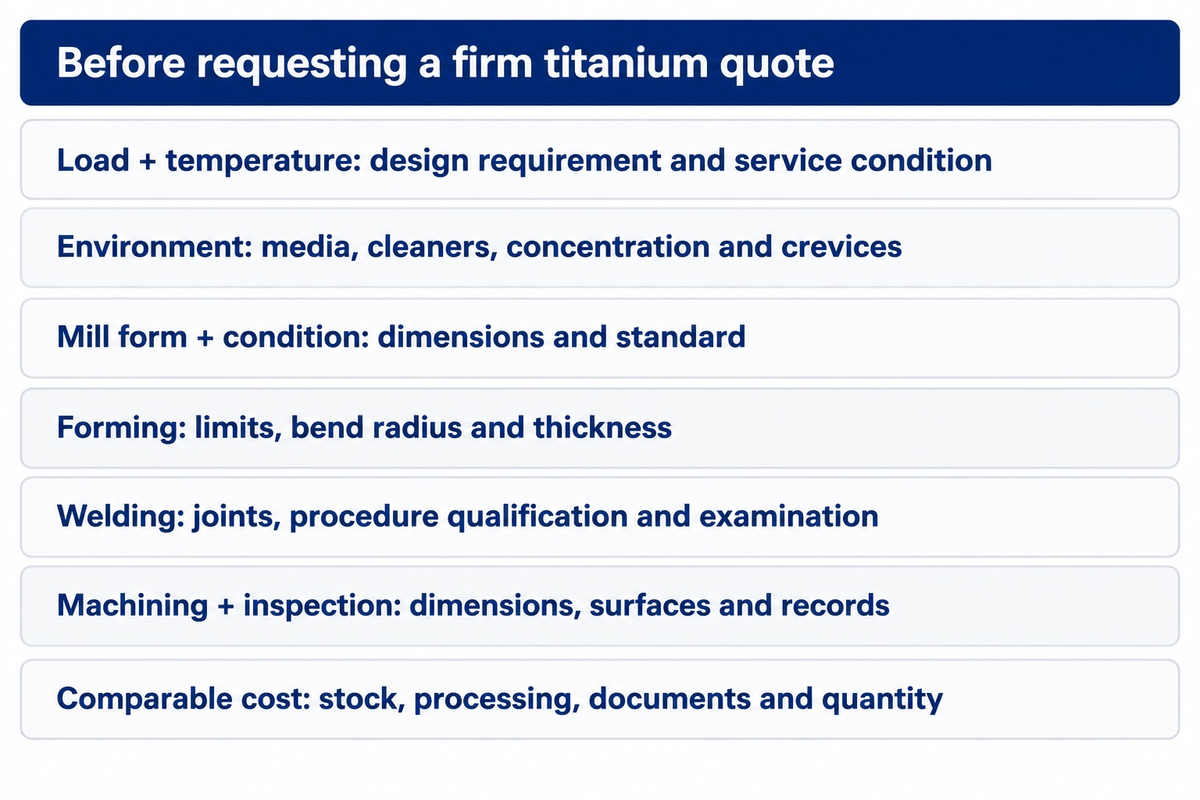
The seven items to address before requesting a firm quote for titanium are load, environmental conditions, product form, forming, welding, machining and cost of acceptance.
- Load and temperature: Provide the design requirement and service condition.
- Environment: List process media and cleaners, concentration and temperature, and locations where deposits and tight crevices may form.
- Mill form and condition: State plate or sheet, bar or billet, or tube, with dimensions and the standard. For example, B348/B348M-25 addresses annealed bars and billets.
- Forming route: Show forming limits, bend radius and thickness.
- Weld requirements: State the quality level or acceptance criteria required for the component; identify welded or dissimilar joints, procedure qualification and agreed examination.
- Machining and inspection: Indicate critical dimensions, surface conditions and requirements for records.
- Comparable cost: separate stock, processing and documentation, and state batch quantity and delivery scope.
What operating details must be confirmed before issuing a titanium RFQ?
To specify the right grade, send grade, product form, dimensions, condition of material, service medium, operating temperature and revision of drawing first. Follow with load basis, forming or welding requirements and inspections that govern acceptance. In the case of repeat orders, identify the approved specification rather than depend on the previous trade name. This puts a limit on the supplier’s freedom and helps the buyer understand what assumptions changed in a revised offer.
For Grade 2 mill products, the commercially pure Grade 2 supply page is a useful starting point. Send TiAlloy your drawing and material specification for a quotation with the required quantity and inspection scope.
ASTM Mill Forms, Standards, Testing, and Traceability to Specify
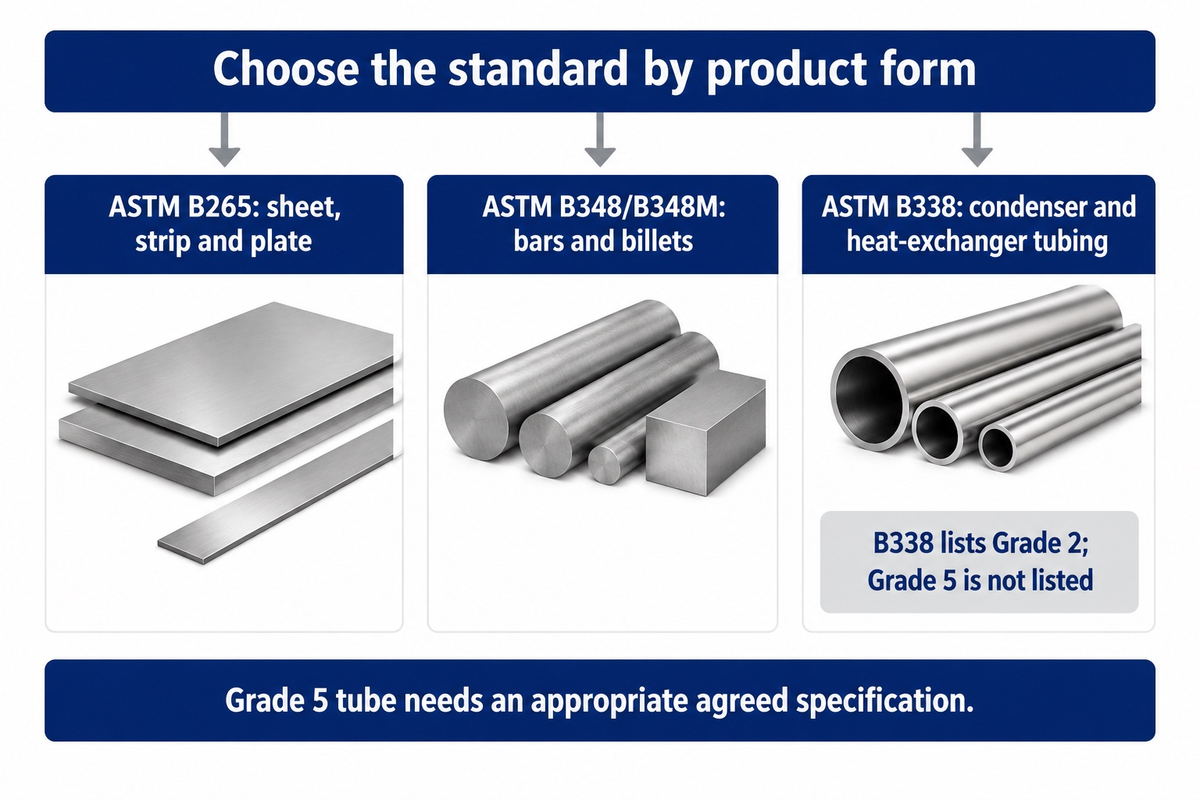
ASTM B265 addresses sheet, strip and plate, B348/B348M addresses bars and billets and B338 addresses tubing for condensers, evaporators and heat exchangers. Compare the mill forms before comparing Grade 2 and Grade 5. The grade, condition and inspection of delivery must fit the specified product.
“This specification covers annealed titanium and titanium alloy strip, sheet, and plate.”
The current public pages identify ASTM B348/B348M-25 for annealed bars and billets, including both grades, and ASTM B338-17(2026) for heat-exchanger tubing. Grade 2 is listed in B338; Grade 5 is not. Therefore, an order for Grade 5 tube is subject to an agreed specification, and cannot be considered as automatically B338 tube.
Request the heat or lot identity, chemical analysis and mechanical test results required by the order. For a titanium industry quotation that uses a trade name, include the corresponding standard grade in the purchase description. If an EN 10204 3.1 inspection document is specified, include that requirement in the quotation. Agree any additional ultrasonic, pressure or other examinations against the actual product form; don’t add the same generic test list to every titanium purchase.
For sheet components, keep thickness tolerance and forming requirements next to the material designation. The titanium plate and sheet specification guide provides related product context. Before ordering, reconcile the quotation, drawing and inspection document requirements line by line. The titanium product-form overview helps to decipher which stock route corresponds to that request.
FAQ: Grade 2 Titanium vs Grade 5
What is the tensile strength of Grade 5 titanium?
AZoM lists Grade 5 titanium’s tensile strength as at least 895 MPa.
References may show where to look for confirmation of the alloy’s strength level. Acceptance values are described in the ordered product specification and delivery condition. A tensile figure from a general materials information page is not a design allowable. Property tables distinguish the Grade 5 reference from the usual Grade 2 values to keep the two bases apart.
Why is grade 5 titanium so expensive?
Grade 5 pricing reflects the alloy, product form and processing scope; a finished-part quote also includes machining and inspection.
Premium over Grade 2 isn’t a given percentage. Size and quantity affect the offer as well. Compare like-for-like quotations and evaluate secondary processing. In the case of a more expensive stock material, a different design may gain useful strength. An unchanged design may still benefit from the higher strength of the expensive material.
Can you provide a detailed chart of titanium grades?
A helpful titanium grades chart presents the product form and property basis for different corrosion resistant alloy grades.
For this comparison, Grade 2 is commercially pure alpha titanium and Grade 5 is alpha-beta Ti-6Al-4V. Grade 7 adds palladium to unalloyed titanium; Grade 12 uses molybdenum and nickel additions; Grade 23 is the ELI version of Ti-6Al-4V. Property and application tables in this handbook keep those selection questions separate. A chart should also differentiate minimum tensile strength from a normal test value, because they serve a different buying purpose. Neither a higher grade nor a larger grade number answers automatically the corrosion, forming or inspection requirement. Consider the actual needs of the drawing before substituting a grade specified.
Which grade has better corrosion resistance in seawater and chemical plants?
Grade 2 is normally the first option when aqueous corrosion resistance and formability are preponderant.
Grade 5 may be required to meet load-bearing requirements, but it’s not a general corrosion improvement. Evaluate the actual medium, temperature, and crevice conditions; a process vessel and an offshore structure can have very different selection problems.
What ASTM standards and mill certificates should buyers request for Grade 2 vs Grade 5?
Identify the product-form standard and the chemical and mechanical test data used for evaluation and traceability.
Refer to B265 for sheet, strip and plate; B348/B348M for bars and billets; and B338 for tubing, covered by its listed grades. Stipulate the edition, grade, dimensions and delivery condition, and an EN 10204 3.1 if applicable. Additional examinations belong in the purchase scope along with their acceptance criteria. Tubular products require an agreed specification. Grade 5 tube needs an appropriate agreed specification, since the current B338 public scope does not list Grade 5.
References & Sources
- ASTM B265-25: titanium strip, sheet and plate scope and grade definitions.
- ASTM B348/B348M-25: annealed titanium bars and billets
- ASTM B338-17(2026): condenser and heat-exchanger tubing
- AZoM: Grade 5 titanium physical and mechanical property reference.
- Total Materia: Corrosion of Titanium Alloys, Part Two
WHY WE PUBLISH
About TiAlloy
TiAlloy supplies titanium, stainless steel, nickel alloy and clad plate for specification-driven industrial orders. Our technical guides are written to help buyers align product form, governing standard, test scope and release documents before a quotation is compared.
01Melt & formPlate, sheet, pipe, tube, bar, wire and forgings
02ProcessHeat treatment, finishing, inspection and export packing
03VerifyEN 10204 Type 3.1 certificate and order documents