Get in Touch with TiAlloy Company


Updated November 2026 | Technical Reference
Hastelloy C22 properties deliver 690 MPa minimum tensile strength, 310 MPa yield strength, and 45% elongation at an 8.69 g/cm³ density under UNS N06022 (W.Nr. 2.4602). Haynes International supplies this grade as Hastelloy® C-22 alloy. This nickel-chromium-molybdenum-tungsten alloy melts across 1357–1399°C and blends 22% chromium with 13% molybdenum and 3% tungsten. Fabricators solution-anneal components at 1121°C followed by rapid water quenching. Avoid sustained exposure across 600–900°C to prevent grain-boundary embrittlement.
Quick Reference Specifications: Hastelloy C22 (UNS N06022)
| Parameter | Verified Benchmark | Governing Basis / Producer Scope |
|---|---|---|
| Designations | UNS N06022 / W.Nr. 2.4602 / NiCr21Mo14W | ASTM B575, ASME SB575, DIN 17744 (Distinct from N07022 C-22HS) |
| Density | 8.69 g/cm³ (0.314 lb/in³); 8.61 g/cm³ published by Special Metals | ASTM B575 Sec 8.1 & Haynes C-22 vs. SMC-049 bulletin |
| Elastic Modulus (RT) | 206 GPa (Haynes) to 209 GPa (Special Metals) | Dynamic room-temperature modulus (not 206 MPa) |
| ASTM Minimum Tensile | 690 MPa UTS / 310 MPa 0.2% Yield / 45% Elongation | ASTM B575 & B574 solution-annealed purchase floor |
| Solution Anneal | 1121°C (2050°F), 10–30 min hold, water quench | Rapid air cooling permitted only under 10 mm thickness |
| ASME Sec VIII Max Temp | 1250°F (677°C) code rating; avoid sustained 593–900°C aging | ASME Sec VIII Div.1/2 vs. GTAW TCP precipitation kinetics |
What Is Hastelloy C22 (UNS N06022) and Which ASTM Standards Govern Each Form?
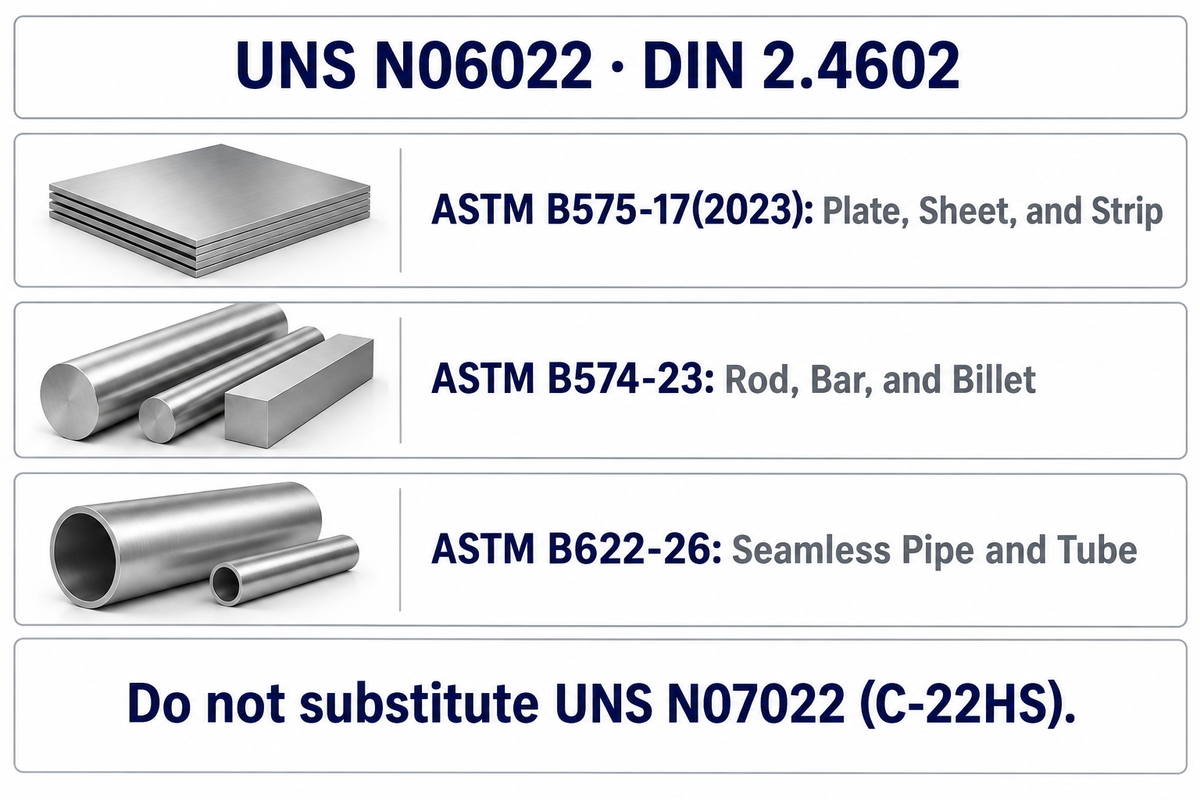
Hastelloy C22 is an austenitic nickel-chromium-molybdenum alloy standardized as UNS N06022 and DIN 2.4602. There are seven core ASTM specifications covering plates, bars, pipes, tubing, fittings, and forgings. Each product form has its own set of dimensional rules, and UNS N06022 cannot be substituted with age-hardenable C-22HS (UNS N07022).
Orders writing only “C22” trigger costly mill mismatches at receiving inspection. Please see our industrial Hastelloy C22 overview and nickel alloy tubing standard guide for background information. ASTM B626 governs welded condenser tubing and never interchanges with ASTM B619 welded pipe. Meanwhile, ASTM B637 and B983 define oilfield HASTELLOY® C-22HS® (UNS N07022), which Haynes restricts under heavy cold work plus aging due to hydrogen embrittlement.
| Product Form | ASTM Standard | ASME / Code Cross-Ref | Critical Procurement Boundary |
|---|---|---|---|
| Plate, Sheet, and Strip | ASTM B575-17(2023) / B906 | ASME SB-575 (P-No. 43) | Inch-pound units govern acceptance per Clause 1.2 |
| Rod, Bar, and Billet | ASTM B574-23 | ASME SB-574 (P-No. 43) | Do not substitute UNS N07022 bar (B637/B983) |
| Seamless Pipe and Tube | ASTM B622-26 / B829 | ASME SB-622 (Sec VIII 677°C) | Mandates annealed delivery condition |
| Welded Pipe | ASTM B619/B619M-19(2023) / B775 | ASME SB-619 / B31.3 427°C | Class I/II weld radiographed or cold-worked options |
| Welded Tube | ASTM B626-26 / B751 | ASME SB-626 | Not interchangeable with B619 process piping |
| Forgings and Flanges | ASTM B564 / ASTM B462 | ASME SB-564 / B16.5 / B16.34 | Section VIII allows 677°C vs B31.1 427°C |
| Wrought Butt-Weld Fittings | ASTM B366 | ASME SB-366 | Trace starting plate or pipe heat number |
| Welding Wire & Electrodes | AWS A5.14 / A5.11 | ASME SFA 5.14 ERNiCrMo-10 (F=43) | BS EN ISO Ni 6022 equivalent filler route |
| Clad Steel Plate & European | ASTM B575 Clad / DIN 17744 | VdTÜV #479 (450°C) | European VdTÜV design limit stops at 450°C |
What Is the Equivalent Alloy for Hastelloy C22?
Alloy C22 carries standard equivalents including UNS N06022, DIN W.Nr. 2.4602, NiCr21Mo14W, Inconel 22, and Alloy C-22. Each designation shares identical ASTM B575 chemical ranges. Hastelloy® C-22 is the registered trademark held by Haynes International, while Special Metals produces INCONEL alloy 22. Conversely, high-molybdenum C-22HS (UNS N07022) is not an equivalent substitute.
Hastelloy C22 Chemical Composition: Nominal Targets vs. ASTM Spec Limits
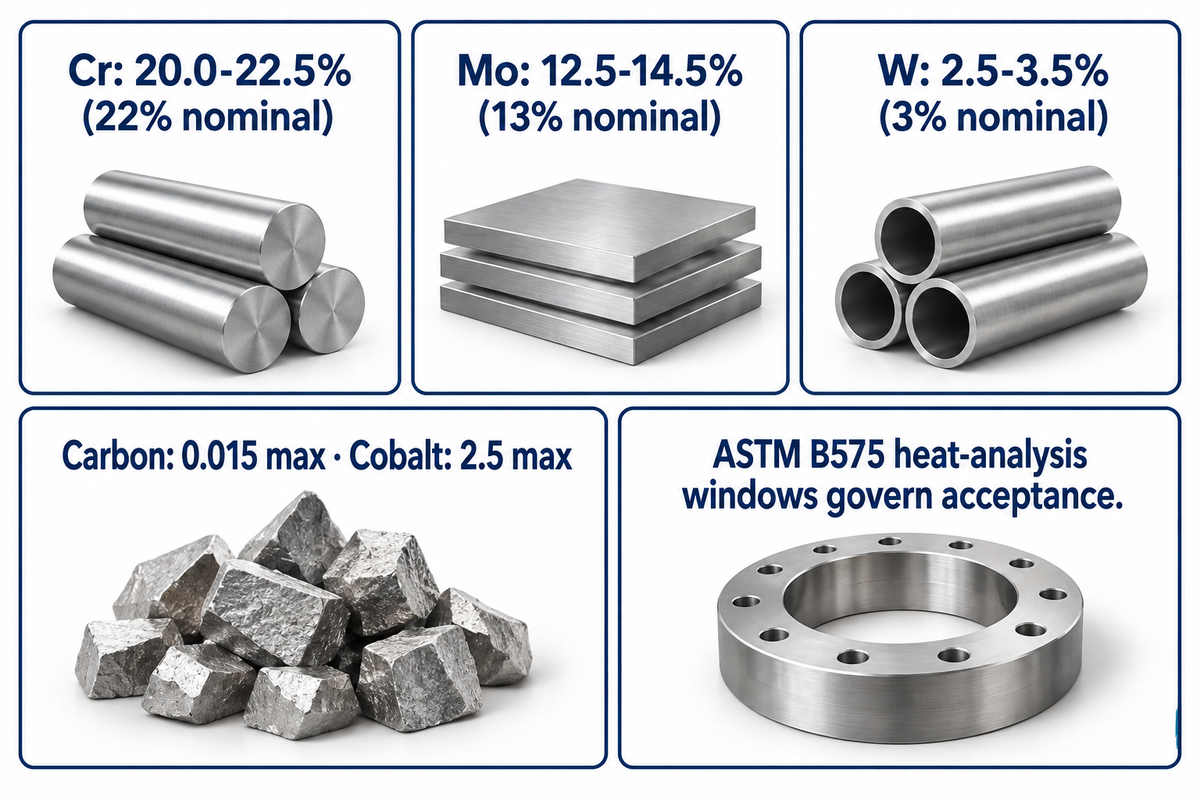
Hastelloy C-22 chemical composition mandates 20.0–22.5% chromium, 12.5–14.5% molybdenum, and 2.5–3.5% tungsten in nickel for high resistance to pitting. Nominal melt summaries list 56% balance nickel, 22% chromium, 13% molybdenum, and 3% tungsten. For procurement audits, mandatory ASTM B575 heat-analysis windows govern acceptance instead of nominal targets.
Some online tables mistakenly invert maximum cobalt and vanadium impurity caps into minimum values. In production, SMC-049 of Special Metals limits iron to 3% while the ASTM specification permits it to be in the range of 2.0 to 6.0%. Our published nickel alloy chromium ranges by grade provide alloy families comparison.
N06022 Spec-to-Nominal Acceptance Delta
| Element | ASTM B575 / SMC-049 Limit | Haynes Nominal Target | Metallurgical Role & Audit Note |
|---|---|---|---|
| Nickel (Ni) | Remainder | 56 (Balance) | Stabilizes single-phase austenitic matrix against chloride SCC |
| Chromium (Cr) | 20.0 – 22.5 | 22 | Passivates oxidizing acids, ferric salts, and wet chlorine |
| Molybdenum (Mo) | 12.5 – 14.5 | 13 | Drives reducing acid stability and pitting resistance |
| Tungsten (W) | 2.5 – 3.5 | 3 | Molybdenum and tungsten combine for solid-solution strength |
| Iron (Fe) | 2.0 – 6.0 | 3 | Special Metals holds typical melts below 3.0% Fe |
| Cobalt (Co) | 2.5 max | 2.5 max | Upper limit only (never a 2.5% minimum) |
| Carbon (C) | 0.015 max | 0.01 max | Low carbon suppresses weld-zone carbide precipitation |
| Silicon (Si) | 0.08 max | 0.08 max | Tight cap limits brittle silicide formation during welding |
| Manganese (Mn) | 0.50 max | 0.5 max | Deoxidation residual ceiling |
| Vanadium (V) | 0.35 max | 0.35 max | Strict upper ceiling; not a minimum addition |
| Phosphorus (P) | 0.02 max | 0.02 max (ASTM B575) | Trace impurity cap for hot ductility |
| Sulfur (S) | 0.02 max | 0.02 max (ASTM B575) | Trace impurity cap to prevent weld cracking |
Worked PREN Check Across Nominal vs. ASTM Floor: Using the standard austenitic formula PREN = %Cr + 3.3×%Mo + 16×%N with N = 0%, nominal chemistry (22% Cr, 13% Mo) equals 64.9. Evaluating at the lowest ASTM B575 floor (20.0% Cr, 12.5% Mo) gives 61.25. On the other hand, Special Metals SMC-049 uses %Cr + 1.5(%Mo + %W + %Nb), and reports a PREN of 47.3 for Alloy 22, and 45.4 for C-276 and 40.8 for Alloy 625. Bid sheets must state which PREN formula applies to each case.
Physical and Thermal Properties: Density, Melting Range, Conductivity, and Expansion
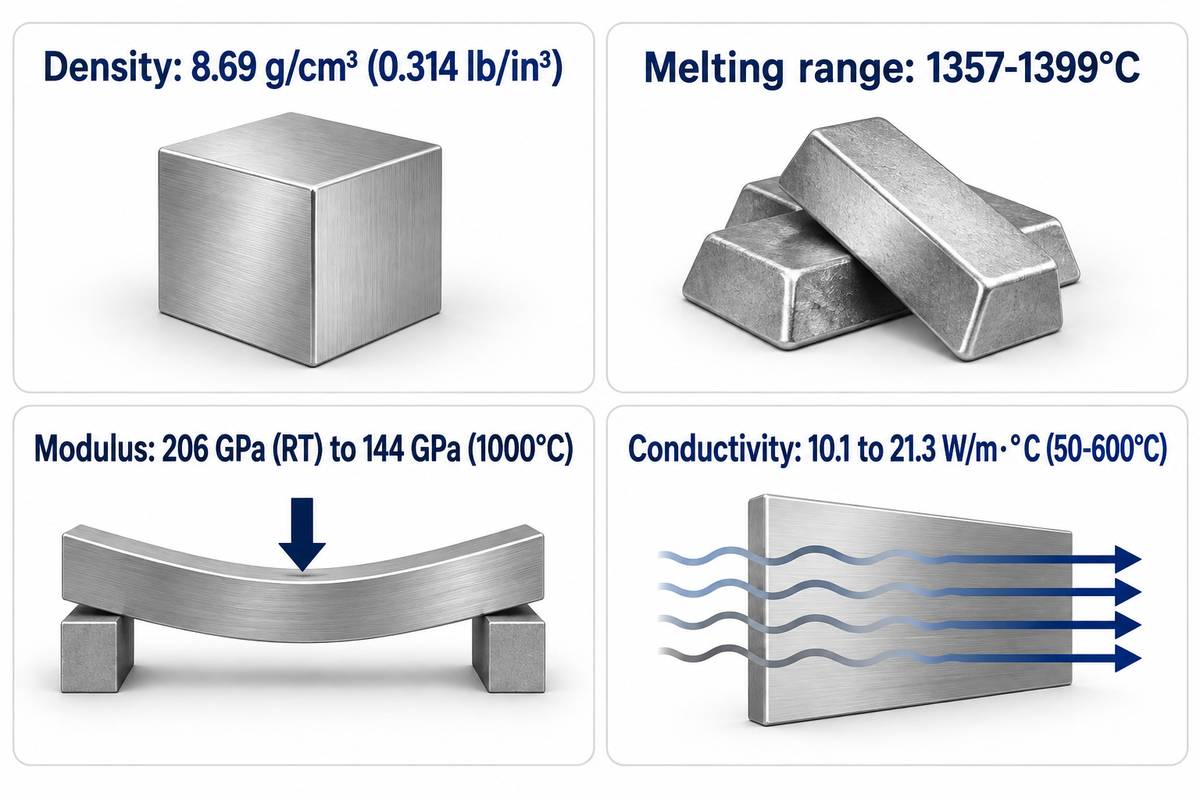
Wrought Alloy C22 delivers an 8.69 g/cm³ (0.314 lb/in³) density under ASTM B575 Section 8.1, while Special Metals lists 8.61 g/cm³. Its melting temperature range runs 1357–1399°C (2475–2550°F), and room-temperature elastic modulus reaches 206–209 GPa. Design teams sizing process shells need temperature-matched conductivity and expansion curves across the working thermal span.
Several outdated web datasheets misprint dynamic elastic modulus as “206 MPa” instead of 206 GPa. Verified Haynes testing shows modulus declining steadily from 206 GPa at room temperature to 144 GPa at 1000°C. Across 50°C to 600°C, thermal conductivity doubles from 10.1 to 21.3 W/m·°C as specific heat rises from 414 to 514 J/kg·°C. Mean thermal expansion increases from 12.4 µm/m·°C (24–100°C) to 15.9 µm/m·°C (24–900°C). Physical properties also vary slightly across melting routes: Special Metals reports ≤1.001 magnetic permeability and 1.215 µΩ·m electrical resistivity.
| Temperature (°C) | Thermal Conductivity (W/m·°C) | Specific Heat (J/kg·°C) | Mean CTE from 24°C (µm/m·°C) | Dynamic Modulus (GPa) | Electrical Resistivity (µΩ·m) |
|---|---|---|---|---|---|
| Room Temp (RT / 50°C*) | 10.1 (50°C) | 414 (50°C) | N/A | 206 (RT) | 1.14 (RT) |
| 100°C | 11.1 | 423 | 12.4 (24–100°C) | N/A | 1.23 |
| 200°C | 13.4 | 444 | 12.4 (24–200°C) | 197 | 1.24 |
| 300°C | 15.5 | 460 | 12.6 (24–300°C) | 191 | 1.25 |
| 400°C | 17.5 | 476 | 13.1 (24–400°C) | 185 | 1.26 |
| 500°C | 19.5 | 485 | 13.7 (24–500°C) | 179 | 1.27 |
| 600°C | 21.3 | 514 | 14.3 (24–600°C) | 174 | 1.28 |
| 700–1000°C | N/A | N/A | 14.9 (700°C) to 15.9 (900°C) | 168 (700°C) to 144 (1000°C) | N/A |
*Special Metals SMC-049 lists 209 GPa modulus and 8.61 g/cm³ density.
Source: Haynes International HASTELLOY C-22 Technical Datasheet.
Mechanical Properties of Hastelloy C22 Across Mill Forms and Temperatures
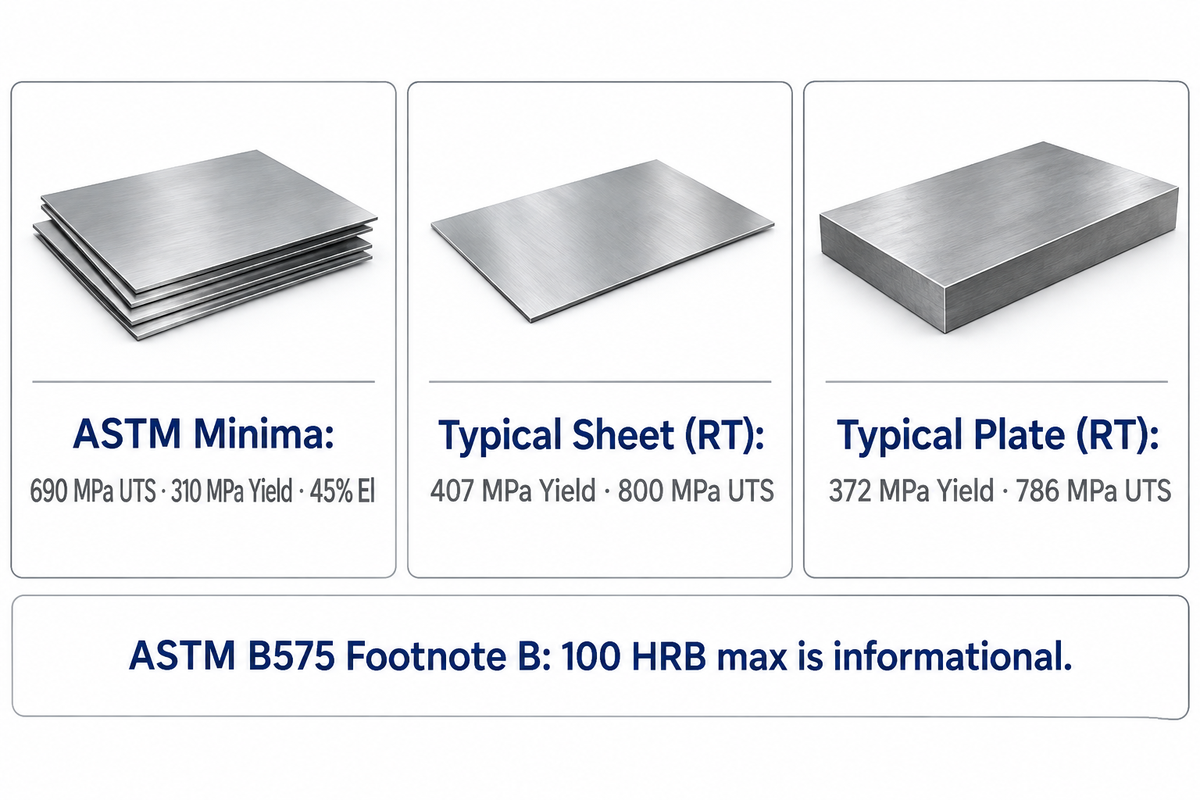
ASTM B575 and B574 specify room-temperature mechanical properties minima of 690 MPa tensile strength, 310 MPa yield strength, and 45% elongation. Annealed sheet averages 800 MPa tensile strength and 407 MPa yield, yet engineers size vessels using contract minima. Under ASTM B575 Footnote B, 100 HRB max hardness is strictly informational.
Mechanical strength declines predictably with section thickness and elevated heat. Annealed plate averages 372 MPa yield and 786 MPa tensile strength, while bar reaches 359 MPa yield and 70% elongation. At 427°C, sheet yield drops to 283 MPa and plate yield reaches 241 MPa, disproving typo-ridden stock tables showing “28 MPa”. Impact energy stays high across cryogenic temperatures, reaching 568 J at room temperature and 469 J at -196°C.
| Form & Gauge / Standard | Test Temp (°C) | 0.2% Yield (MPa / ksi) | Tensile UTS (MPa / ksi) | Elongation (%) | Basis / Hardness Note |
|---|---|---|---|---|---|
| ASTM B575 / B574 All Forms | RT | ≥ 310 (45) | ≥ 690 (100) | ≥ 45 | Contract floor; 100 HRB max informational only |
| Sheet (0.7–3.2 mm, Haynes) | RT | 407 (59) | 800 (116) | 57 | Typical annealed; 88 HRBW average (93 RB in SMC-049) |
| Sheet (0.7–3.2 mm, Haynes) | 427°C (800°F) | 283 (41) | 655 (95) | 67 | Short-term elevated tensile test |
| Sheet (0.7–3.2 mm, Haynes) | 760°C (1400°F) | 241 (35) | 524 (76) | 63 | Short-term only; long dwell causes embrittlement |
| Plate (6.4–19.1 mm, Haynes) | RT | 372 (54) | 786 (114) | 62 | Typical annealed; 88 HRBW; Charpy 568 J RT / 469 J -196°C |
| Plate (6.4–19.1 mm, Haynes) | 427°C (800°F) | 241 (35) | 634 (92) | 68 | Short-term elevated tensile test |
| Bar (12.7–50.8 mm, Haynes) | RT / 427°C | 359 / 214 | 765 / 614 | 70 / 79 | Typical annealed; 84 HRBW average |
Can Hastelloy C22 Be Hardened by Heat Treatment?
Solid-solution Hastelloy C22 (UNS N06022) can’t harden by precipitation heat treatment because carbon and aluminum additions remain minimized. The austenitic matrix cold-hardens rapidly. Haynes H-2019 tests measure Rc 33 at 20% cold reduction and Rc 43 at 50% without cracking in 232°C magnesium chloride. Light cold work rarely harms general corrosion stability; severe forming cuts resistance to stress corrosion cracking. Parts exceeding 7% elongation require solution re-annealing to restore corrosion performance. Where heat-treated hardening is needed, specify UNS N07022 (C-22HS).
Source: Haynes International HASTELLOY C-22 Mechanical & Cold-Work Datasheet.
Corrosion Resistance Envelope: Oxidizing Media, Acids, Pitting, and Crevice Limits
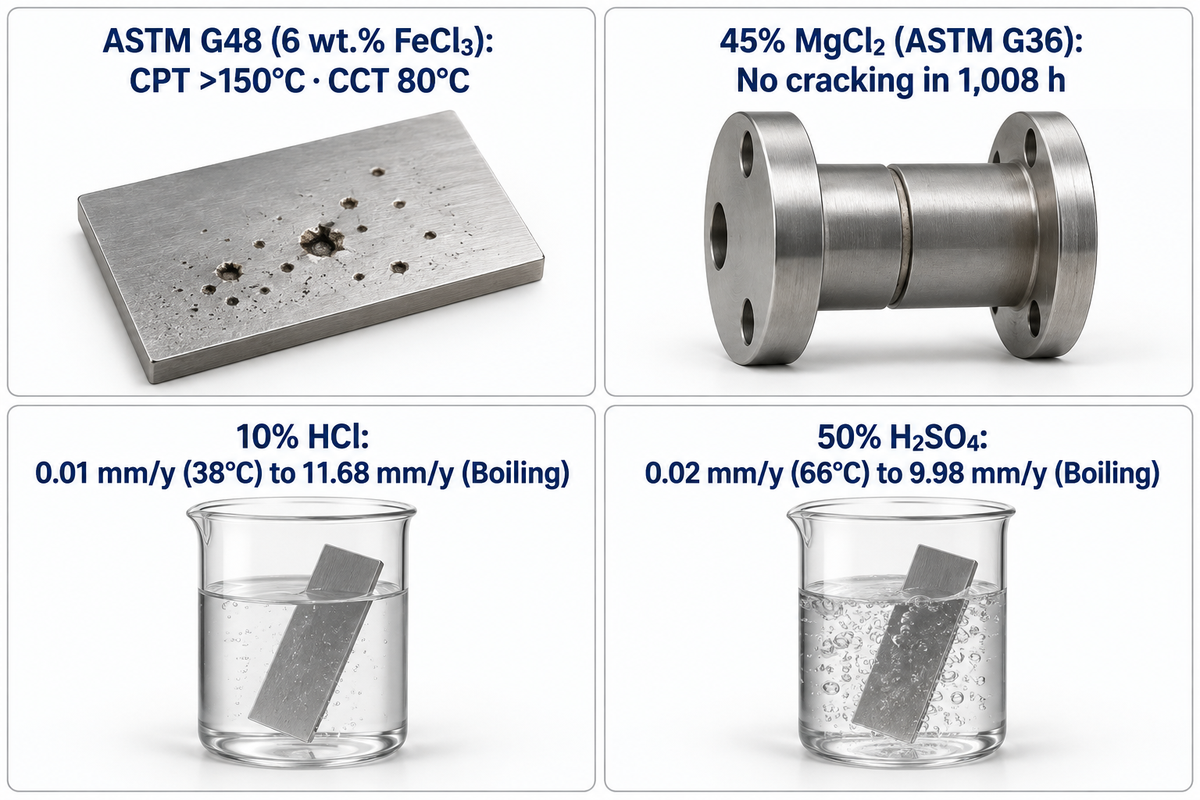
Hastelloy C-22 provides exceptional resistance to chlorine, ferric and cupric chlorides, and boiling organic acids. Its balanced chromium, molybdenum, and tungsten levels outlast stainless steel against chloride-induced pitting and crevice corrosion. However, hot, oxygen free hydrochloric and sulfuric acids attack N06022 above certain boiling limits.
In 72-hour ASTM G48 acidified 6 wt.% ferric chloride, C22 records a critical pitting temperature above 150°C and an 80°C crevice threshold. By comparison, C-276 stops at 55°C and 316L stops at 0°C. Over 1,008 hours in boiling 45% magnesium chloride (ASTM G36), C22 stays crack-free while 316L fails in two hours. Across 180-day LaQue natural seawater testing at 29°C under still and flowing brine solutions, C22 suffered zero attacked sites out of four.
“In Yellow Death, C-22® alloy has not exhibited pitting, even at the maximum test temperature (150°C). The Critical Crevice Temperature of C-22® alloy in Yellow Death is 75°C (as compared with 60°C for C-276 alloy).”
Source: Haynes International, HASTELLOY C-22 Technical Datasheet
DOE LLNL data (OSTI 894333) confirms Alloy 22 dissolves at nanometer-per-year rates in passive multi-ionic brines. Alloy C22 delivers broad resistance to oxidizing media and oxidizing aqueous media across organic and inorganic streams. Chromium holds attack below 0.4 mm/y in 40% nitric acid and protects equipment carrying mixtures containing nitric acid or oxidizing acids. N06022 also provides high resistance in boiling 99% acetic acid and 88% formic acid. Conversely, inorganic 10% HCl climbs from 0.01 mm/y at 38°C to 0.98 mm/y at 66°C and 11.68 mm/y at boiling. Similarly, 50% sulfuric acid jumps from 0.02 mm/y at 66°C to 9.98 mm/y at boiling.
| Test Medium & Standard | Condition / Duration | Measured C22 Result | Source & Engineering Boundary |
|---|---|---|---|
| Acidified 6 wt.% FeCl3 (ASTM G48) | 72 h immersion | CPT >150°C; CCT 80°C | Haynes C-22 (vs. C-276 CCT 55°C; 316L CCT 0°C) |
| 6% FeCl3 + 1% HCl (ASTM G48 Mod) | Max test cap 85°C | CPT >85°C; CCT 58–75°C | Special Metals SMC-049 (capped by 85°C solution limit) |
| Green Death & Yellow Death | 24 h mixed acid/salt | 120°C pit (Green); >150°C / 75°C CCT (Yellow) | Haynes C-22 mixed oxidizing chloride benchmark |
| 50% H2SO4 + Fe2(SO4)3 (ASTM G28 A/B) | Boiling 120 h / 24 h | Method A 34–40 mpy; Method B 6–8 mpy | SMC-049 & Haynes H-2019 (G28-22 intergranular screen) |
| 45% MgCl2 (ASTM G36) | Boiling U-bend, 1,008 h | No cracking in 1,008 h | Haynes C-22 (316L cracks in 2 h; 254SMO in 24 h) |
| Natural Seawater (LaQue U.S. Navy) | 180 days at 29°C, 4 sites | 0/4 sites attacked (still & flowing) | Haynes C-22 (C-276 showed A:1, B:1 quiescent sites) |
| 10 wt.% Hydrochloric Acid (HCl) | 38°C / 66°C / Boiling | 0.01 / 0.98 / 11.68 mm/y | Haynes C-22 & OSTI 894333 (unsuitable boiling 10% HCl) |
| 50 wt.% Sulfuric Acid (H2SO4) | 66°C / 79°C / Boiling | 0.02 / 0.40 / 9.98 mm/y | Haynes C-22 (MIG weld hits 0.24 mm/y at 66°C) |
| 60% HNO3 vs. Acetic & Formic | Boiling | 1.09 mm/y (60% HNO3); 0.00 mm/y (99% Acetic) | Haynes C-22 (88% Formic acid <0.01 mm/y at boiling) |
Why Aren’t Critical Pitting Temperatures Comparable Across Different Test Solutions?
Unacidified 10% or 6% FeCl3 + 1% HCl solutions thermally decompose near 85°C (185°F), capping Special Metals SMC-049 test measurements at 85°C. Conversely, acidified 6 wt.% FeCl3 under ASTM G48 Methods C and D stays intact past 150°C. Comparing an 85°C capped sheet directly against a 150°C acidified rank creates false material selections.
Does Hastelloy C-22 Resist Pitting and Crevice Corrosion in Seawater and Chemical Process Service?
Yes, Hastelloy C-22 delivers high resistance to pitting and crevice corrosion across seawater and oxidizing chemical process service. In 180-day U.S. Navy trials at 29°C reported by Haynes International, C-22 test samples suffered zero attacked crevice sites in both flowing and still seawater exposures.
Hastelloy C22 vs. C276, Inconel 625, C22HS, and 316L Selection Guide
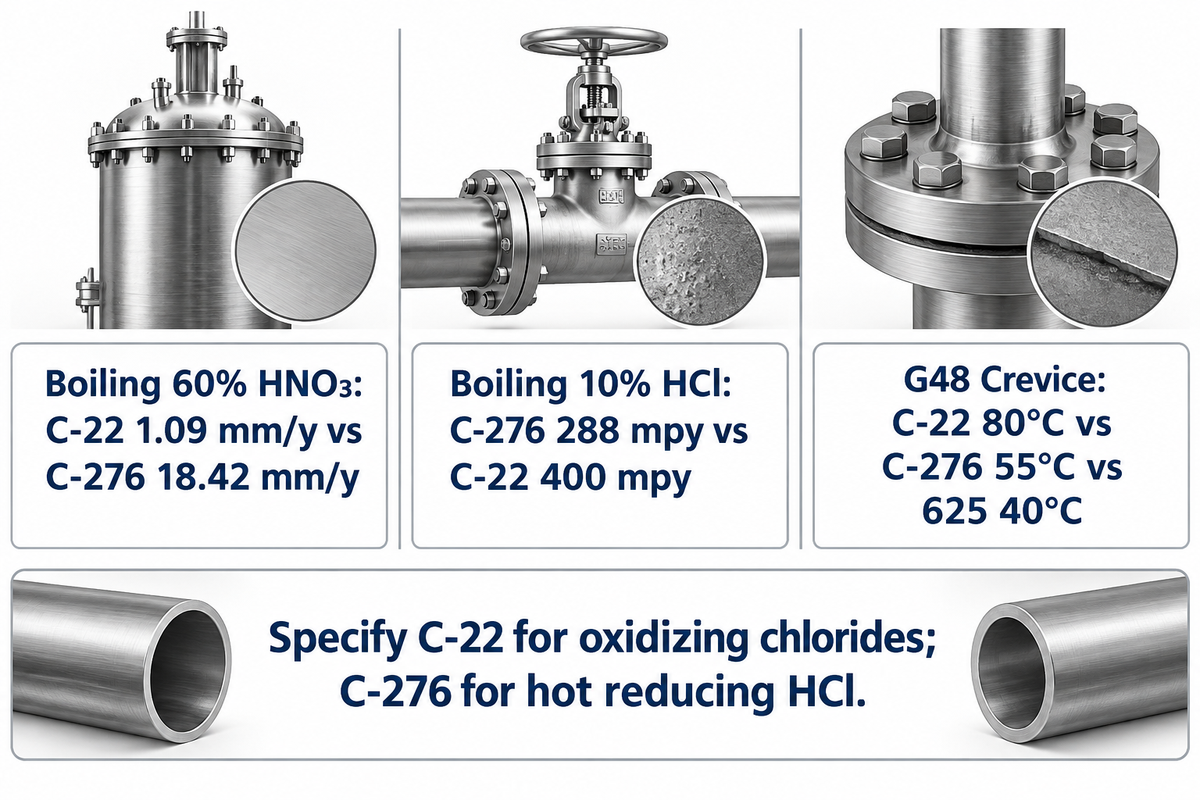
For mixed oxidizing chlorides, oxidizing acids, or welded scrubbers, specify Hastelloy C-22; for hot reducing hydrochloric acid, choose C-276. With 22% chromium versus 16% in C-276, C-22 shows excellent resistance in oxidizing ferric ions and wet chlorine. Buyers, however, must avoid treating C-22 as universal across every chemical stream under mixed reducing and oxidizing conditions.
In boiling 60% nitric acid, C-22 corrodes at 1.09 mm/y against 18.42 mm/y for C-276. Yet in pure reducing boiling 10% HCl, C-276 wins at 288 mpy versus 400 mpy for C-22. Inconel 625 brings niobium-driven yield strength, yet C-22 doubles its crevice resistance (80°C vs. 40°C). Aged C-22HS reaches 1365 MPa yield for sour wells, while 316L fits mild water under 15°C CPT. Review our Hastelloy C276 vs. C22 comparison, Hastelloy C276 guide, Hastelloy C276 supply specifications, and nickel alloy grade comparison tool.
Plant Field Case (Acid Dewpoint & Hydrochloric Streams): Recovery-boiler corrosion debates on Eng-Tips engineering threads compare C-22 against C-276 across 350°C to 70°C HCl dewpoints. In clean boiling 10% HCl, C-276 lasts longer (288 vs. 400 mpy). Once stray ferric chlorides or oxidizing contaminants appear, C-22 resists severe pitting far better than C-276 or B-alloys.
5-Alloy Oxidizing-vs-Reducing Boundary Table
| Criterion | C22 (N06022) | C276 (N10276) | Inconel 625 (N06625) | C22HS (N07022) | 316L (S31603) |
|---|---|---|---|---|---|
| Nominal Cr / Mo / W (%) | 22 Cr / 13 Mo / 3 W | 16 Cr / 16 Mo / 4 W | 21.5 Cr / 9 Mo / 3.6 Nb | 21 Cr / 17 Mo / ≤1 W | 17 Cr / 2.2 Mo / 0 W |
| Density (g/cm³) | 8.69 (8.61 SMC) | 8.89 | 8.44 (SMC PREN ref) | 8.61 | ~7.9 |
| Yield Strength Range | ≥310 MPa min (407 typ) | Comparable Ni-Cr-Mo wrought | Higher Nb solid-soln strength | 690–1413 MPa aged/CW | Lower stainless floor |
| G48 CPT / CCT (6% FeCl3) | >150°C / 80°C | >150°C / 55°C | 100°C / 40°C | 90°C chloride high PREN | 15°C / 0°C |
| Boiling 45% MgCl2 (G36) | No cracking 1,008 h | No cracking 1,008 h | No cracking 1,008 h | High SCC resistance (aged) | Cracks in 2 hours |
| Oxidizing Acid (60% HNO3 Boil) | 1.09 mm/y (Strongest) | 18.42 mm/y (Rapid attack) | Strong oxidizing behavior | Oilfield NACE sour focus | Fails with chloride ions |
| Pure Reducing (Boil 10% HCl) | 400 mpy | 288 mpy (Preferred) | Attacked >8% HCl | Not standard chemical tank | Severe failure |
| Weld & Fabrication Stability | Excellent weldability (1121°C WQ) | Standard Ni-Cr-Mo weldability | Nb overlay crack risk on boilers | Two-step age cycle; no weld swap | Easiest CNC & welding |
| Explicit Rejection Rule | Reject for sustained 593–900°C or 200°C conc. HF | Reject in boiling nitric acid or >55°C ferric crevices | Reject in >8% HCl or cracked boiler weld overlays | Reject heavy CW + age under H2S hydrogen risk | Reject any >15°C G48 chlorides or boiling MgCl2 |
Which Is Better, Hastelloy C22 or C276?
Hastelloy C-22 (22% Cr, 13% Mo) performs better in oxidizing chlorides, ferric or cupric salts, wet chlorine, and as-welded scrubbers (80°C CCT vs. 55°C). By contrast, C-276 (16% Cr, 16% Mo) beats C-22 in hot oxygen-free hydrochloric acid (288 vs. 400 mpy at boiling 10%) and hydrofluoric service up to 200°C.
Fabrication, Welding (ERNiCrMo-10), Annealing, and CNC Machining Guidelines
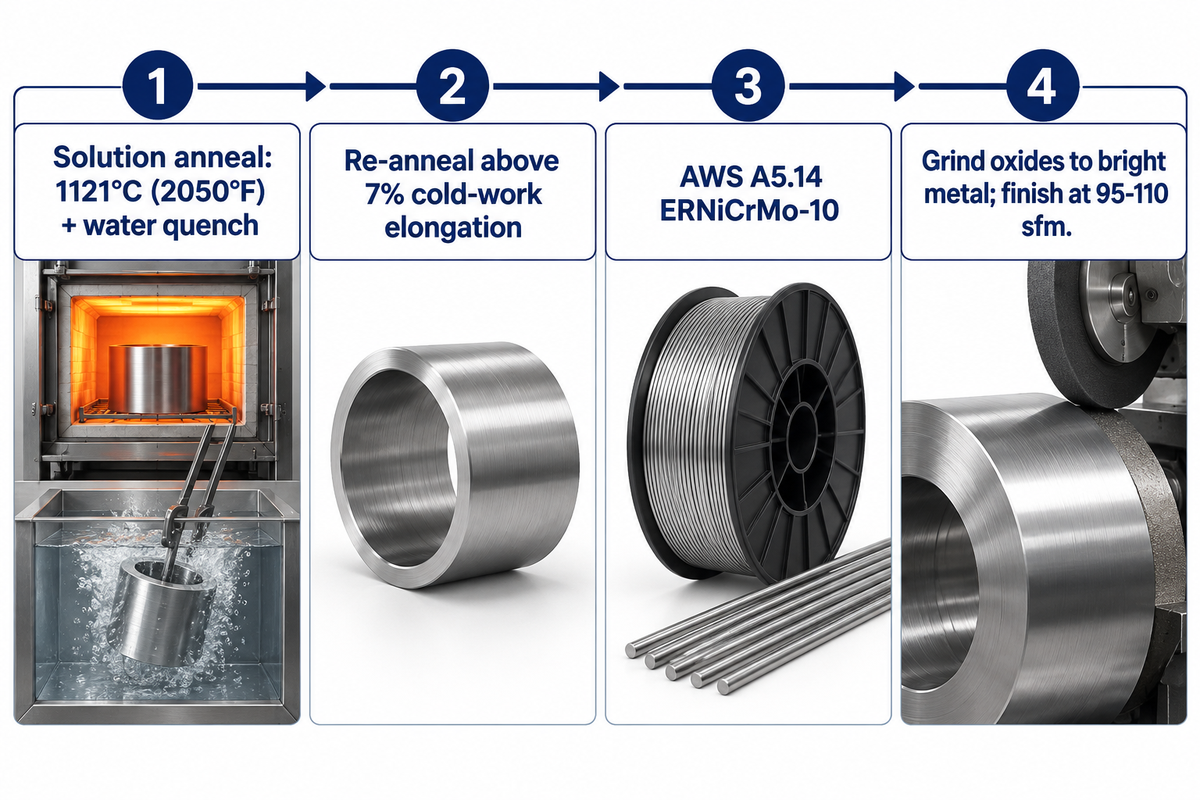
Re-anneal hot formed plates and severe cold forming bends at 1121°C (2050°F) whenever cold work exceeds 7% outer-fiber elongation. Hold parts 10 to 30 minutes before water quenching, using rapid air cooling only below 10 mm thickness. Weld using AWS A5.14 ERNiCrMo-10 (BS EN ISO Ni 6022) and avoid intermediate stress relief above 400°C.
Wrought C22 remains ductile across pressing, hot forming operations, and GTAW, GMAW, or SMAW welding with excellent weldability. Hot forging runs within a narrow 1232°C start to 954°C finish. Before welding, never trust stainless wire brushing on refractory surface oxides because brushing merely polishes oxide scales and traps inclusions.
“Solid solution alloys are normally welded in the annealed condition and precipitation hardened alloys in the solution treated condition. Preheating is not necessary unless there is a risk of porosity from moisture condensation.”
Source: TWI Global, Job Knowledge 22: Weldability of Nickel Alloys
Grind or machine joints down to bright base metal prior to tacking, and clean interpass slag between runs. Finish at 95–110 sfm with 5° positive rake, and run M-33/M-40/T-15 HSS drills at 10–15 sfm using a 135° crankshaft grind (50 sfm carbide-tipped). Never apply water-base coolant in interrupted carbide cuts; thermal shock chips edges rapidly, so run sulfochlorinated EP oil or dry air instead.
CNC Machine-Shop Experience: Machinists sharing C22 setup lessons on Practical Machinist CNC threads stress severe work hardening when tools rub. Shops replace risky NPT tapping with rigid carbide thread milling and run 5% stepover peel milling. Cobalt drills hold near ~20 sfm instead of faster stainless steel speeds.
How Do Forging, Cold Working, Weld Thermal Cycles, and Heat Treating Affect Tensile and Stress Corrosion Cracking?
Hot forging starts at 1232°C (2250°F) and finishes near 954°C (1750°F), using moderate reductions and frequent re-heating. Because C-22 alloy work hardens readily under cold working, intermediate annealing heat treating preserves weld toughness, tensile strength, and resistance to stress corrosion cracking.
Engineering Limitations: Thermal Embrittlement (600–900°C), HF Boundaries, and Galling
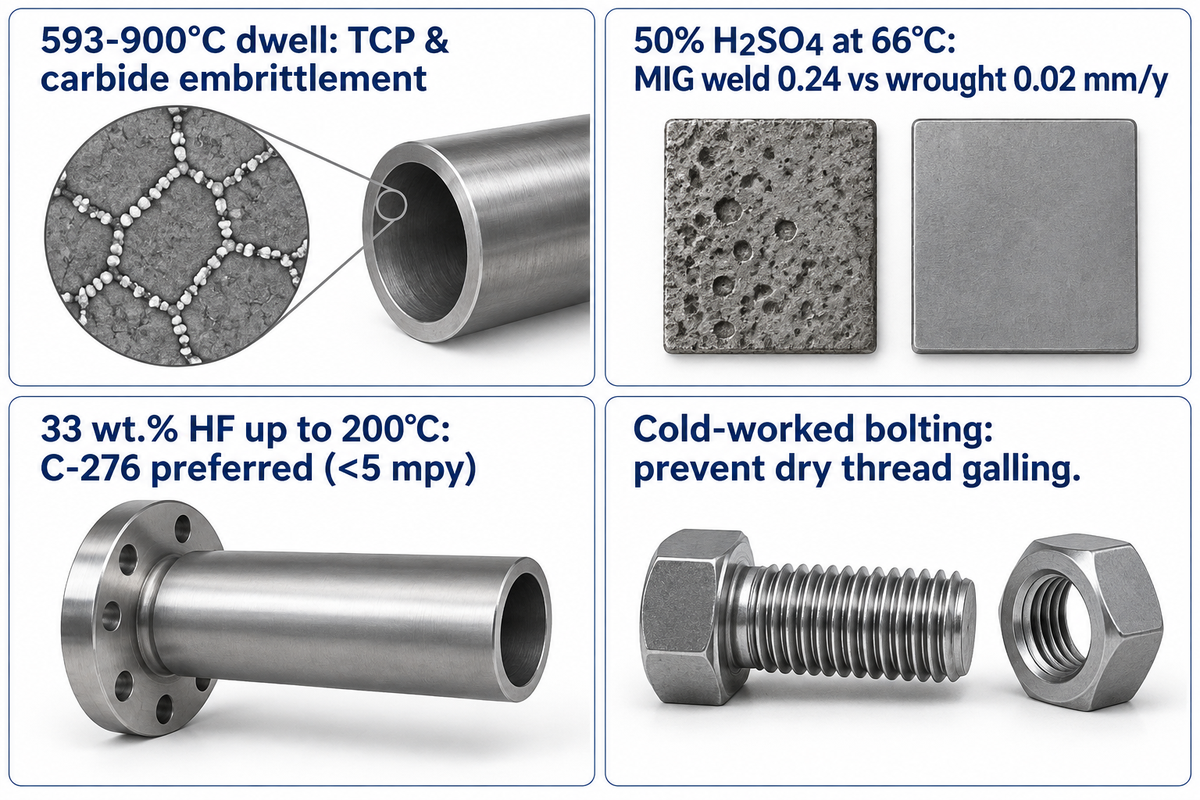
Long exposure across 593–900°C precipitates carbides and intermetallic TCP phases along grain boundaries, embrittling GTAW welds sooner than wrought plate. Penn State and LLNL studies (6,000 hours at 593, 649, 704, and 760°C) document falling toughness and high ASTM G 28 A and boiling 2.5% HCl losses. Conversely, precipitation kinetics stay negligible below 300°C for aqueous vessels.
Additive manufacturing trials show similar sensitization hazards. Wang et al. (2023) aged laser-melted C22 at 600, 750, and 900°C, producing MoSi2 and Cr7C3/Cr23C6 precipitates with peak attack at 750°C. Likewise, Haynes all-weld MIG deposits corrode 12 times faster than wrought metal in 50% H2SO4 at 66°C (0.24 vs. 0.02 mm/y). Where thick joints require low-temperature stress relief, TWI Patent WO2008107660A1 lowers 22 mm tensile residual stress from ~400 MPa to ~150 MPa below 400°C.
Two additional service boundaries restrict alloy deployment:
- Hot Hydrofluoric Acid Transfers: Oak Ridge National Laboratory (ORNL Pub57184) tests in 33 wt.% HF held C-276 below 5 mpy over four weeks, making C-276 preferred for oxygenated HF transfers up to 200°C.
- Galling of Threads on Cold Worked Bolting: When hand-tightened dry, nickel-chromium-molybdenum fasteners develop severe thread galling, hence use of dissimilar alloy or an anti seize coating is recommended.
Mill Forms, Cladding Options, and Core Industrial Applications
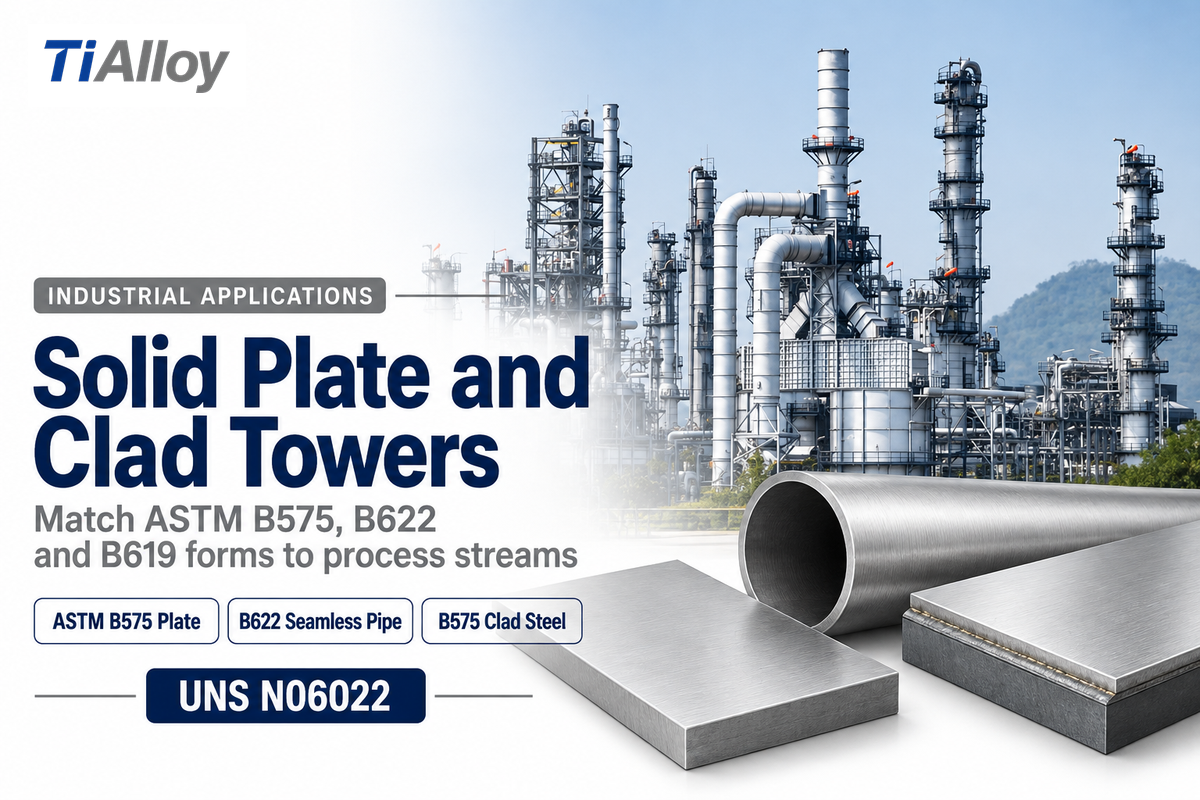
Specify solid ASTM B575 plate for chemical reactors and heat exchangers, or clad steel for tall sulfur dioxide scrubbers across the chemical process industry. Key industrial chemical applications across the industry include pharmaceutical clean loops, pickling tanks, and nuclear fuel reprocessing units.
Mills provide B575 plate and sheet, B622 seamless pipe, B619/B626 welded piping, B574 bar and B564 forgings. Explosion or roll-clad carbon steel backed with ASTM B575 C22 sheet preserves wetted corrosion barriers. For waste-to-energy boiler tubes, Special Metals SMC-049 warns that Alloy 625 weld overlays crack circumferentially, whereas niobium-free Alloy 22 overlays prevent cracking. Review Hastelloy C22 UNS N06022 mill forms, nickel-alloy clad steel plate and our clad plate selection guide when considering scoping towers.
Where Does Hastelloy C-22 Solve Pitting Corrosion in Heat Exchanger and Pulp and Paper Units?
Chemical plants deploy Hastelloy C-22 sheets, welded piping, and tubes across chemical process applications in heat exchanger bundles and pulp and paper processing. Its high chromium balance provides protection from chloride-induced pitting corrosion in oxidizing wet chlorine and acidic ferric process streams.
Inspection Testing, Cost Drivers, and Buyer RFQ Checklist
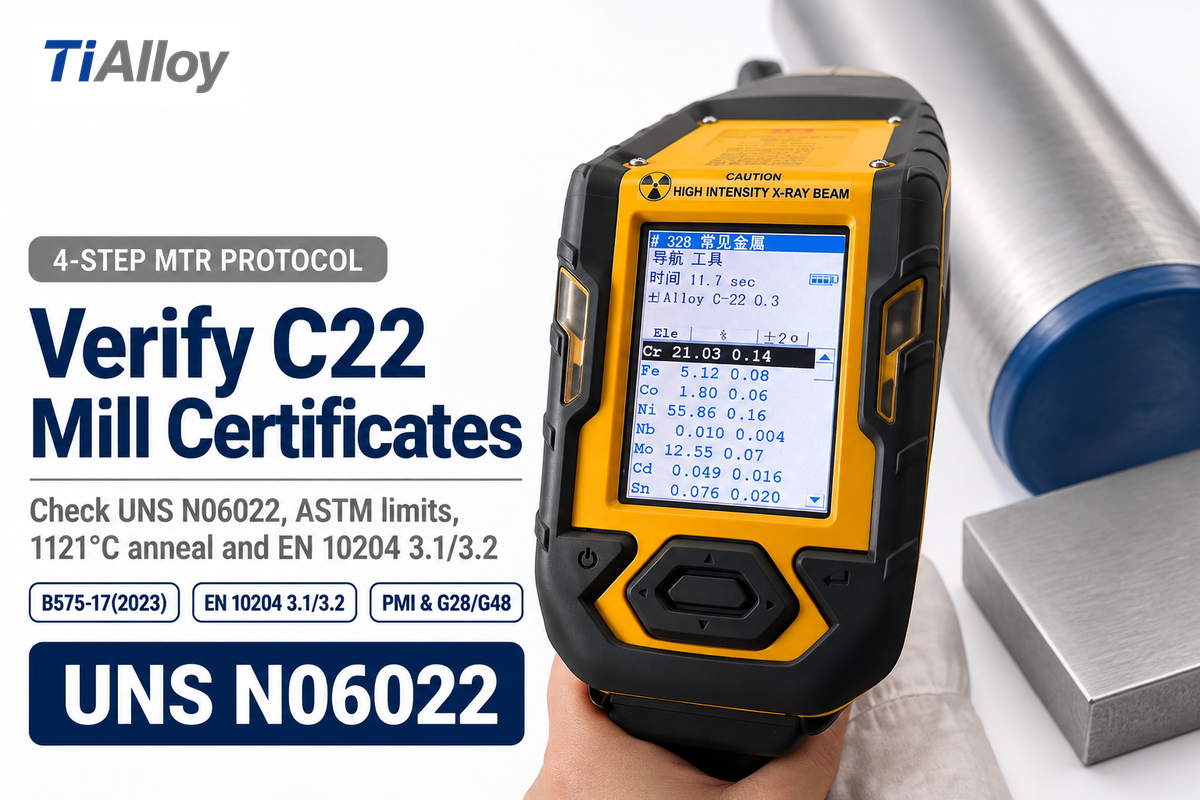
Hastelloy C22 purchase orders should specify ASTM form standard, active edition year, solution-annealed condition, and EN 10204 Type 3.1 or 3.2 certification. Mill acceptance requires heat-analysis chemistry within ASTM limits instead of commercial catalog averages. Because ~56% nickel, ~13% molybdenum, and ~3% tungsten surcharges fluctuate continuously, public spot prices do not exist and mills quote per lot.
Direct conversion costs consist of thin-gauge cold rolling, 1121°C annealing, ultrasonic NDT, hydrostatic testing, and ASTM G28-22 or ASTM G48-11 (2020) Methods C/D lot validation. Related buyer documentation includes reading an EN 10204 mill test report and our nickel alloy products selection hub.
4-Step C22 Mill-Cert Verification Protocol
- Check Alloy & ASTM Edition: Ensure certificates specify UNS N06022 (never N07022) and the current standards like B575-17(2023) or B574-23, and 1121°C water-quenched annealing.
- Audit Limiting Chemistry: Match heat reports against 20.0–22.5% Cr, 12.5–14.5% Mo, 2.5–3.5% W, ≤0.015% C, ≤0.08% Si, ≤2.5% Co max, and ≤0.35% V max.
- Validate Mechanical & Hardness Scope: Confirm ≥690 MPa tensile, ≥310 MPa yield, and ≥45% elongation; keep ≤100 HRB informational per ASTM B575 Footnote B.
- Mandate Traceability & Corrosion Tests: Include EN 10204 3.1 or 3.2 certifications, PMI alloy testing, and project ASTM G28 Method A or ASTM G48 Method C/D reports.
TiAlloy offers UNS N06022 plate, bar, and seamless pipe with full EN 10204 3.1/3.2 traceability, and on request, provides engineering quotes for each lot.
Frequently Asked Questions
What is Hastelloy C22 material?
Hastelloy C22 is a solid-solution austenitic nickel-chromium-molybdenum-tungsten superalloy standardized as UNS N06022 and DIN 2.4602.
Nominal melts target 56% nickel, 22% chromium, 13% molybdenum, 3% tungsten, and 3% iron to handle oxidizing and reducing acids. Solution-annealed stock delivers an 8.69 g/cm³ density and 1357–1399°C melting range. Under ASTM B575, wrought forms guarantee at least 690 MPa tensile strength, 310 MPa yield strength, and 45% elongation.
Is Hastelloy the same as Inconel?
No, Hastelloy and Inconel are distinct alloy families and trademarks from Haynes International and Special Metals.
The majority of the Hastelloy C-series alloys favor wet corrosion resistance by addition of elevated molybdenum and tungsten. On the other hand, most of the Inconel series of alloys prefer high-temperature structural oxidation by chromium and other elements. Alloy 22 is one direct bridge: Special Metals markets exact UNS N06022 chemistry as Inconel alloy 22 beside Haynes’s Hastelloy C-22.
Is Hastelloy C22 better than stainless steel?
Yes, Hastelloy C22 is better than 304L or 316L stainless steels against hot chlorides and mineral acids as well as cracking media.
In acidified 6% ferric chloride (ASTM G48), C22 posts a pitting limit above 150°C and 80°C crevice resistance versus 15°C and 0°C for 316L. At the same time, C22 withstands 1,008 hours in boiling 45% magnesium chloride crack-free. Under that identical ASTM G36 stress-corrosion test, 316L fractures within two hours.
Is Hastelloy C22 magnetic?
No, annealed Hastelloy C22 is practically non-magnetic during service.
Special Metals SMC-049 measures ≤1.001 magnetic permeability at 200 oersteds (15.9 kA/m) in its austenitic state.
What is the difference between Hastelloy and Hastelloy C / C22?
Hastelloy is Haynes International’s umbrella trademark across nickel superalloys, whereas legacy Hastelloy C was the 1930s grade that suffered weld-zone corrosion unless heat treated after fabrication.
Modern Hastelloy C22 (UNS N06022) fixes that older problem by cutting carbon to 0.015% max and silicon to 0.08% max under ASTM B575. Those tight ceilings inhibit damaging carbide precipitation during normal welding. Compared with C-276, C22 boosts chromium to 20.0–22.5% while maintaining 12.5–14.5% molybdenum and 2.5–3.5% tungsten. That chemistry edge elevates oxidizing passivation in nitric blends, wet chlorine, and acidified ferric crevices.
What is the typical Rockwell hardness of annealed Hastelloy C22?
Annealed Hastelloy C22 sheet and plate have an average hardness of 88 HRBW (84 HRBW for bar).
ASTM B575 Footnote B states that 100 HRB max is informational only and is not to be used for rejection.
How much does Hastelloy C22 cost per kilogram, and why do quotes vary?
Hastelloy C22 is quoted per kilogram and has no fixed published price because the primary mill melt surcharges are based on the moving nickel (~56%), molybdenum (~13%), and tungsten (~3%) indexes for each lot.
Mill quotes vary widely by product shape, thickness, and certification tier. Thin cold-rolled sheet, small seamless B622 tubes, and custom forgings require extra 1121°C annealing passes and yield less weight than heavy plate. Mandatory inspection adders also move unit pricing: ASTM G28-22 corrosion coupons, ultrasonic NDT, and EN 10204 3.2 witness certificates add direct lab costs. Cladding ASTM B575 C22 onto carbon steel often cuts tower cost.
What inspection documents should verify a Hastelloy C22 mill order?
Require an EN 10204 Type 3.1 or 3.2 Mill Test Certificate matched to heat numbers.
Check UNS N06022, current ASTM editions, ASTM chemistry limits, mechanical minima (≥690/310 MPa, 45%), 1121°C anneal records, PMI verification, and ASTM G28-22 or G48 reports.
Our Perspective
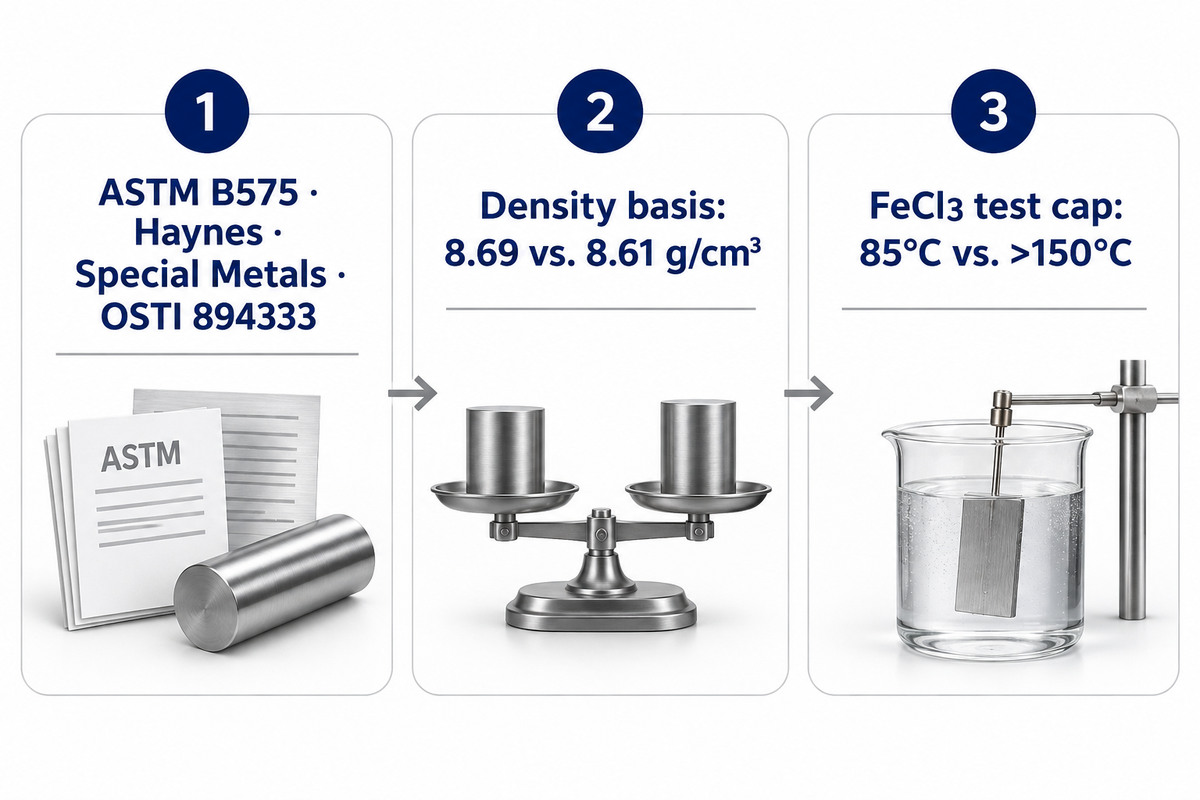
We compiled this UNS N06022 specification guide directly from ASTM B575 standards, Haynes International and Special Metals technical bulletins, and DOE OSTI 894333, ORNL, Penn State, and TWI metallurgical records. Where published datasets diverge (such as 8.69 vs. 8.61 g/cm³ density or 85°C vs. >150°C FeCl3 bounds), both figures and test conditions appear clearly. Reviewed by the TiAlloy technical team.
Primary reference: Haynes International HASTELLOY C-22 Technical Datasheet.
References & Sources
- Haynes International: HASTELLOY C-22 Alloy Technical Datasheet (Physical, Mechanical, Corrosion and Fabrication Data)
- Haynes International: HASTELLOY C-22HS (UNS N07022) Datasheet & Cold-Work Hydrogen Limitation
- Haynes International / Buchi: Hastelloy C-22 Corrosion Resistance & Machining Guide (H-2019/H-2010)
- Special Metals Corporation: INCONEL Alloy 22 Technical Bulletin SMC-049 (ASTM Limits, PREN, & Boiler Overlays)
- U.S. DOE / LLNL (Rebak & Payer, 2006): OSTI 894333: Alloy 22 Corrosion Evaluation & Mineral Acid Immersion Data
- Oak Ridge National Laboratory (ORNL): ORNL Pub57184: Hydrofluoric Acid Alloy Experience & C-276 Boundary
- Pennsylvania State University / MRS Vol. 713 (Edgecumbe, Rebak, Palmer, Crook, 2002): Influence of Thermal Aging (593-760°C) on Mechanical & Corrosion Properties of Alloy C-22 GTAW Welds
- U.S. EPA HERO Reference 1751724 (Rebak et al., 2002): Thermal Stability of Alloy 22 Welds and Wrought Material (482-800°C)
- The Welding Institute (TWI): Patent WO2008107660A1: Sub-400°C Localized Stress Relief of Welded Alloy 22 Components
- The Welding Institute (TWI): Job Knowledge 22: Weldability of Nickel and Nickel Alloys
- VDM Metals (AMPP 2024): C2024-20938: Active ASTM G28-22 & ASTM G48-11 (2020) Nickel Alloy Corrosion Testing
- Wang et al. (2023, Applied Surface Science 608): Intergranular Corrosion Sensitivity of Laser-Additively-Manufactured Hastelloy C22 at 600–900°C
- Zadorozne et al. (2012, Electrochimica Acta 76): Crevice Corrosion Kinetics of C-22 and C-22HS in 90°C Chloride Media
- Thermal Processing Magazine (MacKenzie, FASM, 2023): Sensitization (450–900°C) & Intergranular Corrosion Mechanisms
- TestMetals ISO/IEC 17025 Laboratory: ASTM G48 Methods C/D and G28 Methods A/B Nickel Alloy Testing
- IspatGuru Metallurgy: Hastelloy Alloys Comparative Property Overview
- Practical Machinist Shop Discussion: Thread #449434: Thread Milling, Tool Wear, and Peel Milling C22 Hastelloy
- Eng-Tips Engineering Forum: Thread #157950: Boiling 10% HCl and Oxidizing Impurity Selection (C-276 vs. C-22)