Get in Touch with TiAlloy Company

Titanium Welding Guide for Cleaner Joints and Fewer Repairs

By Cherry
Titanium welding techniques succeed when the alloy, filler, cleanliness and shielding arrangement work together. A stable arc is part of the job, but the cooling weld and exposed root also need protection, and inspection must address the intended service. This Titanium Welding Guide links those choices to shop preparation, weld quality and purchasing. Use the drawing and qualified welding procedure as the operating specification, addressing fatigue, pressure and cryogenic service requirements where applicable.
Before the first weld
- Identify the base metal and the required joint properties.
- Match filler classification and supply form to the procedure.
- Arrange protection for the weld pool, cooling trail and exposed root.
- Agree the inspection method and acceptance criteria before production.
Titanium weldability starts with the alloy and the atmosphere
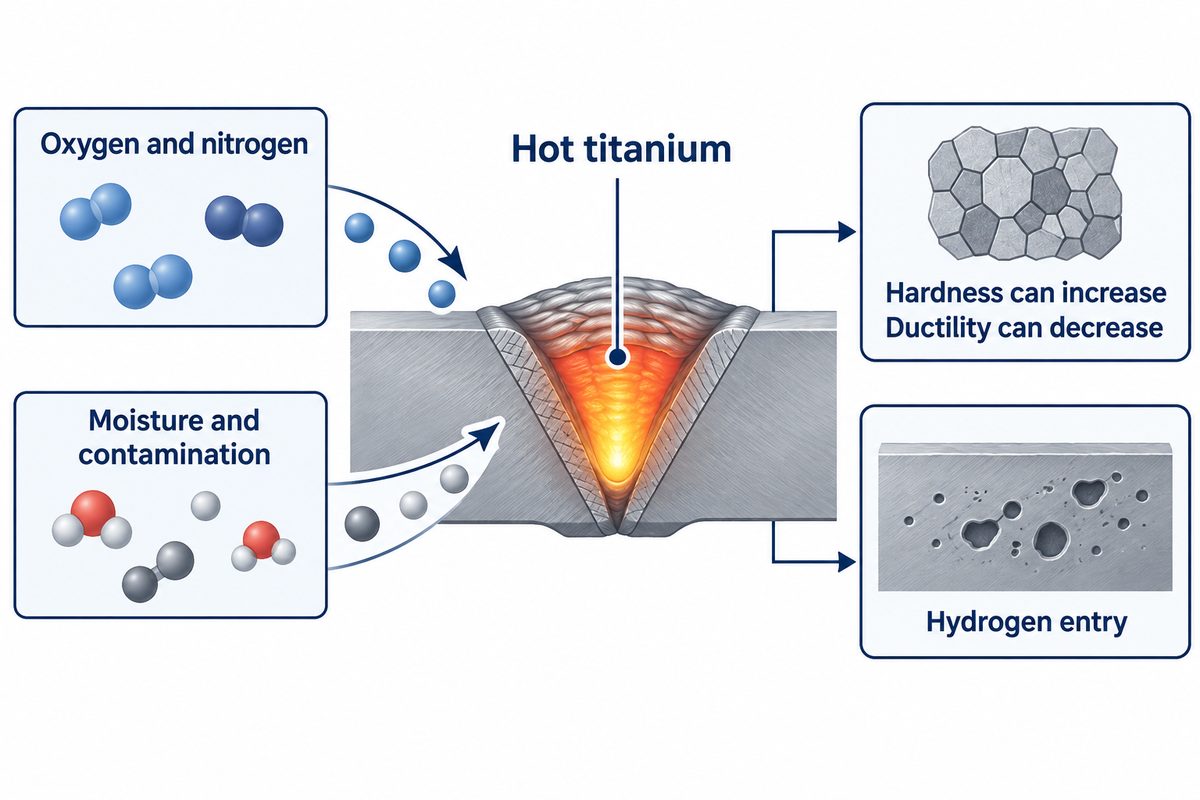
Many common titanium alloys can be welded successfully, including commercially pure grades and Ti-6Al-4V. Their weldability depends on the chemistry of the alloy, the thermal history and protection from air. The protective surface oxide on the alloy provides corrosion resistance in service. Hot metal during welding has different protection needs.
Oxygen and nitrogen absorbed during welding can increase hardness while decreasing ductility. Moisture and surface contamination introduce hydrogen. Thus, a harder weld can be less tolerant of deformation, which explains why judging a joint by strength alone misses an important failure mode. The mechanisms and the precautions required are described in TWI’s titanium weldability guidance.
Industries like aerospace use titanium for its strength-to-weight ratio, while chemical equipment often places corrosion resistance first.
For the buyer, alloy identification precedes machine selection. A Grade 2 tube joint and a Grade 5 structural part can call for different filler, inspection and mechanical properties. Make sure the welder receives the same alloy designation that engineering specifies by attaching the material certificate to the job traveler.
Compare TIG, MIG, laser, and electron beam welding
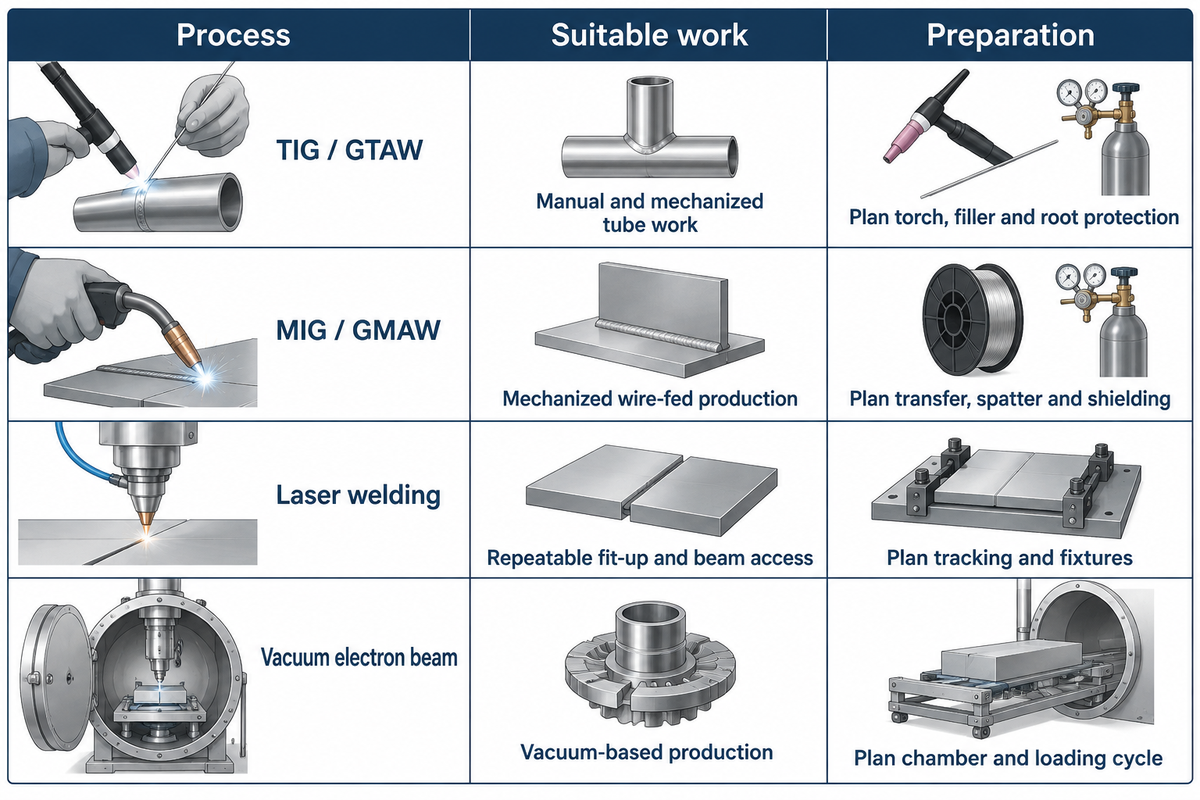
Joining titanium with TIG is an excellent starting point, especially if the operator needs close control of the weld puddle and filler additions. MIG, laser welding and electron beam welding satisfy different access, output and heat-input needs. Compare the complete welding process, including fixtures and protection, and then compare arc speed. Titanium joining costs include the time spent loading and protecting each part.
| Process | Useful starting application | What must be planned |
|---|---|---|
| TIG / GTAW | Controlled manual work and mechanized tube joints | Torch access, filler addition, trailing and root protection |
| MIG / GMAW | Wire-fed production with suitable mechanization | Transfer mode, spatter, shielding hardware and acceptance demands |
| Titanium laser welding | Repeatable joints with controlled fit-up and beam access | Joint tracking, fixtures and protection of heated titanium |
| Vacuum electron beam | Parts suited to a vacuum-based production route | Chamber size, loading cycle and qualified beam parameters |
TWI’s welding-process guidance explains that pulsed MIG technology has narrowed the gap with TIG, although manipulating a torch with supplementary shielding remains difficult. Vacuum electron beam welding uses the chamber environment to replace a protective gas shield. TWI describes keyhole plasma-TIG capability up to 12.5 mm, a process example rather than a thickness limitation for every welding machine.
For cyclically loaded titanium components, include fatigue performance in the comparison. A 2024 study of Ti-6Al-4V welds found that pore size and location affected fatigue life. The study ranks process performance for the tested specimens; a production decision also requires the actual joint geometry and service load.
Choose filler metal for Grade 2 and Grade 5
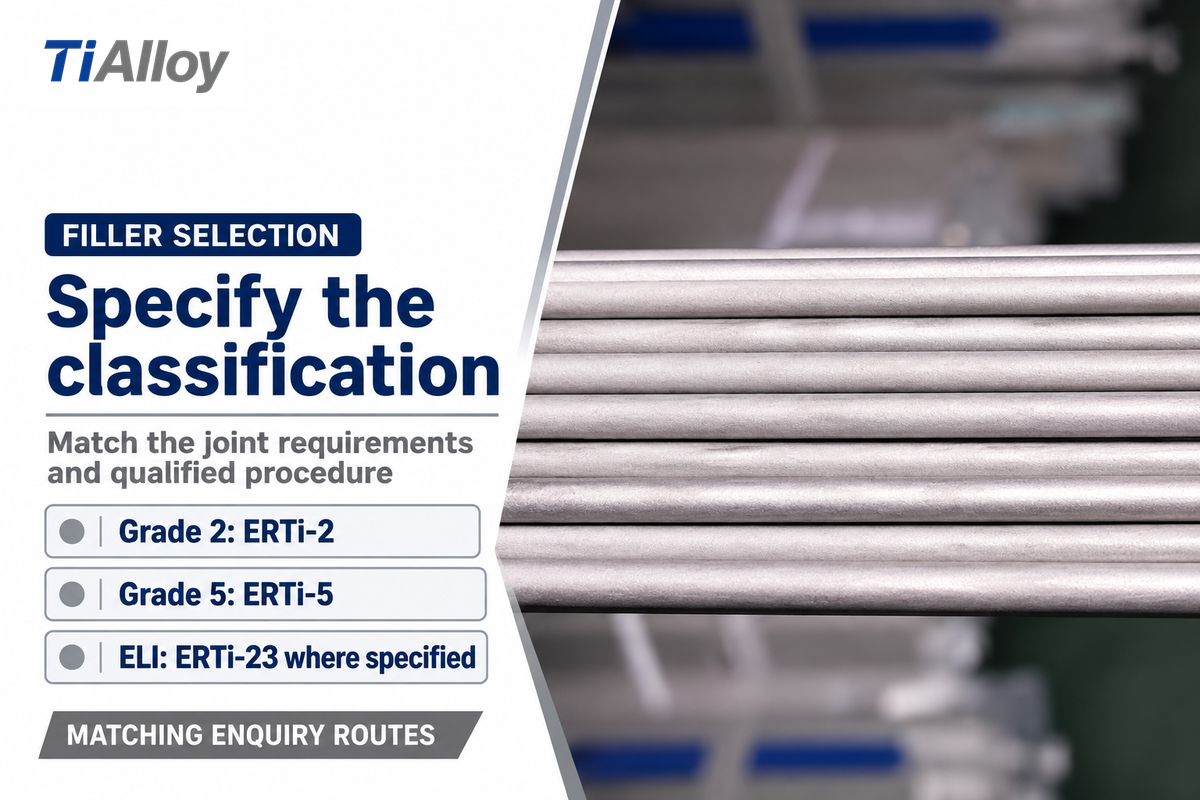
Matching the base-metal composition is typically the starting point for selecting titanium filler metal. Grade 2 tends to lead to an ERTi-2 enquiry, and Ti-6Al-4V tends to lead to ERTi-5. Engineering requirements can alter this selection, particularly if the joint design is governed by ductility, toughness or by service at very low temperature.
What filler material is recommended for Grade 2 titanium?
ERTi-2 is a common starting point for matching Grade 2 titanium when the procedure requires filler. Specify the welding classification as well as diameter and delivery form. Include the required length of straight-length ERTi-2 welding rod. A purchase order specifying only “Grade 2 wire” doesn’t resolve the distinction between industrial wire and a classified welding consumable.
| Base material | Matching enquiry route | Selection boundary |
|---|---|---|
| Grade 2, commercially pure titanium | ERTi-2 | Confirm required joint properties and the qualified procedure |
| Grade 5, Ti-6Al-4V | ERTi-5 | Check strength, ductility and applicable project restrictions |
| Ti-6Al-4V ELI applications | ERTi-23 where specified | Confirm low-interstitial requirements and service conditions |
TWI discusses lower-strength and extra-low-interstitial fillers as possible ways to improve weld-metal ductility. Some project specifications impose a narrower choice. Within its NASA/Johnson Space Center orbital-tube scope, PRC-0015 Rev. A, section 5.2, requires ELI filler for cryogenic applications and prohibits commercially pure filler on Ti-6Al-4V and Ti-6Al-4V ELI. Treat that as a concrete example of why a general substitution suggestion can’t override the job specification.
The separate comparison of Grade 2 and Grade 5 materials assists in the selection of base-metal. The weld procedure explains how this selection becomes a joint.
Clean and fit the joint before striking the arc
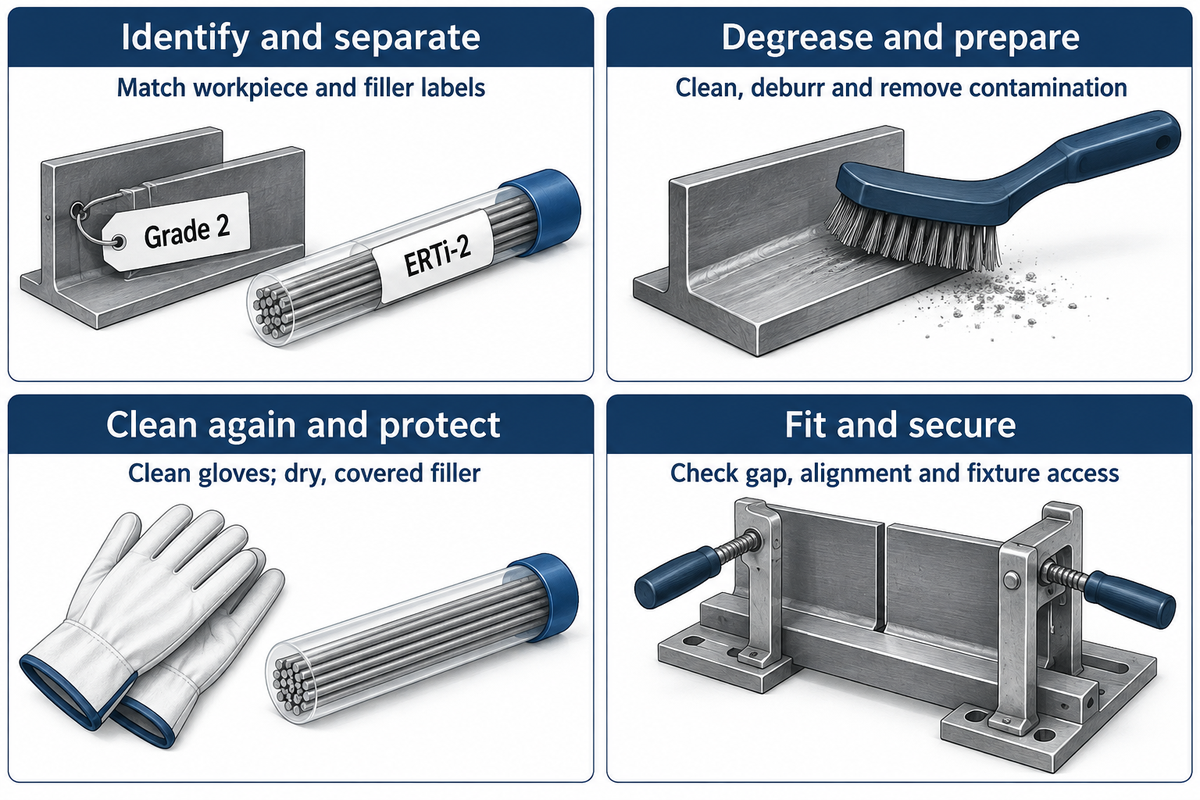
Working with titanium requires clean joint faces, clean filler and clean handling. Before the arc starts, implement controls for the contamination challenges of titanium welding. Remove oil prior to mechanical preparation, use dedicated tools, and keep the prepared parts protected until assembly. Titanium welding joint design also warrants the same attention. The gap in the joint can affect the amount of filler and the penetration depth.
- Identify and separate: match the workpiece and filler labels to the job, then isolate tools from other alloys.
- Degrease and prepare: follow the approved cleaning method, deburr the edges and remove the specified surface contamination.
- Clean again and protect: remove preparation residue, use clean gloves and keep filler dry and covered.
- Fit and secure: check the joint gap, alignment and fixture access before arranging the gas protection.
A dedicated brush is good, but the drive system is important, too. TWI identifies air-powered tools as a possible source of oil or moisture after degreasing. Using stainless steel brushes reserved for titanium avoids one of the contamination routes; blowing oily compressed air across the cleaned joint can introduce another.
An effective handover between preparation and welding includes the method of cleaning, tool identity, and the time the prepared assembly was out of protected storage. When a prepared assembly waits for another shift, keep the joint faces covered instead of assuming they remain clean because preparation was completed earlier.
Protect the weld pool, cooling trail, and root
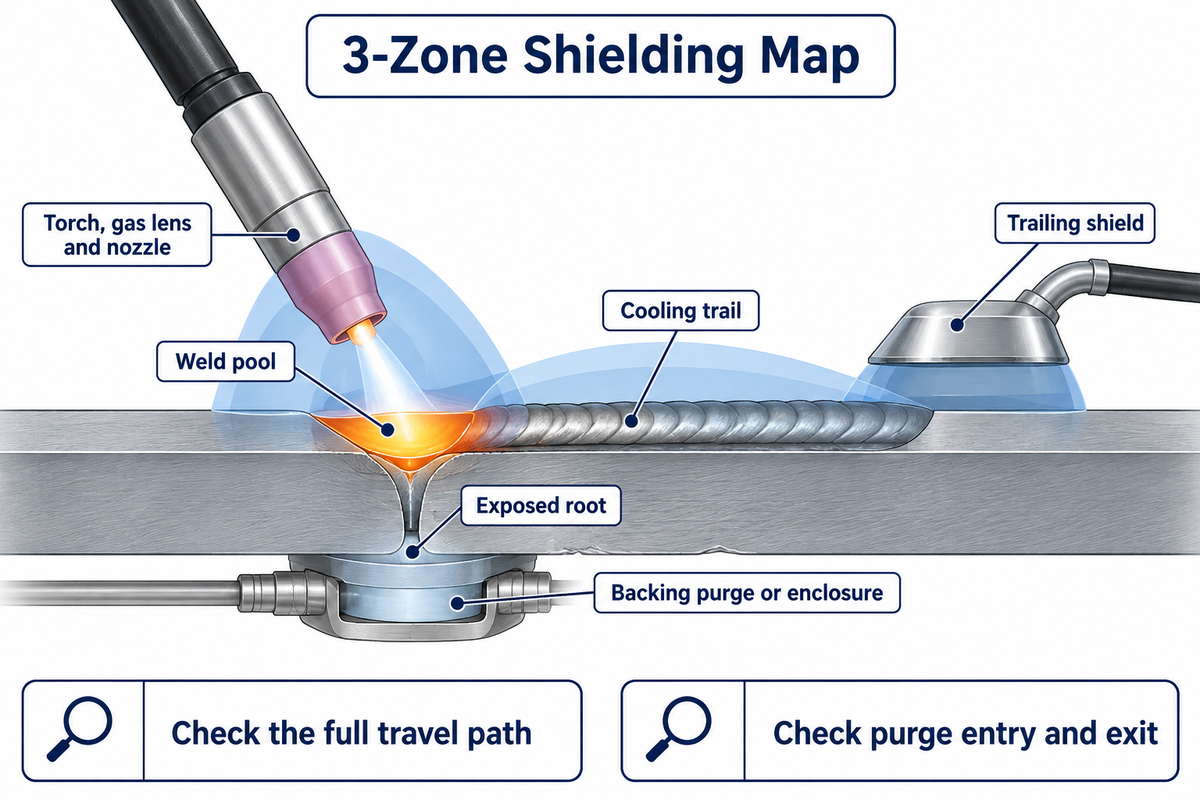
Gas-shielded welding of titanium requires protection for any hot metal left exposed to air. The torch covers the immediate weld pool. Additional shielding protects the cooling weld bead and adjacent area. A purge protects the root. There are additional arrangements beyond the gas in the cylinder.
3-Zone Shielding Map
| Zone | Protection route | Failure path to investigate | Production check |
|---|---|---|---|
| Weld pool | Welding torch, gas lens and nozzle | Leaks, drafts or disturbed gas coverage near the arc | Check the delivered gas and torch arrangement |
| Cooling trail | Trailing shield matched to the joint | Hot weld exits protection as travel continues | Check shield coverage through the full travel path |
| Exposed root | Backing purge or protected enclosure | Air remains inside a tube or reaches the backside of the weld | Check purge entry, exit and the actual enclosed volume |
This illustration separates a gas-supply problem from a delivery problem. A good cylinder can’t make up for a trailing shield that lifts away from a curved part, an inappropriate hose, or leaking connection. TWI notes that moisture can collect in hoses during idle periods; weld porosity after a weekend shutdown is a reason to investigate the gas path as well as the workpiece.
For tube work, plan the purge around the enclosed space and venting arrangement before tacking. Protection must be placed on both sides of the weld and survive the actual assembly process. A purge that’s placed on an open sample may not work with the final piece in place.
Changes to shielding hardware, including a titanium welding chamber, may also require qualification. The cited NASA specification treats the shielding equipment and shielding method as essential variables. According to the specification, a qualification performed outside the chamber may be used inside the chamber. However, a qualification performed inside the chamber may not be used outside the chamber. Record the approved arrangement as part of process control so a production shortcut doesn’t quietly become a different welding method.
Set up TIG welding without copying a universal recipe
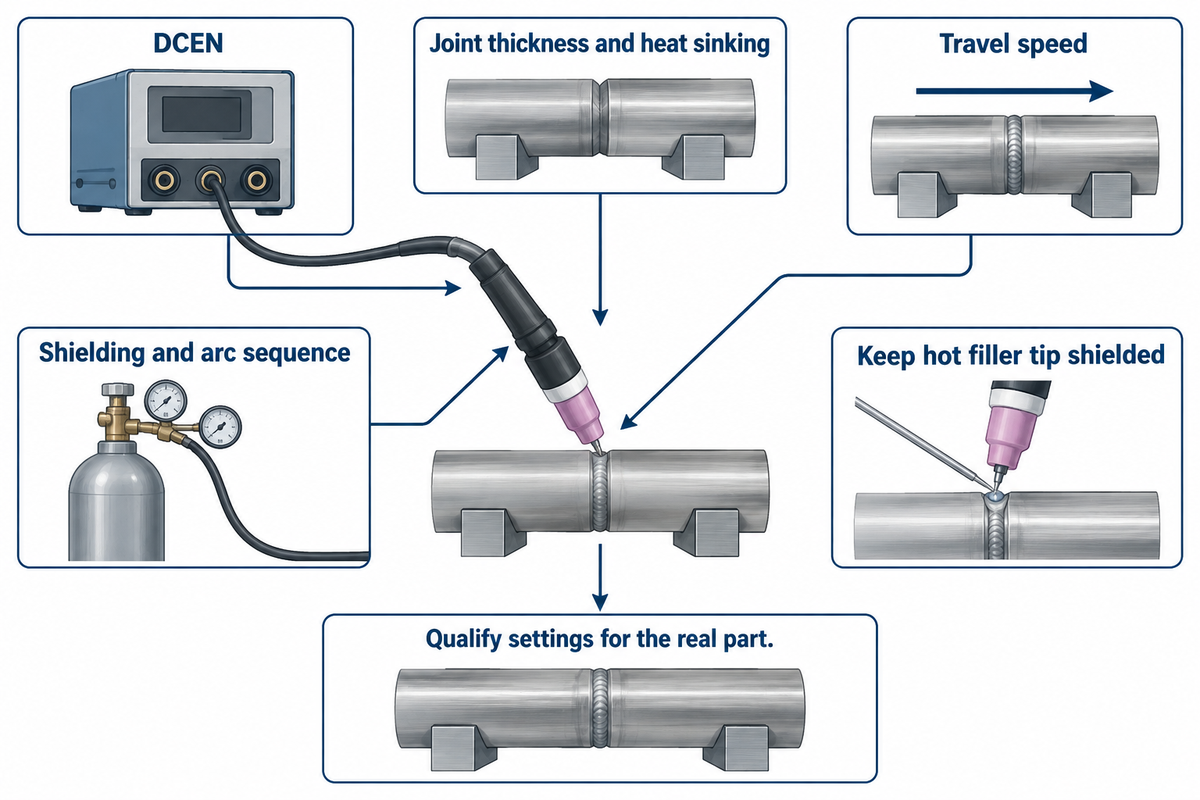
Polarity, electrode, joint preparation, shielding and the arc sequence affect TIG process control. Gas tungsten arc welding gives the operator control over heat and filler addition, but a copied amperage setting leaves joint thickness, heat sinking and travel speed unresolved. Proper welding procedure qualification relates those settings to the real part.
Do you weld titanium with AC or DC?
Titanium TIG welding usually employs direct current with the electrode negative (DCEN). TWI says high-purity argon is the typical shielding gas, with helium or argon-helium mixtures used for some penetration requirements. Its guidance allows high-frequency or Lift Arc initiation to avoid tungsten contamination.
For thin-section work, the TWI weldability guide describes TIG and plasma processes with argon or argon-helium shielding for components typically below 10 mm. Miller’s tube-and-pipe best practices gives 20–25 seconds of post-flow as an example of continued protection after welding. The production procedure must set the timing for cooling conditions.
Keep the hot filler tip in the inert gas shield between additions. For a titanium heat exchanger tube joint, evaluate how the tubesheet and fixture draw heat away from the weld. The tungsten welding equipment can behave differently on a free tube coupon and an assembled exchanger.
Inspect weld color, porosity, and other defects
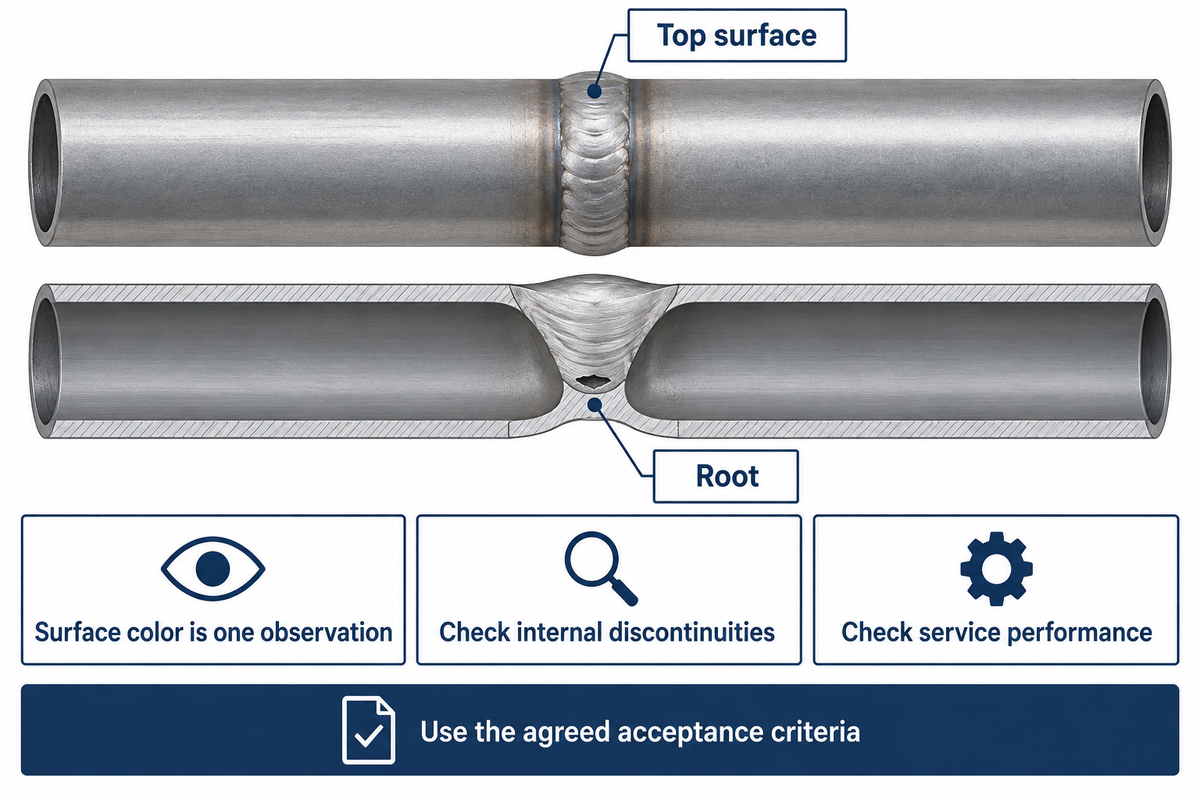
Examine titanium joints against agreed acceptance criteria, observing surface color together with geometry and performing the required examinations. An applicable titanium weld color chart helps identify shielding problems. Internal discontinuities and service performance require their own checks. To document joint quality and integrity, note surface color, geometry and the results of required examinations across the weld.
What does a bright silver sheen on weld bead surfaces indicate?
A silvery reflection can often indicate limited visible surface oxidation. Assess internal soundness and full mechanical acceptance independently of surface color. Inspect the root, cooling trail and top surface, then perform the specified examinations for internal defects. For multi-pass welds, retain the inspection history of earlier passes.
Contamination in an earlier pass can affect subsequent weld metal. For multi-pass titanium welds, TWI cautions: “surface appearance alone is not a reliable guide”.
A 2011 study by Hoye and colleagues also differentiated surface coloration from interstitial contamination within the bulk material. For fatigue-critical work, the 2024 Ti-6Al-4V study highlights another concern: large pores and pores near the specimen surface were particularly detrimental in its tests.
| Observation | Investigation focus | Next controlled action |
|---|---|---|
| Discoloration beside the bead | Cooling-trail coverage and movement | Compare with the applicable color acceptance criteria |
| Oxidation at the root | Backing purge, leaks and trapped air | Review the root-side protection arrangement |
| Porosity | Hydrogen sources, cleanliness and gas delivery | Use the specified examination and repair procedure |
| Porosity after idle time | Moisture in hoses or supply lines | Investigate the gas path before restarting the batch |
| Uneven penetration | Fit-up, heat sinking and travel consistency | Check the joint against the qualified setup |
| Lack of fusion | Joint preparation and process conditions | Determine disposition under the acceptance requirements |
| Suspected tungsten inclusion | Electrode contact and arc initiation | Examine and repair through the approved route |
| Unexpected embrittlement | Contamination, alloy and filler identity | Hold affected work for engineering assessment |
| Fatigue-sensitive joint | Defect size, position and service loading | Apply the inspection scope specified for that duty |
Brushing off an oxide color changes the visible surface, not the history of the metal beneath it. Base titanium weld repair on the recorded original condition and required disposition before cosmetic cleaning obscures the evidence.
Calculate welding cost per accepted joint
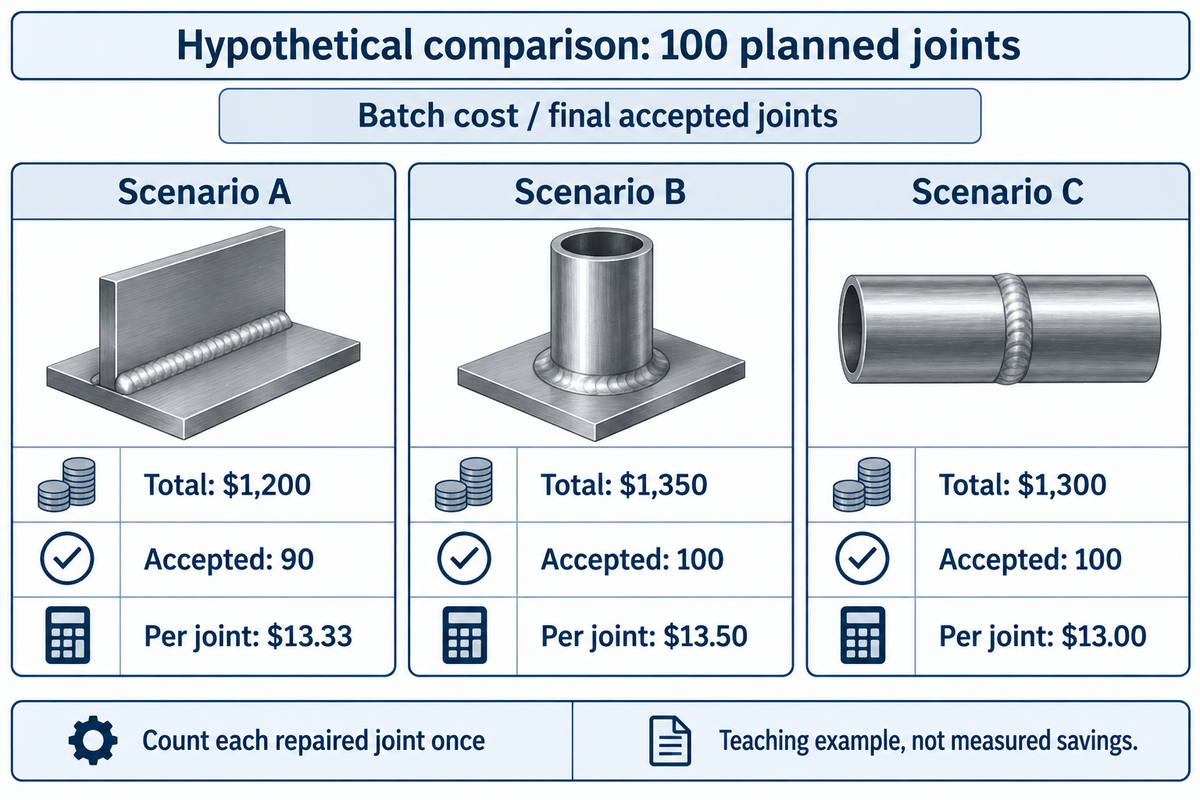
Calculate cost per accepted joint by dividing the complete batch cost by the number of joints finally accepted, counting each accepted joint once even if it required repair. Include costs associated with preparation, fixturing, purging, welding, inspection, repair, and replacement. Compare titanium welding rod price after matching classification, diameter and form; the consumable is only one of the batch-cost inputs.
Cost per accepted joint = total defined batch cost / final accepted joints. Allocate any relevant procedure qualification cost on a stated basis. If material and scrap losses are included in the batch cost, they shouldn’t be included again.
| Scenario | Total batch cost | Final accepted joints | Cost per accepted joint |
|---|---|---|---|
| A | $1,200 | 90 | $13.33 |
| B | $1,350 | 100 | $13.50 |
| C | $1,300 | 100 | $13.00 |
In this teaching example, B accepts more joints than A but costs slightly more per accepted joint: $1,350 ÷ 100 = $13.50. C produces the same accepted quantity as B at a lower total cost. The assumed cost totals illustrate the calculation and are not quotations or measured savings.
Production should record purge and prep time, and quality should record first-pass acceptance and final acceptance separately. Then, finance compares costs for the same cost scope. A Chalmers study of visual weld inspection found that inconsistent assessments could create unnecessary repair. Research published by SAE on welded automotive assemblies also shows why inspection strategy and process improvement belong in the same cost decision. Required joint performance remains an acceptance condition, even when another route has a lower average cost.
Specify titanium filler wire without ordering the wrong product
Order titanium welding wire by filler classification, diameter, supply form and documentation required. AWS A5.16/A5.16M:2023 addresses titanium welding electrodes and rods; ASTM B863-26 addresses titanium and titanium-alloy wire. A drawing that requires a classified consumable needs that requirement stated explicitly on the order.
TiAlloy lists industrial wire and welding-filler routes, including ERTi-2, ERTi-5 and ERTi-23. Its product information gives details on supply in coils, spools and straight lengths. Send the required combination rather than assembling an order from unrelated maximum capabilities of the wire family. When using an external titanium welding service, share the same requirements with the fabricator.
Industrial wire enquiry
- State the titanium grade and wire specification.
- Define dimensions, tolerance and surface condition.
- Specify delivery form and inspection documents.
Welding-filler enquiry
- State the required welding classification.
- Match diameter and form to the welding process.
- Define batch traceability and procedure requirements.
| Order field | What to provide | Who resolves it |
|---|---|---|
| Base material | Grade and material condition | Engineering |
| Filler classification | Required ERTi designation | Welding engineering |
| Applicable specification | Standard, edition and project requirements | Engineering and quality |
| Diameter | Nominal size and required tolerance | Production |
| Delivery form | Straight rod, coil or spool | Production and purchasing |
| Quantity | Batch quantity and delivery schedule | Purchasing |
| Surface and packaging | Cleanliness and protected-storage requirements | Quality |
| Traceability | Lot identity and required inspection records | Quality |
| Service conditions | Cryogenic, fatigue or other specified duty | Design engineering |
The titanium wire forms and ordering guide provides additional information about products. For a consumable enquiry, send the completed requirements along with the drawing to TiAlloy’s titanium welding filler-wire team.
Titanium welding FAQ
Can you weld titanium with TIG?
Yes. TIG is widely used for welding titanium and its alloys in manual and mechanized work. Successful joining requires clean material, a suitable procedure and protection of the hot weld and exposed root. Shielding must continue through the relevant cooling period after the arc stops. Plan torch, trailing-shield and root access before fitting the assembly.
What is the best gas for TIG welding titanium?
High-purity argon is the usual starting gas for titanium TIG welding. Helium or argon-helium mixtures can be selected for particular penetration requirements. Delivered gas quality matters alongside the cylinder specification: leaks, moisture in hoses and poor coverage can introduce contamination before the gas reaches the joint. Check the gas path after idle periods as well as during production.
What is the best way to weld titanium pipe?
TIG is a practical starting process for titanium pipe welding because it allows close control of the root and filler addition. Plan the internal purge, fit-up, torch access and cooling-trail protection together. Mechanized or orbital equipment becomes useful when the joint and production requirements support a documented, qualified and repeatable setup.
Why is it difficult to weld titanium?
The reactivity of titanium at elevated temperatures makes contamination control demanding. Oxygen, nitrogen and hydrogen can change weld-metal properties, so successful titanium fabrication needs protection beyond the immediate arc. Cleanliness, filler handling and protection during cooling are as important as stable welding parameters.
How do welding parameters influence titanium weld quality?
Across titanium welding applications, current, travel speed, arc length and filler addition affect penetration, bead geometry and the thermal cycle. Gas flow and shielding geometry determine how effectively the heated surfaces remain protected. Treat those variables as a coordinated setup: increasing gas flow alone doesn’t correct poor shield coverage, and copying current without the original thickness and joint details leaves the heat input uncontrolled.
Can titanium be welded directly to steel?
Usually, no: ordinary direct fusion welding can form brittle intermetallic compounds. Solid-state joining isn’t an automatic solution either. A 2013 TWI titanium-to-stainless-steel study found brittle compounds in direct friction-welded joints and investigated interlayers. A titanium-to-steel connection needs a specifically engineered joining route and its own qualification.
Which filler material is ideal for Grade 5 titanium alloys?
ERTi-5 is a common matching starting point for Grade 5, or Ti-6Al-4V. ERTi-23 may be specified where extra-low-interstitial filler is required. The final choice follows the required strength, ductility, service conditions and applicable procedure. Project rules can prohibit a substitution that appears reasonable in general welding guidance, so preserve the specified classification throughout purchasing, storage and issue to the welder.
Prepare the material enquiry around the joint
Start with the drawing, base-metal grade and required filler classification. TiAlloy’s titanium material range provides the product routes for matching the material order to the fabrication plan.
Prepared by Cherry from cited references. Findings of studies and rules specific to applications are attributed to their respective organizations.
References & Sources
- Welding of titanium and its alloys, Part 1, TWI, Job Knowledge 109.
- Welding of titanium and its alloys, Part 2, TWI, Job Knowledge 110.
- Microstructure and Mechanical Properties of Ti-6Al-4V Welds Produced with Different Processes, Tolvanen, Pederson and Klement, 2024; Chalmers research record.
- Process Specification for Automatic and Machine Gas Tungsten Arc Welding of Titanium and Titanium Alloy Hardware, NASA/Johnson Space Center, PRC-0015 Rev. A, May 2020.
- Post-weld Atmospheric Contamination of Gas Tungsten Arc Deposited Welds in Commercially Pure and Ti-6Al-4V Titanium Alloys, Hoye, Li, Norrish and Dippenaar, 2011.
- The Subjective Judgement of Weld Quality and its Effect on Production Cost, Öberg and Åstrand, 2013; Chalmers research record.
- CoQ Tradeoffs in Manufacturing Process Improvement and Inspection Strategy Selection: A Case Study of Welded Automotive Assemblies, Zaklouta and Roth, SAE International, 2012.
- A5.16/A5.16M:2023: Specification for Titanium and Titanium-Alloy Welding Electrodes, American Welding Society, public description.
- B863: Standard Specification for Titanium and Titanium Alloy Wire, ASTM International, active B863-26 listing and public scope.
- Weldability of materials: Titanium and titanium alloys, TWI, Job Knowledge 24, updated technical guidance.
- Dissimilar friction welding of Titanium to Stainless Steel, Bertrand Flipo, TWI, public report summary 1040/2013.
WHY WE PUBLISH
About TiAlloy
TiAlloy supplies titanium, stainless steel, nickel alloy and clad plate for specification-driven industrial orders. Our technical guides are written to help buyers align product form, governing standard, test scope and release documents before a quotation is compared.
01Melt & formPlate, sheet, pipe, tube, bar, wire and forgings
02ProcessHeat treatment, finishing, inspection and export packing
03VerifyEN 10204 Type 3.1 certificate and order documents