Get in Touch with TiAlloy Company

Inconel 600: A Comprehensive Engineering Guide

UNS N06600 is a nickel-chromium-iron alloy used for its combination of corrosion resistance, oxidation resistance, fabricability, and retention of strength at extreme temperatures. However, the name contains only first-level information. The product form, the mill condition, the fabrication history, the stress level, the environment of exposure, the type of process, the chemistry of the process, the geometry of the component, and the time of exposure also play a role in suitability.
Updated September 2026 | Written by Cherry
Inconel 600 is a solid-solution nickel-chromium-iron alloy. The designation identifies chemistry, not a tested component or a universal service limit. This guide explains the condition and environment evidence required before a specific engineering selection.
TL;DR
- UNS N06600, Alloy 600, and 2.4816 do not denote an approval of a finished part.
- The producer chemistry lists at least 72% nickel, 14–17% chromium, and 6–10% iron, but chemistry alone doesn’t predict a fabricated component’s life.
- Alloy 600 isn’t precipitation hardenable. Cold work increases strength. Annealing changes the cold-worked structure.
- There’s no one, honest maximum service temperature. Atmosphere, load, time and failure mechanism should all be taken into consideration, along with code jurisdiction.
- Resistance to chloride ion SCC does not offer immunity to fabrication and/or hot caustic, nuclear water, or lead embrittlement cracking.
What Is Inconel 600?
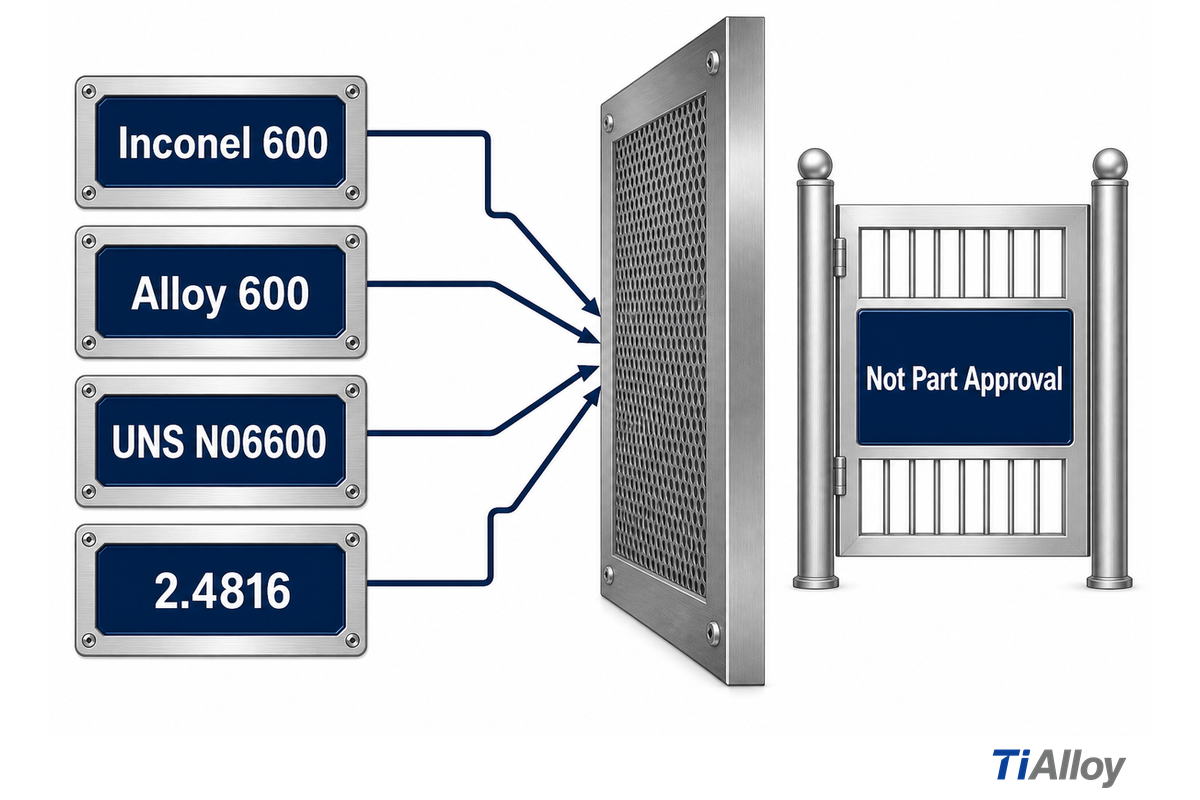
Inconel 600, Alloy 600, UNS N06600, and Werkstoff 2.4816 designate the same nickel-chromium-iron alloy family, but the name alone does not prove that two delivered product conditions are interchangeable. “Inconel” is a registered trademark; UNS is the neutral identifier used in standards and records. The Special Metals Alloy 600 bulletin describes a stable austenitic solid-solution alloy that can retain ductility and be fabricated and welded by standard nickel-alloy methods.
The designation includes “Alloy 600” but doesn’t specify a finished product form or condition. It doesn’t describe the material by reference to shape, state (i.e. annealed or cold worked), grain structure, surface condition, stress, etc. High nickel content is part of alloy identity, not a shortcut to component qualification. A certificate verifying bulk chemistry helps establish identity, but it cannot, on its own, prove corrosion life, pressure integrity, creep life, fatigue resistance, or weld-joint performance.
Key takeaway
The alloy name proves identity. Engineering approval requires four more links: supplied condition, fabrication record, service-matched evidence, and acceptance criteria.
Once the engineering requirements are defined, use TiAlloy’s Alloy 600 product and specification page for forms, dimensions, documentation, availability, and quotation. This guide remains focused on how to interpret the alloy and its service evidence.
Composition: What the Chemistry Does and Does Not Prove
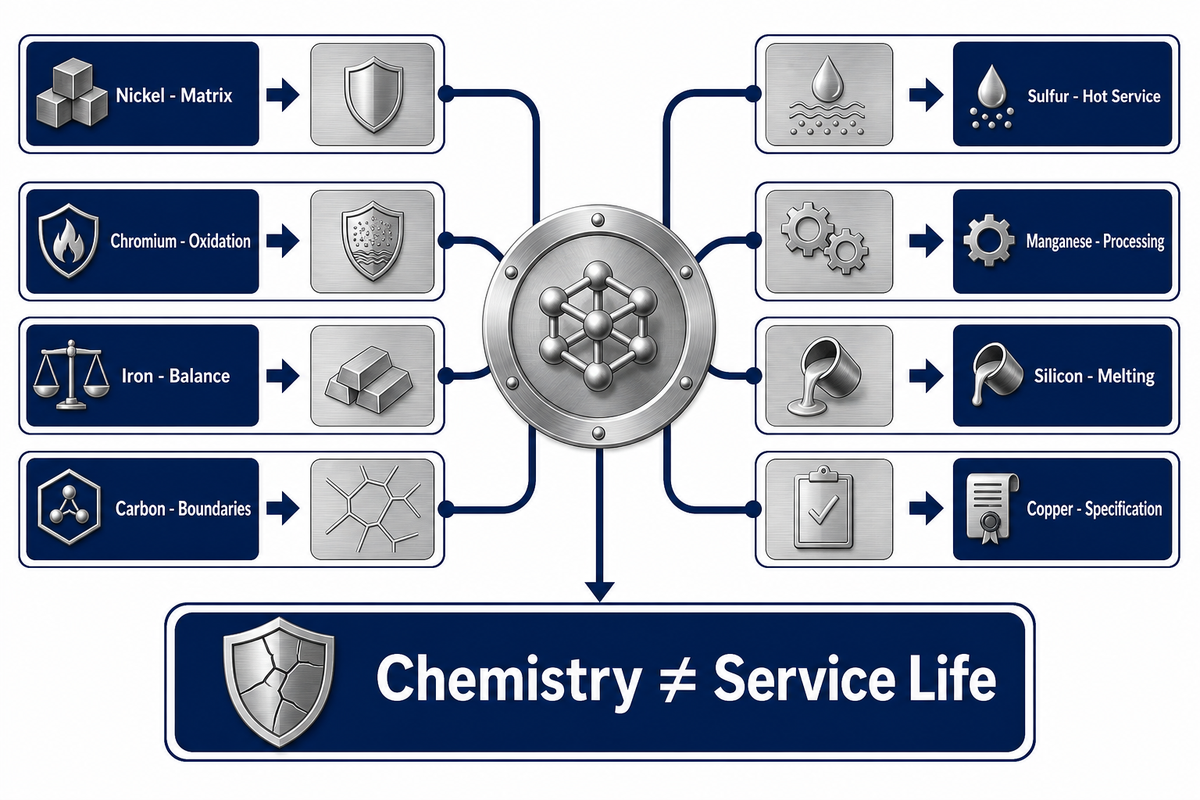
For Inconel 600 composition, the producer bulletin lists at least 72% nickel, 14–17% chromium, and 6–10% iron. It also places limits on carbon, manganese, silicon, copper, and sulfur. An independent VDM Metals alloy listing verifies the UNS N06600 / 2.4816 and nickel-chromium-iron pattern. Minor differences in limits may occur in a supplier page, an old table, and a current product specification.
| Constituent | Published limit or role | What it helps explain | What it does not prove |
|---|---|---|---|
| Nickel | 72% minimum | Austenitic matrix stability and useful behavior in several reducing media | Immunity to every stress-corrosion mechanism |
| Chromium | 14–17% | Passive-film support and oxidation behavior | A universal hot-corrosion limit |
| Iron | 6–10% | The nickel-chromium-iron alloy balance | Interchangeability with another Ni-Cr-Fe grade |
| Carbon | Controlled minor element | Carbide and grain-boundary behavior after thermal exposure | Sensitization state without thermal-history evidence |
| Sulfur | Tightly limited residual | Why hot sulfur contamination deserves special control | Tolerance of a sulfur-bearing furnace atmosphere |
| Manganese | Controlled residual/addition | Deoxidation and processing context | A substitute for weld-procedure evidence |
| Silicon | Controlled minor element | Melting and processing response | Finished-joint cleanliness or soundness |
| Copper | Controlled minor element | Part of the specification boundary | Corrosion resistance in an unnamed solution |
Bulk chemistry is an alloy passport, not a service-life model. Grain size, carbide distribution, inclusions, cold work, weld dilution, heat-affected zones, surface damage, and residual stress can create local conditions that bulk analysis cannot detect. This becomes pertinent when two components have the same UNS number but have different mill or manufacturing histories.
Properties: Read the Label Before the Number
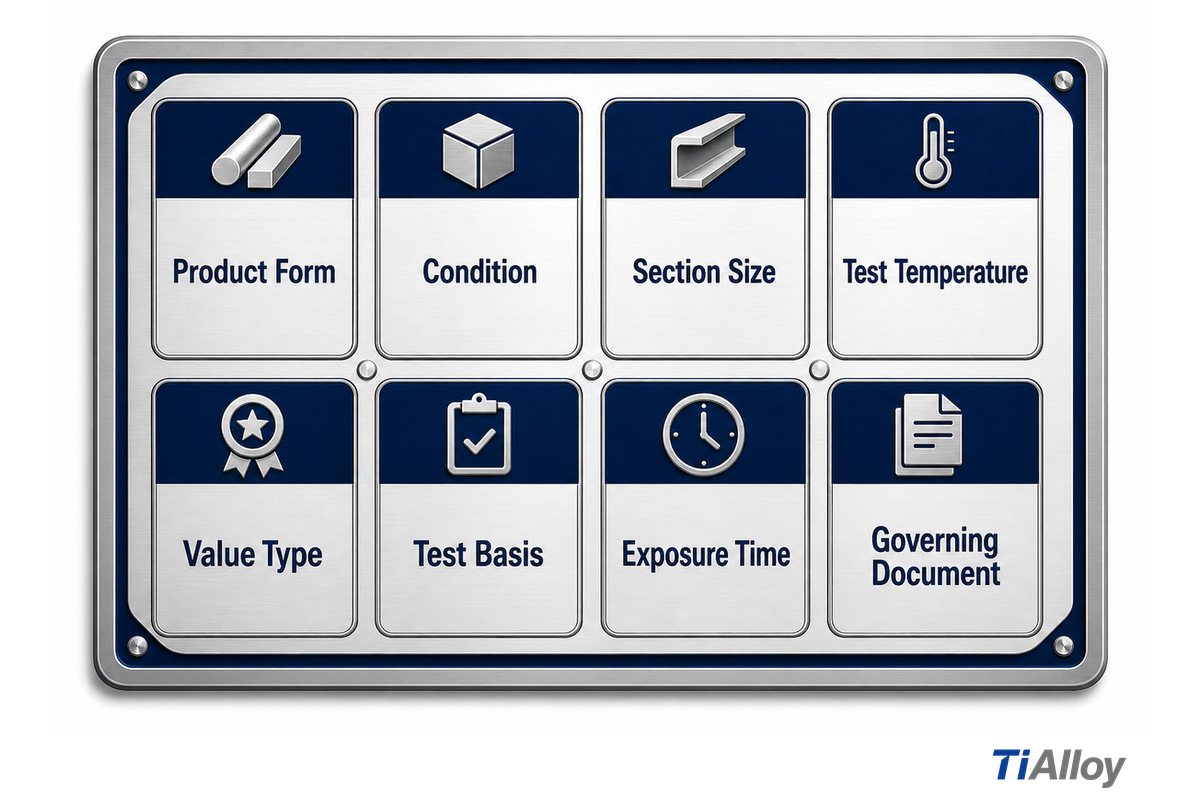
Published Inconel 600 properties are useful only when their labels travel with them. For Inconel 600 density, one supplier dataset reports 8.43 g/cm³ at room temperature, while a producer extraction is closer to 8.47 g/cm³. That small difference is manageable for an early mass estimate, but silently selecting one value creates false precision. Mechanical properties are more sensitive to condition. The High Temp Metals technical table gives an annealed-sheet example of 676 MPa tensile strength, 290 MPa 0.2% yield strength, and 40% elongation. Those three numbers belong to that reported form and condition.
| Label to capture | Why it changes interpretation | Example of an incomplete statement |
|---|---|---|
| Product form | Sheet, bar, tube, wire, forging, and weld metal can have different requirements. | “Yield strength is 290 MPa.” |
| Condition | Annealed and cold-worked material need not respond alike. | “Alloy 600 is this hard.” |
| Section size | Thermal history and test location can vary through a section. | “Bar and thin sheet are equivalent.” |
| Test temperature | Room-temperature strength does not establish hot strength. | “Tensile strength stays 676 MPa.” |
| Value type | Typical, minimum, allowable, and characteristic values serve different decisions. | “The datasheet value is the design value.” |
| Test basis | Orientation, specimen geometry, and method affect comparison. | “Two web tables are directly comparable.” |
| Exposure time | Creep and rupture are time-dependent. | “It withstands this temperature.” |
| Governing document | A code or project specification may control acceptance. | “The supplier page approves the design.” |
The same rule applies to the published melting range of roughly 1354–1413°C. The melting temperature is a physical reference and not a design or service limit value. Well before the design value is reached, the part may lose allowable strength, creep, oxidize, carburize, distort, contaminate, fail at a joint, or reach a service-limit value based on ductility and hardness. Claims of usefulness from cryogenic to elevated temperatures require separate condition- and service-matched evidence at both ends; room-temperature data do not close either question. Published ductility and hardness also need a form, condition, and test basis. Use typical values for screening, then apply the governing product specification, design rules, and project acceptance criteria to the actual procurement.
How Temperature Changes What Inconel 600 Can Do
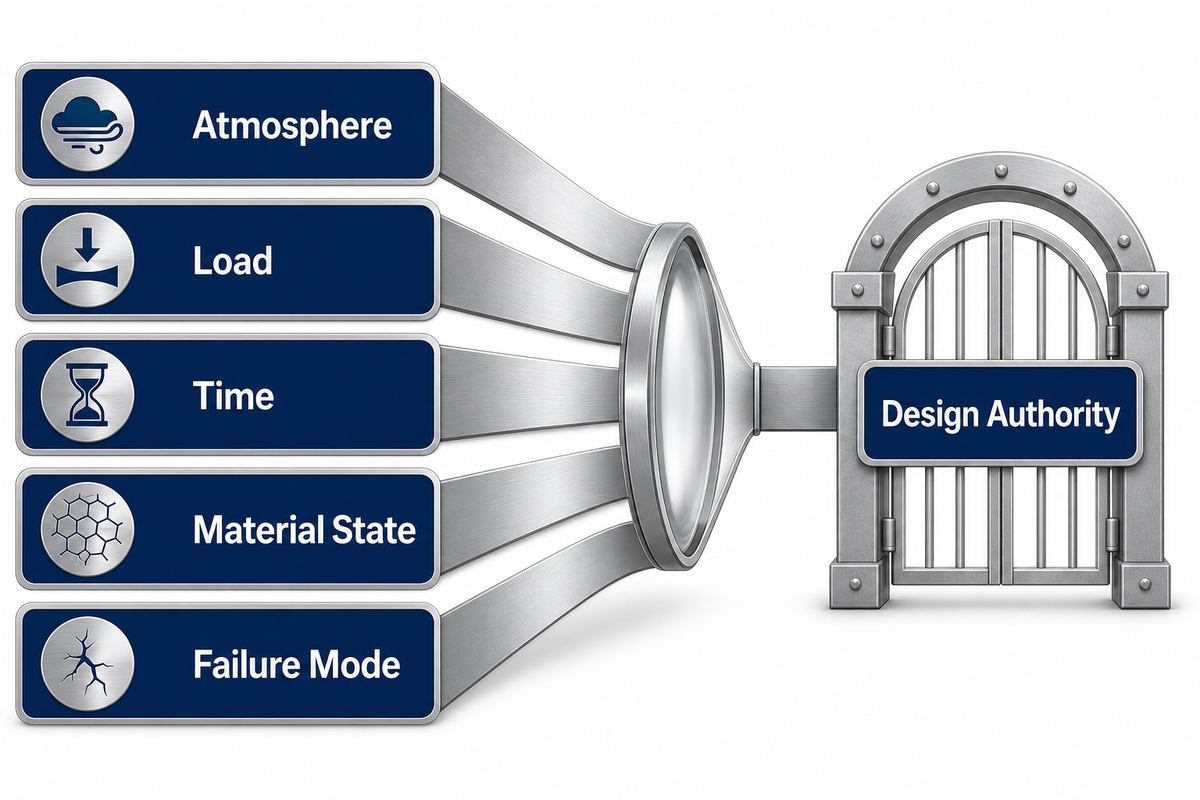
There is no single maximum service temperature for Alloy 600. Oxidation, carburization in reducing furnace atmospheres, short-term strength, creep rupture, thermal cycling, and pressure-design allowables answer different questions. A published operating temperature therefore needs its atmosphere, load, exposure time, and governing failure mechanism.
Carburization research archived by OSTI tested Alloy 600 from 900–1100°C and showed that gas chemistry and oxygen potential can change behavior and comparative ranking. Those test temperatures are not universal operating limits; apply results only with a matched design and service basis.
The Redox, Load, Time Lens
| Question | Evidence needed | Typical shortcut to reject |
|---|---|---|
| Redox / atmosphere | Oxygen potential, water vapor, carbon activity, sulfur, halogens, deposits | “Air oxidation data cover every furnace gas.” |
| Load | Stress, pressure, restraint, vibration, weld residual stress | “An intact oxide scale proves structural margin.” |
| Time | Continuous exposure, cycles, dwell, design life, upset duration | “A short test proves 100,000-hour life.” |
| Material state | Grain structure, cold work, thermal history, surface condition | “Every N06600 heat responds identically.” |
| Failure mode | Oxidation, carburization, hot corrosion, creep, rupture, fatigue, distortion | “One published temperature covers all mechanisms.” |
| Design authority | Applicable code, allowable stresses, joint efficiency, project margins | “A material bulletin substitutes for code qualification.” |
A peer-reviewed 100-hour air-oxidation study at 700, 800, and 900°C reported temperature-dependent oxide behavior and easier scale peeling under applied force above 800°C. This finding is useful because it covers atmosphere, time, temperature, and a mechanical disturbance. It isn’t a universal 800°C cutoff or a complete oxidation resistance rating. Similarly, the statement concerning the presence of sulfur at elevated temperature in service shouldn’t be an afterthought. It should be an indication for a clean furnace and the consideration of process gas.
The Redox, Load, Time Lens is not a complete qualification by itself. Pair it with the Property Label Card: identical atmospheres and temperatures can produce different susceptibility when grain-boundary structure, cold work, surface stress, welding, or geometry differ.
Corrosion Resistance: Strong Does Not Mean Immune
Alloy 600 has widespread uses in both organic and inorganic environments, and it’s known for its resistance to chloride stress corrosion cracking. The editing error is substituting “resistant” with “immune.” The terms organic acids, caustic alkalis, and other corrosive environments are still too general for selection. Corrosion and cracking depend on numerous factors including chemistry, concentration, electrochemical potential, temperature, stress, geometry, deposits, surface conditions, microstructures, and the amount of time. Reports from the U.S. NRC operating experience describe Alloy 600 stress corrosion cracking in primary and secondary high purity water. This doesn’t negate chloride resistance. In fact, it supports the concept that the resistance mechanisms are different.
A bounded caustic case
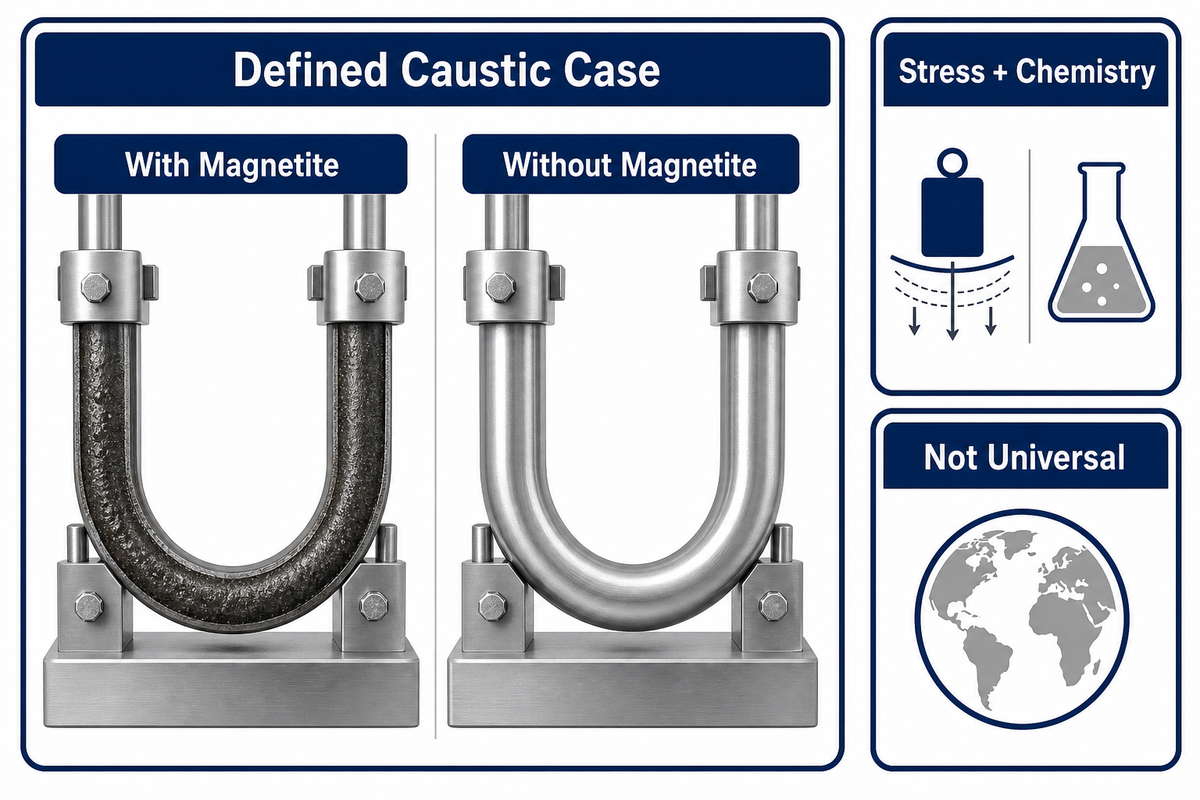
A peer-reviewed magnetite-coupled caustic study tested Alloy 600 U-bend specimens in 10 wt% NaOH at 315°C for 300 hours. The authors reported cracking roughly 150–280 μm deep on the magnetite-deposited specimens but none on the magnetite-free specimens. This doesn’t mean “Alloy 600 always fails in caustic.” It shows how deposit chemistry and electrochemical coupling can change the outcome under the study’s defined stress, concentration, temperature, and time.
Deposit chemistry and electrochemical coupling changed the result under defined stress, concentration, temperature, and time; this case is evidence about conditions, not a universal alloy verdict.
Evidence boundary: 10 wt% NaOH, 315°C, 300 hours, U-bend stress, and magnetite deposition comprise a case. The study’s separate electrochemical test was conducted at 280°C. Change any of those variables and the case must be requalified rather than copied.
Condition and the fabricated system
Microstructure and fabrication history are susceptibility variables, not background variables. Grain-boundary oxidation or corrosion, chromium-rich sulfides, and a chromium-depleted zone were observed by independent microscopy after 325°C simulated pressurized-water reactor primary water exposure. Record the material condition, thermal treatment, machining cold work, surface finish, residual stress, and grain-boundary state alongside the actual environment.
A correct base metal isn’t enough to qualify the joined system. Filler metal, dilution, the heat-affected zone, dissimilar interfaces, joint geometry, repair sequence, restraint, and residual weld stress require their own evidence. The statement “Alloy 600 is weldable” won’t suffice in the absence of a qualified process, inspection, and assessment of the real joint for the service.
Use corrosion rate data only when the medium, concentration, temperature, aeration state or redox potential, velocity, test duration, specimen condition, and measurement method closely approximate the duty. General corrosion data can’t be used to predict crevice corrosion; a clean coupon can’t represent a deposit. An unstressed specimen can’t assess SCC. A base-metal specimen can’t approve a dissimilar weld.
Standards: Match the Alloy to the Product Form
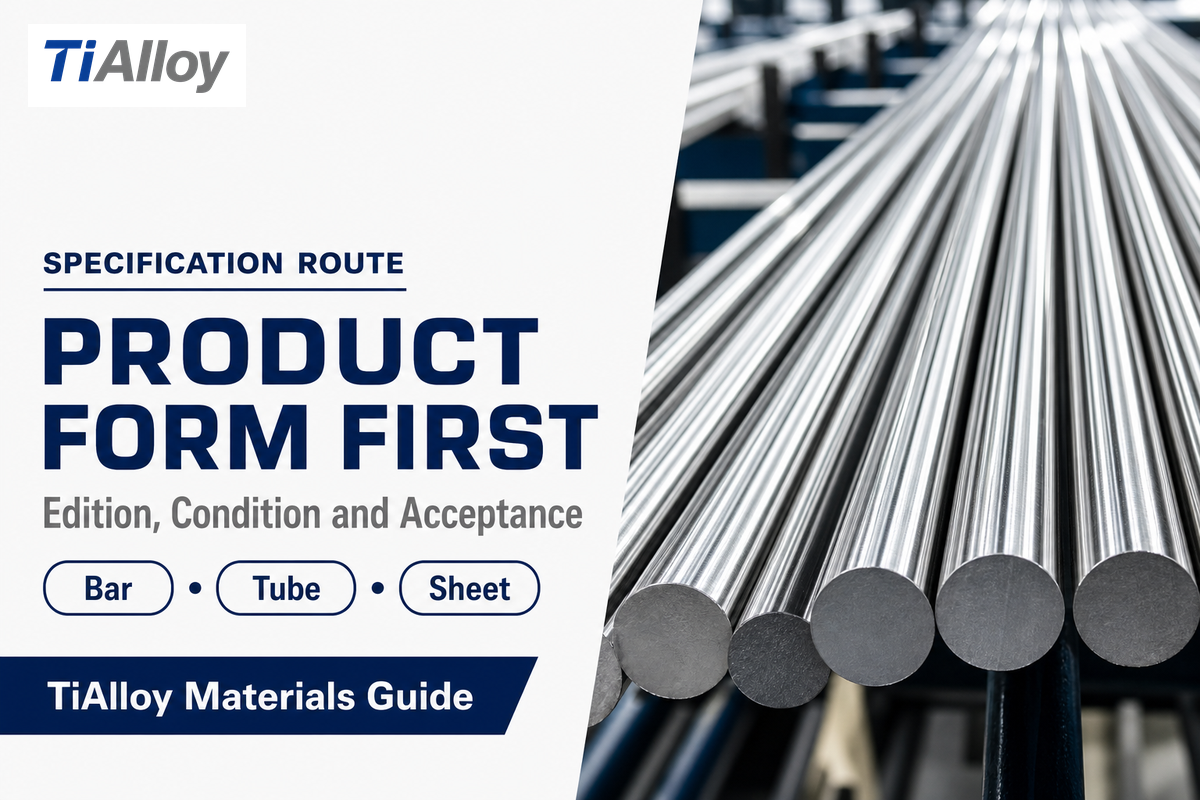
The available versions of ASTM specifications route UNS N06600 depending on the product form. Live versions of the specifications reviewed in September 2026 list ASTM B166-25 for rod, bar, and wire; ASTM B167-23 for pipe and tube without a welded seam; and ASTM B168-26 for plate, sheet and strip. ASTM work item WK97637, initiated January 7, 2026, indicates a B167 revision is being planned. A work item isn’t a published replacement for B167-23.
| Product form | Public ASTM route | What the purchase order must still define |
|---|---|---|
| Rod, bar, wire, forging stock | ASTM B166-25 | Form, condition, dimensions, tolerances, tests, certification |
| Pipe and tube made without a welded seam | ASTM B167-23 | Manufacturing route, condition, size/wall, hydrostatic or NDE requirements |
| Plate, sheet, strip | ASTM B168-26 | Condition, thickness, dimensions, finish, tests, supplementary requirements |
A product standard establishes a scope and framework for acceptance of minimum criteria. It doesn’t qualify a component for each pressure, corrosion, nuclear, furnace, or aerospace service. Ensure the version referenced by the project is identified at time of order. Then include drawings, dimensional controls, certificate requirements, additional tests, surface condition, inspection, and construction-code or service-specific qualification.
Heat Treatment, Machining, Forming, and Welding
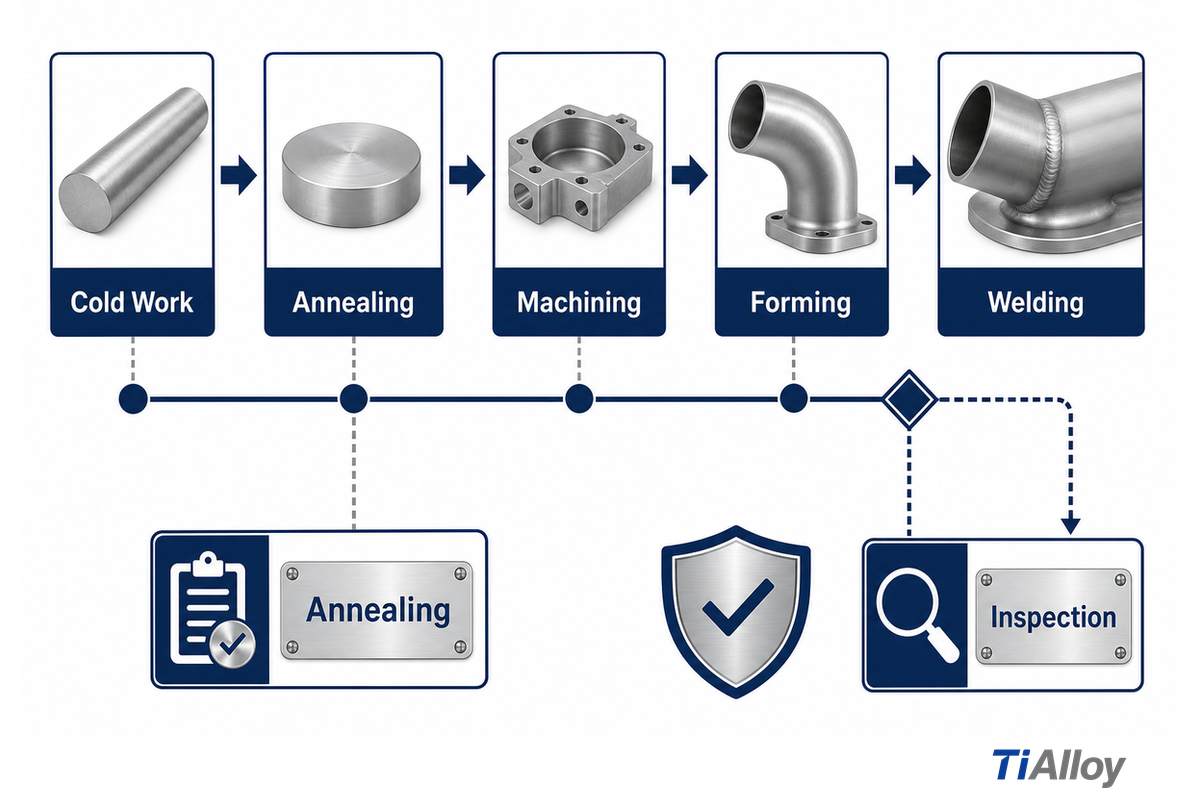
Alloy 600 isn’t a precipitation or age hardening alloy. According to the producer bulletin and the supplier data, cold work is the only practical strengthening method; annealing can soften a cold-worked structure and change grain condition. Therefore, the generic instruction to “heat treat for more strength” is incorrect. Heat treating must be aimed at a particular goal, for example, softening, recrystallization, stress management, process preparation, or another goal that’s justified, and the change must be evaluated for the grain boundaries and the surface condition as well as their influence on the subsequent service. The alloy’s practical weldability doesn’t remove the controls specified for the process.
Machining
Machining difficulty comes from work hardening, toughness, cutting heat, tool-workpiece interaction, tool condition, and chip control. The American Machinist high-nickel explanation focuses primarily on work hardening and heat concentration. Shop discussions describe rubbing and rapid tool wear, but their numeric feeds and speeds shouldn’t be treated as universal settings.
- Control runout, chatter and interrupted engagement by maintaining a rigid set up.
- Keep tooling sharp, and avoid rubbing or contact on a hardened surface.
- Coordinate coolant and lubricant delivery based on operations, tooling, finish, and contamination stipulations.
- Set the interval for inspection and tool-change to avoid damage from drift.
- Verify parameters for the form, condition, machine, tool holder, and feature.
Forming and welding
Designs used in the forming process should consider springback, work hardening, intermediate annealing when allowed, protection of the surface, minimum radii, and the requirements of the final condition. In designing welds, consideration should be given to the base metal and filler metal types and the behavior of the weld joint. Other considerations are the design of the joint, the cleaning of the joint, the heat input, the interpass and post-weld procedures, the amount of metal that is involved, shielding, inspection, and the repair of the defect. The construction code and the welding procedure that’s qualified in conjunction with the construction code are the sources of the information. The nominal base-alloy composition doesn’t qualify the heat-affected zone or weld metal.
Fabrication Handoff: note the fabrication condition, fabrication process, maximum allowable cold work, thermal cycles, surface-cleanliness control, welding, repair route, and post-fabrication inspection. Such records allow the traceability of the fabricated part.
Applications: Ask Which Failure Mode Is Being Controlled
The Special Metals Alloy 600 bulletin lists furnace components, process equipment, heat exchangers, heaters, electrical parts, nuclear steam-generator systems, and high-temperature fixtures as application examples. A usage listing isn’t an endorsement. One component may use the alloy to control oxidation; another may be used to control a specific process chemical; another may be used for the alloy’s formability and dimensional stability. Start with the governing failure mode, not the industry label.
| Application type | Selection-driver category | Evidence still required |
|---|---|---|
| Furnace muffles or fixtures | Oxidation behavior and fabricability | Gas chemistry, sulfur, carbon activity, temperature-time cycle, load and distortion limits |
| Chemical process vessels or piping | Resistance in selected organic/inorganic media | Actual species, concentration, contaminants, redox state, temperature, stress and corrosion testing |
| Heat-exchanger tubing | Corrosion resistance plus tube fabricability | Both-side fluids, deposits, crevices, wall, velocity, pressure code, NDE and leak test |
| Nuclear-water component | Established nickel-alloy route for a defined system | Specific code, condition, water chemistry, residual stress, SCC model, inspection and replacement strategy |
| Electrical heater sheath | Oxidation response and workable product forms | Insulation chemistry, thermal cycling, sheath condition, forming, welds and dielectric test |
| Caustic-service component | Candidate resistance in a defined alkaline process | Concentration, temperature, stress, deposits, electrochemical coupling, heat treatment and test evidence |
| Welded transition or repair | Ductile nickel-alloy fabrication route | Filler, dilution, interface, restraint, heat input, repair geometry, NDE and service mechanism |
| Laboratory or thermal-processing hardware | Shapeability and high-temperature material family | Atmosphere purity, contamination tolerance, load, time, cycling, cleaning and dimensional acceptance |
This mapping prevents the selection error of copying an industry label while losing the mechanism that made the original application work. “Used in heat exchangers” isn’t justification for a new heat exchanger. The two working fluids, temperatures, velocities, deposits, crevices, pressure boundaries, welding path, inspection, and design life must be identified.
Inconel 600 vs 601, 625, and X-750
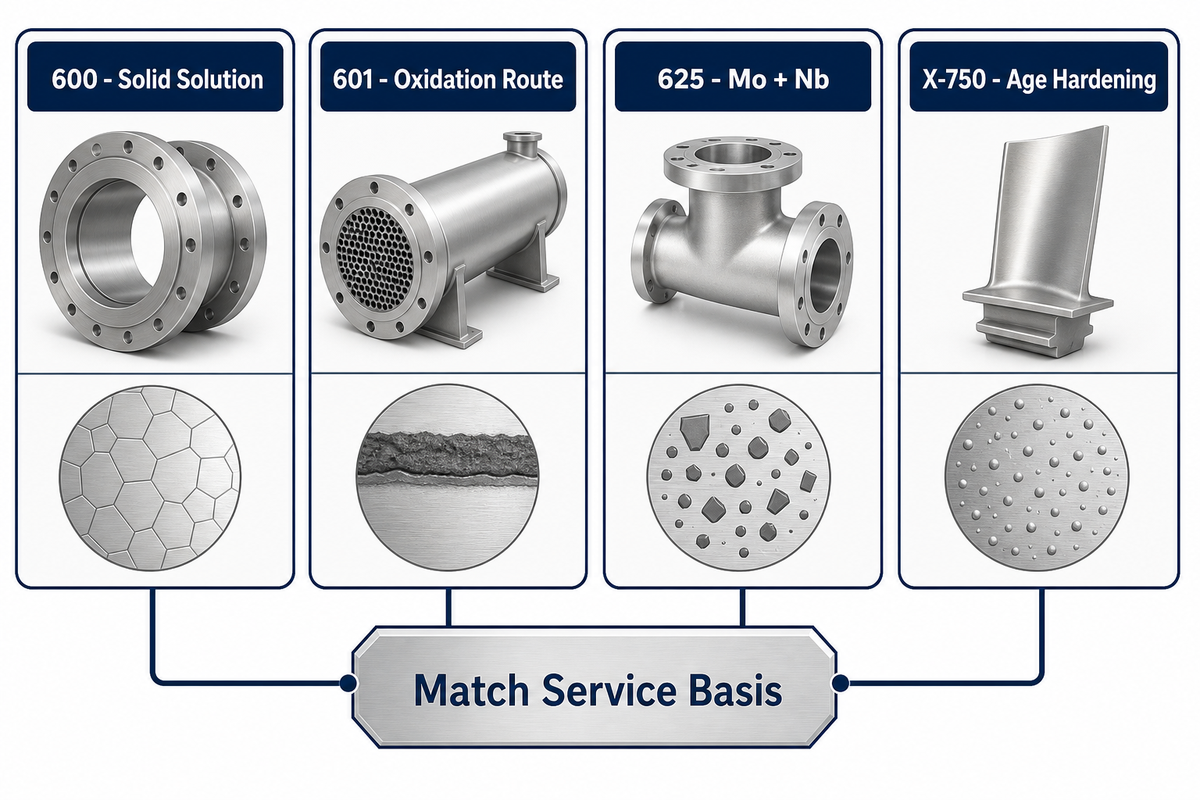
Alloy 600, 601, 625, and X-750 are different chemistries and strengthening approaches, not steps on a single ranking. Compare them for the same service condition, temperature, environment, load, time and on the same evaluation basis. The Alloy 600 producer bulletin provides a baseline. If the family choice is still open, TiAlloy’s nickel alloy grade selector offers an initial route, not a component qualification.
| Comparison | Useful first distinction | Question that decides the next test | Do not conclude |
|---|---|---|---|
| 600 vs 601 | 601 adds an aluminum-bearing oxidation route. | Is high-temperature scale behavior in the actual atmosphere the governing need? | 601 is automatically better in every aqueous or fabricated service. |
| 600 vs 625 | 625 adds substantial molybdenum and niobium to a different corrosion-strength balance. | Does the defined medium, stress, product condition, or strength requirement justify that route? | 625 universally outlasts 600 in every chemical and temperature. |
| 600 vs X-750 | X-750 is precipitation hardenable; 600 is solid-solution and cold-work strengthened. | Is heat-treated strength central, and can the application qualify that condition? | A higher strength number also proves better corrosion or weld behavior. |
| 600 vs stainless steel | Different alloy-cost and performance classes. | Does a qualified stainless grade already provide enough margin? | A nickel alloy is justified whenever it has the larger datasheet number. |
Ranking 600 and X-750 by one room-temperature yield value addresses only a narrow strength consideration in the given situation. It excludes caustic SCC, oxidation scale, weld repair, thermal fatigue, and long-duration creep. Compare the relevant property on the same test basis; unmatched data leave an open qualification. For the precipitation-strengthened branch, the separate Inconel 718 engineering guide explains how condition changes the comparison.
The Alloy 600 Evidence Stack
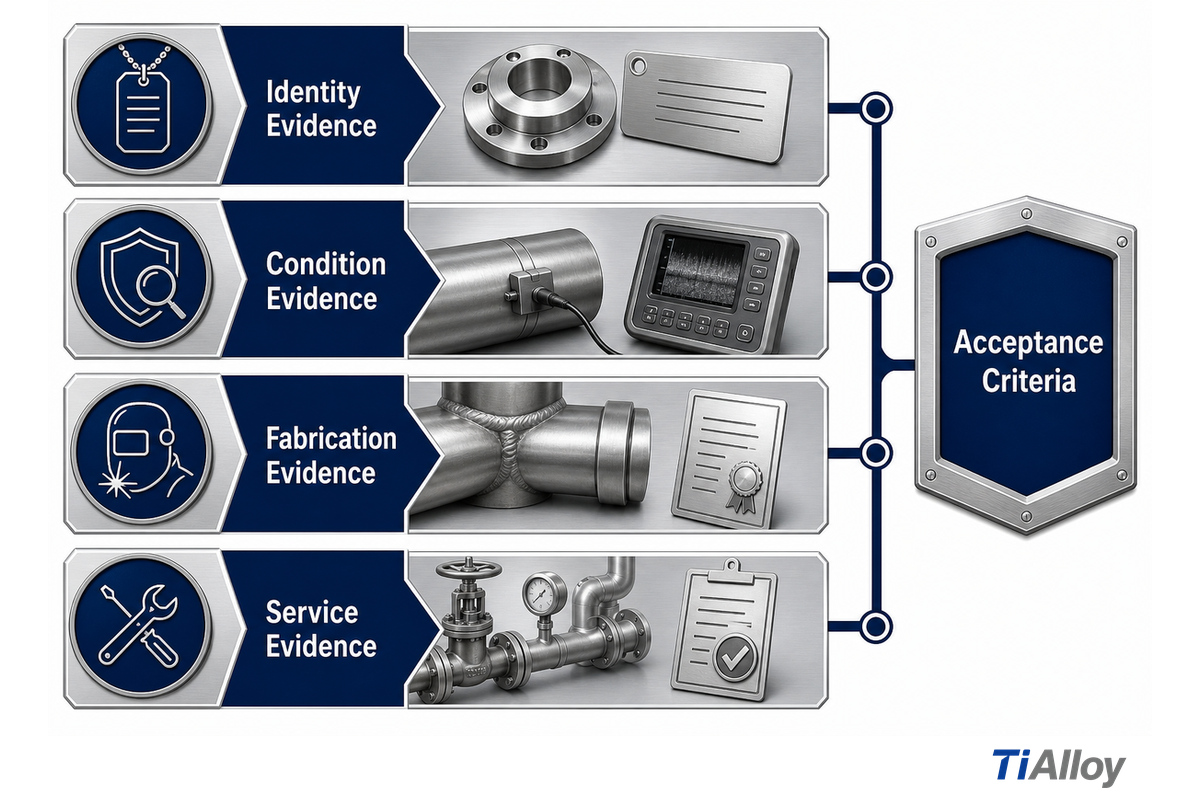
The surest route from “Alloy 600 is potentially acceptable” to an approvable component is closing four evidence layers. Each of these gaps has a different owner and a different failure if it isn’t addressed.
- Identity evidence — specify UNS N06600, the correct product-form standard and edition, dimensions, and type and certification. Failure if skipped: the correct chemistry may arrive in the incorrect form or condition.
- Condition evidence — record mill processing, cold work, annealing, grain and surface requirements, and condition-labelled properties. Failure if skipped: a typical web value is mistaken for the delivered material’s certified property.
- Fabrication evidence — record processes of forming, machining, cleaning, inspection, and welding as per qualified procedures. Failure if skipped: a finished surface or joint can differ from the base-metal assumption.
- Service evidence — provide medium, contaminants, atmosphere, temperature, stress, geometry, deposits, time, cycling, code rules, and acceptance tests. Failure if skipped: a general claim is considered in an incorrect mechanism.
The Stack works with the Property Label Card and the Redox, Load, Time Lens. The Card preserves numerical context. The Lens distinguishes environmental and loading questions. The Stack provides additional layers of fabrication, condition, traceability, and acceptance evidence to avoid confusing either of the tools as complete qualification.
For broader comparison of materials under specific media, see TiAlloy’s corrosion-resistant materials selection guide. The company describes its supply history and quality strategy on its TiAlloy company page. Once the service basis, form, standard, condition, and records are fixed, Discuss the Alloy 600 specification.
Frequently Asked Questions
What is Inconel 600 used for?
Inconel 600 appears in furnace hardware, chemical-processing equipment, heat-exchanger tubing, heater components, fixtures, and some nuclear-water components. An application name starts a materials screen; it does not qualify the part. Match the actual component’s product-form specification, environment, loading, fabrication, inspection, and credible upset conditions.
A furnace fixture needs evidence for atmosphere, carbon and sulfur activity, the temperature-time cycle, load, and distortion. Heat-exchanger tubes need chemistry on both sides, deposits, crevices, wall thickness, pressure rules, and inspection. Nuclear-water service also requires condition-specific SCC evidence, residual-stress assessment, and code routing.
What are the key differences between Inconel 600 and Inconel 601?
Both are nickel-chromium-iron alloys, but Alloy 601 uses aluminum-bearing chemistry that changes its high-temperature oxidation route. Compare 601 when protective-scale behavior in a defined hot atmosphere governs. It does not make 601 a universal upgrade. A candidate must still be compared in the delivered form and condition, under the cycle and gas chemistry. If aqueous chemistry, caustic cracking, weld condition, or code properties govern, compare the grades under those matched conditions rather than choosing from the alloy name alone.
What are the disadvantages of Inconel?
Compared with common steels, Alloy 600 can cost more to buy and fabricate. Work hardening and cutting heat complicate machining. It is not immune to stress-corrosion cracking, hot-caustic damage, sulfur contamination, creep, scale loss, or weld-system failure. The largest selection error is paying for a nickel alloy without proving that it addresses the governing failure mechanism.
A lower-cost qualified alternative may offer sufficient margin. If Alloy 600 is justified, account for the specified product condition, process controls, maintenance, and lifecycle cost rather than comparing bare purchase prices.
Can Inconel 600 be hardened through heat treatment?
No. Alloy 600 is not precipitation or age hardenable. Cold work can increase strength; annealing can soften or recrystallize cold-worked material. Specify a thermal cycle for an identified metallurgical or fabrication purpose, not as a generic hardening step. Product form, starting condition, final properties, and service mechanism determine the cycle.
Before prescribing it, also review grain and surface concerns, residual stress, weld history, and any service-sensitive corrosion mechanism. Document the required delivered condition and tests rather than assuming that the alloy name establishes strength.
What is the difference between Inconel 600 and Inconel X-750?
Alloy 600 is a solid-solution nickel-chromium-iron alloy that can gain strength through cold work. X-750 is a precipitation-hardenable nickel-chromium alloy; a specified heat-treated condition can offer a different strength profile. That distinction is about the strengthening route, not automatic fitness for a corrosive or welded component.
Neither is universally better. Compare their specified conditions at service temperature under the same loading, fabrication, corrosion, and test basis, not two unlabeled web strength figures.
References & Sources
- Special Metals, INCONEL Alloy 600 technical bulletin.
- VDM Metals, complete alloy range and N06600 designation.
- ASTM B166-25, rod, bar, and wire public scope.
- ASTM B167-23, pipe and tube public scope.
- ASTM B168-26, plate, sheet, and strip public scope.
- U.S. NRC NUREG-1771, Alloy 600 cracking operating experience.
- Peer-reviewed study, magnetite-coupled Alloy 600 SCC in high-temperature caustic conditions.
- OSTI, environmentally assisted cracking of nickel alloys.
- OSTI, carburization of Alloy 600.
- Peer-reviewed microscopy study, grain-boundary attack of Alloy 600 in simulated PWR primary water.
- American Machinist, high-nickel machining mechanisms.
WHY WE PUBLISH
About TiAlloy
TiAlloy supplies titanium, stainless steel, nickel alloy and clad plate for specification-driven industrial orders. Our technical guides are written to help buyers align product form, governing standard, test scope and release documents before a quotation is compared.
01Melt & formPlate, sheet, pipe, tube, bar, wire and forgings
02ProcessHeat treatment, finishing, inspection and export packing
03VerifyEN 10204 Type 3.1 certificate and order documents