
Get in Touch with TiAlloy Company

Inconel 625: A Practical Guide to Properties, Limits, and Applications

Inconel 625 is a nickel-based superalloy and nickel-chromium-molybdenum alloy with niobium, identified as UNS N06625. Engineers appreciate the alloy’s capacity to combine aqueous corrosion resistance, useful strength, and practical weldability. The alloy’s identity is simply one factor in material selection. Product form, ordered condition, fabrication history, temperature, stress, geometry, and the actual process medium will determine if alloy 625 meets the requirements.
Updated September 2026 · Written by Cherry · Reviewed by the Titanium Alloy Co., Ltd. technical team.
TL;DR
- Inconel 625 is an alloy family designation, not a finished-part approval.
- Nickel, chromium, molybdenum, and niobium explain much of its behavior, but local phases and processing history still matter.
- Property values are usable only when product form, condition, test temperature, and value type are stated.
- Decide on specification with a product, traceability, qualified fabrication, and inspection. Use seven factors to assess the service.
What Is Inconel 625?

Inconel 625, Alloy 625, Inconel® 625, and UNS N06625 commonly refer to the same nickel-base alloy chemistry. “Inconel” is a trade name; UNS N06625 is the alloy designation used across technical documents. The grade is strengthened mainly by molybdenum and niobium in the nickel-rich matrix rather than by the age-hardening route normally associated with Alloy 718. Chromium and molybdenum account for the fact that 625 is regularly considered for many oxidizing, chloride, and mixed service conditions in industry.
What the name doesn’t include is just as important. It doesn’t specify if the material is plate, pipe, tube, bar, a forging, weld filler, or an additive build. It does not identify the ordered condition, heat treatment, dimensions, acceptance criteria, or whether a qualified welding procedure applies. It doesn’t indicate that one heat of material has been assessed to satisfy the project requirements for sour-service, pressure, fatigue, high temperature, or corrosion.
Key takeaway
UNS N06625 establishes the starting material identity, not finished-part approval. A defensible order also names product-form specification, condition, dimensions, tests, certification, and service-specific acceptance rules.
Once the engineering basis is complete, TiAlloy’s inconel 625 product forms and specification route is the correct area to check supply information. Price, size availability, lead time, and quotation information belong there and not in this engineering guide.
Composition: The 5-Element Chemistry-to-Behavior Map

The familiar chemistry range, nickel (Ni) at least 58%, chromium 20–23%, molybdenum 8–10%, and niobium plus tantalum 3.15–4.15% by mass, helps explain Alloy 625’s baseline behavior. It should be read as a bulk-composition map, not as a guarantee of uniform microchemistry at every location in a weld, casting, or additive build.
| Element or group | Typical role | Behavior it can influence | Boundary to remember |
|---|---|---|---|
| Nickel | Austenitic matrix | Matrix stability, ductility, resistance in several reducing environments | Nickel content alone does not settle localized-corrosion or cracking risk. |
| Chromium | Passive-film and oxidation contributor | Oxidizing media and elevated-temperature oxidation behavior | Deposits, crevices, temperature, and mixed chemistry can change the result. |
| Molybdenum | Solid-solution strength and localized-corrosion contributor | Pitting and crevice-corrosion resistance in many chloride services | The benefit is environment-specific; it is not an immunity statement. |
| Niobium + tantalum | Solid-solution strengthening; phase-forming constituents | Room- and elevated-temperature strength | Segregation and secondary phases can matter after heat exposure or rapid solidification. |
| Iron + controlled residuals | Balance within composition limits | Processing response, cleanliness, and phase balance | Minor constituents and inclusions can influence a local failure even when bulk chemistry passes. |
The map is useful because it presents a correlation of chemistry and mechanisms. It shouldn’t be used as a shortcut from a mill certificate to a service life estimate. Welding, long thermal exposure, and additive manufacturing can redistribute niobium, molybdenum, and chromium across cells and grain boundaries. Carbides, Laves phase or delta-related precipitation may occur and affect the local matrix although a bulk chemical analysis remains within grade specifications.
That distinction also explains why alloy 625 isn’t merely a weaker version of Alloy 718. Both contain nickel, chromium, and niobium, but their approaches to strengthening differ. Alloy 718 is used when the most important consideration is strength that can be precipitation hardened. Alloy 625 is a solid solution strengthened grade often selected where strength properties, corrosion behavior, and fabrication compatibility form the better combination.
Properties: Why Condition and Temperature Change the Numbers

The published inconel 625 properties are divided into two groups. Some properties, such as density, are relatively stable reference values, and others, such as strength and ductility, can vary significantly depending on the form of the product, the size of the section, the route of processing, heat treatment, and the test temperature. A number without these labels is a comparison value, not a design value.
| Reported value | Value | Condition and basis | Permitted use |
|---|---|---|---|
| Density | 8.44 g/cm³ | Reference value at 22°C | Mass and section estimates, with normal engineering tolerances |
| Ultimate tensile strength | 910 MPa | A reported 6.35 mm plate example, annealed at 1052°C and rapidly cooled | Condition-specific benchmark, not a universal minimum |
| 0.2% yield strength | 452 MPa | Same reported plate example | Like-for-like comparison only |
| Elongation | 46% | Same reported plate example | Ductility context tied to specimen and test basis |
The three mechanical values above belong together. Pulling 910 MPa from one condition and a yield value from another produces a fictional material. The reported plate example was annealed at 1052°C and rapidly cooled before testing; it recorded 910 MPa ultimate tensile strength, 452 MPa yield strength, and 46% elongation.
Another differentiation is necessary for design work: specification minimums are acceptance limits, while “typical” values refer to samples or datasets. Neither should silently replace code-allowable stress, fatigue data, fracture toughness, creep or rupture data, or a project’s governing design basis. The temperature indicators are also important. A room-temperature tensile table can’t be applied to set strength at elevated temperature, and rupture data measured at various temperatures can’t rationally compare the two alloys. Every mechanical properties table must cite a basis.
Evidence capsule: one public supplier dataset reports 910 MPa tensile strength, 452 MPa yield strength, and 46% elongation for 6.35 mm plate annealed at 1052°C and rapidly cooled. Use those values only with that condition attached.
Corrosion Resistance and Its Service Boundaries

Alloy 625 is being considered for application in many corrosion scenarios due to the presence of a nickel-rich matrix, chromium, and molybdenum. Each of these provides several resistance mechanisms. However, “corrosion resistant” isn’t a singular test result. General corrosion, pitting, crevice corrosion, stress-corrosion cracking, oxidation, hydrogen-related damage, and weld-related cracking are distinct phenomena.
Aqueous and localized corrosion
Addressing seawater or chloride-containing process streams, consider the relevant chemistry, concentration, temperature, oxygen level, contaminants, velocity, and exposure time. Add geometry. A clean and flowing coupon and a gasketed flange don’t have the same local chemistry in terms of flow, exposure, and stagnation. Deposits, shielded surfaces, tight gaps, and stagnant zones can create crevice corrosion. This can be easily missed with a broad alloy description.
Manufacturing route also matters. A NIST study found better localized-corrosion behavior for directed-energy-deposited Alloy 625 than for wrought material in its defined chloride test. The authors associated pit initiation in the wrought sample with Ti/Nb-rich precipitates larger than 1 μm. That result overturns the shortcut that additive material must always corrode faster, but it doesn’t prove that every additive build outperforms every wrought product.
Stress, hydrogen, and weld-specific questions
Aqueous coupon data do not provide sufficient clarity on hydrogen-environment embrittlement. Nor do they settle cracking under applied stress, residual weld stress, or a sour-service combination of pressure, sulfide chemistry, temperature, hardness, and cold work. For situations where the sour-service provisions of NACE or ISO are triggered, it is necessary to examine the exact product form, condition, hardness, fabrication history, and environmental limits mentioned in the respective document. Appearance of an alloy in a standard does not amount to blanket approval for all service conditions.
Weld metal and heat-affected zones deserve their own review. Local response can vary due to dilution, restraint, joint geometry, heat input, interpass control, surface contamination, and filler classification.
High-temperature exposure
Oxidation resistance is distinct from load-bearing capability. A material may retain a protective surface scale while losing strength, accumulating creep strain, or developing phases that alter ductility. Published technical data, including the 800°C study example below, usually refer to a specific condition, time scale, stress state, or code context. They should be treated as routing information until the complete design constraints are known. ASTM B446, for example, uses a 593°C boundary between its Grade 1 and Grade 2 temperature contexts; that is a product-condition rule, not a universal service limit.
⚠️ The shortcut to reject: high nickel, chromium, and molybdenum content does not remove the service envelope. Start by identifying the failure mechanism; then, look for evidence for the medium, temperature, stress, geometry, and material condition.
For a more complete review of materials at a family level, please refer to the guide by the TiAlloy team on corrosion resistant materials and their selection limits.
Standards and Product Conditions: Read the Scope First

ASTM specifications route alloy 625 by product form. Currently, at the time of this update, ASTM’s live B02.07 list shows B443-26 for plate, sheet, and strip; B444-23 for pipe and tube; B446-26 for rod and bar; and B564-25 for forgings. Edition numbers can change, so the purchase order should cite the edition relevant to the project rather than the date found in this article.
| Product form | Public ASTM route | Order controls still needed |
|---|---|---|
| Plate, sheet, strip | ASTM B443 | Condition, dimensions, tolerances, tests, certification |
| Pipe and tube | ASTM B444 | Construction route, size, wall, condition, testing |
| Rod and bar | ASTM B446 | Grade/condition, dimensions, mechanical requirements |
| Forgings | ASTM B564 | Part route, heat treatment, tests, supplementary requirements |
“in the form of hot-worked rod and bar and cold-worked rod”
ASTM B446 public scope
The B446 public page also separates two conditions by intended temperature context: Grade 1 is normally used through 593°C, while Grade 2 is normally used above 593°C where creep and rupture properties are needed. This is a specification-condition boundary, not a universal permission to use any Alloy 625 component at those temperatures.
AMS documents may be applicable to aerospace product forms and conditions, while AWS ERNiCrMo-3 identifies a welding consumable classification. Neither of these documents should be considered a substitute for the base-metal product specification or a qualified welding procedure.
Wire also needs its own product-form and end-use route; don’t assign the plate, pipe, bar, or forging specification from the table merely because the chemistry is UNS N06625.
Machining, Forming, and Welding Behavior

Alloy 625 is often called difficult to machine, but “work hardening” is not the whole explanation. Tool wear research proposes high hardness and cohesiveness, chemical affinity between the tool and the workpiece, hard carbide particles, localized heat, and difficult chip control. The correct response is not a speed-and-feed recipe; it is a controlled process.
Machining questions
- Engagement: will the tool stay cutting instead of dwelling and rubbing on a newly hardened surface?
- Rigidity: will chatter be controlled with the overall rigidity of the machine, workholding, toolholder, and overhang?
- Edge and grade: is the selected insert or cutter appropriate for interrupted cuts and anticipated heat?
- Heat and chips: can coolant reach the cutting zone, and can chips be easily cleared without recutting or damaging the surface?
- Inspection: are tool wear, dimensions, surface integrity, and any work-hardened layer monitored at useful intervals?
Shop experience is valuable for locating pain points, but an online parameter should not be copied into production without matching the machine, tooling system, section, operation, setup, and acceptance criteria. Trial cuts and tool-wear checks turn broad advice into local evidence.
Do
- Match parameters to the operation and setup.
- Keep the edge engaged and watch tool wear.
- Verify surface integrity and dimensions.
Don’t
- Copy an unlabeled speed-and-feed table.
- Let a dull tool dwell on the surface.
- Treat one acceptable cut as process qualification.
Forming questions
Behaviors associated with forming are dependent on thickness, direction, cold work, bend radius, surface, tooling, and amount of strain with each operation. Consider springback and interim inspection. If the route includes heating or an anneal, verify the temperature-time history and cooling requirement against the ordered condition; a generic “soften it first” instruction can change both properties and surface condition.
Welding questions
Alloy 625 is widely welded, yet good weldability is not the same as automatic joint acceptance. Verify base-metal specification and condition, filler classification, joint design, cleaning, heat input, interpass control, shielding, dilution, restraint, and inspection. A procedure qualification record and the applicable construction code provide the evidence; the alloy name does not.
✔ Fabrication handoff: replace “625 is machinable and weldable” with three records: an operation-specific machining plan, a documented forming/heat route, and a qualified welding package connected to the actual joint.
Heat Exposure, Microstructure, and Additive Manufacturing

Alloy 625 may have the same nominal chemistry when it is wrought, welded, or additively manufactured. However, it may have different solidification structures, stress patterns, segregation patterns, and secondary phases. This is why condition belongs along with chemistry in any technical statement.
NIST researchers studying powder-bed-laser Alloy 625 observed niobium segregation and delta-phase platelets after stress relief; in their study, precipitation at 800°C appeared within exposure times up to four hours. The authors’ findings support homogenization as a way to address the segregated microstructure, but they do not establish one heat-treatment schedule for every machine, build geometry, or acceptance rule.
Peer-reviewed microscopy has also identified Nb-rich MC-type carbides, Nb/Cr/Mo-rich Laves constituents, and M23C6-type carbides in additively made alloy 625. Separate corrosion research shows that laser-powder-bed material can respond differently after heat treatment because the microstructure changes. These findings make four questions mandatory for an additive route:
- What process, machine, powder batch, orientation, and build parameters pertain to the coupon and the part?
- What stress relief, homogenization, hot isostatic pressing, and other thermal treatments were done?
- Where were chemistry, microstructure, mechanical, and corrosion specimens taken?
- Which properties and defects are accepted for the actual geometry and service?
Current manufacturing papers and patents indicate active work toward both solid-state and fusion-based options. These are process-direction signals and don’t demonstrate that a patented route produces qualified parts for an unrelated service. The qualification package must still connect procedure, material, part, tests, and acceptance criteria.
Applications: Match the Failure Mechanism, Not the Industry Label

Inconel 625 can be found in marine, chemical-processing, oil-and-gas, aerospace, and power equipment because those sectors might require corrosion resistance, weldability, and strength in the same component. An industry name isn’t evidence; use the Nickel Institute’s alloy application overview only as category context: https://nickelinstitute.org/en/nickel-applications/nickel-alloys. “Marine” may mean cool flowing seawater, a hot stagnant crevice, splash-zone hardware, or a loaded sour subsea connection, four different assessments.
| Application category | Why 625 enters the screen | Evidence still required |
|---|---|---|
| Seawater piping or hardware | Localized-corrosion resistance plus fabrication compatibility | Temperature, flow, deposits, crevices, galvanic couples, stress, inspection |
| Chemical process equipment | Resistance across several aggressive media | Actual composition, concentration, contaminants, transients, corrosion data, design code |
| Oil-and-gas components | Corrosion resistance and useful strength | Sour-service limits, hardness, cold work, pressure, temperature, stress, qualification standard |
| Aerospace ducts or hot hardware | Fabricability, oxidation response, strength | Load spectrum, temperature-time cycle, condition, fatigue/creep basis, process approval |
| Power or high-heat equipment | Oxidation behavior and high-temperature material family | Allowable stresses, creep/rupture, thermal cycling, weld condition, code requirements |
| Heat-exchanger tubing | Corrosion resistance in a weldable nickel alloy | Both-side fluids, tube specification, wall, velocity, crevices, pressure code, test plan |
| Bellows or expansion joints | Formability plus corrosion and thermal capability | Cycle count, formed condition, weld details, fatigue basis, leak test |
| Pollution-control ducting | Mixed-condensate corrosion screen | Dew point, deposits, wash chemistry, joint condition, upset exposure |
| Nuclear reactor auxiliary duty | Candidate nickel-alloy chemistry for a defined subsystem | Nuclear code route, irradiation relevance, material condition, quality class, full qualification record |
The 7-Factor Service-Envelope Check
1. Medium
Species, contaminants, gas/liquid phase
Species, contaminants, gas/liquid phase
2. Concentration
Normal range and upset limits
Normal range and upset limits
3. Temperature
Steady, cyclic, and transient values
Steady, cyclic, and transient values
4. Stress
Applied, residual, fatigue, and pressure
Applied, residual, fatigue, and pressure
5. Geometry
Crevices, deposits, thickness, flow path
Crevices, deposits, thickness, flow path
6. Fabrication history
Cold work, welding, heat, additive route
Cold work, welding, heat, additive route
7. Inspection evidence
Traceability, tests, NDE, acceptance
Traceability, tests, NDE, acceptance
If any factor is unknown, record it as an open item instead of substituting an industry assumption. This simple check clarifies to suppliers and engineers what’s missing before ordering material.
Inconel 625 vs 718, 600, C-276, and 316L

For these alloys, there’s no ranking based on a single element. The selection should be based on the governing failure mechanism, fabrication route, and design basis. If the material family is still open, TiAlloy’s nickel alloy grade selector gives a useful first routing step.
| Comparison | Useful first distinction | Do not conclude |
|---|---|---|
| 625 vs 718 | Solid-solution/corrosion-and-welding route versus precipitation-hardened high-strength route | That the higher room-temperature yield value wins every hot or corrosive service |
| 625 vs 600 | 625 adds substantial molybdenum and niobium to a different chemistry balance | That one is always more resistant without naming the environment |
| 625 vs C-276 | Compare against the exact reducing/oxidizing mixed chemistry and fabrication need | That a broader alloying package creates a blanket winner |
| 625 vs 316L | Different cost and performance classes; test whether 316L’s margin is enough | That 625 is justified when the less costly material already meets the duty |
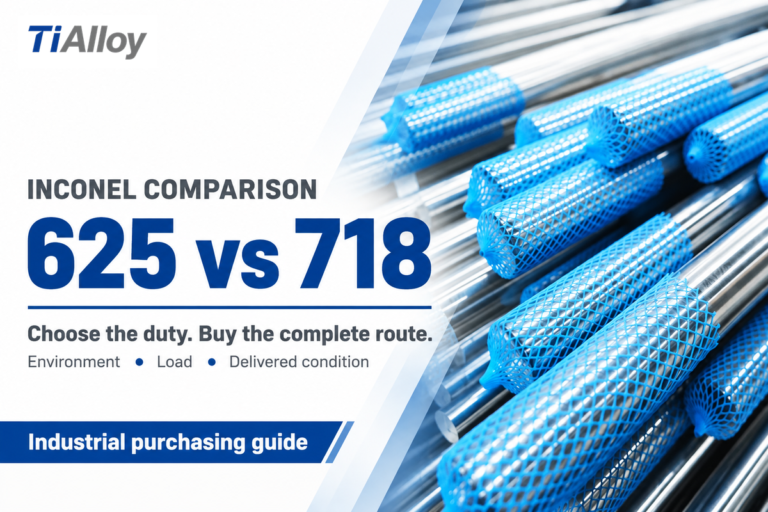
A peer-reviewed welding review illustrates the danger of unlabeled strength rankings: its table reports room-temperature yield values of 285 MPa for Alloy 600, 490 MPa for Alloy 625, and 1186 MPa for Alloy 718. Those matched room-temperature data explain the strengthening effect; they do not rank the corrosion life, weld behavior, or high-temperature life.
For a more detailed view of the precipitation-strengthened path, review the Inconel 718 properties and selection guide. Then compare both candidates under the same temperature, product condition, specimen basis, and failure mode.
Engineering Handoff: From Grade Idea to Evidence

When alloy 625 clears the initial screen, convert the idea into an evidence chain prior to procurement. Start with the service basis: process composition, concentration, temperature range, loads, design life, transients, and target failure mechanisms. Then define the product form and governing specification, including edition, condition, dimensions, tolerances, testing, and supplementary requirements.
Next, connect the material to the finished part. Require heat or lot traceability, material certificates, and any positive material identification as per the project. Tie forming, heat treatment, machining, and welding to qualified procedures. Close with dimensional inspection, nondestructive examination, mechanical or corrosion tests where required, and clear acceptance records.
- Define the service — record the medium, concentration, temperature, stress, geometry, life, and failure mechanisms.
- Specify the product — name the product form, standard edition, condition, dimensions, tests, and certificate requirements.
- Qualify fabrication — bind forming, heat treatment, machining, welding, and repair to approved procedures.
- Verify acceptance — connect heat or lot traceability, inspection, NDE, and required tests to the finished part.
This evidence chain avoids two common pitfalls: accepting a certificate that proves only bulk chemistry, and requesting a quote from a supplier prior to the technical basis being finalized. TiAlloy provides company background and quality approach on the About Titanium Alloy Co., Ltd. page. When your service basis and product-form route are ready, Discuss the specification with TiAlloy.
Frequently Asked Questions
What is Inconel 625 used for?
Inconel 625 is used for components that need a combination of corrosion resistance, strength, and weldability. The fit depends on the ordered condition, product form, temperature, stress, geometry, fabrication history, and the real process medium rather than the alloy name alone.
Examples occur in offshore seawater systems, chemical equipment, high pressure oil-and-gas hardware, aerospace ducts, and high-temperature equipment. Examples of typical parts are tubes, bellows, transition pieces, fasteners, and welded constructions; however, each part introduces a new stress and geometry issue. The industry label isn’t an approval because medium, concentration, temperature, stress, geometry, fabrication history, and inspection facts must be the same as the proposed duty. Confirm the product-form specification and service evidence before moving from an application idea to a drawing. If the duty contains stagnant crevices, sour chemistry, long heat exposure, or high cyclic load, treat that mechanism as its own qualification task.
Is Inconel 625 hard to machine?
Yes, Inconel 625 is generally difficult to machine compared with common carbon steels and stainless grades. Work hardening, concentrated cutting heat, tool-material affinity, hard particles, and chip control complicate cutting. Rigid setups, continuous engagement, directed coolant, suitable tooling, and planned wear checks are important.
What are the disadvantages of Inconel?
Disadvantages include higher material and machining cost, faster tool wear, tighter fabrication control, and the risk of paying for performance a milder duty does not need. Alloy 625 can still face localized corrosion, stress-assisted damage, and phase changes. High-temperature strength loss also remains duty-specific.
Is Inconel 625 stronger than steel?
Inconel 625 can be stronger than some steel grades under particular conditions, but it is not universally stronger. Compare the exact steel grade and Alloy 625 product form, condition, section, and test temperature, then match the property basis: yield, tensile, fatigue, creep, or rupture. A room-temperature tensile comparison cannot settle corrosion life or elevated-temperature design. UNS N06625 identifies the Alloy 625 chemistry family, while the governing product specification and code provide the acceptance and design basis.
Is Inconel 625 the same as UNS N06625?
UNS N06625 is the alloy designation commonly associated with Inconel 625 or Alloy 625, so the names usually point to the same chemistry family. They do not establish product form, ordered condition, heat treatment, dimensions, test methods, fabrication qualification, or service acceptance; purchase and design documents should pair UNS N06625 with the applicable product-form specification, edition, supplementary requirements, inspection plan, and project criteria because the designation starts the material definition but does not finish the engineering decision.
References & Sources
- ASTM B446, public scope for nickel-chromium-molybdenum-columbium alloy rod and bar.
- ASTM B02.07, active standards and current editions.
- NIST, delta-phase formation in powder-bed-laser Alloy 625.
- NIST, localized-corrosion comparison of directed-energy-deposited and wrought Alloy 625.
- Peer-reviewed study, precipitates in additively manufactured Inconel 625.
- Peer-reviewed study, microstructure and selective corrosion of LPBF Alloy 625.
- Peer-reviewed review, welding of nickel and nickel alloys.
- Nickel Institute, nickel alloy application context.
WHY WE PUBLISH
About TiAlloy
TiAlloy supplies titanium, stainless steel, nickel alloy and clad plate for specification-driven industrial orders. Our technical guides are written to help buyers align product form, governing standard, test scope and release documents before a quotation is compared.
01Melt & formPlate, sheet, pipe, tube, bar, wire and forgings
02ProcessHeat treatment, finishing, inspection and export packing
03VerifyEN 10204 Type 3.1 certificate and order documents
![Hastelloy C276 Guide [UNS N10276]](https://tialloy.com/wp-content/uploads/2026/10/hastelloy-c276-guide-featured-150x150.png)


