Get in Touch with TiAlloy Company

Titanium Price Guide for Industrial Buyers

Industrial buying guide
This Titanium Price Guide begins with a fundamental rule: a titanium price per kilogram is useful only when you understand what a kilogram means. One purchaser may seek a price per pound, while another may request a price per kilo. Each may be comparing a titanium metal benchmark with a raw material signal or a finished product. This guide separates market benchmarks, sponge and scrap from mill finished products, and provides a means to compare supplier quotes for plate, sheet, tube, pipe, bar and rod.
Quick answer: a 2026 titanium price guide lists commercially pure titanium (Grades 1-4) at $8 to $15 per pound and Ti-6Al-4V (Grade 5) at $20 to $35 per pound. Grade, product form, dimensions, condition, quantity, yield, inspection, delivery terms and destination can all change the offer. A public benchmark is dated context, not a binding TiAlloy quotation.
Why titanium has no single universal price
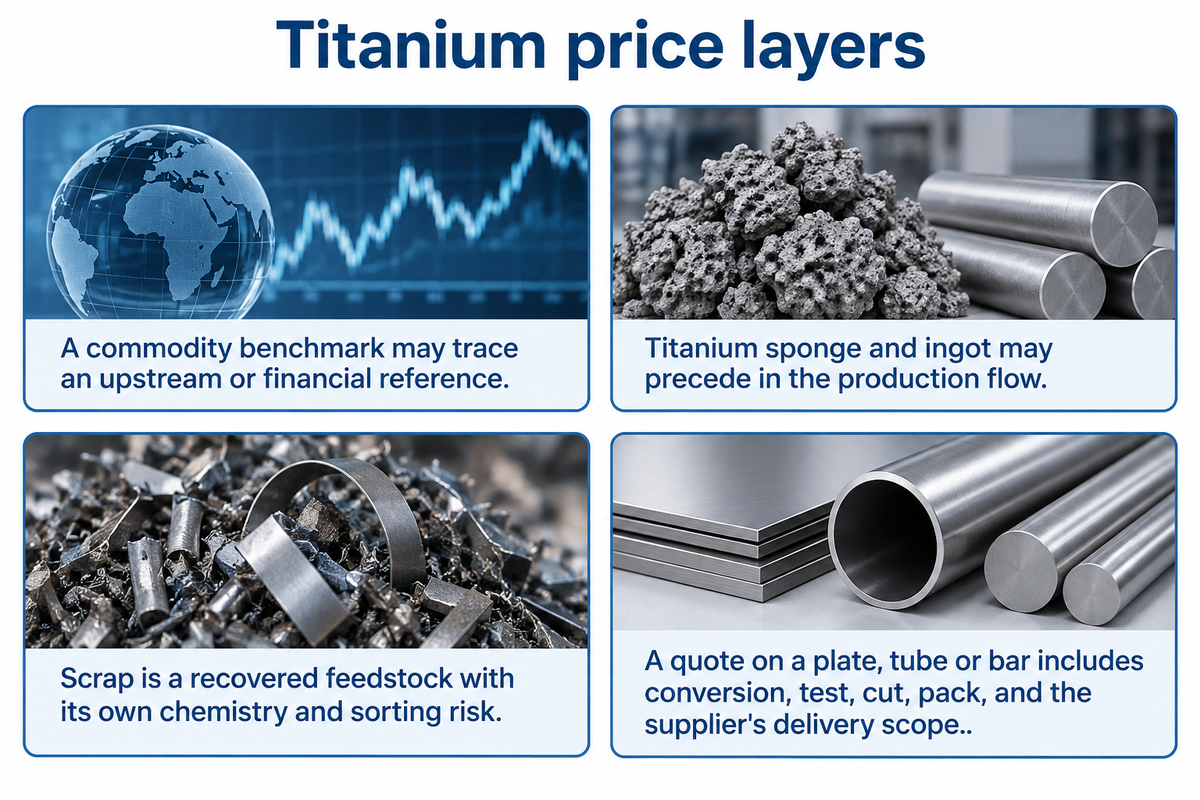
Search results often display several price objects side by side. The factors affecting the price include grade, form, processing, and delivery scope. A commodity benchmark may trace an upstream or financial reference. Titanium sponge and ingot may precede in the production flow. Scrap is a recovered feedstock with its own chemistry and sorting risk. A quote on a plate, tube or bar includes conversion, test, cut, pack, and the supplier’s delivery scope.
At the upstream end, extracting pure titanium involves smelt and refine steps before a finished mill product exists; titanium ore and the Kroll process belong to that upstream cost context. These are among the factors affecting the price of titanium. Factors affecting the price of a finished product also include global titanium supply, increasing demand, market demand, market fluctuations, market trends, the global economy and geopolitical conditions. Engineers use titanium in commercial aircraft and other demanding applications because its unique properties and strength-to-weight ratio matter, but how titanium is used does not create one universal quote. A titanium price per kilo, quoted in US dollars per kilogram or another unit, still needs a grade, the form of the metal, quantity and delivery basis.
How titanium is used affects the commercial specification. Titanium is a versatile pure metal for industrial use, and its strength and corrosion resistance support widely used industrial applications; these key factors affect titanium pricing without creating a universal number. A wholesale buyer may request high-purity raw titanium or a finished product, but the quote still depends on the grade, form, quantity, processing route and delivery basis.
A buyer asking what titanium used in a specific application costs should compare the application scope with the price of one kilogram on the same usable-weight basis. The factors affecting the price of titanium include grade, form, quantity and delivery terms.
Global titanium supply and market demand can move with increasing demand, the global economy, geopolitical conditions, market fluctuations and market trends. Treat those signals as context for a current quote, not as a substitute for the buyer’s defined grade and delivery basis.
| Price object | What it represents | Why it cannot be copied into every quote |
|---|---|---|
| Benchmark or index | A dated market indicator with a stated unit and instrument. | It may cover a region, contract or upstream layer rather than your grade and form. |
| Sponge or ingot | Upstream material before rolling, forging, drawing or tube conversion. | Conversion yield, melting route and downstream qualification are still missing. |
| Scrap | Recovered material sorted by chemistry, cleanliness and form. | Impurities and recovery value make it a different purchase decision. |
| Finished mill product | Plate, sheet, tube, pipe, bar or rod supplied to a defined specification. | Testing, tolerances, dimensions, cutting, packing and delivery point are part of the scope. |
What is the current cost of titanium?
As a dated benchmark, Trading Economics indicated 43.00 CNY/kg for titanium in 2026; Grade 2 or Grade 5 plate, tube or bar is quoted on its own grade, form, quantity and delivery basis. If you require an estimate, document the source date, unit and state it as a benchmark. Seek a specific form, quote and eval before an award.
How much does titanium cost per pound?
A 2026 price guide puts commercially pure titanium at $8 to $15 per pound and Grade 5 at $20 to $35; check whether a quote’s pounds are net, gross, theoretical or usable. An all-in-inclusive quote at one pound can’t be compared to a quote at one pound where cutting and freight is excluded.
How grade, form and condition change the quote
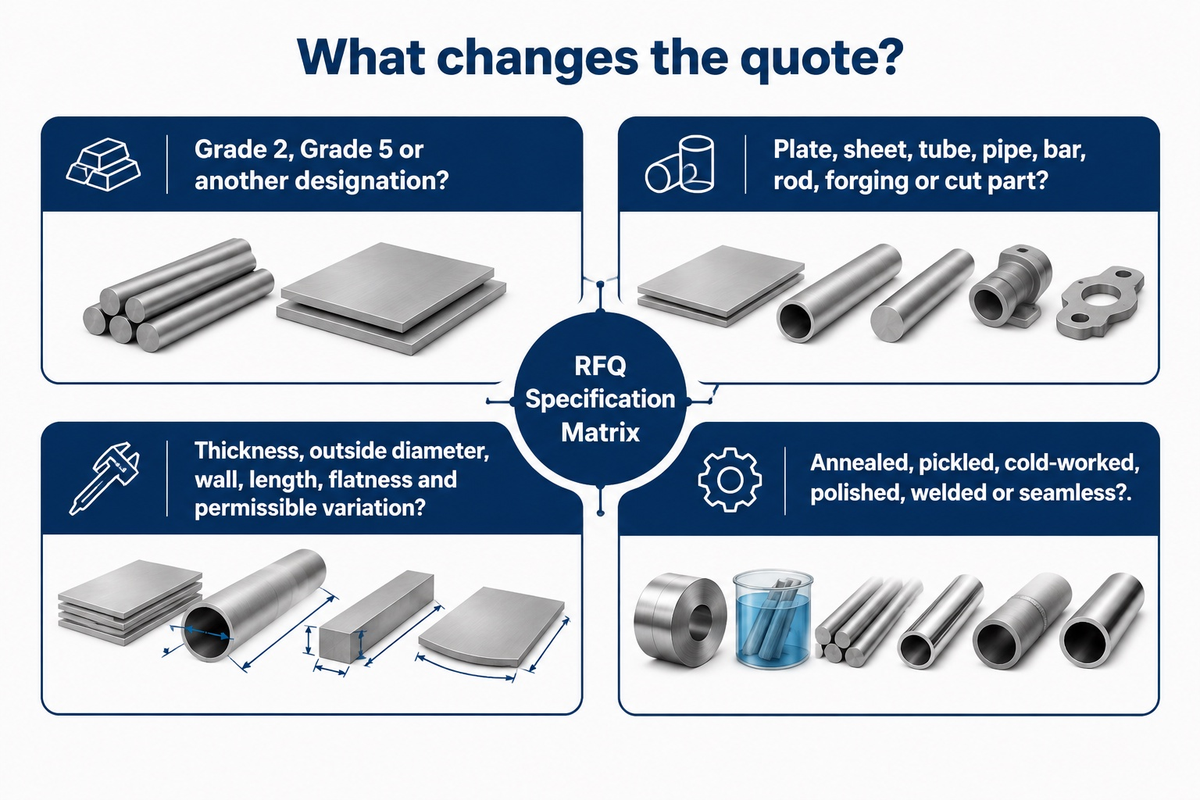
Grade is one field, not the whole specification. Commercially pure titanium grade 2 is commonly selected for corrosion and forming service. Grade 5 is also known as Ti-6Al-4V, when the governing specification confirms it, is an alloy selection when higher strength or a special qualification is required. The right grade selection depends upon the service and product form.
| Quote field | Questions to answer | Cost effect to investigate |
|---|---|---|
| Grade and alloy | Grade 2, Grade 5 or another designation? Is the alloy identity confirmed on the material test report? | Chemistry, mechanical properties and qualification route. |
| Product form | Plate, sheet, tube, pipe, bar, rod, forging or cut part? | Rolling, drawing, forging, welding, straightening and cutting steps. |
| Dimensions and tolerance | Thickness, outside diameter, wall, length, flatness and permissible variation? | Yield, machining time, oversize input and scrap allowance. |
| Condition and finish | Annealed, pickled, cold-worked, polished, welded or seamless? | Heat treatment, surface work, inspection and acceptance criteria. |
| Documents | Which standard edition, inspection plan and material test report are required? | Testing, traceability, review time and document package. |
A higher grade number doesn’t guarantee a higher delivered quote. Quantity, stock position, dimensions, and processing can reverse the order.
How to normalize titanium quotes
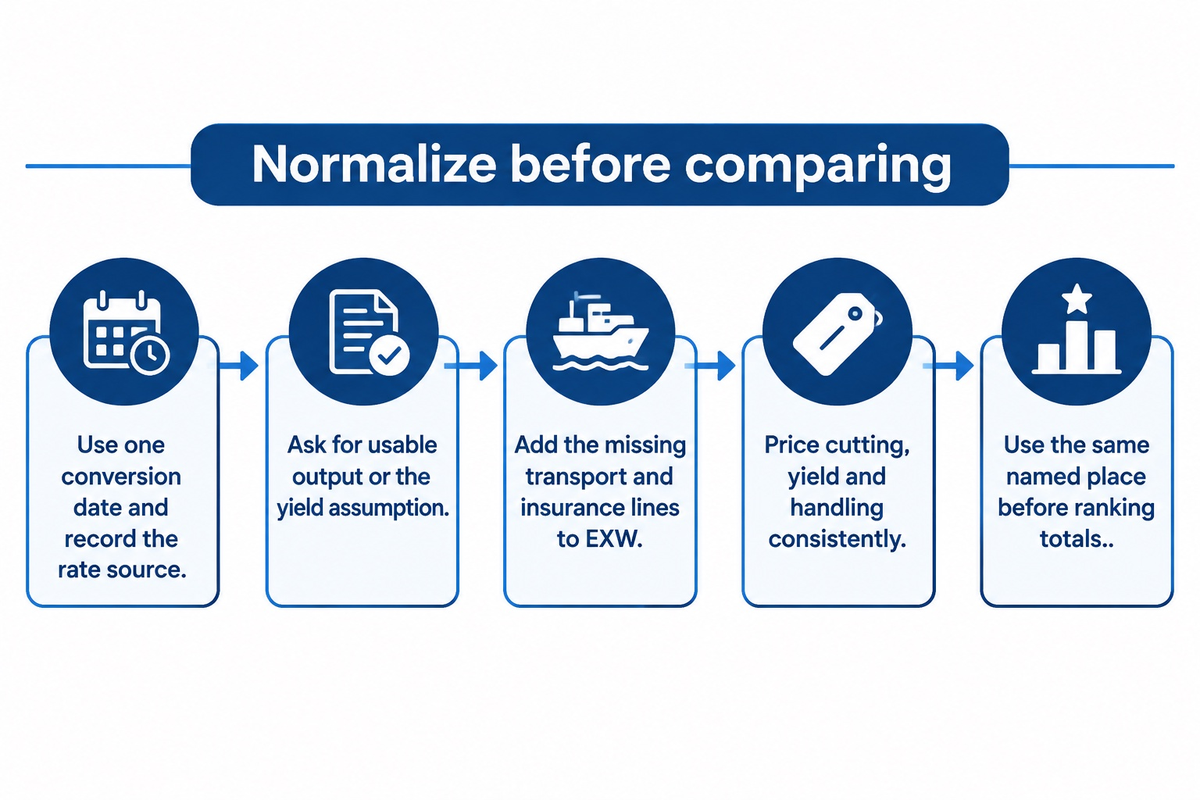
The lowest number on a quote doesn’t necessarily mean the lowest cost. To determine cost, normalize offers to a common currency, weight, and a defined point of delivery. Then, show what’s outside the material scope so a supplier and a buyer see the same delivered-cost boundary, identify which line covers cutting, inspection, packing or freight, and avoid treating an apparently cheaper material line as the delivered total before the destination and usable-weight assumptions have been aligned.
Reference: HWHG Steel supplier article (commercial example) on grade, form and specification.
6-Line Quote Normalization Grid
Normalized material cost per usable kilogram = quoted line total ÷ defined usable kilograms
State the currency date, exchange-rate source, Incoterm and whether cutting, inspection, packing and freight are included.
Normalized material cost per usable kilogram = quoted line total ÷ defined usable kilograms
State the currency date, exchange-rate source, Incoterm and whether cutting, inspection, packing and freight are included.
5-Factor Titanium Cost Ladder: compare (1) grade and standard, (2) form and dimensions, (3) condition and yield, (4) inspection and documents, and (5) delivery and destination.
| Example input | Illustrative value | Why it is recorded |
|---|---|---|
| Thickness | specified thickness | Defines the sheet or plate scope. |
| Outside diameter | 25 mm | Defines a tubular or bar section. |
| Wall | 2.00 mm | Prevents a tube quote being compared with solid bar. |
| Cut length | 1 m | Separates cut-to-length work from mill length. |
| Order quantity | 120 kg | Allows the same mass basis across offers. |
| Small order check | 20 lb ≈ 9.07 kg | Shows the unit conversion before freight. |
| Line total | 2,400 USD | Provides the numerator for the illustrative formula. |
| Benchmark context | 43 CNY/kg | A dated market indicator, not a finished-product offer. |
| Document scope | required inspection document | States the requested inspection-document route. |
The numbers in the table are illustrative. They aren’t a TiAlloy price list or product specification.
| Line | Quote A | Quote B | What to reconcile |
|---|---|---|---|
| Currency and date | USD, date stated | EUR, date stated | Use one conversion date and record the rate source. |
| Weight basis | Net kilograms | Theoretical kilograms | Ask for usable output or the yield assumption. |
| Delivery term | EXW | CIF destination port | Add the missing transport and insurance lines to EXW. |
| Processing | Cut lengths included | Mill length only | Price cutting, yield and handling consistently. |
| Inspection and documents | Report included | Optional | Make the same report and review scope mandatory. |
| Destination | Warehouse delivery | Port delivery | Use the same named place before ranking totals. |
For a worked comparison, use clearly labeled illustrative values: if a line total is USD 2,400 and the defined usable output is 120 kg, the normalized line is USD 20/kg before any costs that the quote excludes. The arithmetic is reusable.
How much is 20 lbs of titanium worth?
Multiply the supplier’s normalized price by 20 lb, converted to the same unit of mass, and add the same delivery and documentation lines used for the large order. Responses are only as accurate as the definition of grade, form and the usable weight.
Titanium RFQ checklist for comparable pricing
Send a complete scope to each supplier. More often than not, a precise RFQ yields a more complete response than a lengthy request that leaves the form and the basis of inspection (BOI) undefined.
Reference: the same quotation comparison guide supports standardizing grade, form and specification before supplier scoring.
| RFQ section | Write this explicitly |
|---|---|
| Material identity | Grade, alloy designation, governing standard and edition. |
| Form and size | Plate/sheet, tube/pipe, bar/rod or other form; dimensions, lengths and tolerances. |
| Quantity | Pieces, net kilograms, cut lengths and repeat-order profile. |
| Condition | Annealed, cold-worked, welded/seamless and surface finish. |
| Quality documents | Material test report, heat/lot traceability, inspection points and acceptance rules. |
| Logistics | Incoterm, named place, destination, packing, marking and requested delivery window. |
| Commercial response | Validity period, currency, payment basis, exclusions and a separate freight/inspection line. |
| Application and service | Industry, temperature range, corrosion environment and whether the part is structural or decorative. |
| Reference sample | Drawing, old purchase order or sample description, with revision and requested quantity in kg or pieces. |
Ask the supplier to confirm any fields that are unavailable. It’s better to say a field is “to be confirmed” than to assume a standard, certificate or delivery commitment.
Mill-direct, stockist or service centre?
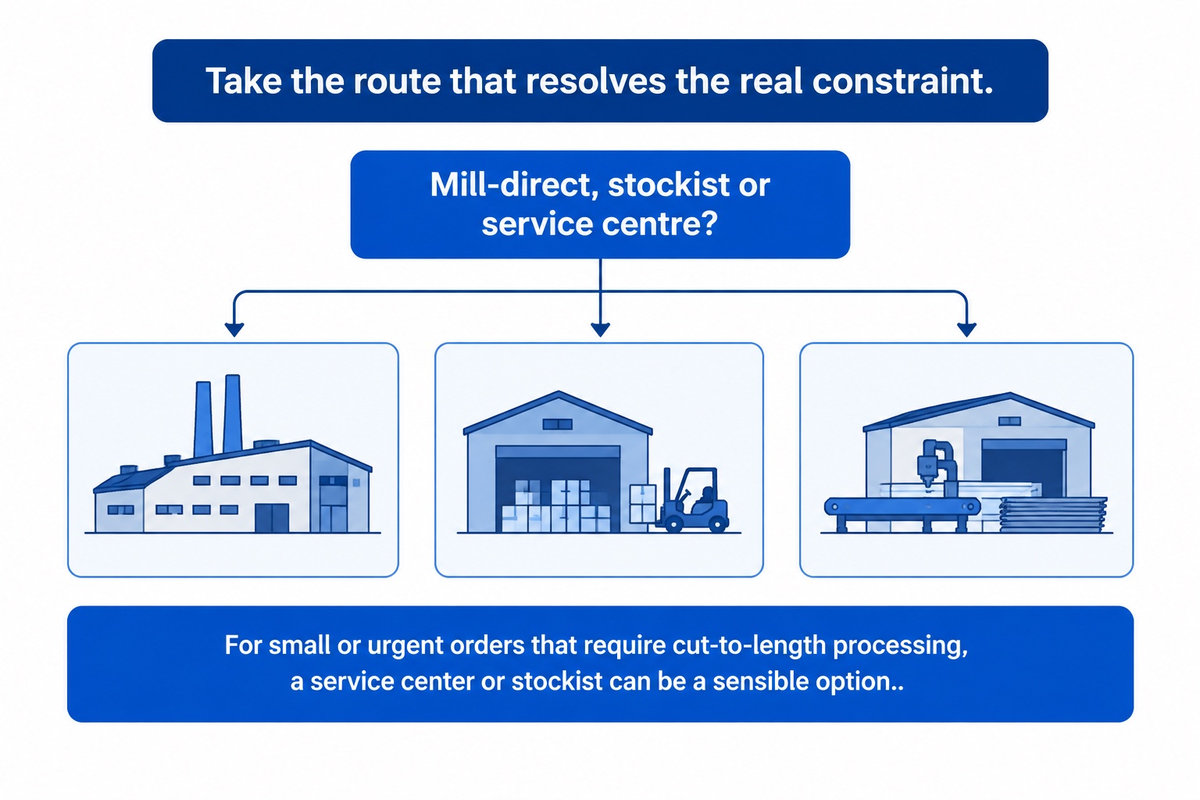
Take the route that resolves the real constraint. It is predictable, and can be produced in a known volume and specification by the mill directly. For small or urgent orders that require cut-to-length processing, a service center or stockist can be a sensible option. The right comparison is total cost at the specified delivery time.
| Route | Often fits | Check before choosing |
|---|---|---|
| Mill-direct | Repeat volume, planned production and stable dimensions. | Minimum quantity, production slot, qualification, yield and payment terms. |
| Stockist | Small lots, short lead time or common grades already in inventory. | Heat/lot traceability, actual stock, cut charge and remaining shelf or storage conditions. |
| Service centre | Cutting, slitting, machining or a finished size that saves your own processing. | Processing tolerance, yield, scrap ownership, inspection and packing. |
Don’t use a copied percentage premium from a metal and apply it to a titanium. Use the same six-line grid for each case, and select the case that works for your delivery and technical constraints.
See TiAlloy Manufacturing Route for public process context. The page is a routing reference, not an assurance of capacity, certification or lead-time commitment for a given order.
Landed cost: freight, duty, inspection and packing
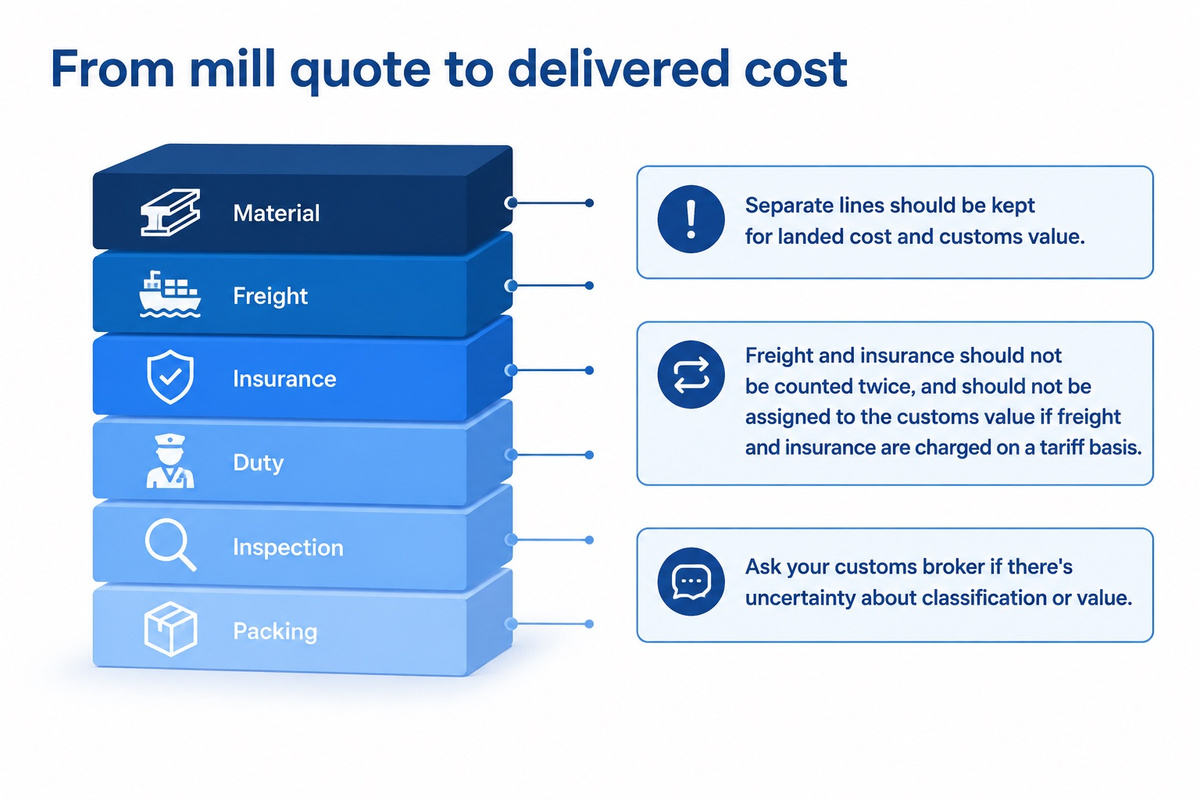
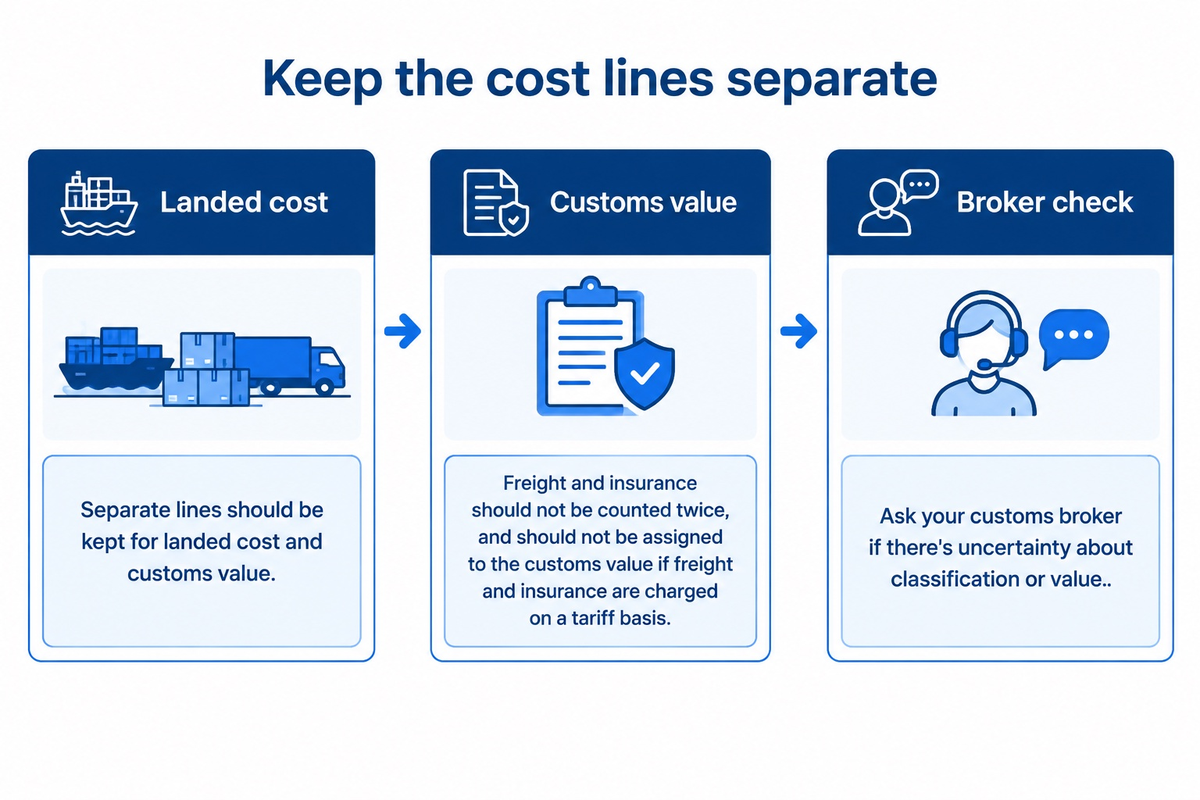
Separate lines should be kept for landed cost and customs value. Freight and insurance should not be counted twice, and should not be assigned to the customs value if freight and insurance are charged on a tariff basis.
Landed-cost stack
Material line + origin handling + freight + insurance + duty/tax where applicable + inspection + packing + destination charges
Confirm which items are included in the customs value and which are internal or destination costs for your shipment.
Material line + origin handling + freight + insurance + duty/tax where applicable + inspection + packing + destination charges
Confirm which items are included in the customs value and which are internal or destination costs for your shipment.
| Cost line | Allocation question |
|---|---|
| Material | Is the amount for net, theoretical or usable weight? |
| Freight and insurance | Which Incoterm and named place apply? |
| Duty and tax | Which current classification and importing country rules apply? |
| Inspection | Is third-party or additional testing required? |
| Packing and destination | Are export packing, port, broker and final delivery included? |
Ask your customs broker if there’s uncertainty about classification or value. An estimate from supplier is useful for budgeting; however, it isn’t a substitute for advice from the destination country.
Can public titanium price benchmarks answer current cost?
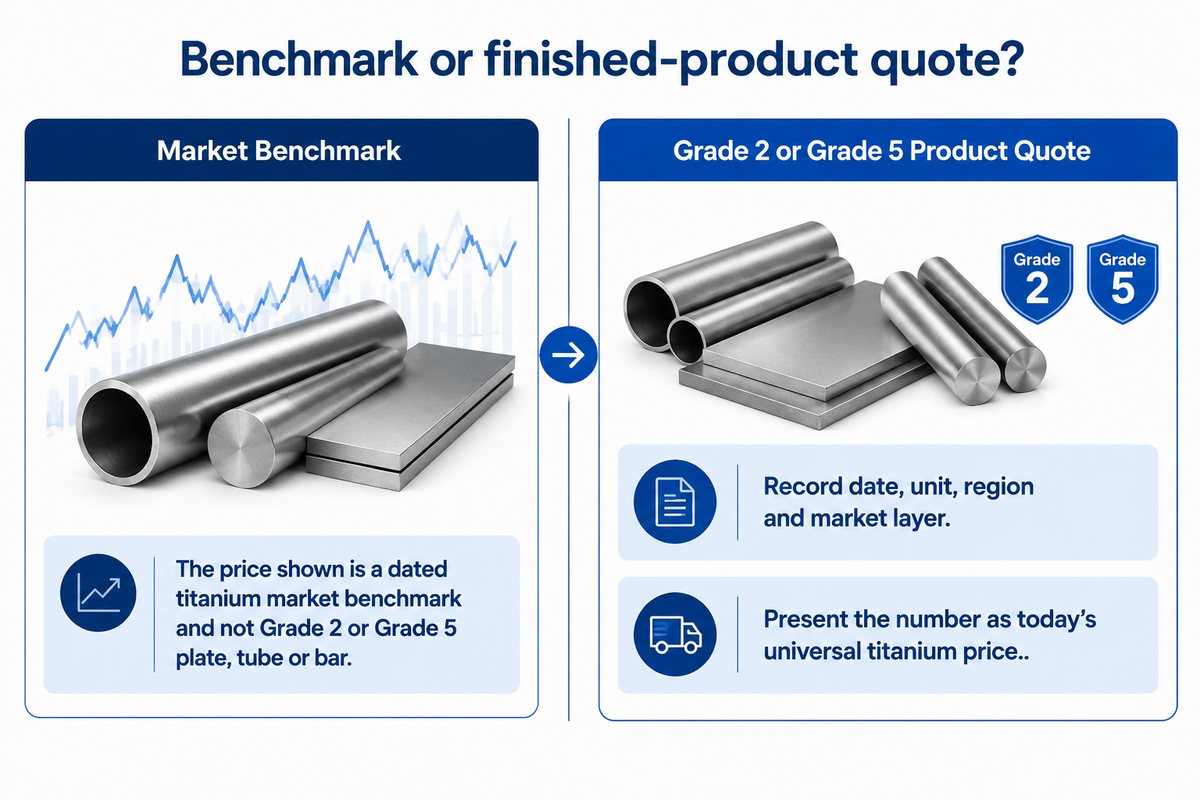
Market Indicators may answer the question: what was the market price for a given good on a specific date? For example, the Trading Economics page indicated 43.00 CNY/kg for 2026, and provided a historical data series. The price shown is a dated titanium market benchmark and not Grade 2 or Grade 5 plate, tube or bar. Demand for titanium can change by sector and region, so a market chart should not be treated as a supplier promise.
| Safe use | Unsafe use |
|---|---|
| Record date, unit, region and market layer. | Present the number as today’s universal titanium price. |
| Use it to frame a budget or ask why offers diverge. | Use it to promise a Grade 2/Grade 5 finished-product price. |
| Recheck before a new order or contract. | Assume the benchmark includes freight, inspection or packing. |
Will the price of titanium go up?
The benchmark has been falling: on November 3, 2026, Trading Economics showed titanium down 10.87% compared to the same time last year. Factors such as supply and demand, processing route, region, currency and the position of stocks and flows can diverge. Use a dated benchmark for context, then request a current RFQ before making a buying decision, because supply, demand, processing route, region, currency and inventory may move on different cycles while a chart does not define the delivered scope of your specific product form.
How TiAlloy product forms map to a quote
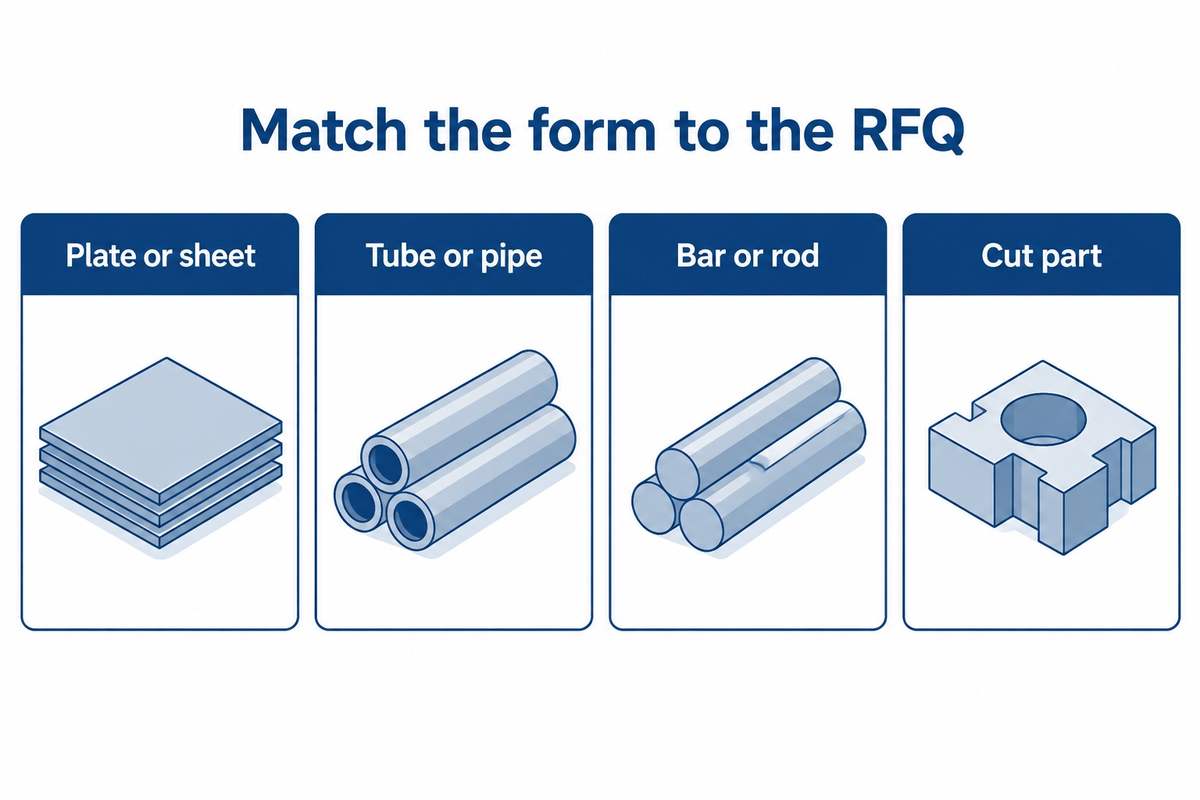
Begin with the product form that corresponds to the engineering requirement, and populate the same RFQ fields for the inquiry. TiAlloy’s publicly available product navigation provides these starting points:
Titanium productsUse for the general material family and to route a request.
Titanium plate and sheetFor a titanium sheet or plate request, include thickness, width, length, tolerance, condition and standard.
Titanium tube and pipeInclude outside diameter and wall for tube, or NPS and schedule for pipe, plus length, welded/seamless scope and tests.
Titanium bar and rodInclude diameter or section, cut length, straightness, finish and inspection.
| If you need | Put in the first message |
|---|---|
| Plate or sheet | Grade, ASTM/other standard edition, thickness, width, length, surface and test documents. |
| Tube or pipe | Grade; outside diameter and wall for tube (ASTM B338) or NPS and schedule for pipe (ASTM B861/B862); length, seam scope, hydro or other required tests. |
| Bar or rod | Grade, diameter/section, cut length, condition, straightness and traceability. |
These links route the inquiry. Get the current stock position, certification, capacity and delivery date in the written quote.
FAQ
Does titanium cost more than gold?
No. Trading Economics put gold at 3,924.93 USD/t.oz on November 3, 2026, far above titanium’s per-pound industrial metal prices. Compare the defined titanium form, grade, quantity, and delivery scope with the alternative material and required lifecycle. A commodity or piece of jewelry doesn’t include your inspection and logistics scope.
What is titanium price per kg?
As a dated benchmark it was 43.00 CNY/kg in 2026; finished-product figures differ by price object, because a benchmark, sponge, scrap, and finished mill product sit at different stages and carry different units, processing assumptions, document packages, delivery terms, and destinations; identify that scope first, then use the matching grade and form before comparing any per-kilogram figure or asking a supplier to confirm the current quotation. State whether the number is a dated benchmark, sponge, scrap or a finished product, and state grade, form, quantity, condition, Incoterm and destination. In the absence of these, a per kilogram number is a lead not a purchase price.
Is titanium worth the price?
It is when corrosion resistance and lower weight save more in maintenance, downtime or replacement than the higher material and processing cost. Compare corrosion performance, weight, maintenance, fabrication, inspection and replacement risk against the alternatives. The least expensive material line can be the wrong choice if it creates higher processing or downtime costs.
How do Grade 2 and Grade 5 differ?
Grade 2 is commercially pure titanium commonly used where corrosion resistance and forming matter. Grade 5 is a titanium alloy commonly chosen for higher strength. Verify the governing standard, product form and material test report before assessing price or suitability.
Can I buy titanium direct from a mill?
Once the specification, volume and schedule align with a chosen production route, ask for the minimum quantity, qualification, production slot and yield. Check delivery terms, request documents and time. For minor, urgent or oversized orders, check total cost of a stockist or service-center.
What does a material test report add?
A material test report identifies the inspection basis for the material and gives the buyer a traceable record to compare with the quoted grade, form, heat or lot, testing scope, dimensions, delivery documents and acceptance requirements before the shipment is released or the price is treated as evidence of compliance. State the required document and review scope in the RFQ and verify heat or lot traceability upon receipt. A document label alone shouldn’t be construed as proof that the product meets the project requirements.
Need a comparable titanium quote?
Send TiAlloy the grade, product form, dimensions, quantity, condition, standard, inspection documents, Incoterm and destination. That gives both sides a defined scope for a useful price discussion.
Send TiAlloy the grade, product form, dimensions, quantity, condition, standard, inspection documents, Incoterm and destination. That gives both sides a defined scope for a useful price discussion.
References & Sources
- ASTM International, Subcommittee B10.01 on Titanium – standard scope and B265-25 listing.
- U.S. Customs and Border Protection, Duty and CIF guidance – Customs Value.
- Trading Economics, Titanium price and historical data dated benchmark context; accessed for this draft on 2026-10-29.
- Rolled Alloys, How titanium sponge and scrap become final products feedstock distinction.
- HWHG Steel supplier article, Titanium grade, form and specification – commercial RFQ example.
- NASA Materials Data Handbook: Titanium 6Al-4V – Background and Technical aspects.
- TiAlloy public website product-form routing links.
Public market data can be changed. Check the publication date, source, unit and product layer before relying on any number to make a purchasing decision.
WHY WE PUBLISH
About TiAlloy
TiAlloy supplies titanium, stainless steel, nickel alloy and clad plate for specification-driven industrial orders. Our technical guides are written to help buyers align product form, governing standard, test scope and release documents before a quotation is compared.
01Melt & formPlate, sheet, pipe, tube, bar, wire and forgings
02ProcessHeat treatment, finishing, inspection and export packing
03VerifyEN 10204 Type 3.1 certificate and order documents