Get in Touch with TiAlloy Company


Titanium is expensive not because its ore is rare, but because extreme chemical reactivity at high temperature forces slow batch refining and difficult fabrication. Imported bulk sponge averaged $12/kg in 2025. Precision ground Grade 5 distributor bar reaches $170–$243/kg ($77–$110/lb) before CNC machining multiplies part cost again.
Titanium ranks ninth among elements in Earth’s crust and fourth among structural metals. However, the price of titanium greatly exceeds that of carbon steel, stainless steel, and common industrial metals like aluminum. Its raw material ore is plentiful, so the high cost of titanium arises across four manufacturing stages rather than at the mine.
Customers who ask “Why is titanium so expensive?” promptly learn to distinguish costs associated with sponge from those associated with ingot melting, alloy surcharges, and CNC machining. Factory conversion and machining make up a larger part of the price than raw ore. All figures are from government commodity records, peer-reviewed journals, and currently active ASTM standards.
Quick Specs: Titanium Cost Baseline
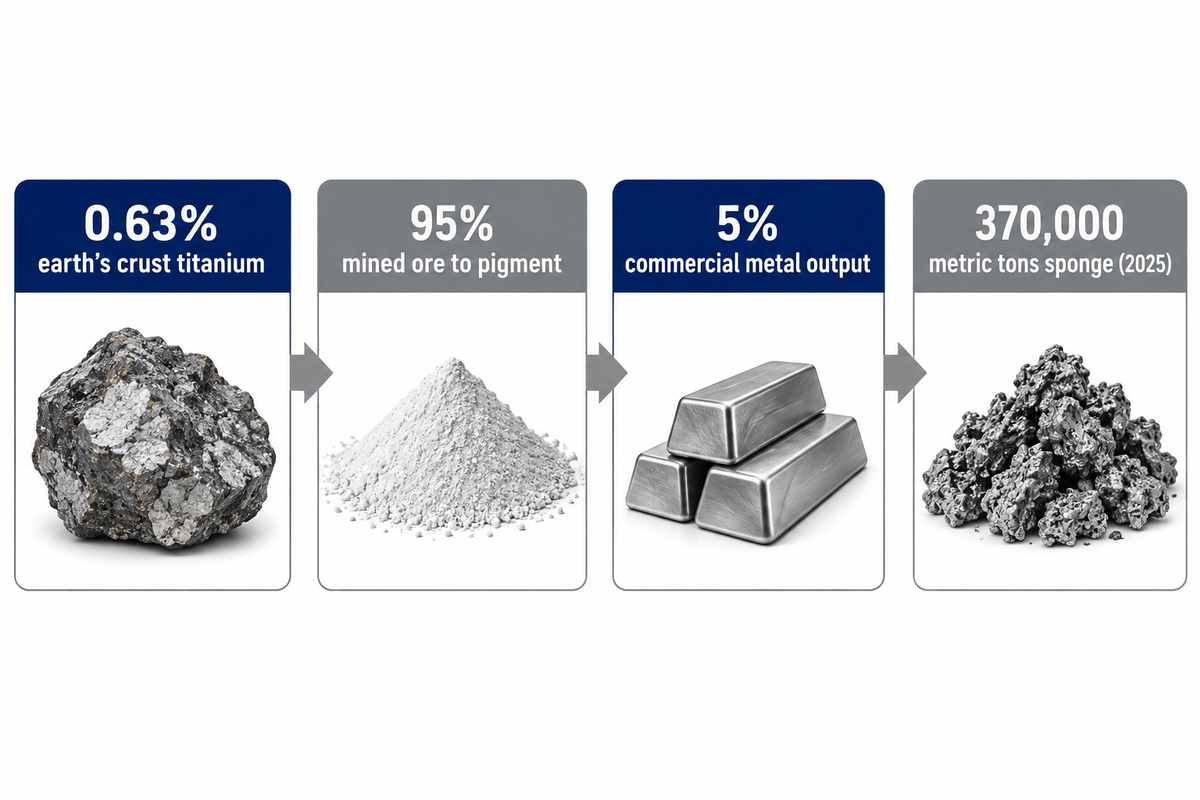
| 2025e Global Sponge vs. Ore | 370,000 metric tons sponge vs. ~95% TiO2 ore consumed as pigment (USGS) |
| Extraction Energy Intensity | ~50 kWh/kg metallic Ti in conventional Kroll processing (NIH PMC6956875) |
| Post-Extraction Plate Share | 62% of a rolled 2.54 cm plate cost occurs after sponge production |
| Machining Heat Bottleneck | 6.7–7.5 W/m·K conductivity for Ti-6Al-4V vs. 167 W/m·K for 6061 Al |
| Governing Flat Standard | ASTM B265-25 (Grades 1, 2, 2H, 5, 7, 9, 12, and 23 ELI) |
62%
Plate cost incurred after sponge reduction
25×
Lower thermal conductivity than Al 6061
$7.70/kg
2025 US clean scrap import unit value (USGS)
Why Is Titanium So Expensive Despite Being Abundant?
Producing titanium remains expensive because converting titanium oxide into ductile metal uses reactive halogens and vacuum furnaces. This energy intensive refining chain explains the high cost of titanium. Compared to other metals, titanium costs stay high because titanium is about six times more expensive to produce than stainless steel (UC Berkeley Engineering).
Earth’s crust holds roughly 0.63% titanium. That makes it about 30 times more common than carbon and 100 times more common than copper (Construction Physics). The majority of titanium ore, nearly 95% of mined ilmenite and rutile, goes straight into white pigment for paint, paper, and plastics. Only about 5% enters commercial titanium production.
Production scale widens the cost gap. Global titanium sponge output was estimated at 370,000 metric tons in 2025, against nameplate capacity of 470,000 metric tons. China produced roughly 70% (260,000 metric tons), followed by Japan (53,000 metric tons), Russia (25,000 metric tons), and Kazakhstan (16,000 metric tons). Even at full capacity, U.S. sponge imports hit an estimated 44,000 tons in 2025, topping the 40,300 tons record in 2023 (USGS MCS 2026), while global tonnage stays tiny next to crude steel.
| Value-Chain Stage | Primary Process | Verified Benchmark / Cost Split | Primary Cost Driver |
|---|---|---|---|
| 1. Ore & Concentrate | Heavy-mineral sand mining (rutile / ilmenite) | Upgraded rutile feedstock = 10% of conventional extraction cost | Ore upgrading; ~95% volume competes with pigment sector |
| 2. Primary Reduction | Chlorination to TiCl4 + Kroll Mg batch reduction | $12/kg US imported sponge (2025e); ~50 kWh/kg; 24% chlorination + 66% reduction | ~1,200 °C argon batch cycle lasting up to 17 days (~1 t/day) |
| 3. Ingot & Mill Forms | Double/triple VAR melting + hot rolling + pickling | 62% of rolled 2.54 cm plate cost; ~£8,000–£25,000/t historical mill reference | Vacuum melting, surface conditioning loss, thin-gauge rolling passes |
| 4. CNC & Fabrication | Low-speed CNC milling, argon-purged welding, NDT | 5×–10× cycle time vs. Al 6061; $77–$110/lb small-lot ground Grade 5 bar | 6.7 W/m·K heat trap, carbide wear, high buy-to-fly chip loss |
Sources: USGS Mineral Commodity Summaries 2026; US Patent US10190191B2; NIH PMC6956875; RSC Education; Criterion Precision machining benchmarks.
From Kroll Sponge to VAR Ingot: Primary Refining Bottlenecks
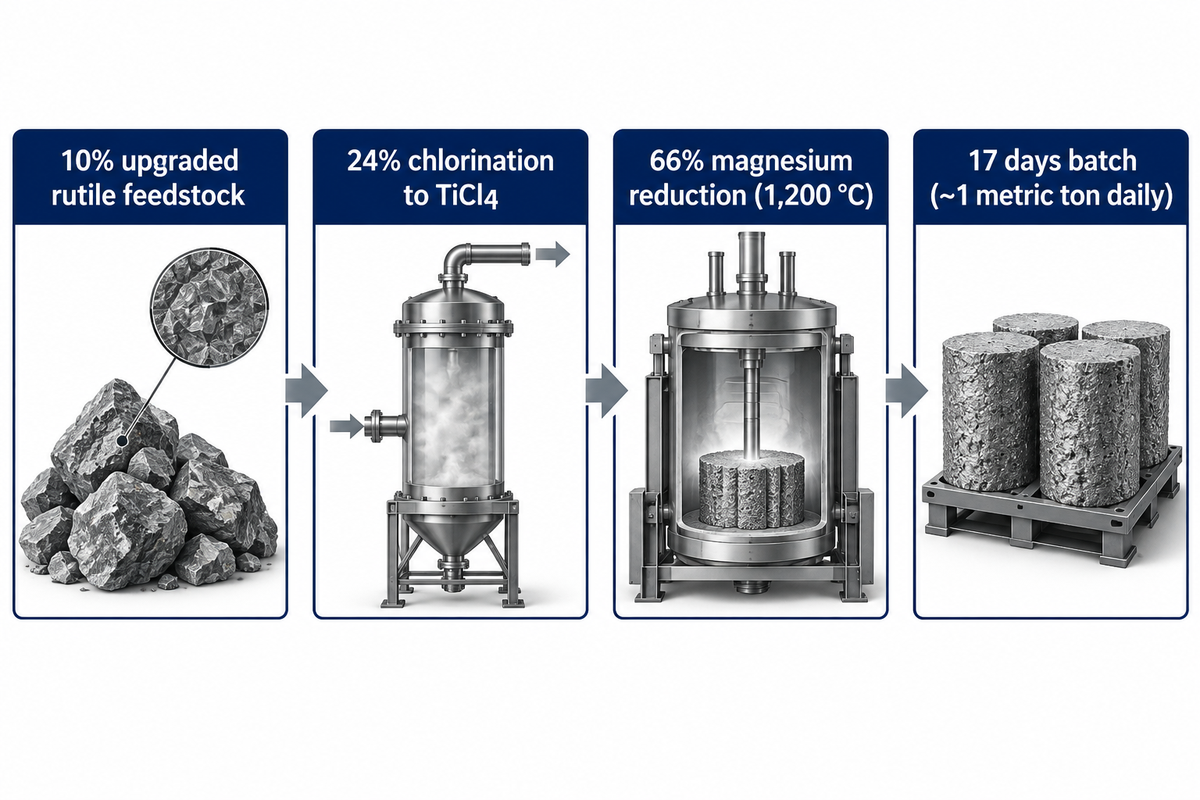
Turning purified titanium dioxide into forgeable ingot requires roughly 50 kWh/kg of titanium. That extraction route emits over 2 kg of CO2 per kilogram of metal (NIH PMC6956875). Each kilogram of titanium also consumes roughly 4 kg of liquid titanium tetrachloride (TiCl4) reacted with chlorine and petroleum coke.
In the Kroll process, titanium producers reduce titanium tetrachloride with magnesium inside a sealed steel reactor. The vessel operates under an inert atmosphere of argon near 1,200 °C to protect the purity of the metal. Vacuum distillation then strips trapped magnesium chloride over many days. One full batch stretches up to 17 days and yields roughly 1 metric ton per day, whereas a continuous iron blast furnace outputs 10,000 metric tons daily (Royal Society of Chemistry).
Extracting titanium by this multi-step route shows why cheap ore barely lowers market price. Patent US10190191B2 assigns 10% of conventional extraction cost to upgraded rutile feedstock. Chlorination to TiCl4 takes 24%, while magnesium reduction consumes 66%. To make titanium suitable for rolling, operators crush raw titanium sponge, weld electrodes, and cast a solid titanium ingot through double or triple Vacuum Arc Remelting (VAR).
Why Can’t Titanium Be Smelted Like Iron in a Blast Furnace?
Titanium can’t be reduced with carbon in a blast furnace because hot titanium binds tightly to carbon, oxygen, and nitrogen. Heating titanium ore with coke forms brittle titanium carbide (TiC) instead of pure metal. Even small traces of dissolved oxygen or nitrogen cause planar slip, making finished parts brittle.
Blast furnaces rely on air and carbon both for heat and for chemical reduction. Because titanium is extracted with an extremely high affinity for oxygen, it tolerates neither. Melting titanium requires deep vacuum chambers around 1,668 °C (3,034 °F). Any hot forging or welding exposed to air needs continuous inert argon shielding.
“The continuing story of the titanium discovery made by scientists in Cambridge shows that it is not always easy to introduce a new process, even if it has clear benefits.”
Royal Society of Chemistry, Titanium Extraction Overview
Electrochemical cells such as the FFC-Cambridge process reduce titanium dioxide directly in molten calcium chloride without chlorination. Lab trials lowered cell energy toward 17–21.5 kWh/kg using inert anodes. However, low current efficiency (32.3%), salt recovery cost, and scale-up capital risk have kept Kroll dominant on commercial mill bars.
How Much Does Titanium Cost Per Pound and Kilogram Across Mill Forms?
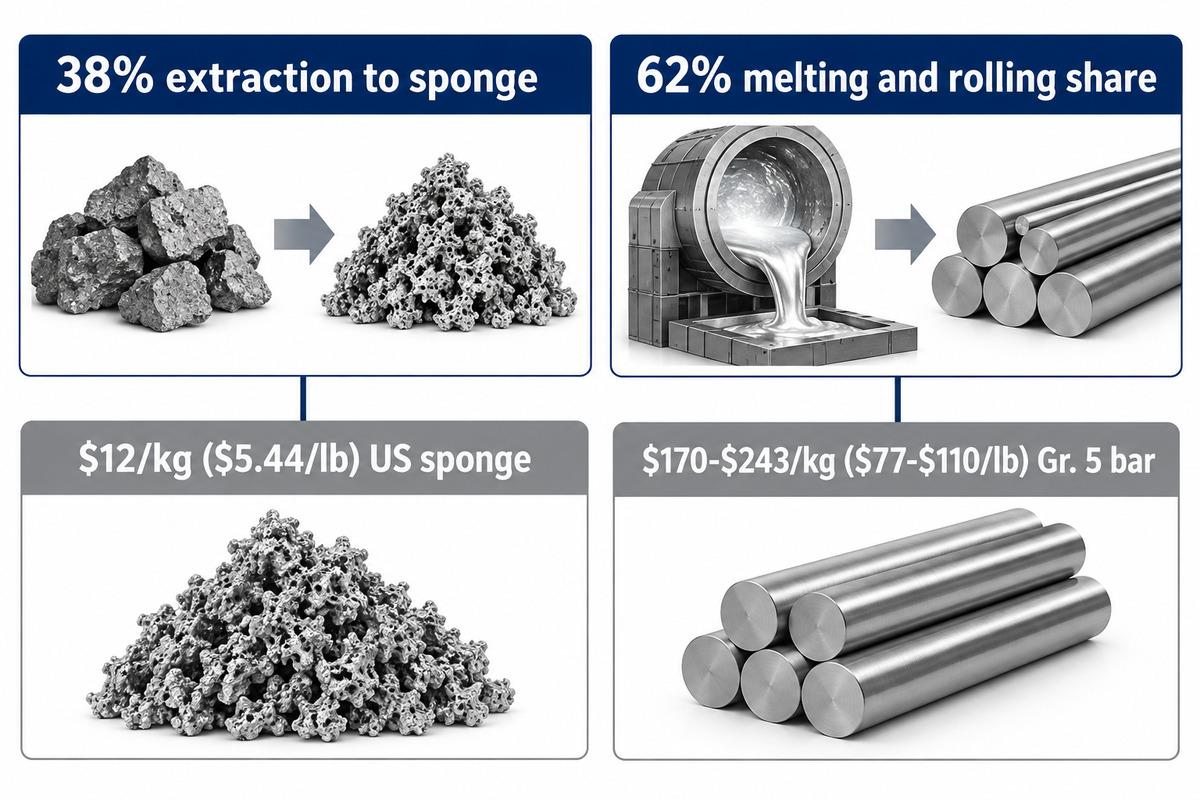
US imported titanium sponge averaged an estimated $12/kg ($5.44/lb) in 2025, whereas small-lot centerless-ground Ti-6Al-4V distributor bar runs $170–$243/kg ($77–$110/lb). Sponge prices edged down from $13.30/kg in 2024 after holding at $11.10/kg in 2021–2022. Meanwhile, BusinessAnalytiQ index tracking through 2026 shows wrought mill pricing stays far above sponge due to conversion losses.
Post-extraction melting and rolling account for 62% of a 2.54 cm (1 inch) thick titanium alloy plate’s cost. Only 38% comes from extraction to sponge. Historical UK industrial comparisons place bulk iron near £250/t and stainless steel or aluminium near £1,500/t. Under that same reference scale, commercially pure titanium reaches £8,000/t and alloyed titanium climbs to £25,000/t.
Every hot-rolling pass adds surface scale (alpha case) that mills must grind off and pickle away in acid. Small-lot distributor pricing compiled by Criterion Precision reflects those yield losses. Ground 6061-T6 aluminium bar runs ~$11–$14/lb, 304/316 stainless runs ~$64–$70/lb, and Grade 5 Ti-6Al-4V reaches ~$77–$110/lb. Review thickness grades and spot market behavior in our current titanium mill and spot price guide.
📐 Engineering Note: Mill Lots vs. Cut Pieces
Titanium doesn’t trade on an open exchange like the London Metal Exchange. Across the global titanium market, pricing scales with heat-lot minimum order quantities (MOQs), rolling recovery, and ultrasonic testing. Never benchmark a 5 kg cut bar quote against a bulk industrial sponge price index.
How Much Does Medical Grade or Grade 23 Titanium Cost?
Medical-grade Ti-6Al-4V ELI (Grade 23, UNS R56407) commands a steep mill premium over industrial Grade 5 bar of the same size. Extra-Low Interstitial (ELI) melting caps oxygen and iron impurities far below commercial tolerances under AMS 4907 and surgical implant standards. Reaching those purity floors demands premium sponge and tighter vacuum melt controls.
Medical mills inspect every surgical billet with strict ultrasonic and chemical lot traceability for medical implants. Unless a finished titanium product contacts human tissue or sees cryogenic fracture loads, these expensive grades add recurring spend without improving corrosion resistance.
Grade 2 vs. Grade 5 vs. Specialty Alloys: Why Alloy Additions Multiply Price
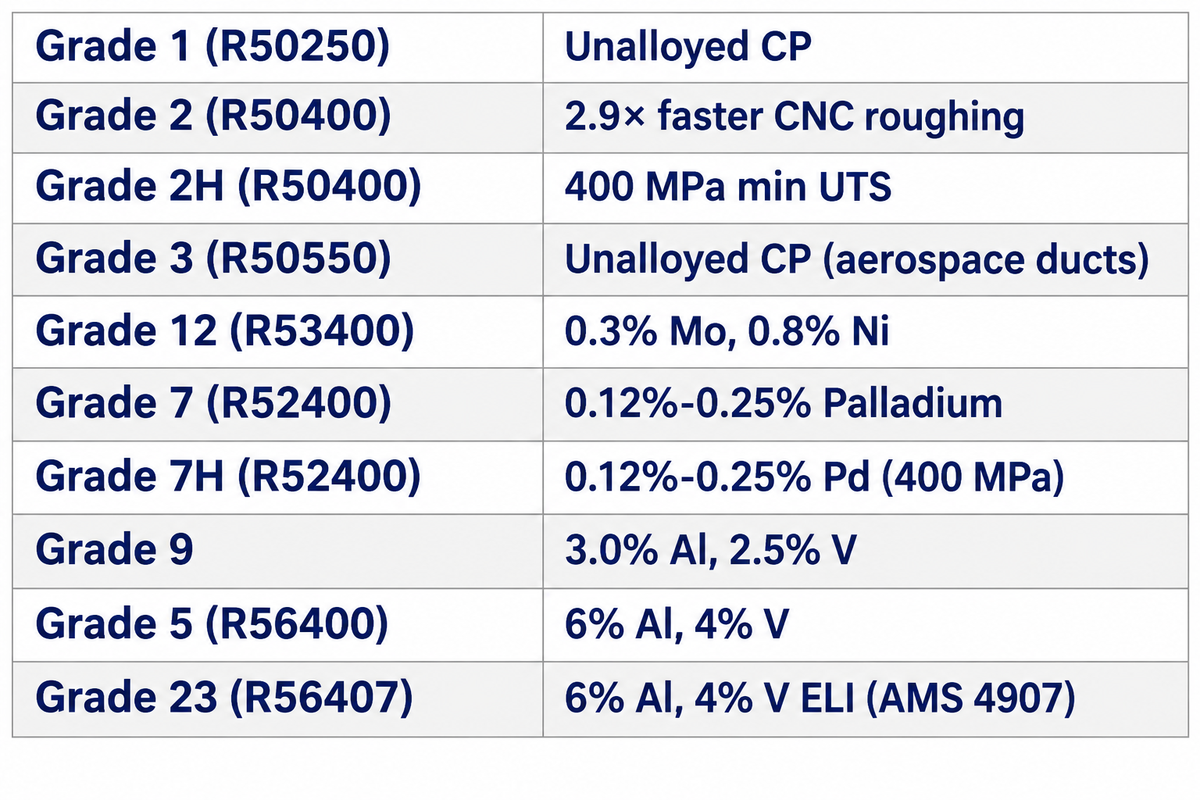
Across industrial grades of titanium, defaulting to Grade 5 (Ti-6Al-4V) on every engineering drawing can unnecessarily increase part cost. Commercially pure Grade 2 (UNS R50400) avoids costly master alloys and lowers the price of titanium alloy billets. It also forms easier at lower press loads and cuts far faster than alpha-beta Grade 5 (UNS R56400).
Makino machining trials show CNC roughing speeds drop from 145 m/min in CP Grade 2 to 50 m/min in Ti-6Al-4V. That equals a 2.9× slower material removal rate. Adding 6% aluminium and 4% vanadium creates an alloy mixture of titanium that lifts tensile strength from ~434 MPa in pure titanium up to 900–950 MPa at 36 HRC hardness. Hot strength increases forging energy, roll passes and spindle hours.
Corrosion-resistant alloy grades have gone up further still. Under ASTM B265-25, Grade 7 contains 0.12%-0.25% palladium (a precious metal) added to unalloyed titanium for hot reducing acids. For moderate brine or acid duty, MatWeb alloy records show Grade 12 (0.3% molybdenum, 0.8% nickel) prevents crevice corrosion without palladium pricing. Compare exact grade rules in our ASTM B265 titanium plate standard guide or test options in the TiAlloy grade selector.
| Grade Tier & Alloy Class (UNS) | Key Alloying Elements | Relative Cost Driver | Best-Fit Service Boundary |
|---|---|---|---|
| Unalloyed CP — Grade 1 (R50250) | Unalloyed CP titanium | Base CP tier (maximum ductility) | Deep-drawn heat exchanger plates and cladding liners |
| Unalloyed CP — Grade 2 (R50400) | Unalloyed CP titanium | Lowest standard stock cost; 2.9× faster CNC roughing than Gr. 5 | Seawater piping, chemical tanks, marine condensers |
| CP Elevated UTS — Grade 2H (R50400) | Unalloyed CP (400 MPa min UTS) | Same chemistry as Grade 2 with certified 400 MPa tension check | ASME pressure vessels needing Grade 2 weldability |
| CP Medium-UTS — Grade 3 (R50550) | Unalloyed CP titanium | Moderate forming force above Grade 2; zero precious metals | Aerospace ducts and chemical shell baffle plates |
| Low-Alloy Mild — Grade 12 (R53400) | 0.3% Mo, 0.8% Ni | Moderate Ni-Mo surcharge well below Pd alloys | Hot brines and moderate reducing acid streams |
| Pd-Stabilized CP — Grade 7 (R52400) | 0.12%–0.25% Palladium | Precious metal Pd surcharge per melt heat | Aggressive reducing acids & high-temp crevice duty |
| Pd Elevated UTS — Grade 7H (R52400) | 0.12%–0.25% Pd (400 MPa min UTS) | Pd surcharge plus higher 400 MPa pressure certification | High-temperature acid pressure vessels |
| Lean Tube Alloy — Grade 9 | 3.0% Al, 2.5% V | Cold-formable alloy tier between Grade 2 and Grade 5 | Hydraulic tubing and thin aerospace pressure lines |
| Alpha-Beta Structural — Grade 5 (R56400) | 6% Al, 4% V | Al-V master alloy + slower hot working & CNC speed | Aerospace brackets, high-stress fasteners, structural hubs |
| Surgical ELI Tier — Grade 23 (R56407) | 6% Al, 4% V ELI (AMS 4907) | Strict ELI oxygen cap & premium sponge premium over Gr. 5 | Surgical bone screws, implants & fracture-critical cryo parts |
Why Machining Titanium Parts Multiplies Cost Beyond Raw Stock
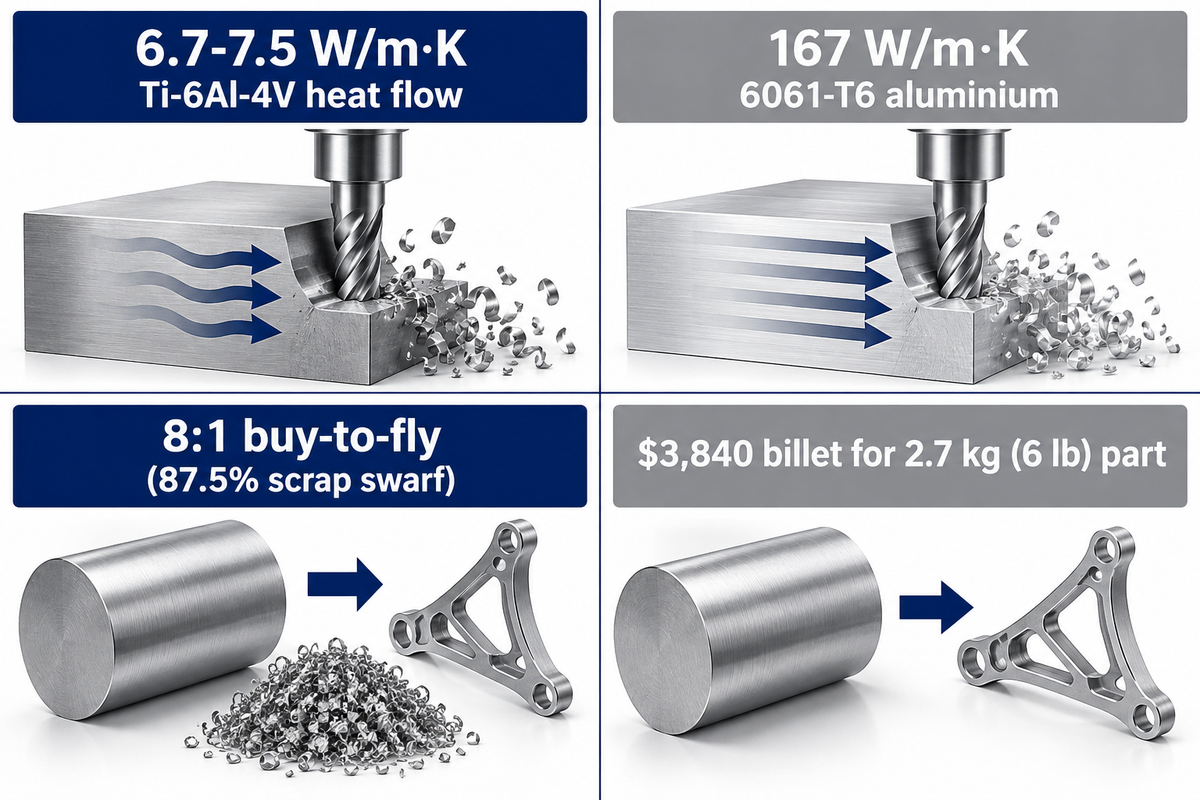
Peer-reviewed milling research in Procedia CIRP confirms that raw metal extraction is only a small fraction of finished CNC titanium part cost. Slow cutting feeds, rapid carbide insert wear, and high-pressure coolant requirements multiply machining hours five to ten times beyond aluminium.
Aerospace pocketed parts suffer steep buy-to-fly material losses. An 8:1 buy-to-fly ratio turns 87.5% of forged billet mass into scrap swarf. At the low end of Criterion Precision’s $80–$110/lb bar benchmark ($80/lb), machining one 2.7 kg (6 lb) finished bracket consumes 21.8 kg (48 lb) of starting billet. That puts raw billet spend at $3,840 before any spindle hour runs, leaving 19.1 kg (42 lb) of low-value chips.
Fabrication costs are pushed up by welding as well. Hot titanium above ~400 °C absorbs oxygen and nitrogen from air within seconds, turning welds brittle. Shops must build custom trailing argon gas cups, backing bars, or sealed purge chambers; see our titanium welding shielding guide for purge setup rules. Our titanium welding shielding guide covers purge setup rules.
Why Is Titanium Hard to Machine Compared to Stainless Steel?
Thermal properties of titanium make Grade 5 much harder to machine than stainless steel. Specifically, Ti-6Al-4V conducts heat at just 6.7–7.5 W/m·K (Ti-6Al-4V properties). That’s less than half of 304 stainless steel (16.2 W/m·K) and 25 times below 6061-T6 aluminium (167 W/m·K). Heat stays trapped right at the tool nose instead of flowing out with chips, burning through coated carbide inserts.
Low elastic stiffness worsens chatter. Young’s modulus for Grade 5 is 104–113.8 GPa, nearly half that of steel (~200 GPa), so thin walls flex away from the cutter and spring back. Shops therefore hold carbide speeds around 45–100 m/min—versus 300–1,800 m/min for aluminium—and run 70–80 bar (~1,015–1,160 psi) through-insert coolant to extend tool life over 2.5×.
Is Titanium Cheaper Than Stainless Steel or Aluminum Over Its Lifecycle?
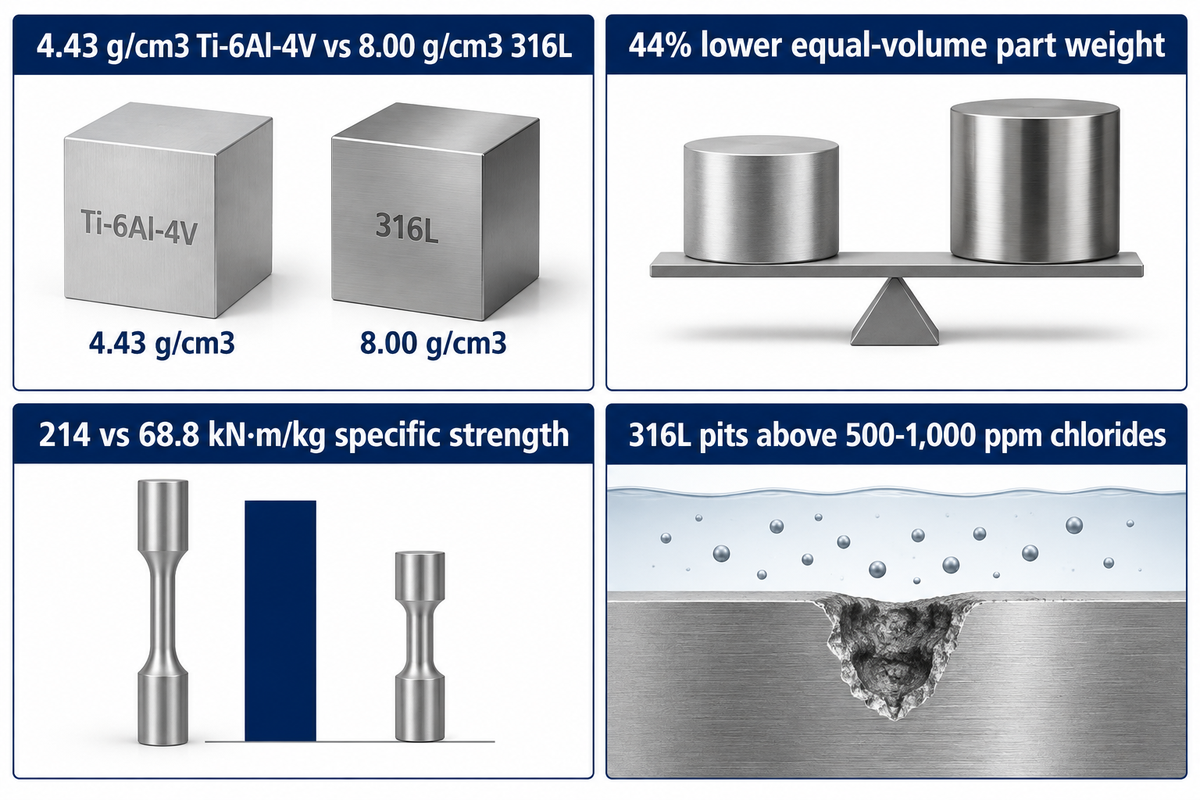
Using titanium is justified by engineers despite its high cost because a high strength to weight ratio or zero chloride corrosion prevents costly shutdowns. Titanium is also valued across the aerospace industry and subsea hardware because its high strength and corrosion resistance slash replacement cycles. Judging any component made from titanium purely per ton or per kilogram ignores equal-volume density math.
Low density shrinks mass on every cubic centimeter ordered. Pure titanium weighs 4.502 g/cm3 and Ti-6Al-4V weighs 4.43 g/cm3. By contrast, 316L stainless weighs 8.00 g/cm3 and 6061-T6 aluminium weighs 2.70 g/cm3 (2.81 g/cm3 for 7075). Even though brushed titanium looks visually similar to stainless steel in corrosive plants, matching part volume cuts weight ~44% compared with 316L stainless steel. Meanwhile, Grade 5 hits ~214 kN·m/kg specific strength versus 68.8 kN·m/kg for annealed 316 stainless and 115 kN·m/kg for 6061-T6 aluminium.
Seawater and process brines bare the true cost floor for stainless steel. An Eng-Tips corrosion engineering discussion reports pitting in 316/316L above 1,000 ppm of chlorides, and even above 500 ppm under warm conditions or below pH 7. One 316 seawater condenser in a power plant developed thousands of leaks within one week after its ball-cleaning system paused during shutdown. Compare equal-volume weights and chloride limits with our titanium weight comparator and titanium vs. stainless steel corrosion guide.
| Material Option | Density / Specific Strength | Distributor Bar & Cycle Index | Equal Volume Mass (1,000 cm3) | When This Alloy Wins on Lifecycle Cost |
|---|---|---|---|---|
| Aluminium 6061-T6 | 2.70 g/cm3 | 115 kN·m/kg | ~$11–$14/lb ground | 1× baseline cycle | 2.70 kg | Low-temp housings below ~150 °C in fresh air or oil |
| 316 Stainless Steel | 8.00 g/cm3 | 68.8 kN·m/kg | ~$64–$70/lb ground | 3×–4× cycle time | 8.00 kg | Stationary fluid fittings < 500 ppm Cl- below 60 °C |
| CP Titanium Grade 2 | 4.502 g/cm3 | ~76 kN·m/kg | Lower alloy cost than Gr. 5 | 2.9× faster roughing vs. Gr. 5 | 4.50 kg | Seawater heat exchangers > 1,000 ppm Cl-, zero retubing downtime |
| Ti-6Al-4V Grade 5 | 4.43 g/cm3 | 214 kN·m/kg | ~$77–$110/lb ground | 5×–10× cycle time | 4.43 kg | High-payload aerospace, sub-sea high-stress fasteners, up to ~400 °C |
Worked math note: Equal 1,000 cm3 volume multiplies density directly to mass. Ground distributor stock prices (Criterion Precision) exclude large volume mill contract rebates; request project quotes for mill plate runs.
Titanium Scrap Recycling Limits and Certification Overheads
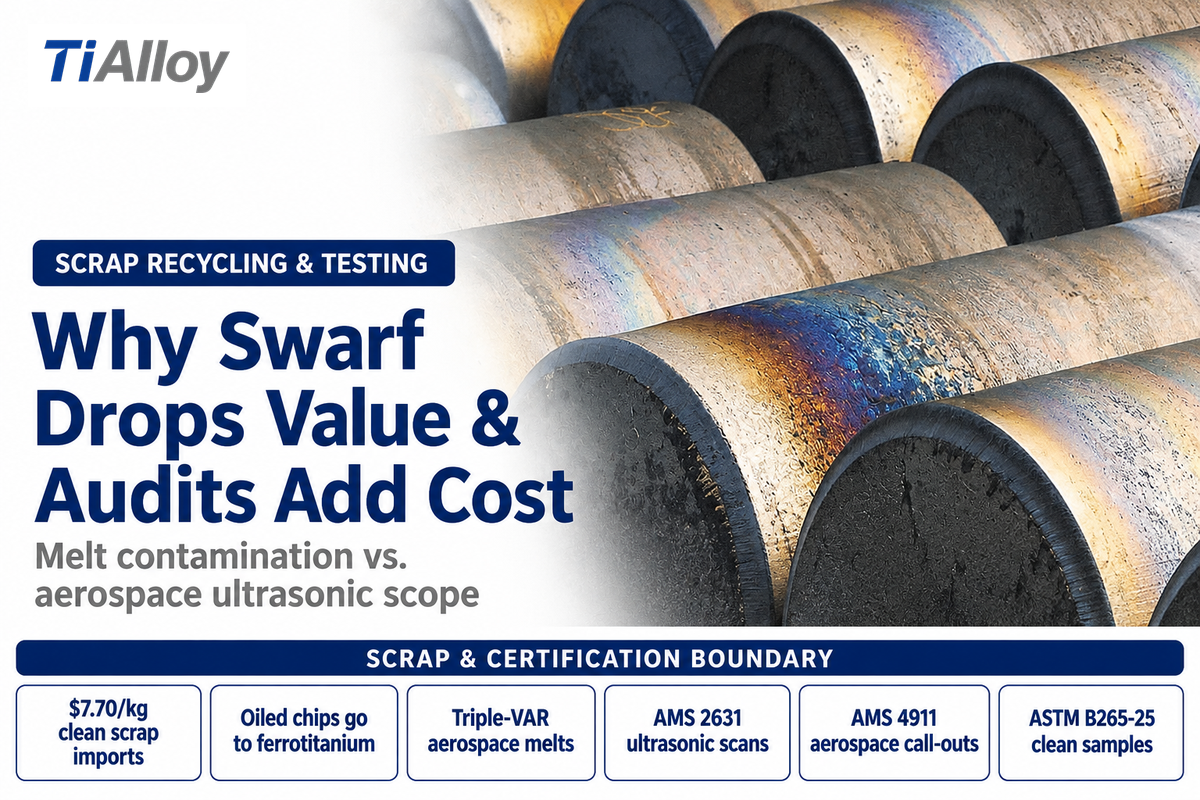
Machined titanium turnings recover almost nothing compared with ground bar cost because cutting oil, oxidation, and tungsten-carbide fragments ruin melt chemistry. On Practical Machinist, machinists report scrap yards pay hardly anything—or refuse loose turnings due to fire liability. Clean, segregated, solid scrap imports averaged $7.70/kg through July 2025 (USGS MCS 2026).
Another large price divide comes from testing tiers. After the 1989 DC-10 crash was traced to a hard-alpha defect in a double-melted titanium compressor disc, aviation buyers required triple-VAR melting (around 4,000 A @ 480 V continuous) and AMS 2631 ultrasonic scans on stock over 12.7 mm thick. Industrial tank buyers who imitate aerospace AMS 4911 and AMS 2631 call-outs for static vessels pay heavy inspection premia unnecessarily.
Can Titanium Machining Chips Be Recycled Back Into Aerospace Ingots?
No, unprocessed CNC titanium chips cannot enter aerospace rotating-grade ingots directly. One iron shaving or broken carbide tip creates fatal inclusions in a VAR electrode. Therefore, most machine-shop swarf goes into steel making ferrotitanium additive instead of primary remelt.
Even basic lab tests require a lot of attention to detail. ASTM B265-25 warns mills to collect chemical samples dust-free because fine titanium particles oxidize rapidly and skew the assays for oxygen, nitrogen and hydrogen. Only clean, dry, heat-segregated solid turnings and bar ends qualify for high-value furnace revert credits.
How Engineers and Buyers Reduce Titanium Component Costs
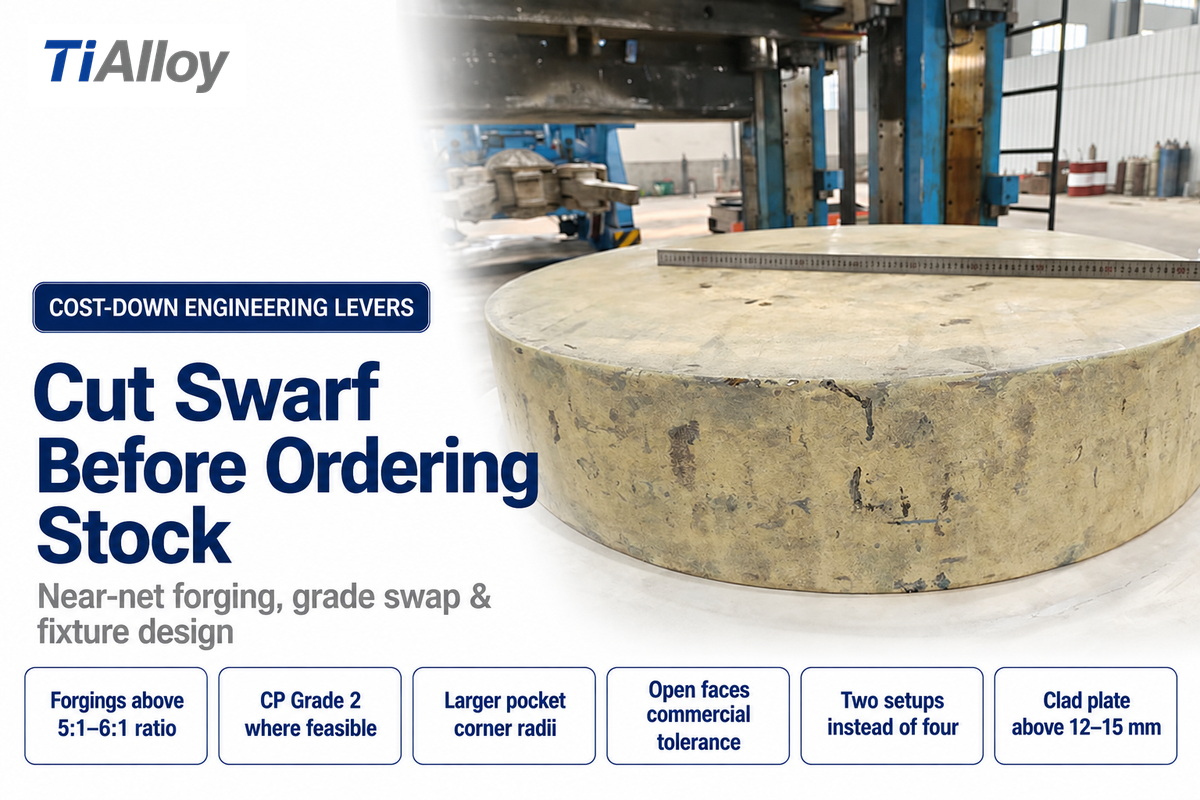
Matching the right form of titanium to your part geometry cuts delivered costs faster than squeezing shop hourly rates. Future sponge economics may improve: University of Utah HAMR research eliminates chlorination and models >50% lower energy at ASTM B299-13 purity, while a 1,400 t/yr non-Kroll US facility targets 2027 commissioning. Today, design-for-manufacturing (DFM) and smart channel buying cut costs immediately.
6 Buy-to-Fly Machining & Spec Traps to Eliminate
- Switch brackets exceeding 5:1–6:1 buy-to-fly ratios from thick solid plate to near-net closed-die forgings.
- Substitute CP Grade 2 (or Grade 2H for pressure vessels) where Grade 5 yield strength is unnecessary, reducing cutting-tool cycle hours and avoiding Al-V alloy surcharges.
- Enlarge internal pocket corner radii so larger, rigid end mills can run faster without tool chatter.
- Keep open faces at commercial machining tolerances and use tight fit tolerances on mating surfaces.
- Orient features to allow two fixture setups instead of four.
- Compare explosion-bonded titanium-clad carbon steel to thicker, solid alloy walls on large chemical reactors.
When Should You Choose Forgings or Clad Plate Instead of Solid Billet?
Go with near-net closed-die forgings over solid billets when pocketed parts push buy-to-fly ratios above 5:1 to 6:1. Upfront die tooling costs are quickly recovered with shorter run times on medium batches, resulting in a substantial reduction in raw material purchases and milling times. For chemical pressure vessels with wall thickness above ~12–15 mm, explosion-bonded titanium-clad carbon steel provides a thin, corrosion-proof Grade 1 or Grade 2 liner on low-cost structural steel.
| Channel | Strengths | Cost & MOQ Trade-offs | Best Fit Order |
|---|---|---|---|
| Primary Melt Mill | Lowest $/kg on full melt heats; custom ingot chemistry | Multi-ton MOQs and multi-month melt scheduling | Large annual OEM plate/billet contracts |
| Master Stocking Distributor | Fast cut-piece dispatch for repair & prototypes | Highest $/lb retail & saw-cut surcharge | Emergency MRO repairs or 1–10 prototype parts |
| MTO Certified Mill (e.g., TiAlloy) | ASTM/AMS cut-to-spec bar & plate with EN 10204 3.1/3.2 | Batch-matched lead times; request formal RFQ by size/grade | Mid-volume industrial & machined OEM runs via certified titanium bar & rod |
Procurement Summary: Choosing Mill Forms, Grades, and Sourcing Channels
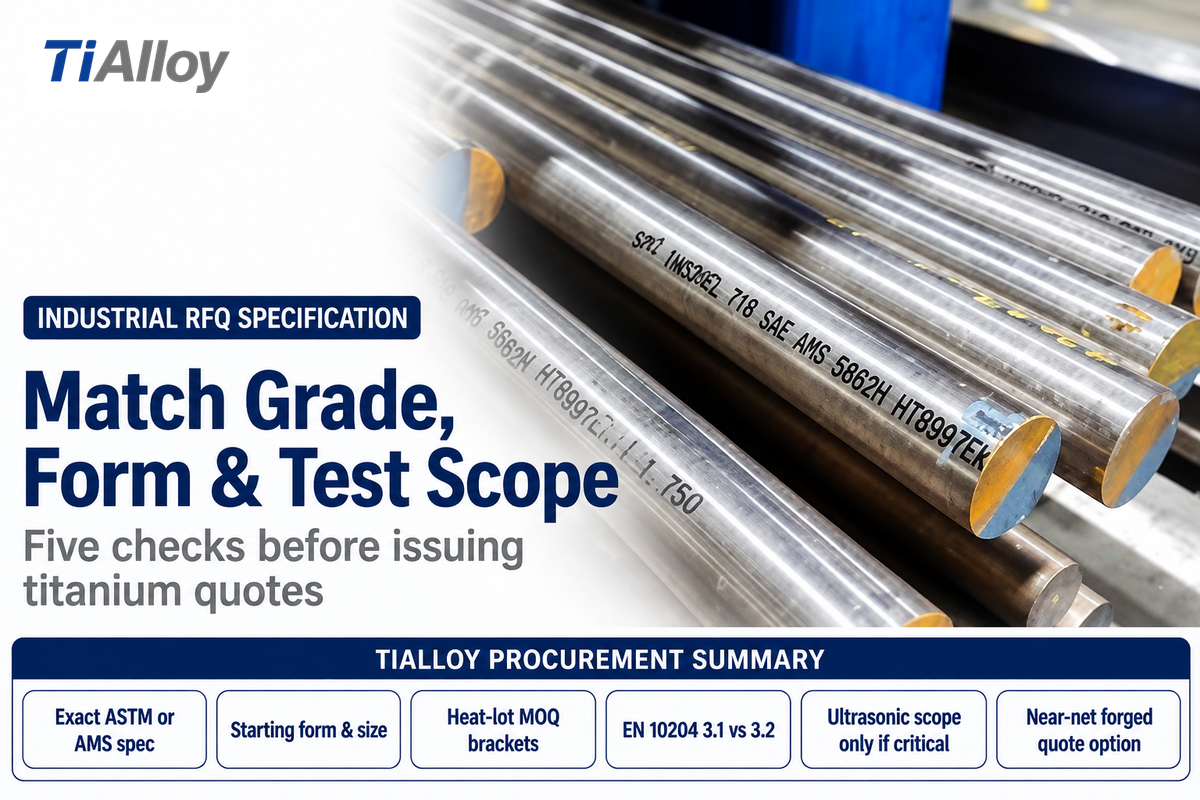
Tight request-for-quotation (RFQ) specifications stop primary mills and machine shops from padding titanium quotes to cover ambiguous inspection risks. Before requesting formal quotes on industrial plate, sheet, or Grade 2 and Grade 5 bar stock, lock these five commercial procurement rules inside every outgoing engineering bid package:
- Name exact material specifications such as ASTM B265-25 or AMS 4911 with exact UNS grade instead of generic “titanium.”
- Clearly list delivery conditions for annealed vs. aged as well as raw machining/cleanup allowances on inquiry.
- Specify EN 10204 3.1 certification for static industrial vessels and reserve AMS 2631 ultrasonic scans for aerospace or rotating duty.
- Separate commercial mill flatness tolerances from final CNC print tolerances in your bid package.
- Consider consolidating multiple parts to share bar diameter or plate thickness to share the cost of ultrasonic tests.
Ready to price exact dimensions without aerospace over-specs? In the TiAlloy Titanium RFQ Builder, enter your drawing requirements for grade-matched quotes.
Frequently Asked Questions
Is titanium more expensive than stainless steel?
Yes, titanium typically costs 5 to 6 times more to produce per kilogram than stainless steel. Precision ground Ti-6Al-4V bar also runs costlier than ground 304/316 bar and takes 2 to 3 times longer to CNC machine. However, titanium’s 4.43–4.502 g/cm3 density cuts equal-volume part weight ~44% versus 8.00 g/cm3 stainless steel, shrinking volume cost differences in seawater duty.
Why is titanium metal not traded on the London Metal Exchange (LME)?
Titanium is not traded on the LME because alloy grades, oxygen caps, and double vs. triple VAR melt routes vary too widely for one standard ingot warrant. Aerospace and medical customers require heat-lot chemical traceability, ultrasonic test verification, and controlled mill tolerances. Standard warehouse warrants can cover bulk, uniform ingots.
Why is Grade 5 titanium (Ti-6Al-4V) more expensive than Grade 2 titanium?
Grade 5 Ti-6Al-4V costs more than commercially pure Grade 2 for three compounding reasons. First, it requires the addition of 6% Al and 4% V master alloys. Second, the alloy containing 6% aluminium and 4% vanadium requires higher forging forces under narrow heat windows, and cuts nearly 2.9 times slower on CNC mills (50 m/min vs. 145 m/min for Grade 2). Unless strength near 900–950 MPa is needed, Grade 2 cuts material and shop cost.
Is titanium more expensive than gold or silver?
No. Commercial titanium sponge and mill bars cost a tiny fraction per kilogram of precious bullion metals such as gold and silver.
What is the cheapest grade of industrial titanium?
Commercially pure Grade 1 and Grade 2 titanium (UNS R50250 and R50400) carry the lowest mill cost because they skip vanadium and palladium additions.
How long is the typical mill lead time for custom titanium plate or bar orders?
Stocked distributor bars ship within days, while custom primary-mill VAR melts, hot-rolled plates, and ultrasonic tested lots take several weeks to a few months. Lead-times are based on the utilization and availability of the melt furnaces, rolling-mill schedules, and testing queues. In order to get a more accurate lead-time, it’s best to provide the grade, condition, dimensions, and the quantity of heat-lot in your RFQ.
Does argon shielding significantly add to titanium welding costs?
Yes, the use of an inert argon shield substantially increases the time and consumables required for titanium welding compared to using stainless steel. Hot titanium above ~400 °C instantly absorbs oxygen and nitrogen from the ambient air, embrittling the weld zone. Shops must build trailing shields, backing gas bars, and purge chambers that consume extra argon and setup labor on every pass.
What inspection documents should accompany an industrial titanium order?
Industrial plate or bar ordered under ASTM B265-25 should ship with an EN 10204 3.1 mill test report. That certificate records heat number, chemical analysis, and mechanical tensile results. Reserve third-party 3.2 witness and AMS 2631 ultrasonic inspection for critical rotating hardware.
Our Perspective
This cost breakdown examines why titanium is so expensive across Kroll sponge refining, VAR melting, ASTM mill tolerances, and CNC machining realities using USGS 2026 data and peer-reviewed metallurgy sources. Equal-volume density calculations and 8:1 buy-to-fly examples are directly from public physical constants and not from private factory ledgers to prevent over-specification. The analysis is reviewed by the TiAlloy technical team.
References & Sources
- Titanium Statistics and Information (Mineral Commodity Summaries 2026) U.S. Geological Survey (USGS)
- FFC-Cambridge Process vs. Kroll Energy & Fabrication Cost Share (PMC6956875) National Institutes of Health / JOM
- A New Time for Titanium: Oxygen Embrittlement & Production Cost UC Berkeley Engineering
- HAMR Non-Kroll Titanium Powder Metallurgy Process University of Utah
- Titanium Extraction Chemistry, Batch Kinetics & FFC Limits Royal Society of Chemistry
- ASTM B265-25 Standard Specification for Titanium Strip, Sheet, and Plate ASTM International
- Patent US10190191B2: Direct Titanium Reduction Cost Breakdown USPTO via Google Patents
- Milling Cost Modelling of Difficult-to-Machine Titanium Alloy Ti-6Al-4V Procedia CIRP / ScienceDirect
- The Story of Titanium (RAND MG789 Abundance & Learning Curve) Construction Physics
- Titanium Price Index (2025–2026 USD/kg Tracking) BusinessAnalytiQ
- Overview of Titanium & Grade 12 / Grade 5 Properties MatWeb Material Property Data
- Ti-6Al-4V Machining Chip Recycling & Triple-VAR Melt Practice Practical Machinist Forum
- Chloride Corrosion Pitting on 316 Stainless vs. Marine Titanium Eng-Tips Engineering Forum