Get in Touch with TiAlloy Company

Grade 2 Titanium Corrosion Resistance: Limits, Chemical Compatibility, and Material Selection

While Grade 2 titanium corrosion resistance is generally superb, “corrosion resistant” isn’t a complete service specification. The better engineering question is narrower. What’s the composition of the fluid? What’s the temperature and velocity of the fluid? What’s the level of oxygen? Where does the design create a stagnant crevice?
Corrosive covers many different fluids; therefore, the review of service envelope separates oxidizing and reducing environments, as well as chloride and fluoride conditions, before a grade is assigned.
When considering titanium alloy selection, describe the conditions as precisely as possible. Titanium Grade 2 is one of the commercially pure titanium grades; Grade 1, Grade 3, Grade 4, Grade 7, Grade 9, Grade 12, and Grade 23 possess different combinations of chemical composition and mechanical properties. Used titanium alloys also occur in chemical processing, industrial applications, aerospace industry, and medical implants. The required yield strength, tensile strength, weldability, and the service environment vary by case and affect the durability of titanium parts. The guide treats these differences as a titanium alloy selection question, and describes them qualitatively by service conditions.
This guide explains the passive-film mechanism in commercially pure Grade 2 titanium, identifies the environments in which it excels, and indicates where another grade or alloy should be considered. This guide concludes with a service-envelope check list for quick reference and quotation. This is a list of documents the buyer should be requesting.
What Gives Grade 2 Titanium Its Corrosion Resistance?
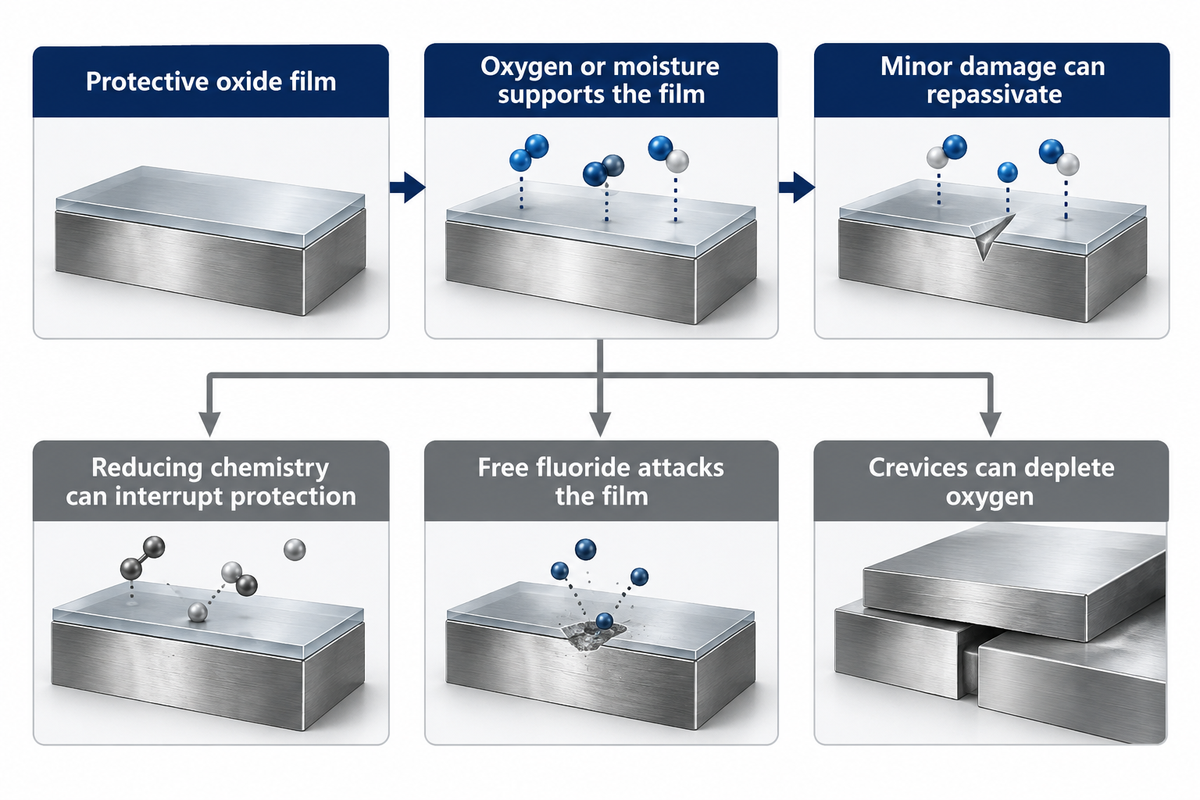
Grade 2 is a commercially pure titanium grade. Its protection comes from a thin, adherent, titanium oxide film, primarily titanium dioxide. This film quickly forms on a clean surface when it comes in contact with air or with water that contains dissolved oxygen. If only a small area is disturbed, the film can reform, as long as the chemistry is still in favor of passivation. That’s why Grade 2 often outperforms carbon steel and a lot of stainless steels in wet chloride or in marine service.
Evidence check: The comments in this section are supported by a reference on titanium passive films, titanium passive film reference.
The film is a surface condition and not a promise that the bulk metal is immune to all forms of attack, including cracking and crevice corrosion. There are several factors such as a reducing environment, the presence of free fluoride, oxygen depletion, contamination or a tight stagnant geometry that can stop repassivation. Therefore, the corrosion resistance properties of titanium are part of the complete material-and-design system comprising grade, surface, weld condition, fluid, temperature, velocity, and crevice control.
What creates the passive film on Grade 2 titanium?
A stable oxide film forms on titanium in most oxidizing aqueous environments. This is the reason that general corrosion rates can be extremely low, but it’s a barrier that should be respected. The film can dissolve faster than it reforms. Use the film as the starting mechanism for selection, and then verify the actual service envelope.
How Grade 2 Titanium Performs in Seawater and Chloride Service
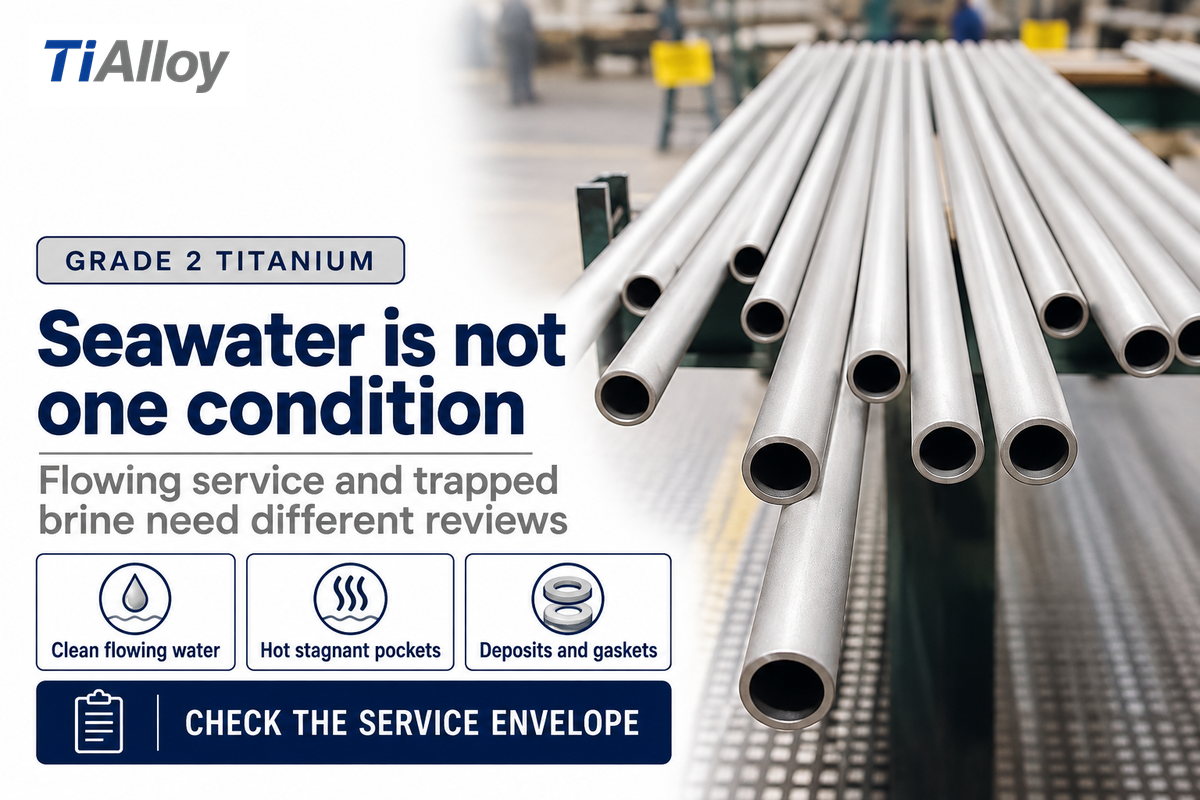
Seawater, marine atmospheres, and many neutral chloride solutions are common reasons engineers consider Grade 2 for high corrosion resistance. In clean, flowing service the passive film is generally stable, and titanium is valued for its resistance to general corrosion, pitting, and chloride stress-corrosion cracking. Heat-exchanger tubes, condenser components, desalination equipment, and seawater piping are typical examples.
Redox state and dissolved oxygen belong in the service envelope. Deaeration, reducing chemistry, or oxygen depletion can change passivity even when the bulk fluid is described simply as seawater or chloride water.
Evidence check: Total Materia seawater and crevice discussion provides the source context used for this section.
| Service condition | What Grade 2 usually offers | What still needs review |
|---|---|---|
| Neutral seawater, aerated | Strong resistance to general corrosion and chloride attack | Deposits, stagnant pockets, temperature excursions, and galvanic couples |
| Flowing chloride water | Good resistance when the surface stays clean and passivated | Velocity, suspended solids, erosion, and dead legs |
| Hot concentrated brine | Potentially suitable only inside a verified envelope | Crevice temperature, concentration, pH, oxygen depletion, and gasket geometry |
| Wet chlorine or hypochlorite | Often favorable because moisture supports passivation | Dry chlorine, oxidizer concentration, startup and shutdown chemistry |
| Desalination feedwater | Often considered for clean, oxygenated flow | Scale deposits, dosing chemicals, heat-transfer surfaces, and shutdown pockets |
| Chloride cleaning cycle | Can be acceptable after the cleaning chemistry is qualified | Residual cleaner, temperature spike, rinse quality, and trapped solution |
| Marine splash zone | Strong general-corrosion candidate when the surface stays clean | Wet-dry cycling, deposits, crevice details, and dissimilar-metal contact |
| Oxygen-depleted process water | Requires a chemistry-specific review | Redox state, stagnant zones, hydrogen uptake, and microbial deposits |
| High-velocity slurry | Corrosion resistance may remain useful | Particle impingement, erosion, elbows, and velocity profile |
Don’t apply a seawater conclusion to every chloride process. A clean, aerated, flowing stream behaves differently from a hot brine trapped under a gasket. The same nominal chloride percentage can produce a different risk when pH, oxygen, deposits, or temperature changes.
Chemical Environments: Where Grade 2 Titanium Performs Well and Where It Does Not
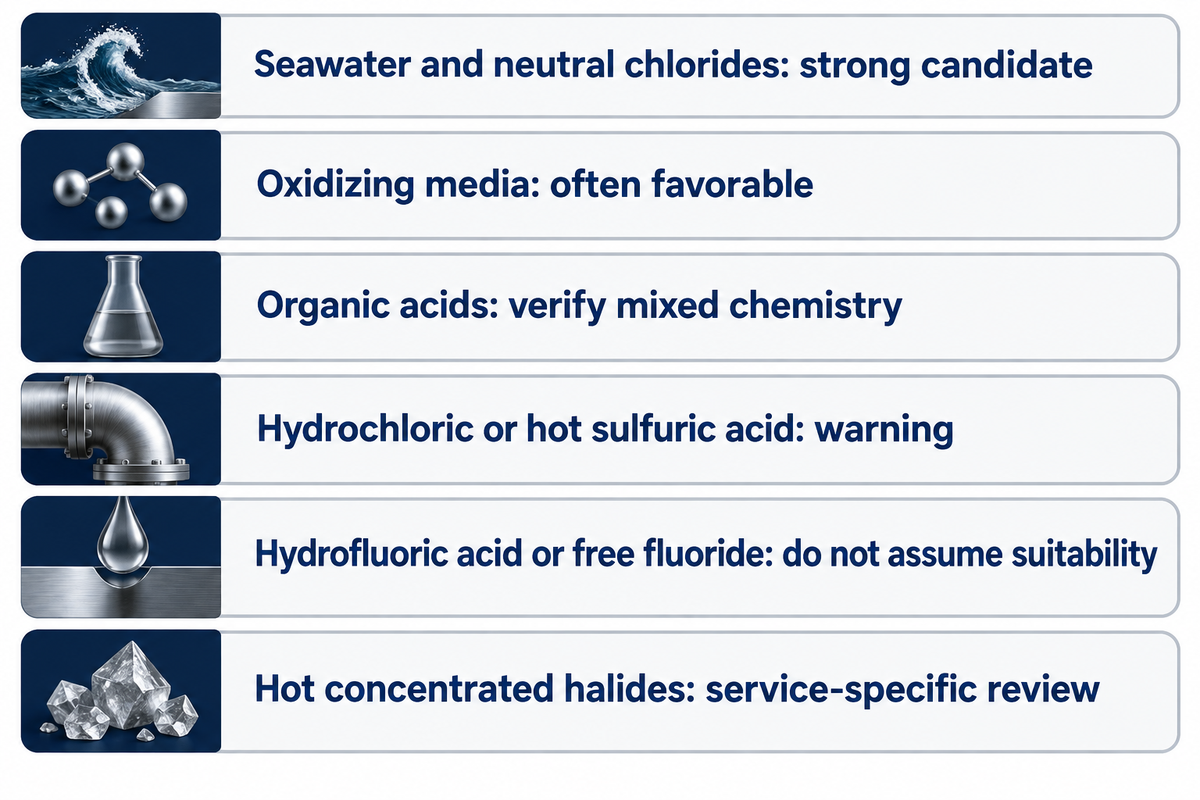
A practical compatibility screen separates environments that support passivation from those that attack the film. The matrix below is a screening tool for a specification discussion, not a substitute for a corrosion test or a qualified alloy handbook.
Evidence check: titanium material-selection limitations reference provides the source context used for this section. For the acid-screening boundaries, see TIMET’s corrosion manual.
Buyer asset: Chemical Compatibility and Boundary Matrix
| Environment | Initial selection signal | Boundary to verify |
|---|---|---|
| Seawater and neutral chlorides | Usually a strong candidate | Hot concentrated pockets, deposits, crevices, and velocity |
| Nitric and other oxidizing media | Often favorable | Concentration, temperature, contaminants, and weld condition |
| Organic acids and many industrial organics | Frequently workable | Water content, halides, temperature, and mixed chemistry |
| Hydrochloric or hot sulfuric acid | Warning condition | Reducing chemistry, dissolved oxygen, inhibitors, and temperature |
| Hydrofluoric acid or free fluoride | Do not assume suitability | Free fluoride, pH, complexing ions, and exact concentration |
| Hot concentrated halides | Requires a service-specific review | Crevice temperature, oxygen depletion, deposits, and concentration |
Some references may cite a single value for a concentration or temperature limit. Treat these as source-specific screening flags. Just because a limit was used in one test setup, doesn’t mean that the same limit can be applied to a different pressure vessel, tube sheet, weld, or cleaning cycle without determining the relevant chemistry and geometry.
Crevice, Galvanic, Erosion, and Hydrogen-Related Failure Boundaries
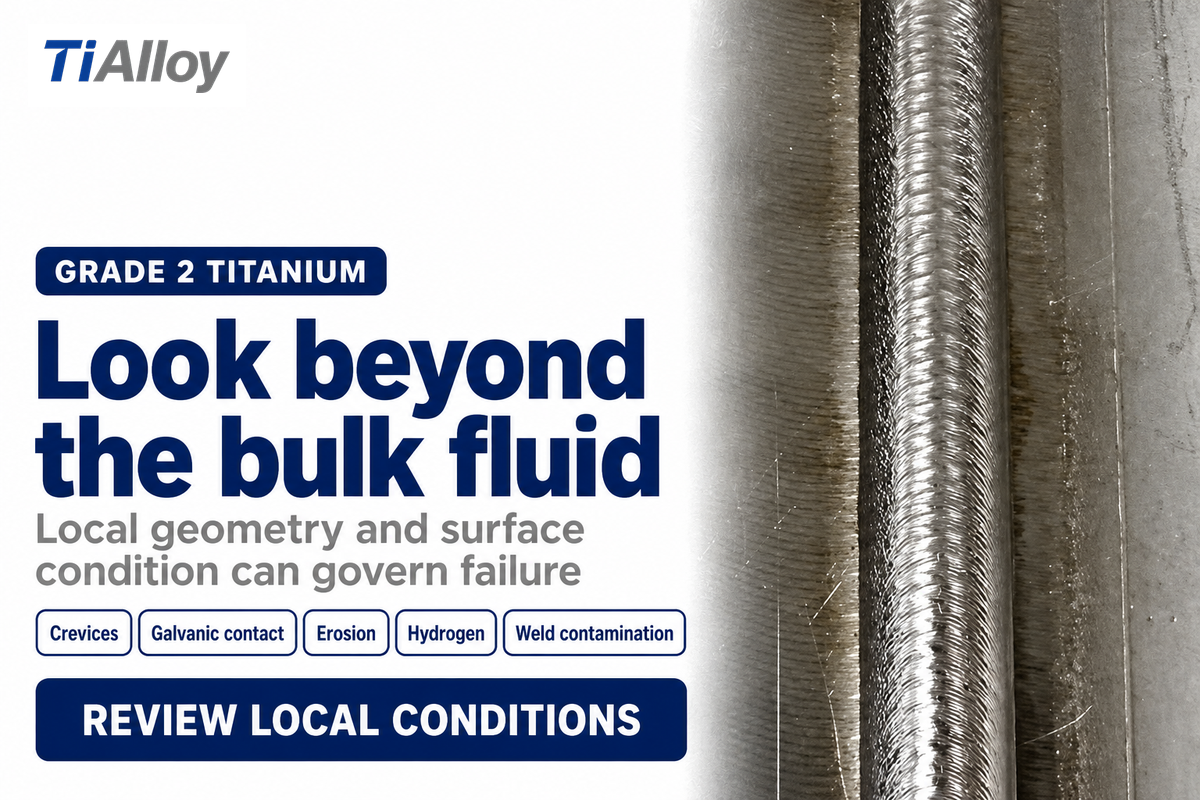
While Grade 2’s general resistance to attack is high, localized risks exist. For example, a gasketed joint, lap joint, or tube sheet can use up the oxygen and concentrate chlorides in a small crevice. The local environment can become more acidic and reducing than the bulk fluid. Therefore, the design of crevices merits the same consideration as alloy design.
Heat transfer limitations, deposits, stagnant regions and crevices can lead to localized chemistry that’s different from the bulk fluid. Consider differential aeration, temperature gradients, and post fabrication contamination rather than using a ‘handbook’ value as a design limit.
Evidence check: The TIMET titanium corrosion reference hosted by the NRC describes the conditions related to the sections written in this paper.
- Crevice corrosion: eliminate stagnant zones by using cleanable or inherently low fluid-retention geometry, and evaluate halide and hot brine services separately.
- Galvanic corrosion: review contact with dissimilar metals, area ratios, insulation and conductivity of the electrolyte.
- Erosion or erosion-corrosion: check flow velocity, suspended solids, impingement, and abrupt changes in flow direction.
- Hydrogen uptake: Consult cathodic protection and reducing high-temperature streams and any process that can charge titanium with hydrogen.
- Weld contamination: include type of shielding, purge quality, heat tint limits and post-weld surface condition; a contaminated weld isn’t the same as a clean parent surface.
Grade 2 vs Grade 5 Titanium: Corrosion, Strength, and Fabrication Trade-offs
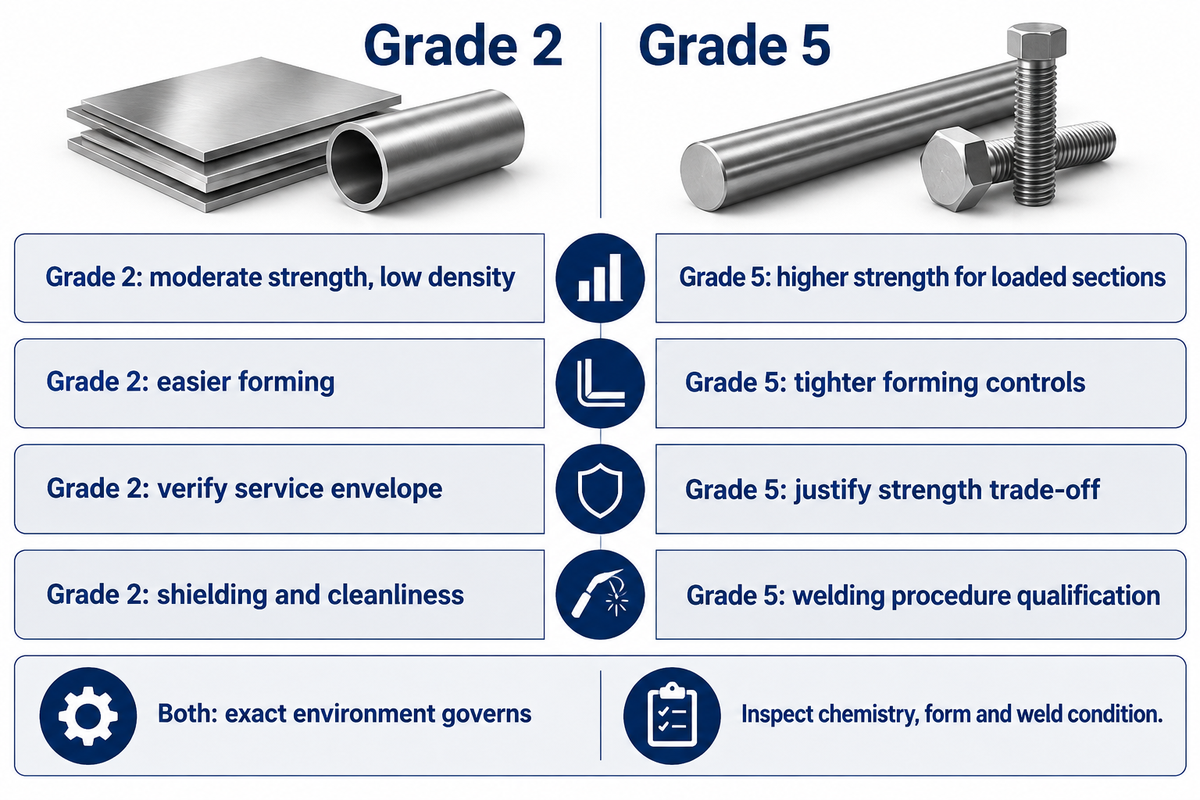
Grade 5 titanium (Ti-6Al-4V) is typically the better choice for strength, though Grade 2 is commercially pure and can be easier to form and weld. If the design is driven by load, fatigue, or section thickness, then Grade 5 can be considered first. If the design is driven by corrosion resistance and good ductility, forming, or welded fabrication in a compatible chemical environment, then Grade 2 is typically the better choice among widely used titanium grades.
The comparison is chemistry- and temperature-bounded: corrosion response, weldability, strength and crevice behavior can change with fabrication state and local service conditions.
Starting the comparison with the application is more productive. Grade 2 is selected for excellent resistance and superior corrosion resistance in wet service, while Grade 5 trades some formability for strength and corrosion resistance in a different design envelope.
Piping systems and chemical industry equipment require a highly resistant surface finish that’s cleanable. Titanium content, the availability of oxygen, and the passive film, ultimately determine the stability of the material. Compared to stainless steel, titanium may provide better corrosion resistance in chloride service, but the phrase ‘titanium is the strongest’ isn’t a selection rule, and the softest grade of titanium isn’t necessarily the correct grade.
Grade 5 tips the balance towards strength, while Grade 2 holds on to the corrosion resistance and ductility profile that usually impacts forming and chemical service. Compare the titanium grades to the actual chemistry, not a blanket statement that one titanium alloy is always better.
Evidence check: Grade 2 corrosion and fabrication overview provides the source context used for this section.
| Decision category | Grade 2 | Grade 5 |
|---|---|---|
| Strength-to-weight | Moderate strength with low density | Higher strength for highly loaded or thinner sections |
| Formability and fabrication | Generally more formable and weld-friendly | Higher strength can make forming and welding controls more demanding |
| Corrosion selection | Strong candidate for many oxidizing chloride and seawater services | Often comparable in broad service, but the exact environment still governs |
| Typical question | Can the grade meet the service and fabrication envelope? | Does the extra strength justify the material and processing trade-off? |
| Load case | Usually adequate when corrosion and forming control the design | Useful when fatigue, load, or section thickness controls |
| Joining route | Weld shielding and clean surface preparation remain essential | Welding procedure qualification deserves closer attention |
| Cold forming | Often the easier choice for formed parts | May require more force and tighter process control |
| Inspection focus | Trace chemistry, form, weld condition, and surface cleanliness | Trace strength condition, heat treatment, weld condition, and fatigue assumptions |
| Procurement decision | Choose when the verified service envelope and fabrication route fit | Choose when the strength benefit pays for the added fabrication trade-offs |
Grade 2 Titanium vs 316 Stainless Steel and Nickel Alloys
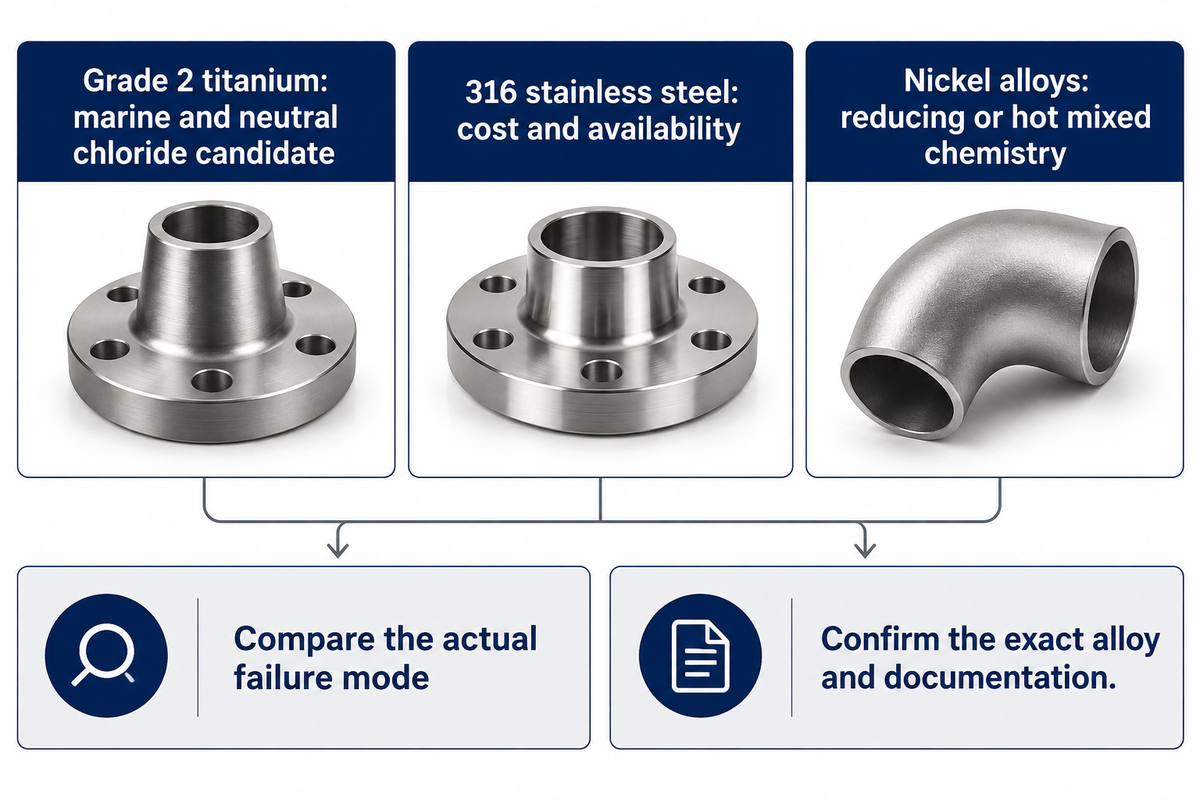
Compare materials against the actual failure mode instead of ranking them in the abstract. Grade 2 is attractive where seawater, chloride exposure, low weight, and long service life matter. 316 stainless steel can win on purchase cost, local availability, hardness, or a less aggressive dry service. Nickel alloys become more relevant when the stream is strongly reducing, hot, or chemically mixed in a way that threatens titanium’s passive film.
Evidence check: AZoM titanium materials reference provides the source context used for this section.
Buyer Asset: Grade 2 / Grade 5 / Stainless / Nickel Selection Table
| Selection question | Grade 2 titanium | 316 stainless steel | Nickel alloy |
|---|---|---|---|
| Marine and neutral chloride service | Often a strong candidate | May need pitting and crevice review | Usually technically capable but may be unnecessary |
| Reducing acids or hot mixed chemistry | Warning condition | Can also be unsuitable | Often worth screening first |
| Weight and formability | Low density and good formability | Widely available, heavier | Usually heavier and more expensive |
| Procurement | Confirm grade, form, standard, and traceability | Broad market availability | Strong documentation is essential because grades differ substantially |
A Buyer’s Service-Envelope Checklist for Grade 2 Titanium
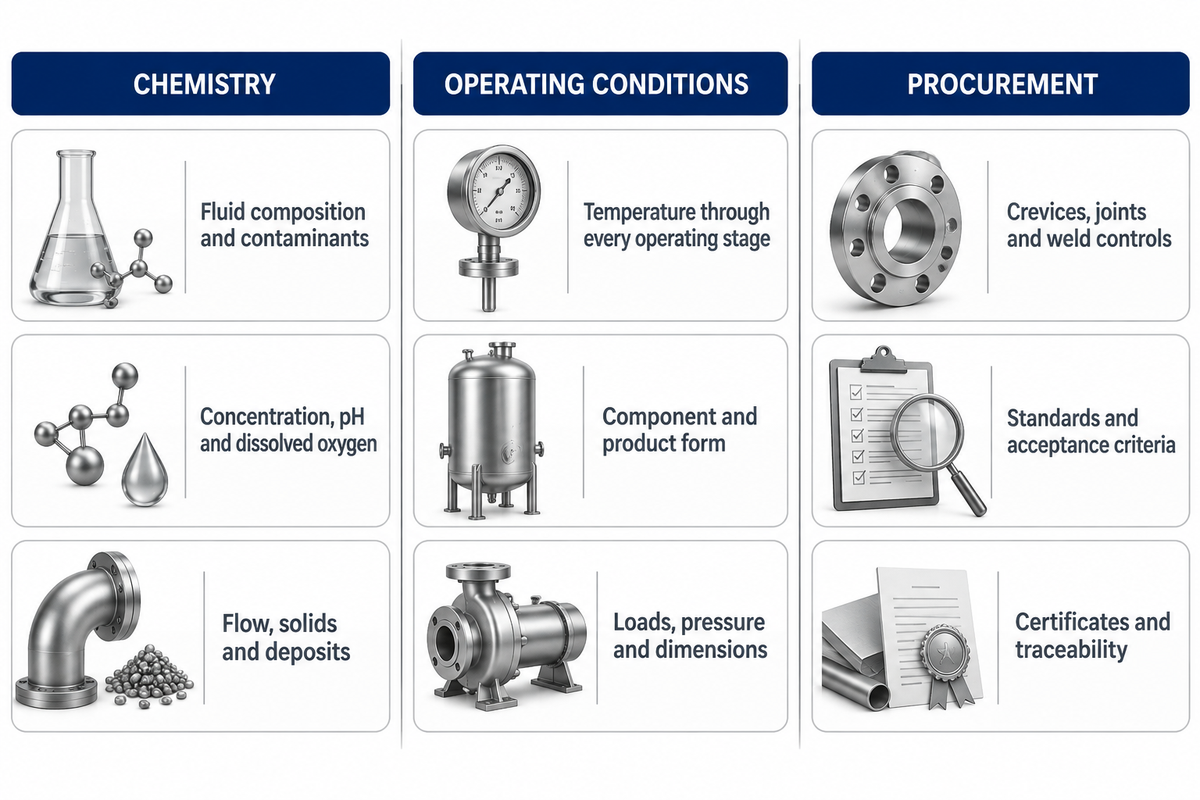
Buyer asset: Service-Envelope Checklist
Before soliciting a quote, create a checklist of the factors that determine if passivation is stable. This checklist allows a broad corrosion question to be converted to a material decision that’s auditable.
- Complete composition of all process fluids including chlorides, fluorides, oxidizers, reducing species, sulfur compounds, impurities, and moisture.
- Normal, minimum, maximum, startup, shutdown, cleaning, upset, and transient temperatures.
- Concentration ranges, pH, dissolved oxygen, aeration or degassing, and any chlorination cycles.
- Velocity of fluids, turbulence, suspended solids, impingement, dead legs, deposits, and allowable erosion risk.
- Component type and product form: plate, sheet, tube, pipe, bar, forging, lining, cladding construction or welded assembly.
- Things like loads, pressure, vacuum, fatigue, vibration, wall thickness, thermal cycling, dimensional limits, etc.
- Crevice geometry, gasket materials, dissimilar metal contact, weld shielding, purge, surface finish, and contamination controls.
- Applicable ASTM, ASME, or EN requirements, heat treatment, testing scope, inspection points, and acceptance criteria.
- Required documents: Material test certificate, Heat or Lot traceability, dimensional report, surface inspection, PMI, ultrasonic test and any project specific corrosion test.
Make the inquiry measurable without making these fields design limits. Record 4 temperature values in °C, 2 concentration values in %, 2 flow velocities in m/s, 2 pressure values in bar, 2 wall-thickness values in mm, 2 surface-finish values in μm, 1 test pressure in MPa, 1 cleaning hold time in hr, 2 shutdown times in min. These are documentation slots for the service envelope; they aren’t universal Grade 2 acceptance thresholds.
The TiAlloy supply chain covers titanium and titanium alloys in plate/sheet, pipe/tube, and bar forms, and includes inspection records, dimensional checks, surface reviews, batch traceability, and export packing per customer order. Refer to the Grade 2 titanium product specification, and state the service envelope in the inquiry.
Forms, Standards, Testing, and Traceability to Specify
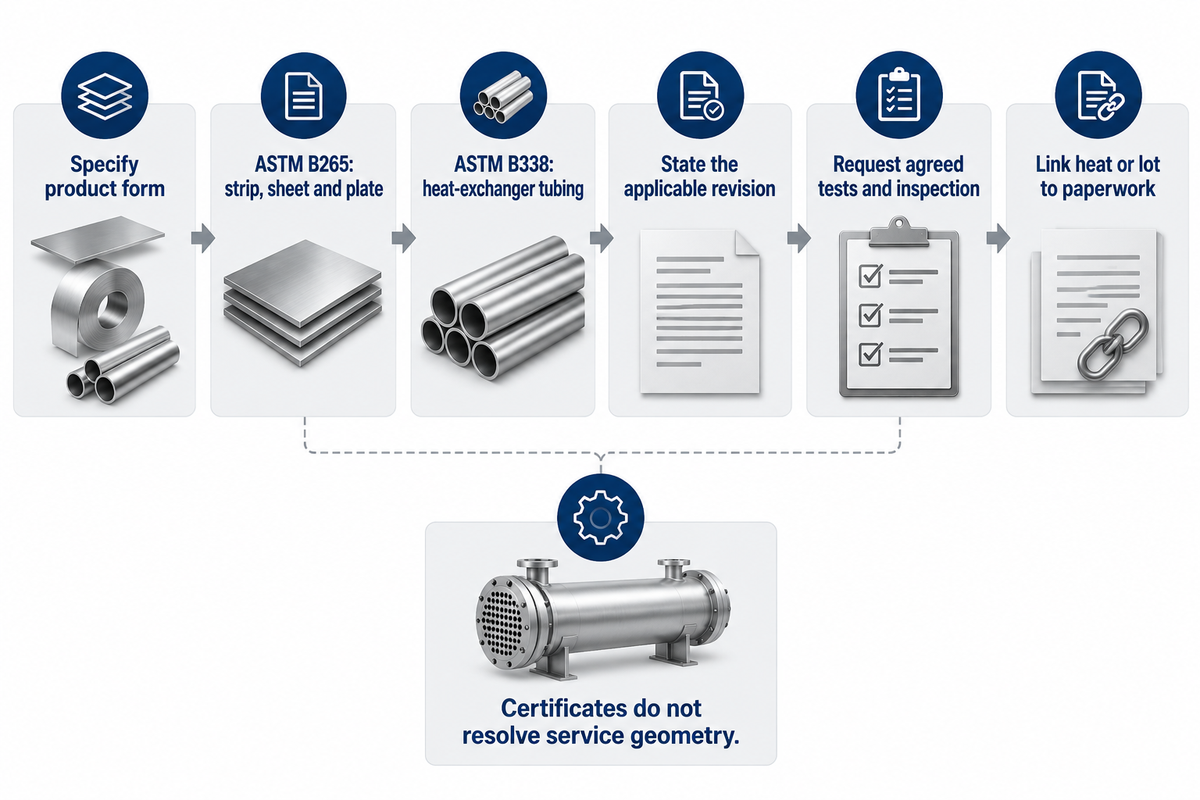
“Grade 2 titanium” is only one line in a purchase order. The form and governing standard determine which tests and dimensions must be reported. A sound request identifies the product form, specification revision, dimensions and tolerances, heat treatment condition, surface quality, and any additional testing.
Evidence check: For context, see the ASTM specification for titanium casting. For annealed flat products, see ASTM B265 for titanium strip, sheet and plate.
- Product form: Form may include plate/sheet, tube, pipe, bar, rod, forging or an assembly of fabricated components. ASTM B338 addresses titanium tubing for condensers, evaporators and heat exchangers.
- Standards: the applicable ASTM, ASME, or EN product requirement and revision stated in the order.
- Certificates: may include MTC/MTR and, as required, EN 10204 3.1 or an agreed independent inspection.
- Verification: chemistry, mechanical properties, dimensional checks, surface review, PMI, UT, corrosion testing, as justified.
- Traceability: link the heat or lot number on the material with the paperwork via packing and shipment documents.
A certificate can verify Grade 2 chemistry and mechanical results while the process design still creates a hot, oxygen-depleted crevice.
FAQ: Grade 2 Titanium Corrosion Resistance
What gives Grade 2 titanium its corrosion resistance?
Titanium forms a passive film quickly in air and can reform the film after minor damage. Stabilization is dependent on chemistry, temperature, velocity, surface condition and geometry, and the presence of reducing agents. Always ensure the grade is tied to the actual chemistry and conditions.
Evidence check: Grade 2 technical FAQ provides the context used for this section.
Is Grade 2 titanium suitable for seawater and chloride service?
It’s a good candidate for many services involving neutral chloride and marine environments. It’s a good candidate especially when the fluid is in motion and aerated. Review gasketed crevices, dead legs, and deposits. A seawater line shouldn’t always be treated as a safe crevice. Use the complete service envelope for a review.
Does Grade 2 titanium resist every acid?
No. Oxidizing acids are generally OK, while reducing acids and fluoride-bearing solutions are warning conditions. Hydrofluoric acid and free fluoride attack the oxide film directly. Hydrochloric acid and sulfuric acid attack depends on factors such as concentration, temperature, dissolved oxygen, inhibitors and contaminants. Exact limitations are source and geometry dependent, so don’t just take a published threshold value and apply it to a different process. Corrosion assessments are often needed for severe acid service.
How does Grade 2 compare with Grade 5 titanium?
Grade 5 provides higher strength; Grade 2 is generally more formable and easier to weld. Both require an environment-specific corrosion review. Choose Grade 2 when the service and fabrication envelope favor commercially pure titanium, and the added strength of Grade 5 isn’t needed. Choose Grade 5 when loads, fatigue, section thickness or weight savings dominate. Compare the grades against the same chemistry, temperature and product form.
What documents should a buyer request?
State the product form and governing ASTM, ASME, or EN requirement, then request an MTC/MTR with chemistry and mechanical results, heat or lot traceability, dimensional and surface checks, and any agreed PMI or ultrasonic testing. Add a project-specific corrosion test when the service is severe or the chemistry is unusual. The document package proves what arrived; it does not replace review of the operating envelope and component design.
References & Sources
This article combines the client’s public company and product pages with public technical references, including TIMET’s titanium corrosion reference, Corrosion Materials’ Grade 2 overview, and Total Materia’s corrosion discussion. It includes TIMET’s corrosion reference hosted by the Nuclear Regulatory Commission; a corrosion materials article on Grade 2; and corrosion discussion by Total Materia. Public sources describe general behavior; they do not represent a batch-specific TiAlloy corrosion test.
WHY WE PUBLISH
About TiAlloy
TiAlloy supplies titanium, stainless steel, nickel alloy and clad plate for specification-driven industrial orders. Our technical guides are written to help buyers align product form, governing standard, test scope and release documents before a quotation is compared.
01Melt & formPlate, sheet, pipe, tube, bar, wire and forgings
02ProcessHeat treatment, finishing, inspection and export packing
03VerifyEN 10204 Type 3.1 certificate and order documents