Get in Touch with TiAlloy Company


Yes, stainless steel can rust. Salt, trapped deposits, unsuitable cleaners and fabrication damage can defeat its corrosion resistance. Orange spots may also come from carbon steel particles sitting on otherwise sound stainless. The useful question after “does stainless steel rust?” is what remains beneath the stain and why that location became wet, dirty or contaminated.
A smooth surface after cleaning suggests a different repair from a cavity that remains in the metal. Start with that distinction before ordering stronger chemicals or replacing every part with 316.
Why stainless steel can rust
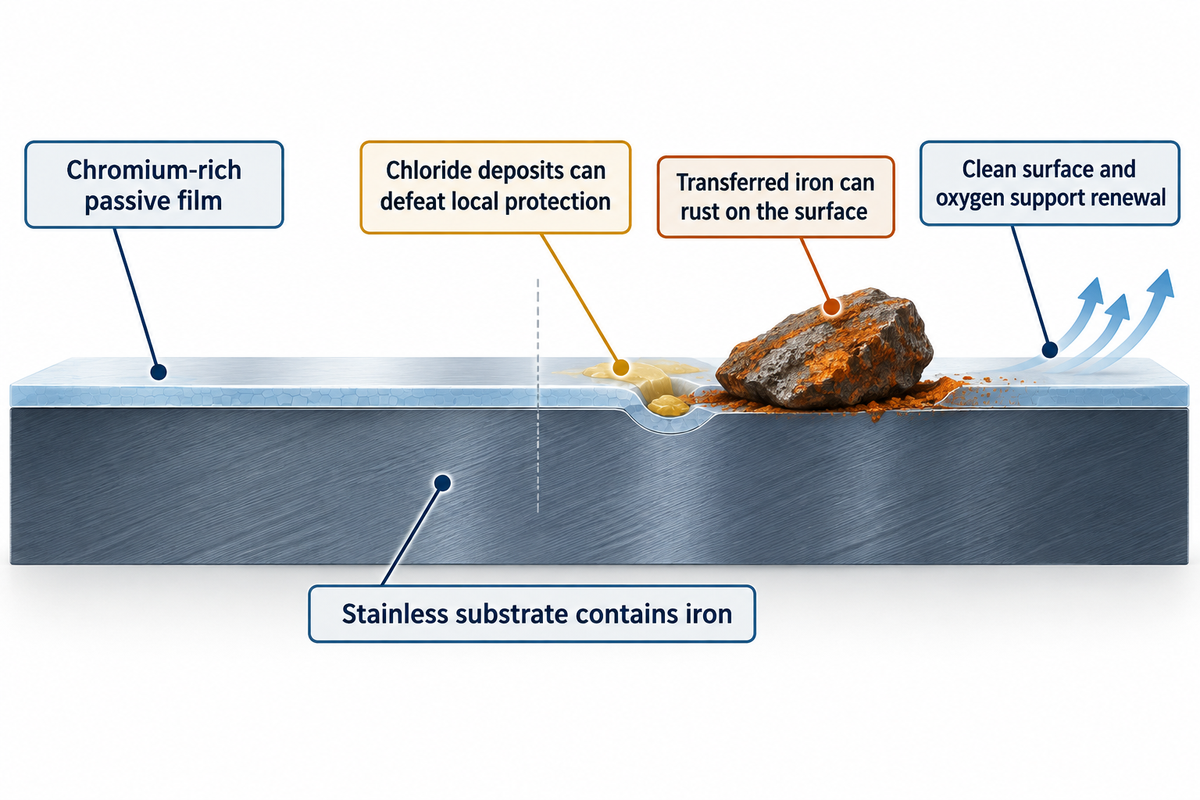
A thin layer of chromium oxide formed on its surface helps protect stainless steel from corrosion. This chromium-rich film includes mixed oxides and oxyhydroxides, as opposed to a paint-like coating. Chromium belongs to the alloy throughout the metal. It reacts with oxygen in the air and creates a protective surface film where the conditions allow.
“Stainless steel is an alloy of iron with a minimum of 10.5 percent chromium.”
Chromium content describes alloy composition, not coating thickness. Conventional stainless protection involves chromium-rich oxides and oxyhydroxides, as explained in a peer-reviewed study of passive-film chemistry.
Regular steel, including ordinary carbon steel, develops rust through oxidation: electrochemical reactions consume iron in the presence of water and oxygen. Stainless steel contains iron too, but its protective layer makes it more resistant to rust. Chloride deposits, crevices and surface damage can create local conditions in which protection fails. Thus, stainless steel does rust under certain conditions even when the original grade is correct.
Does stainless steel rust in water?
Stainless steel can rust in water especially when salts or residues occur in tight joints; aggressive media may attack and deteriorate the surface. Fresh water exposure is different from immersion in seawater. A rinsed kitchen sink that dries between uses also faces different conditions from a submerged fitting or a sheltered joint that holds deposits.
Stainless steel has the ability to renew its passive layer when a clean surface is exposed to oxygen. A dirty, oxygen-restricted crevice behaves differently. Water’s effect also reflects what it carries, where it collects and what remains after it evaporates.
What the rust pattern tells you
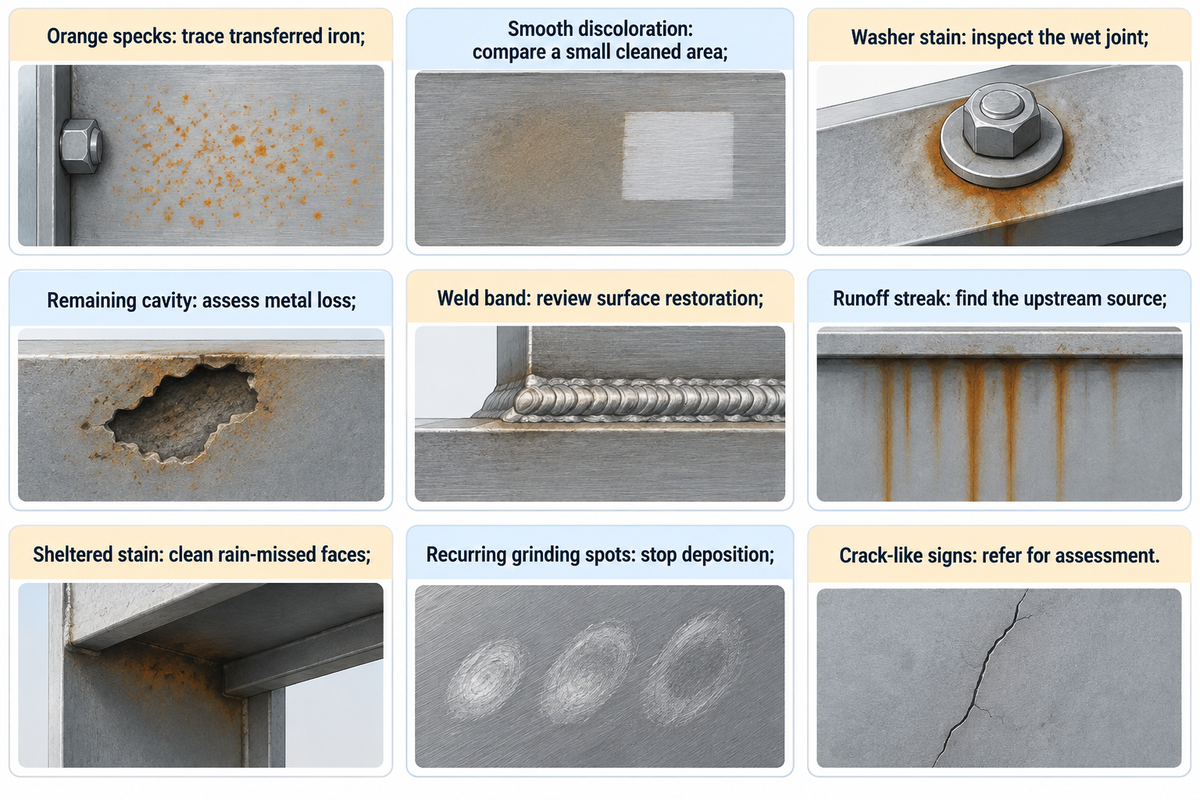
The location of rust narrows the next check, and a cleaned surface may reveal a cavitated area. Scattered orange specks near grinding suggest transferred iron; staining around a washer directs attention to trapped moisture. Contamination and corrosion may occur simultaneously on the stainless substrate, and both should be documented.
What Remains After Cleaning
This table provides choices for the next check after gentle, finish-compatible cleaning. Photograph the area first. A surface rust deposit belongs with the cleaning investigation; a remaining cavity belongs with the damage assessment. Equipment acceptance follows responsible inspection.
| Observation | Plausible cause | Useful next check | Response |
|---|---|---|---|
| Scattered orange specks | Transferred steel particles | Nearby cutting, grinding or shared tooling | Remove contamination and separate the work areas. |
| Broad smooth discoloration | Deposit, staining or finish variation | Compare a small cleaned area with the original finish | Avoid aggressive polishing before identifying the surface condition. |
| Rust beneath a washer | A wet crevice, contamination or both | Accessible contact surfaces and drainage | Correct the joint condition rather than cleaning only its visible edge. |
| A cavity remains | Localized metal loss | Its extent and the component’s required function | Have the damage assessed; cleaning cannot replace lost metal. |
| A band beside a weld | Heat tint or incomplete restoration | The weld-cleaning and finishing sequence | Return the affected area to the fabricator’s surface-treatment process. |
| A streak below another metal | Rust-bearing runoff | Fasteners or fittings above the mark | Fix the upstream source as well as cleaning the stainless. |
| Stains on sheltered exterior faces | Retained salt and dirt | Undersides that rain does not wash | Include those faces in the maintenance route. |
| Spots return after nearby grinding | Repeated iron deposition | The next fabrication activity | Stop the contamination route before paying for another cleaning. |
| Crack-like indications or consequential service | Damage beyond a stain-removal task | The responsible inspection and acceptance process | Refer the part for assessment instead of judging it from a cleaned photograph. |
The British Stainless Steel Association’s contamination guidance identifies fabrication and handling routes that transfer iron. Rust color alone doesn’t identify the underlying type of steel, and a large iron oxide stain may hide a much smaller source.
Not all visible lines are dirt that can be removed. In the 2014 field work for the Gateway Arch surface investigation, two cleaning trials evaluated removal methods. Vertical streaks remained. Surface replicas suggest some streaking was caused by overlapping grinding marks. Finish variation from grinding requires a surface-finishing decision.
Hidden damage needs a different process. A 2015 HSE alert about particular 316/316L pipe connectors described internal cracks found by radiography before they became visible at the surface. That specific connector case explains why a clean appearance is insufficient for a serviceability decision.
Why rust returns after fabrication or welding
Ordinary steel debris, oxide, and joints retaining deposits can be formed during fabrication. A new piece of stainless steel may therefore stain before an older, well-finished part in the same building. Trace where the surface was cut, handled, welded and stored before assuming the entire material delivery is wrong.
Particles of carbon steel or iron can be transferred from grinding discs, carbon steel brushes, bearing surfaces, lifting hardware and other contact surfaces, and these particles are susceptible to rust. Transferred iron can become deposited on a rust-resistant alloy or a part that’s stainless and cause rust. Cleaning the finished part while continuing the same handling practice creates a repeat visit, not a lasting repair.
Why does stainless steel rust after welding?
Rust after welding can come from heat tint, the chromium-depleted surface beneath it, embedded iron or residues left during fabrication. High temperatures change the weld-adjacent surface. Appropriate post-weld treatment addresses those changes; just removing an orange mark or using a lower-carbon grade of steel doesn’t complete the post-weld treatment.
Post-weld treatment guidance by the BSSA categorizes surface treatment tasks. Cleaning is the removal of dirt and contamination. Descaling or pickling is used to treat oxide and the affected surface material. Chemical passivation is yet another operation that’s performed per a defined procedure. These terms should describe the work performed, rather than appear as interchangeable labels on a purchase order.
Certain job requirements can also affect exposure. A washer, gasket or lap joint can trap liquid in a location where the original sheet of metal drained freely. Crevice corrosion can occur in protected areas. Polishing an exposed surface won’t affect the joint. The fabricator must consider the location of staining along with the finishing and assembly processes.
Does 304 or 316 stainless steel resist rust better?
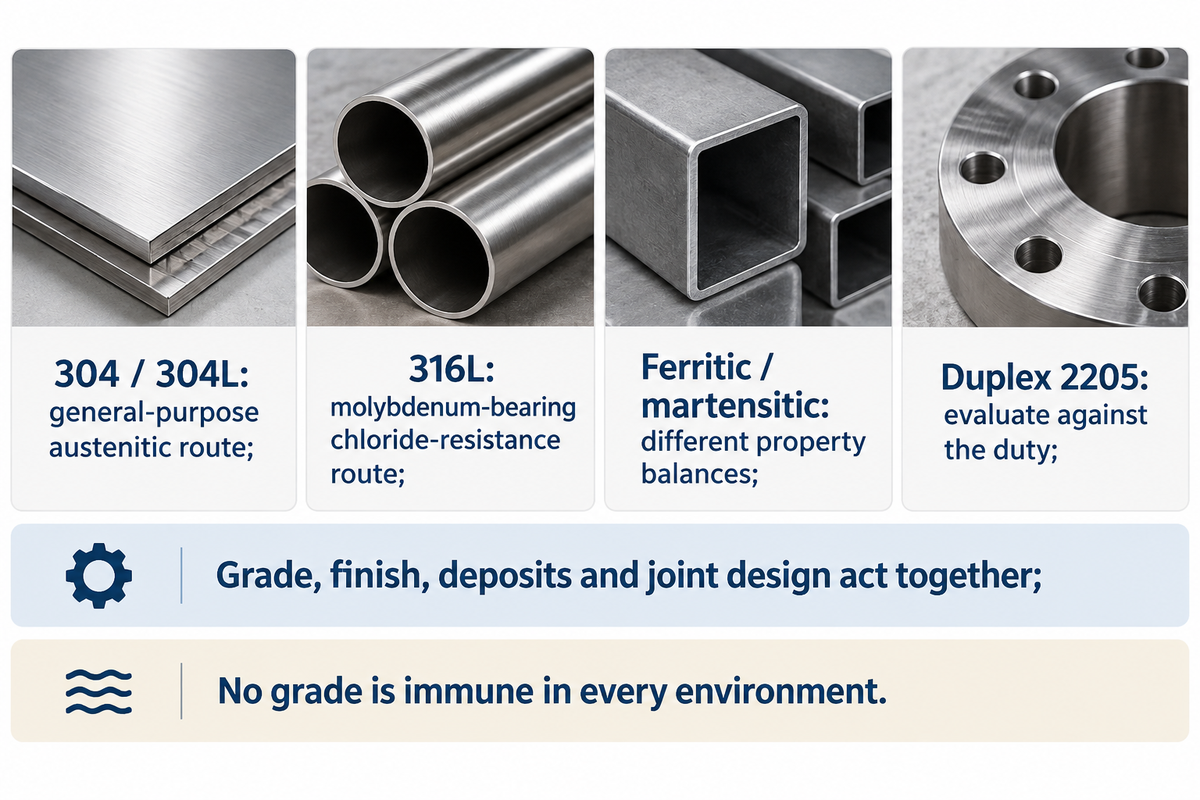
316 stainless steel is typically more resistant to pitting corrosion in chloride environments than 304 because of the presence of molybdenum in its alloy. It has a better performance in many salt-exposed applications compared to 304. Surface finish, deposits, temperature and joint design still affect the performance of stainless steel; changing the grade of stainless steel leaves behind a dirty crevice or a carbon-steel contamination source.
Pitting-resistance equivalent numbers (PREN) allow comparison of alloy compositions as explained in the BSSA article on pitting-resistance equivalent numbers. Suitability for a given corrosive environment is specific even with a higher calculated ranking or higher chromium content. The ability to resist corrosion depends on the particular conditions of the part.
| Material route | Useful distinction | What still needs attention |
|---|---|---|
| 304 and 304L stainless steel | General-purpose austenitic grades; low-carbon options address particular welding concerns. | Chloride exposure and post-weld surface restoration. |
| 316L stainless steel | Molybdenum-bearing austenitic route for improved resistance in many chloride environments. | Seawater immersion, hot deposits and tight crevices. |
| Ferritic or martensitic grades | Different balances of corrosion behavior, formability and hardness. | An application-specific comparison rather than an assumption that all stainless behaves like 316. |
| Duplex 2205 | Another alloy family to evaluate when common austenitic grades do not meet the duty. | The actual environment, fabrication requirements and applicable acceptance criteria. |
Mirror-finished 304 outperformed the tested 316 finishes in a Thailand atmospheric-exposure study of six grade/finish combinations in four environments for up to 39 months. This finish-specific comparison had steel-producer participation and funding.
What grade of stainless steel will not rust?
No grade of stainless steel is immune to corrosion in every environment. The right grade of steel matches the liquid, temperature, deposit pattern and required function. Nickel content, magnet response and price are not substitutes for that match. Some families of austenitic stainless steels become magnetic after cold work, and some of the other families are normally magnetic.
Our stainless steel grades and product forms page allows comparison of supply alternatives once service conditions have been defined.
How to remove rust without making the problem worse
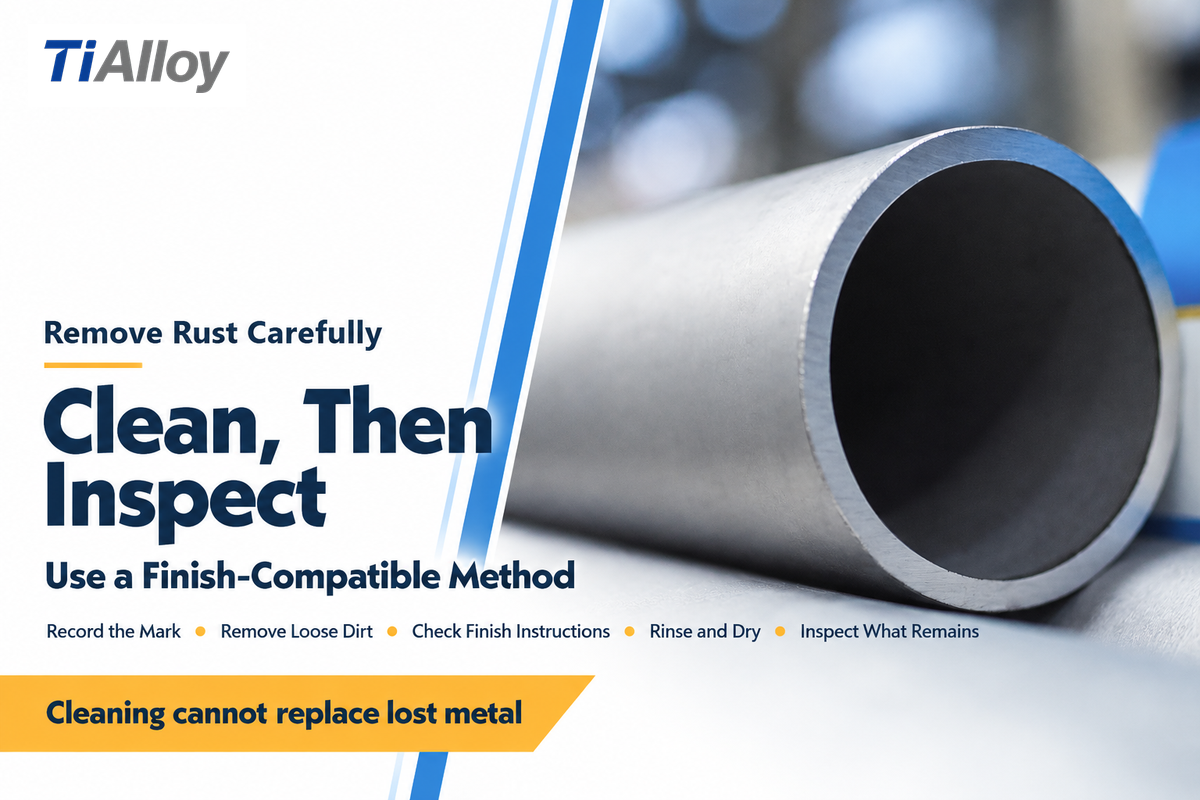
Clean the surface with mild detergent and a soft cloth, rinse with clean water, and dry. Use appropriate cleaners for the finish of the surface of stainless steel. If staining remains, use a stainless cleaner approved for the particular finish. Brushed, polished, coated and decorative surfaces tolerate different methods. Avoid unsuitable abrasives, as they can cause permanent bright patches and scratches.
- Record the mark. Photograph its location and any nearby weld, fastener or runoff path before polishing changes the evidence.
- Remove loose dirt gently. Use clean, non-metallic tools and fresh cleaning materials rather than a pad previously used on mild steel.
- Check the finish instructions. Test an approved product in a hidden area. Work with the grain on brushed surfaces.
- Rinse and dry. Remove cleaner and loosened residues instead of leaving them to concentrate in a joint.
- Inspect the result. A remaining pit, weld band or rapidly recurring spot needs attention to its cause, beyond another routine wipe.
BSSA’s cleaning guidance warns against carbon steel wool and pads contaminated by prior work on carbon steel. Ordinary steel wool can leave the very iron from the surface-cleaning tool that later produces new rust spots. Chlorine-containing bleach and chloride residues can also cause corrosion on corrosion-resistant grades; follow the item’s care instructions and keep unsuitable chemicals away. Care instructions should be followed in order to avoid unsuitable chemicals.
Treatment can involve nitric acid or other specified processes, which are controlled operations and are not instructions to mix an acid bath at home. Alternative qualitative effectiveness tests of chemical passivation are described in ASTM A967/A967M-25’s public scope. Treatment may restore an appropriate surface condition, but it cannot rebuild the lost metal.
How to prevent the next stain
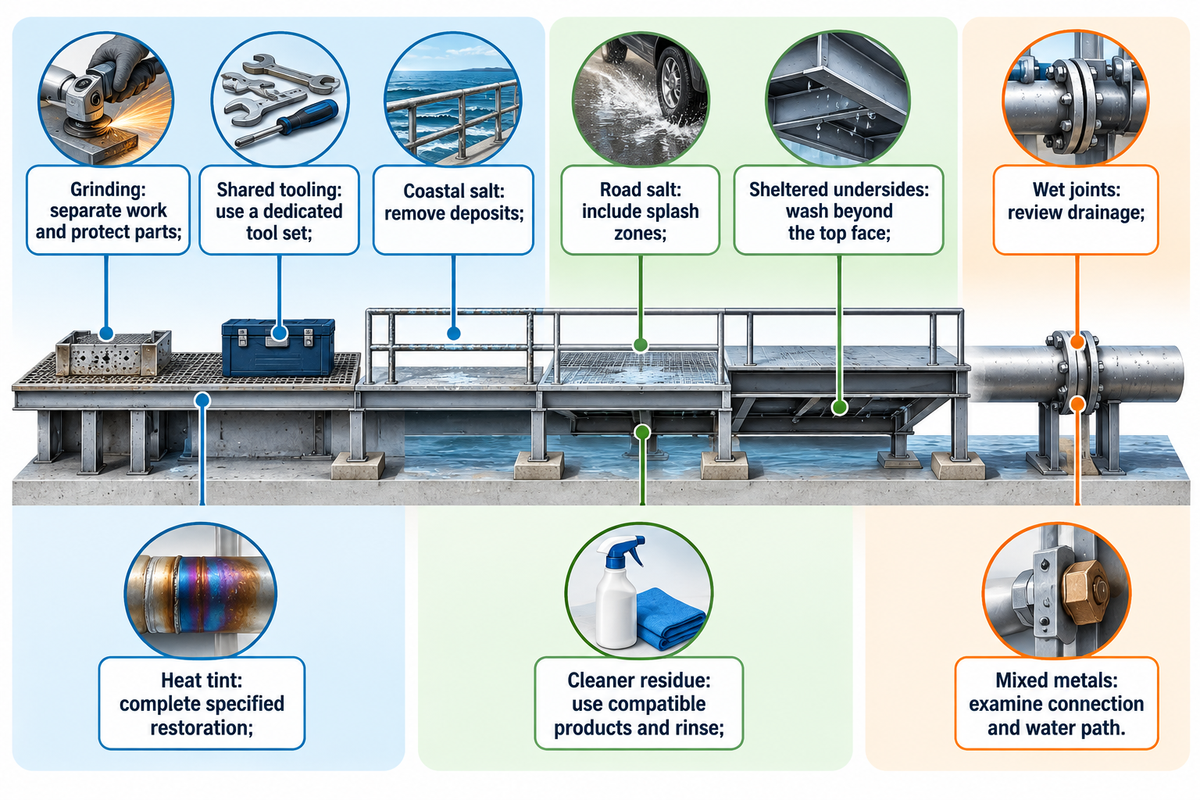
Prevent repeated stains by eliminating their cause: separate carbon-steel fabrication, wash away retained salt, improve drainage and clean the surfaces the rain misses. Stainless steel corrosion often starts at a small, sheltered location. A copied, fixed cleaning interval is less useful than a route that reaches the sites where deposits actually build up.
The Australian Stainless Steel Development Association’s coastal guidance connects tea staining with surface finish, salt deposition and maintenance. Tea staining describes a particular type of corrosion discoloration; it isn’t a generic term for all iron deposits and welds.
| Exposure or condition | Why it matters | Prevention priority |
|---|---|---|
| Carbon-steel grinding | Airborne particles settle on finished stainless. | Separate work and protect finished parts. |
| Shared tooling | Contaminated tools transfer ordinary steel. | Use a dedicated stainless tool set. |
| Coastal salt | Deposits create aggressive local chemistry. | Match grade and finish to the site, and remove salt. |
| Road salt | Splash reaches low parts and hidden joints. | Include splash zones in cleaning. |
| Sheltered undersides | Rain leaves some deposits untouched. | Wash beyond the visible upper face. |
| Tight wet joints | Trapped liquid changes crevice chemistry. | Review drainage and joint detail. |
| Weld heat tint | The surface differs from the original finish. | Complete the specified restoration process. |
| Cleaner residues | Remaining chemicals concentrate as water evaporates. | Use compatible products and rinse thoroughly. |
| Mixed-metal assemblies | Runoff or galvanic corrosion may involve another metal. | Examine the whole connection and water path. |
Three example cases illustrate the difference. Contamination control is needed for a new sheet placed next to carbon steel that has been ground. A coastal handrail with a stained underside needs cleaning where the rain can’t reach. At a washer where two surfaces meet and both are stained, the wet contact area should be examined. These are example applications of the mechanisms, rather than TiAlloy customer cases.
Total damage was greater at 40% relative humidity than at 76% in a one-year study of coarse-ground 304 under sea-salt particles. Lower humidity can make a salt-contaminated surface more aggressive. Concentrated salt-bearing deposits can create conditions for accelerated corrosion. These experimental humidity levels are not recommended installation operational limits.
When cleaning stops paying
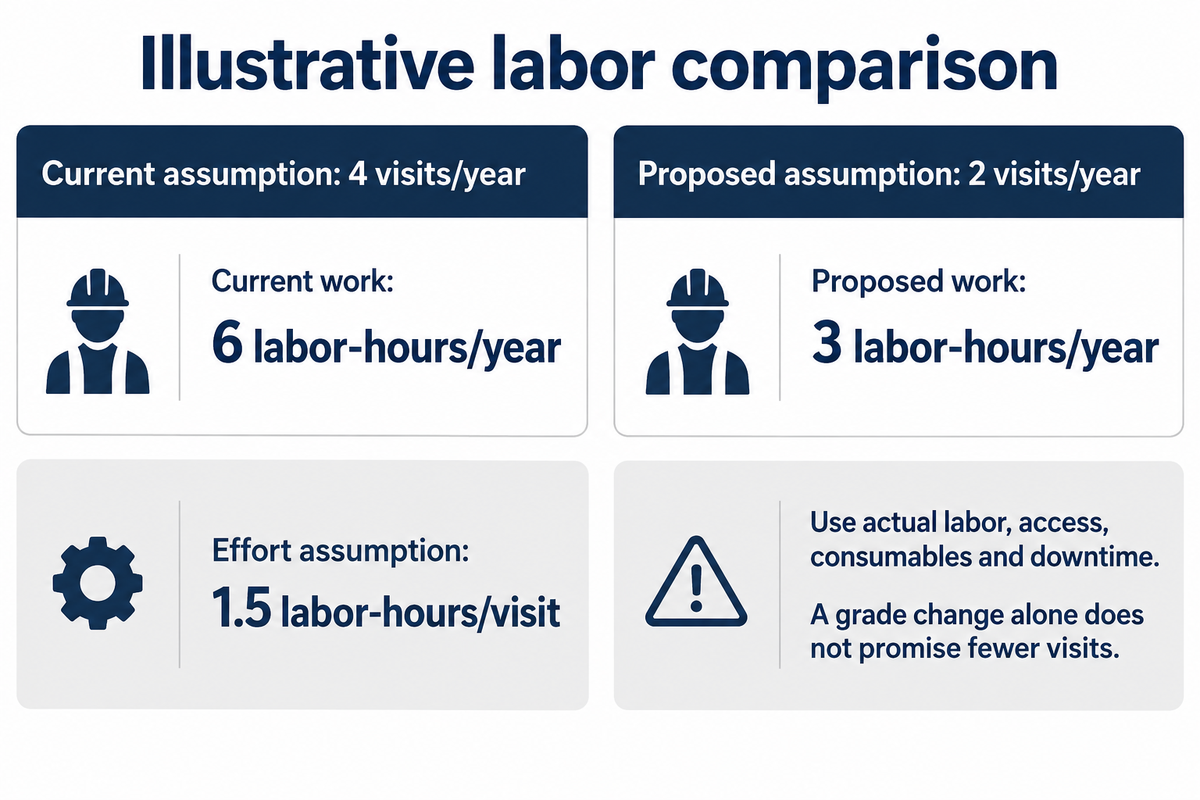
Cleaning becomes a poor choice when it addresses the symptom, not the cause, or when it costs more than a better alternative. To determine if a component is performing its duty, compare its condition with the required function. Then consider the cost of labor, access and consumables, and the disruption to system operation, in the context of a fabricator’s proposal to change the surface finish, joint, the route of contamination, or the material.
The Cost of the Next Cleaning
The ASSDA life-cycle costing method includes the cost of purchasing and installing the product, as well as production losses from stoppages, plus the cost of its maintenance and replacement. For a first estimate, use a narrow calculation that you can easily measure, and add broader, more speculative estimates later.
Illustrative labor comparison: assume the current job requires 4 visits/year at 1.5 labor-hours/visit. Annual work is 4 × 1.5 = 6 labor-hours/year. If a proposed correction actually reduces that to 2 visits/year at the same effort, the work becomes 3 labor-hours/year. The assumed difference is 3 labor-hours/year.
Multiply that difference by your actual hourly labor cost, then add any measured changes in access, consumables and downtime. Compare the resulting annual amount with the installed correction quote over the period you expect to keep the asset.
Don’t enter “half the cleaning” just because a quote says 316 stainless. Procurement needs to know which mechanism the quote addresses; maintenance needs the expected remaining tasks; finance needs the cost and replacement assumptions. If airborne iron caused the stain, upgrading otherwise suitable material while leaving the grinding operation in place may buy another contaminated surface.
Industry outlook: specify the treatment, not a rust-free promise
For chemical treatment and acceptance methods, use ASTM’s 2025 passivation document as a reference for treatments and effectiveness checks.
Frequently asked questions
Can stainless steel rust in salt water?
Yes. Salt water can cause localized corrosion, including pitting and crevice attack.
316 is generally a stronger chloride-resistance starting point than 304, but seawater immersion requires its own material and design assessment. Salt deposits left by splashing also deserve attention, even when a part is not continuously submerged. A sheltered joint can retain a different liquid chemistry from the open surface beside it. Include deposits, temperature and drainage when comparing materials, and separate a removable surface stain from a cavity that remains after cleaning.
How long does it take stainless steel to rust?
There is no universal rust timetable for stainless steel.
Transferred iron, concentrated deposits, the alloy and the surface condition change what appears and when. Early staining can reflect fabrication contamination; long use without visible rust does not predict the next exposure. Record the actual conditions instead of relying on a fixed number of days. A rust mark after fabrication calls for a different investigation from damage after long salt-water exposure.
Does stainless steel rust in the shower?
It can stain or corrode where water, deposits or cleaning residues remain.
Rinse and dry according to the item’s care instructions, including joints and undersides. Coated fittings and jewelry can require different care from bare stainless. A rust-colored mark by itself does not identify the alloy. Trapped residues around a screw or beneath a fitting may need attention even when the exposed face looks clean.
Will vinegar make stainless steel rust?
Vinegar is not suitable for every stainless finish or assembly.
Concentration, contact time, temperature and adjacent materials affect the result. Use the product maker’s approved cleaning method, remove residues and rinse thoroughly. Avoid leaving an improvised cleaner trapped against a decorative finish or inside a joint.
How do you remove rust from stainless steel?
Begin with mild detergent and a soft cloth, rinse and dry, then use a finish-approved stainless cleaner if needed.
Test a hidden area and work with the grain on brushed surfaces. Avoid carbon-steel brushes and ordinary steel wool. A cavity that remains after rust removal needs an assessment of the damage rather than repeated polishing.
Does stainless steel rust outside?
Yes, particularly where retained salt and dirt create aggressive conditions.
Outdoor performance depends on grade, finish, exposure, drainage and maintenance. Sheltered surfaces may need more attention than rain-washed faces. Check the undersides and joints, not just the cleanest face of an installation.
Why does a stainless-steel knife rust if left in water overnight?
Moisture and residues can stain a blade, while transferred iron can rust on it too.
Different types of stainless steel serve different purposes. These kinds of stainless steel balance hardness and corrosion behavior differently. A martensitic knife grade such as 440C is selected partly to hold an edge; stainless cutlery is not necessarily the same alloy as a 316 fitting. Wash, rinse and dry according to the maker’s instructions rather than leaving the blade soaking.
What is the next step for your stainless steel surface?
For new specks, trace contamination. Finishing work on a weld band should be reviewed. Exposure and drainage of salt caught under a joint should be addressed. Buying quality stainless steel for a replacement should include the grade, product form and finish, service environment and photographs.
Discuss your stainless steel requirements
Why surface condition matters to our material discussions
At TiAlloy, stainless steel inquiries distinguish alloy selection from surface condition and cover finish, fabrication and exposure. Published corrosion guidance supplies the illustrative mechanisms; the examples aren’t TiAlloy corrosion tests or customer failure investigations.
References & Sources
- Passive-film chemistry background npj Materials Degradation.
- Gateway Arch stainless surface investigation US National Park Service, presentation by investigation participants.
- Atmospheric Corrosion of Stainless Steels in Thailand Daopiset et al., AIJSTPME 5(1), 2012, pages 63–69.
- Humidity effects on pitting under sea-salt particles Weirich et al., 2019; university research abstract.
- Specific 316/316L connector cracking alert UK Health and Safety Executive, ED 01-2015.
- ASTM A967/A967M-25 public scope ASTM International.
- Iron contamination and rust staining British Stainless Steel Association.
- Post-weld cleaning and finishing British Stainless Steel Association.
- Cleaning methods for stainless steel British Stainless Steel Association.
- Preventing coastal tea staining Australian Stainless Steel Development Association.
- Life-cycle costing Australian Stainless Steel Development Association.