Get in Touch with TiAlloy Company


Karry
I cover titanium and nickel alloys, including the relationship between material properties, fabrication considerations, and application requirements. My articles explain grade differences and common specification terms, helping readers identify what needs confirmation before comparing materials or discussing a particular alloy with a supplier.
Does Stainless Steel Rust? What Actually Causes It, and What It Tells You
Yes, stainless steel can rust. Salt, trapped deposits, unsuitable cleaners and fabrication damage can defeat its corrosion resistance. Orange spots may also come from carbon steel particles sitting on otherwise sound stainless. The useful question after “does stainless steel rust?”…
How to Select, Test, and Fabricate Clad Plate
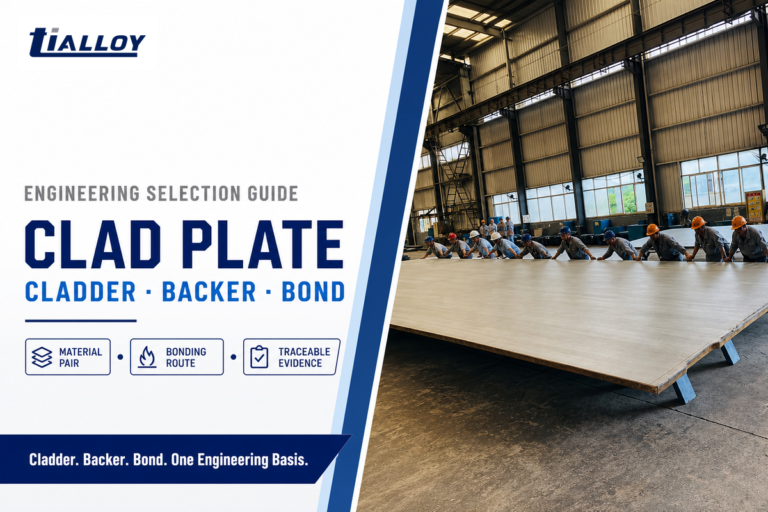
Quick Specs Construction Corrosion-resistant cladding metallurgically bonded to a structural backing plate Routes compared Explosion bonding and hot-roll bonding Core decision inputs Service, layer duties, geometry, heat history, forming, welding, inspection, and traceability Evidence stack Material specification, construction code, project…
How to Select and Specify Titanium Heat Exchanger Tubes
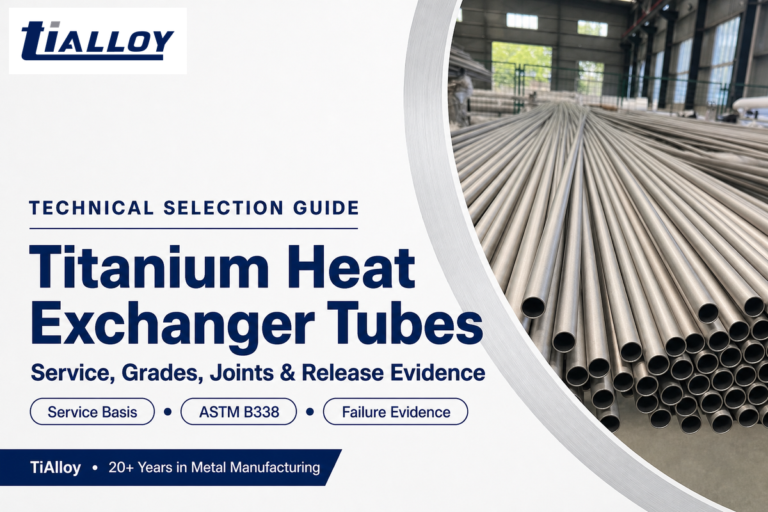
Updated October 2026 Titanium heat exchanger tubes are bought as pressure-boundary components, but acceptance requires more than a grade name. A defensible specification connects both fluids, temperature, deposits, tube form, tubesheet joint, inspection, evidence of cleaning, the consequence of a…
Ti-6Al-4V (Grade 5) Titanium: Properties, Standards, and Applications Explained

(Updated September 2026) Ti-6Al-4V (Grade 5) is the alpha-beta titanium alloy that accounts for roughly half of all titanium consumed worldwide, combining a tensile strength of roughly 900-950 MPa with a density near 4.43 g That strength-to-weight profile, not a…
Inconel 718: A Practical Guide to Properties, Fabrication, and Alloy Selection

Quick Specs UNS Designation N07718 Class Precipitation-hardenable Ni-Cr-Fe superalloy 0.2% Yield Strength (aged) ~150 ksi (1,034 MPa) Ultimate Tensile Strength (aged) up to 185 ksi (1,276 MPa) Density 8.19-8.22 g/cm³ Hardness 24-26 HRC annealed → 36-40 HRC fully aged Continuous…
Titanium Forging: How Process, Grade and Method Shape the Part

Titanium forging is the controlled, high-pressure deformation of heated titanium alloy stock into a shaped component — and the alloy you choose, the temperature window you hold, and the forging method you pick each change what the finished part can…
Titanium Wire: Grades, Standards, and How to Specify It Correctly

Updated August 2026 · Reviewed by the TiAlloy technical team Titanium wire is round-section titanium or titanium-alloy mill product, drawn and annealed to ASTM B863, used across aerospace, medical, chemical-processing, and marine applications. The term covers a wider range of…
How 316L Stainless Steel Behaves in Welds, Chlorides and Heat

316L stainless steel is a low-carbon, molybdenum-bearing austenitic grade identified as UNS S31603, but the grade name alone doesn’t tell a buyer whether a specific heat, condition and service environment will actually hold up. This guide separates what the “L”…
Stainless Steel Bar and Rod: Mechanical Properties and Grade Selection (303 vs 304 vs 316)

Stainless steel bar and rod refers to straight, solid stainless steel stock — round, hex, and square cross-sections sold under product specifications such as ASTM A276 and A582, plus flat bar as a related form whose dimensional conventions come from…
Duplex 2205 Stainless Steel: Composition, Properties, and How to Choose It

Quick Specs UNS Designation S32205 (current) / S31803 (older, wider chemistry) Structure Duplex: roughly 50% ferrite, 50% austenite Tensile Strength (min) 655 MPa (95 ksi) per ASTM A240 (S32205) Yield Strength (min) 450 MPa (65 ksi) per ASTM A240 (S32205)…