Get in Touch with TiAlloy Company


Hastelloy C276 vs C22 is a condition-based choice: C276 brings more nominal molybdenum, while C22 has higher chromium content. Neither chemical composition creates a universal winner. Process chemistry, temperature, exposure of liquid or vapor, fabrication condition, product form, and the acceptance documents must be evaluated altogether.
Quick Specs
- C276: UNS N10276; Haynes lists nominal 16% chromium, 16% molybdenum and 4% tungsten.
- C22: UNS N06022; Haynes lists nominal 22% chromium, 13% molybdenum and 3% tungsten.
- Selection rule: compare measured conditions and matched test evidence, then specify product form, standard edition and inspection scope.
- Commercial rule: compare technically acceptable quotations on the same delivered basis.
Hastelloy C276 vs C22: Chemical Composition and Key Differences
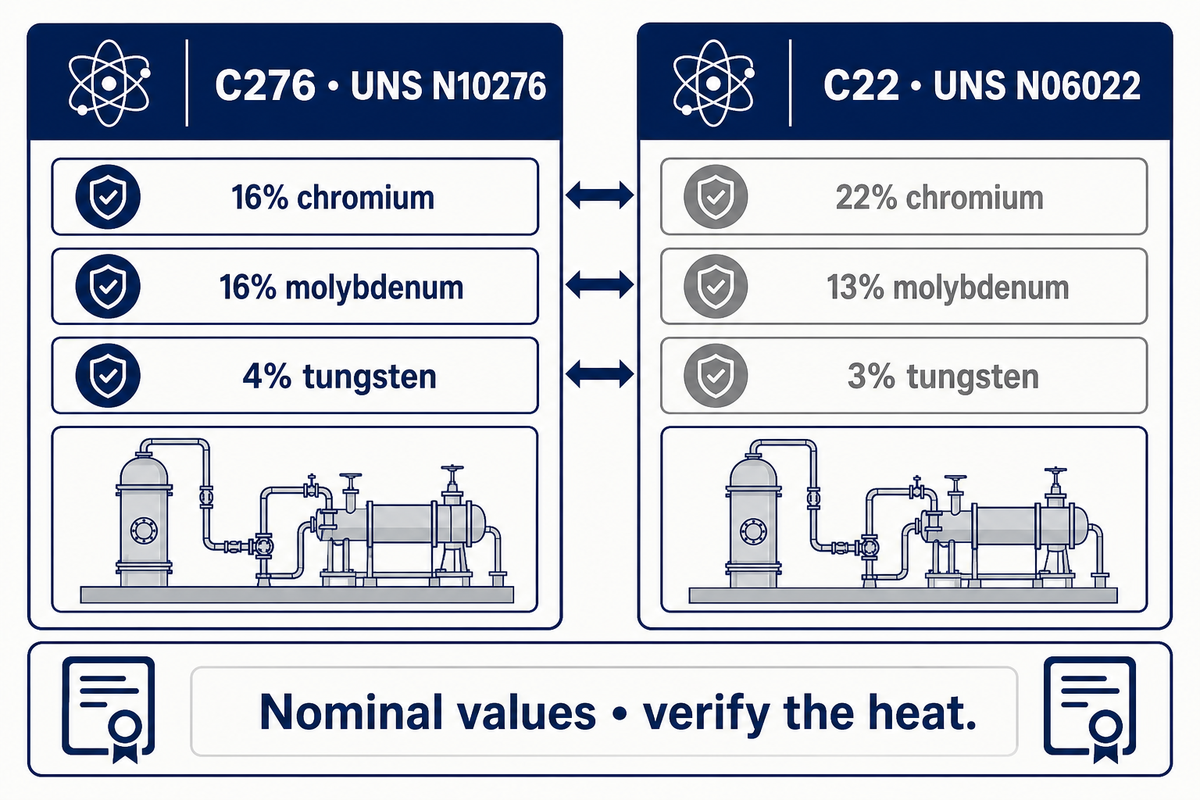
Hastelloy C-22 and Hastelloy C-276 are nickel-chromium-molybdenum-tungsten alloys, but their nominal balances differ. In C22, chromium is higher; in the C-276 alloy, molybdenum and tungsten are higher. Those differences help explain corrosion resistance characteristics, yet composition alone cannot approve either grade for an aggressive chemical service.
The difference between Hastelloy grades begin with chemistry and must be tested against process. The higher chromium content in Hastelloy C-22 can support passivity in an oxidizing media, while the greater nominal molybdenum content in C276 matters in other chemical environments. Neither pattern replaces service evidence.
| Grade | UNS | Nickel | Chromium | Molybdenum | Tungsten | Interpretation boundary |
|---|---|---|---|---|---|---|
| HASTELLOY C-276 alloy | N10276 | 57% balance | 16% | 16% | 4% | Nominal producer values, not heat acceptance limits |
| HASTELLOY C-22 alloy | N06022 | 56% balance | 22% | 13% | 3% | Nominal producer values, not a service guarantee |
What are the chemical components of Hastelloy C276?
Hastelloy C276 is primarily nickel with nominal chromium, molybdenum, iron and tungsten, plus controlled minor elements. Haynes International lists 16% chromium, 16% molybdenum, 5% iron and 4% tungsten. A purchase order should use UNS N10276 and the relevant product specification because nominal chemistry is different from a certificate acceptance range.
HASTELLOY is a registered trademark of Haynes International. The unified numbering system identifiers N06022 and N10276 eliminate ambiguity without indicating that TiAlloy manufactured the alloys under the quality system of the trademark owner.
Haynes identifies the products as HASTELLOY® C-22® alloy and HASTELLOY® C-276 alloy. The composition of Hastelloy C22 and the chemical makeup of Hastelloy C276 belong on separate heat records. Chemical composition and performance remain connected, but they are not the same acceptance question.
Key takeaway
A 6-percentage-point chromium difference and a 3-percentage-point molybdenum difference help frame the comparison; the heat certificate and service conditions still control acceptance.
Purchasing Limits: A buyer who sees more total alloying content shouldn’t evaluate that amount as a performance score. Match the specified heat chemistry to the ordered standard and then let the process review assess the heat acceptance.
Corrosion Resistance in Hydrochloric Acid and Reducing Environments
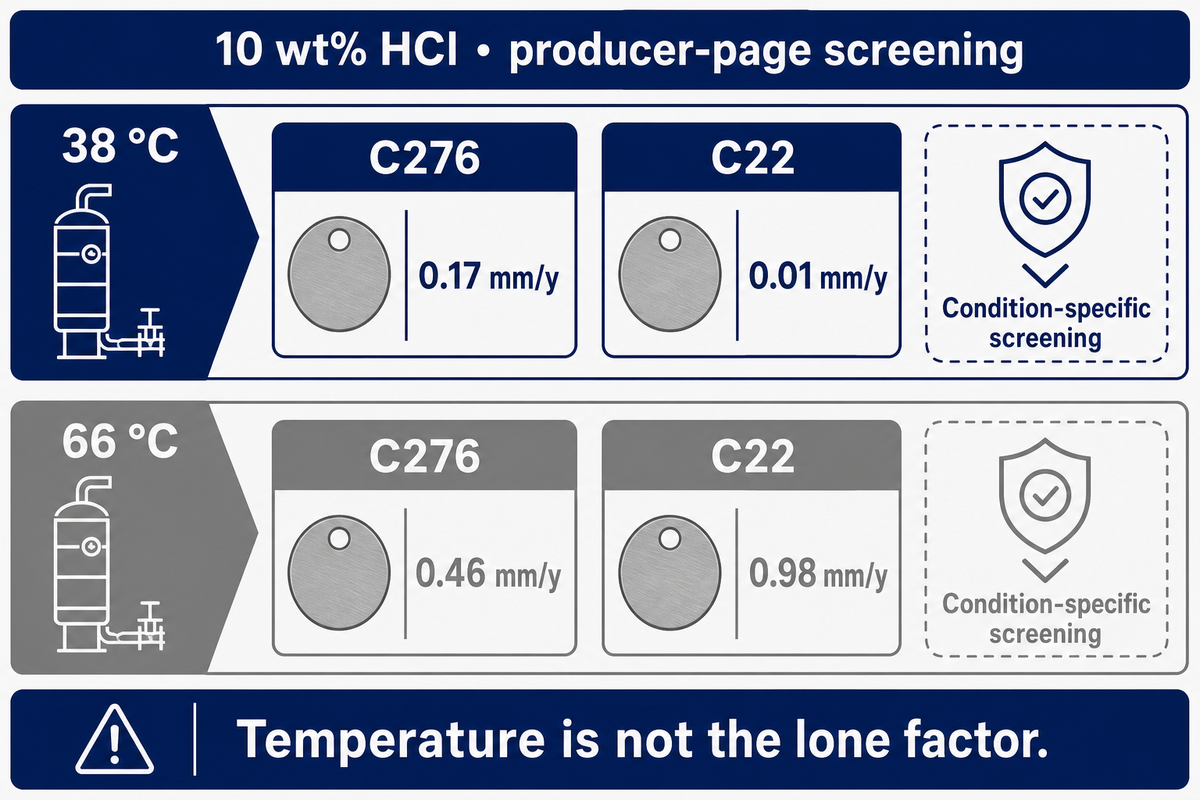
C276’s composition provides no automatic pass in hydrochloric acid, and an acid name can’t be the basis of a C-22 vs Hastelloy decision. Concentration, temperature, dissolved oxidants, aeration, velocity and exposure time alter corrosion. Producer tables contain useful data; however, different datasets don’t isolate temperature as the lone factor in ranking differences.
A Hastelloy C-22 vs C276 heading often states one grade offers better protection. Compared to Hastelloy C-276 at the 38 °C row, C-22 provides the lower rate; the 66 °C row points the other way.
| Temperature | C276 | C22 | What the comparison supports |
|---|---|---|---|
| 38 °C | 0.17 mm/y | 0.01 mm/y | C22 has the lower displayed corrosion rate at this row. |
| 66 °C | 0.46 mm/y | 0.98 mm/y | C276 has the lower displayed rate at this row. |
The table demonstrates why a blanket claim about better performance fails. The table doesn’t indicate that temperature was the sole factor that reversed the ranking. The two grade pages don’t document one matched campaign with the same specimens, gas sparging, solution volume and duration. A corrosion test used for release should reproduce the chemistry and fabrication state that matter to the project.
C-22 also requires a boundary statement. C-22 provides better displayed performance in one table row, while C276 provides better displayed performance in the other. A designer may use Hastelloy data for screening, then match the alloy to a representative test or a qualified corrosion review.
Is Hastelloy C-276 compatible with hydrochloric acid?
Hastelloy C-276 can be a candidate for hydrochloric acid and other reducing environments, but compatibility needs concentration-temperature pair and contaminant profile. A rate from reagent-grade solution does not approve commercial acid containing oxidizing species. Record normal operation, cleaning, shutdown and upset conditions before the project engineer selects the right material.
A hypothetical heat exchanger normally is exposed to 10 wt% HCl at 35 °C, but during cleaning it reaches 65 °C with an oxidizing cleaner. Purchasing requests C276 because the equipment tag says hydrochloric acid. The 4-Condition Alloy Review flags two missing inputs: oxidant concentration and exposure duration during cleaning. The correct course of action is a defined test or corrosion review, not automatic grade release.
Evidence capsule: the published rows move from 0.17 versus 0.01 mm/y at 38 °C to 0.46 versus 0.98 mm/y at 66 °C. The observation supports condition-specific screening; it doesn’t establish a universal safe concentration, lifetime or single-variable mechanism.
Procurement objection: “C276 handles acid” isn’t an adequate purchase reason. If concentration, temperature, and/or oxidant content aren’t stated, the quote can describe the material’s availability while the technical selection remains open.
C22 vs C276 in Oxidizing Chlorides and Wet Chlorine
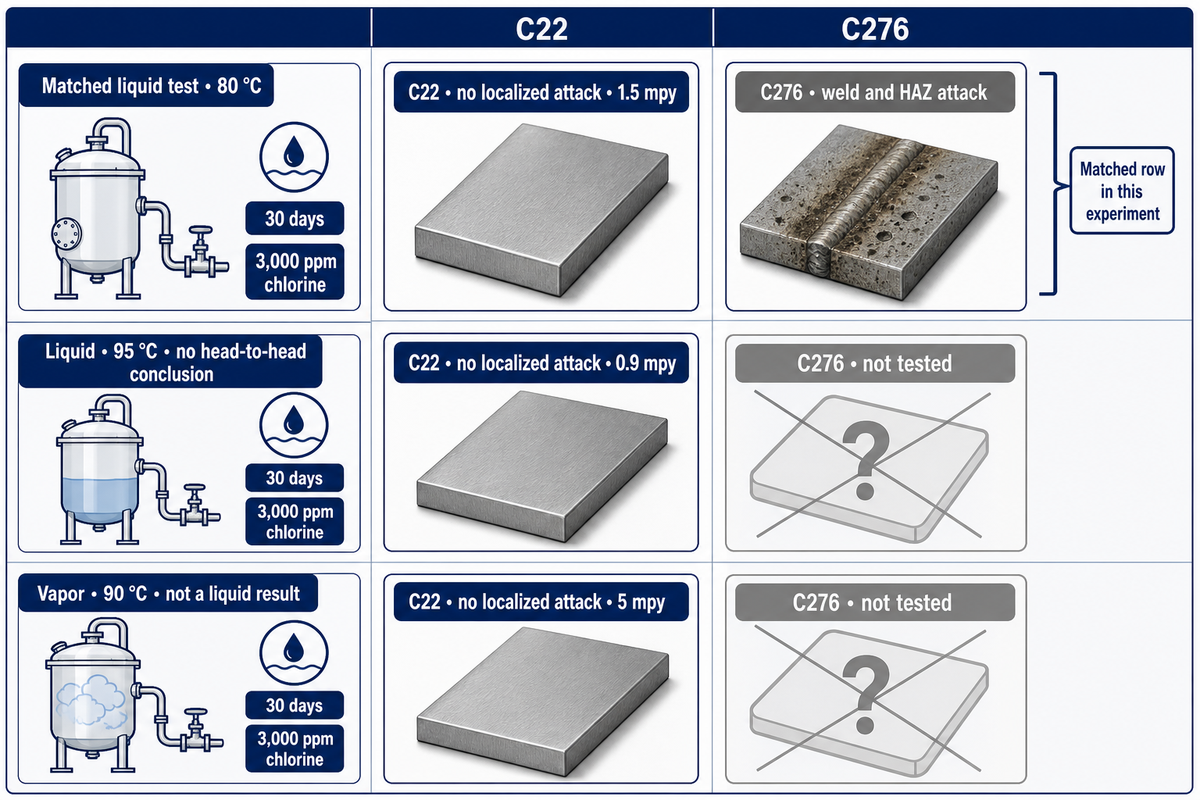
C22 deserves focused evaluation in many oxidizing environments because its higher chromium content can support resistance to localized corrosion. A specific wet chlorine experiment favors C22 under its stated conditions, yet the result cannot be carried into every chloride process. Liquid, vapor, weld, crevice and deposit exposures must remain separate.
C22 offers a stronger result in the matched 80 °C liquid comparison, and C-22 also offers a higher nominal chromium level. However, that isn’t sufficient to prove superior corrosion resistance everywhere. Any claim of better corrosion resistance in oxidizing service must include the oxidant, chloride, temperature, and specimen labels.
| Location / temperature | C22 result | C276 result | Boundary |
|---|---|---|---|
| Liquid, 80 °C | No localized attack reported; 1.5 mpy uniform corrosion | Severe weld and heat-affected-zone attack reported | Matched row in this experiment |
| Liquid, 95 °C | 0.9 mpy | Not tested in the cited row | No head-to-head conclusion |
| Vapor, 90 °C | 5 mpy | Not tested in the cited row | Vapor result is not a liquid result |
The test solution was 3,000 ppm chlorine with an initial pH of 1.5 and final pH of 0.9. Its usefulness lies in the conditions and the mode of attack observed. “No localized attack” doesn’t mean “zero uniform corrosion.” The 95 °C and 90 °C C22 rows can’t be used to declare supremacy over an untested C276 specimen.
“Understanding the uncertainties due to the variability of the exposure environments will be a critical element of these predictions.”
Bulk-liquid evidence, in general, neglects deposited salts and intermittent condensation. Weld filler, heat input, and crevice geometry may create a local condition that the base-metal label hides. Resistance to pitting and crevice corrosion should therefore be reviewed against the exact surface and joint, not inferred from a general resistance to oxidizing environments.
A pit on the surface of Hastelloy material and attack in a gasket crevice may show different local chemistry. C-22 provides better resistance to localized attack only where the supporting condition matches; no cited test proves corrosion resistance across every type of wet, dry or depositing chloride exposure. Crevice corrosion resistance is geometry-specific.
Evidence capsule: 30 days, 3,000 ppm chlorine, pH 1.5 to 0.9 and an 80 °C liquid zone define the comparison. Thirty days and 3,000 ppm chlorine would also need to be included. Taking any of those factors out turns a corrosion rate with a localized attack observation into an unsubstantiated service promise.
Purchasing objection: The statement stops at the tested environment for better resistance in C-22’s wet-chlorine row. Unknown deposits, vapor zones or welded details require separate evidence before a buyer can release material.
Welding, Mechanical Properties and Temperature Limits
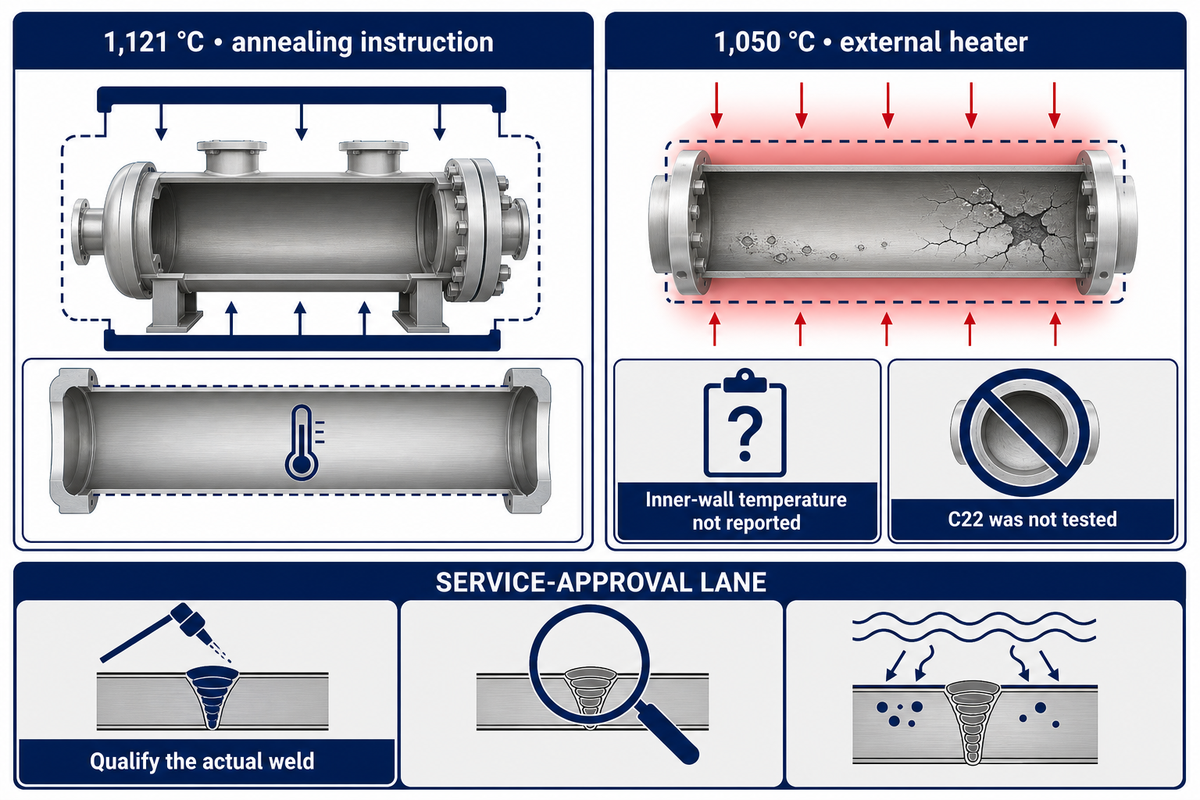
How C276 and C22 behave can be altered by welding and heating history. A solution-annealing temperature is a manufacturing instruction, not a continuous wet-corrosion limit. Procedure qualification, filler choice, joint geometry and post-fabrication condition belong in the selection record.
The mechanical properties of Hastelloy C-22 must be compared with the same form and condition as C-276. Hastelloy C-22 has higher nominal chromium, yet that chemistry does not qualify a weld. The finished joint requires its own procedure, inspection and corrosion basis.
Can you weld Hastelloy C-22 and C-276 easily?
Both alloys can be welded with established nickel-alloy procedures, but “easy” is the wrong acceptance criterion. Confirm the welding process, matching or dissimilar filler, heat input, shielding, cleaning and inspection plan. The supplier can provide the mill and material records. The fabricator and project authority must qualify the welding procedure and joint performance.
A peer-reviewed failure investigation described a C276 pipe externally heated to 1,050 °C and periodically exposed to internal water mist. After months of service, the pipe contained intermetallic precipitates, preferential intergranular attack, cracks and thinning. The inner-wall temperature was not reported, and C22 wasn’t tested in that study. The case shows how a thermal gradient and microstructural change can defeat a generic “high-temperature alloy” label; it does not rank C22 against C276.
| Number or property | What it means | What it cannot mean |
|---|---|---|
| 1,121 °C producer annealing instruction | A processing condition for restoring alloy condition | A universal design or corrosion service limit |
| 1,050 °C external heater in one failure case | A severe, documented thermal exposure with water mist | The exact inner-wall temperature or a C22 comparison |
| Room-temperature tensile data | Mechanical properties in the reported form and condition | Permission to substitute grades in a welded pressure component |
Evidence capsule: 1,121 °C and 1,050 °C describe different facts: one is an annealing instruction and the other an external heater setting in a failure investigation. Neither number supplies a wet-service temperature limit or a stress corrosion cracking allowance.
Procurement objection: similar listed tensile strength does not make the alloys interchangeable. The specification must state the required condition, and the fabricator must qualify the actual weld.
Which Alloy Fits Your Chemical Process?
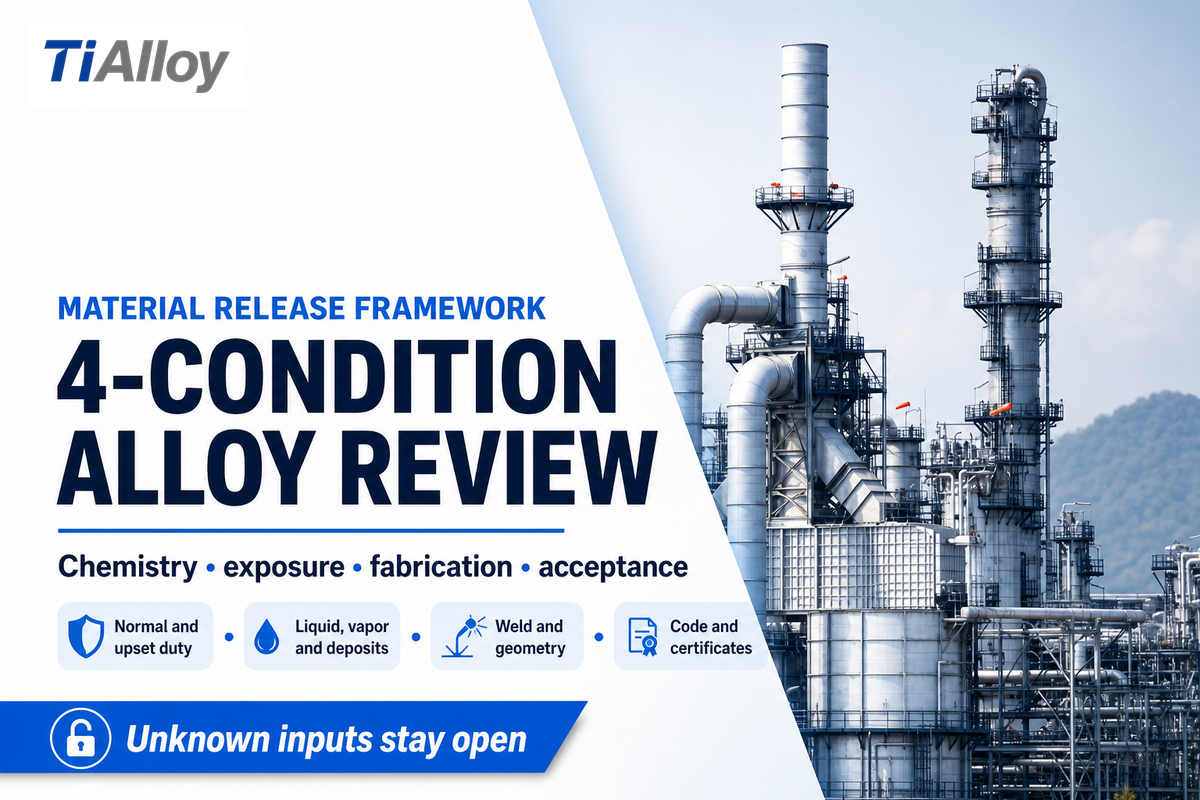
Choosing the right alloy requires four types of evidence: chemistry, exposure envelope, fabrication geometry, and acceptance basis. The 4-Condition Alloy Review converts these evidence types to release questions. An unknown in any group does not prove failure, but it identifies the owner and evidence needed before C22 or C276 can be approved.
Hastelloy C276 and C22 address overlapping problems, and C22 and C276 are separate purchase specifications. A comparison that says one grade “offers better” performance without a condition label cannot release material. The review below connects each claim to an owner and a document.
Can C22 be substituted for C276?
C22 cannot be substituted for C276 from a composition table alone. The project authority should compare normal, cleaning and upset chemistry; liquid, vapor, deposit and crevice exposure; welding and product form; then confirm the governing code and acceptance documents. A substitution is complete only after these differences are addressed and documented through a competent technical approval.
| Condition | Record | Owner | Release evidence | Limitations / Not suitable for |
|---|---|---|---|---|
| Normal chemistry | All species, concentration, pH | Process engineer | Approved process basis | Acid name without concentration |
| Cleaning chemistry | Cleaner, strength, temperature, time | Operations | Cleaning procedure | Normal duty used as a cleaning proxy |
| Upset chemistry | Peak oxidant and contaminant levels | Process safety | Defined credible upset | Undefined “occasional” exposure |
| Temperature | Normal and peak metal temperature | Thermal engineer | Design temperature basis | Using an anneal number as a limit |
| Phase location | Liquid, vapor, interface | Process engineer | Equipment exposure map | Transferring liquid data to vapor |
| Deposits / condensation | Deposit chemistry, wet-dry cycle | Corrosion specialist | Representative test plan | Bulk solution as the only exposure |
| Weld condition | Process, filler, heat input, cleaning | Welding engineer | Qualified procedure and inspection | Base-metal data applied to every joint |
| Crevice geometry | Gaskets, fasteners, dead legs | Mechanical engineer | Drawing review | Uniform rate used to dismiss a pit |
| Product form | Plate, pipe, tube or bar | Procurement | Applicable product standard | One standard copied to all forms |
| Acceptance basis | Edition, tests, certificates, hold points | Quality lead | Approved inspection plan | A website description as release proof |
A hypothetical exchanger review has 12 wt% mixed acid at 52 °C during production, a 70 °C alkaline clean, chloride carryover and a welded tube to tubesheet joint. The plant has no deposit analysis and no upset oxidant maximum. The matrix doesn’t pick a winner. It gives deposit characterization to the corrosion specialist and puts the setting of the oxidant limit to process safety before material approval is given.
Evidence capsule: Four evidence groups create 10 release rows because one process stream creates distinct liquid, vapor, deposit and welded exposures. A recommendation that leaves any of those rows blank is a candidate screen, not an approved material selection.
Procurement Objection: the matrix may feel slower than ordering the familiar grade. However, skipping the matrix may result in a faster expedite, but may allow an unresolved corrosion risk to proceed to fabrication, rework or commissioning.
Match Plate, Pipe, Tube and Bar to the Right Standard
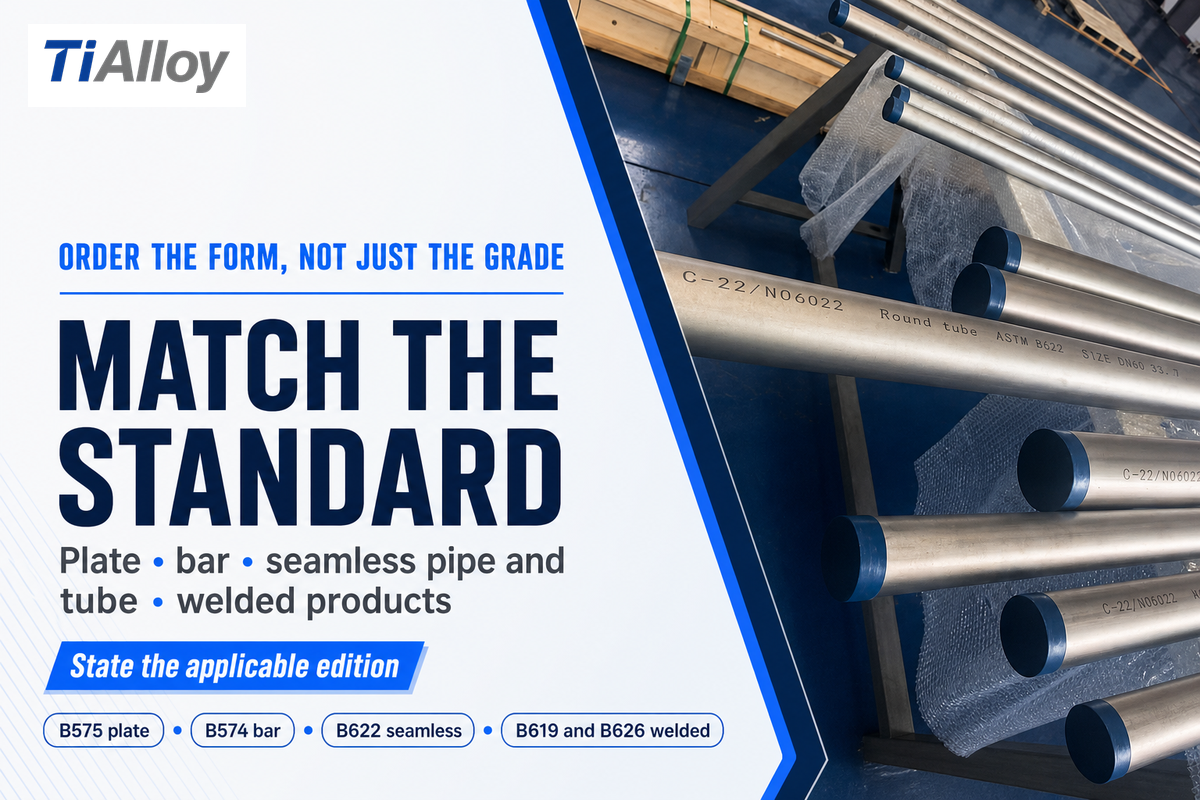
The naming of a designation for a complete order requires the alloy designation and standard of the product form. ASTM B575 does not cover every pipe, tube or bar requirement. The form matrix below separates plate, sheet, strip, rod, bar, pipe or tube made without a welded seam, welded pipe and welded tube so quality and purchasing review the correct scope.
| Product form | Standard | Enquiry dimensions | Acceptance focus |
|---|---|---|---|
| Plate | ASTM B575-17(2023) | T × W × L | Heat treatment, finish, flatness, tests |
| Sheet | ASTM B575-17(2023) | T × W × L | Thickness tolerance and finish |
| Strip | ASTM B575-17(2023) | T × W × coil or cut length | Edge, coil condition and tolerance |
| Rod | ASTM B574-23 | Diameter × L | Condition, diameter tolerance, tests |
| Bar | ASTM B574-23 | Shape / size × L | Form, machining allowance, test results |
| Pipe without a welded seam | ASTM B622-26 | OD or NPS × wall × L | Construction and ordered tests |
| Tube without a welded seam | ASTM B622-26 | OD × wall × L | Tube dimensions, condition, testing |
| Welded pipe | ASTM B619/B619M-19(2023) | OD or NPS × wall × L | Welded construction and inspection |
| Welded tube | ASTM B626-26 | OD × wall × L | Tube scope, weld condition, tests |
TiAlloy publishes a C276 plate envelope of 0.8–36 mm thickness, 650–2,000 mm width and 800–12,000 mm length. Those numbers give the boundaries of the supply envelope, and not necessarily every combination in stock. Review C276 plate, tube and bar details and request order-specific confirmation. The C22 product specifications page likewise states that size availability depends on the enquiry.
Evidence capsule: five standards cover nine form clusters. B622-26 and B626-26 represent the 2026 editions, and the other listed scopes represent the editions shown. Write the applicable edition into the purchase specification instead of assuming every form follows one document.
Procurement objection: Using the matrix to name a standard and edition supports a complete comparison and prevents an unresolved risk from progressing to fabrication or commissioning.
Compare C276 and C22 Prices on the Same Basis
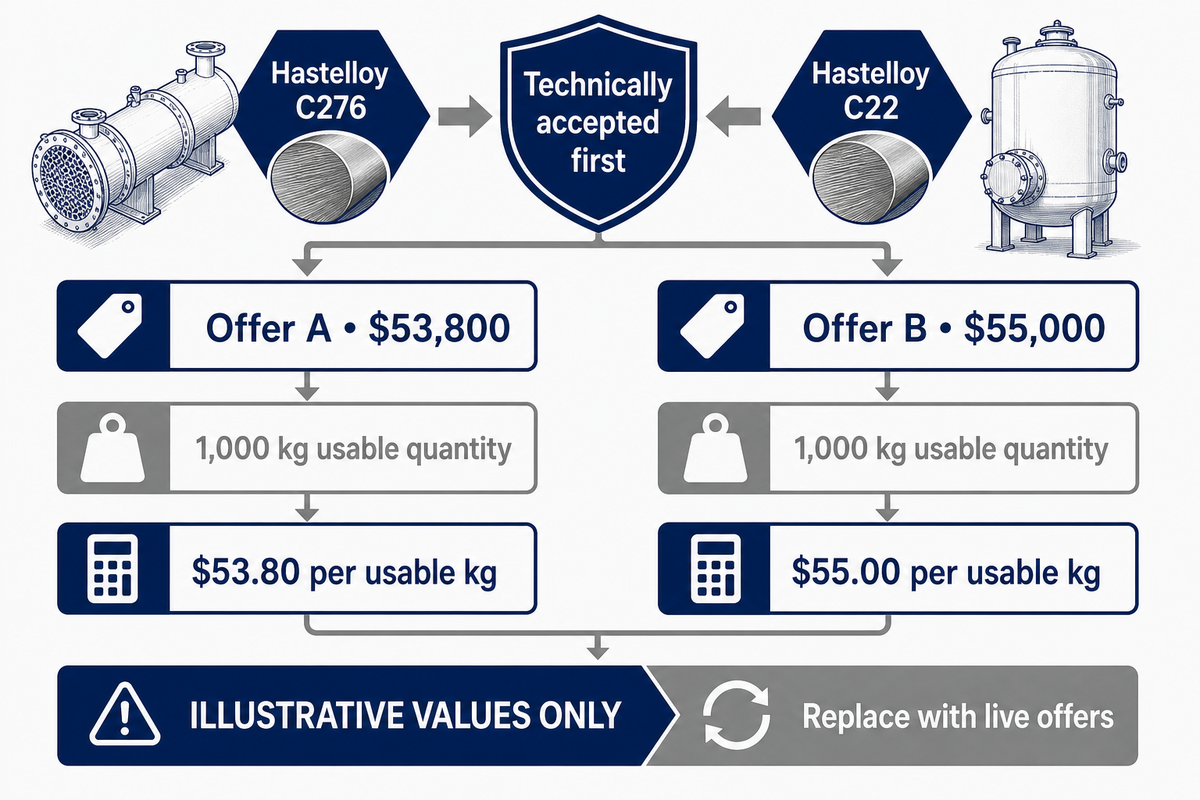
Fair price comparisons can be made after technical acceptance. Various factors can impact a total cost, including Nickel value, alloy conversion, form, dimensions, quantity, testing, cutting, packing, freight and delivery term. No defensible public evidence establishes a universal C22 premium, so the Comparable Quote Worksheet uses explicit hypothetical arithmetic rather than a market-price claim.
| Line item | Offer A | Offer B | Normalization action |
|---|---|---|---|
| Technically accepted grade | C276 | C22 | Compare only after both are approved |
| Usable quantity | 1,000 kg | 1,000 kg | Exclude unusable trim |
| Material | $50,000 | $52,000 | Illustrative values only |
| Cutting | Included | $800 | Put both on cut-size basis |
| Ordered testing | $1,200 | Included | Match inspection scope |
| Packing | $500 | $500 | Use the same export protection |
| Freight | $2,100 | $1,700 | Normalize destination and Incoterm |
| Normalized total | $53,800 | $55,000 | Sum the same scope |
| Normalized $/usable kg | $53.80 | $55.00 | $53,800 ÷ 1,000; $55,000 ÷ 1,000 |
The hypothetical offers begin only $2,000 apart on material. After cutting, tests, packing and freight are aligned, the difference becomes $1,200, or $1.20 per usable kilogram. Finance can now see the commercial difference, while engineering still owns alloy acceptance. A low unit price can’t compensate for an unapproved grade, missing inspection or unusable dimensions.
USGS reports a 2025 estimated annual average London Metal Exchange cash nickel price of $15,000 per metric ton, versus $16,812 in 2024. That commodity background doesn’t calculate a finished C22 or C276 quote. Alloy yield, conversion, form and order scope sit between commodity metal and delivered product.
Evidence capsule: the illustrative worksheet moves from material totals to $53.80 and $55.00 per usable kilogram on the same 1,000 kg basis. Replace every value with live offers; leave the nine comparison rows unchanged, so finance can see like for like scope.
Procurement objection: a quote normalization table can’t forecast lifetime costs. It supports a clean commercial comparison after corrosion, design and quality requirements have been accepted.
When Not to Buy C22 or C276 Yet
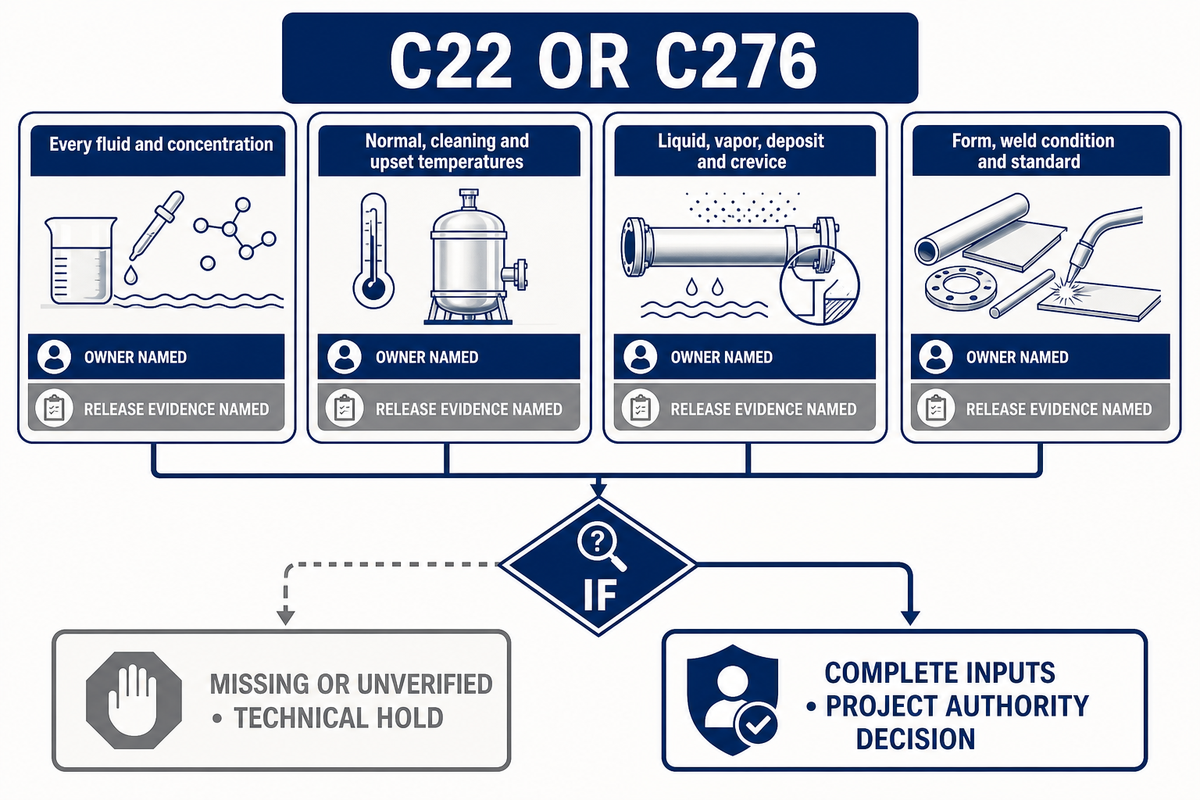
There should be no purchase of this kind while the service envelope, fabrication route, and/or acceptance basis aren’t defined. Neither overall corrosion resistance nor a well-known brand name fills the gaps. The right alloy may be C22, C276, Alloy 625 or something else, but an unresolved process case isn’t ready for material release.
Proceed to technical review
- Record every fluid species and concentration.
- Define normal, cleaning and upset temperatures.
- Map liquid, vapor, deposit and crevice locations.
- Name the product form, weld condition and standard.
Hold the order
- Do not infer a service life from one corrosion rate.
- Do not use an annealing number as a design limit.
- Do not accept a broad application list as approval.
- Do not compare quotations with different test scope.
Engineers also compare Hastelloy alloys when they evaluate adjacent families. Alloys like Hastelloy B and Hastelloy X are selected for different chemical environments or thermal requirements. Alloy 625 may enter for another mix of strength, fabrication and corrosion needs. Adding any of them to a shortlist may be warranted; calling them equivalents isn’t. A resistance to intergranular corrosion statement also needs the material condition and exposure that supports it.
Hastelloy C-22 also appears in broad claims that it provides better or gives it better protection than every alternative. This kind of wording removes the test boundary. Match the alloy for the actual duty, and leave “better” for a specified metric for a specified condition.
Evidence capsule: one published failure case involved 1,050 °C external heating and water mist, while one wet-chlorine comparison ran for 30 days at defined liquid and vapor locations. Neither test supports a purchase of unlabeled “severe service”.
Procurement objection: A technical hold isn’t a rejection of the supplier. It provides the supplier a defined basis for form, processing, inspection, and lead-time.
Industry Outlook: What 2026 Standard Updates Change for Buyers
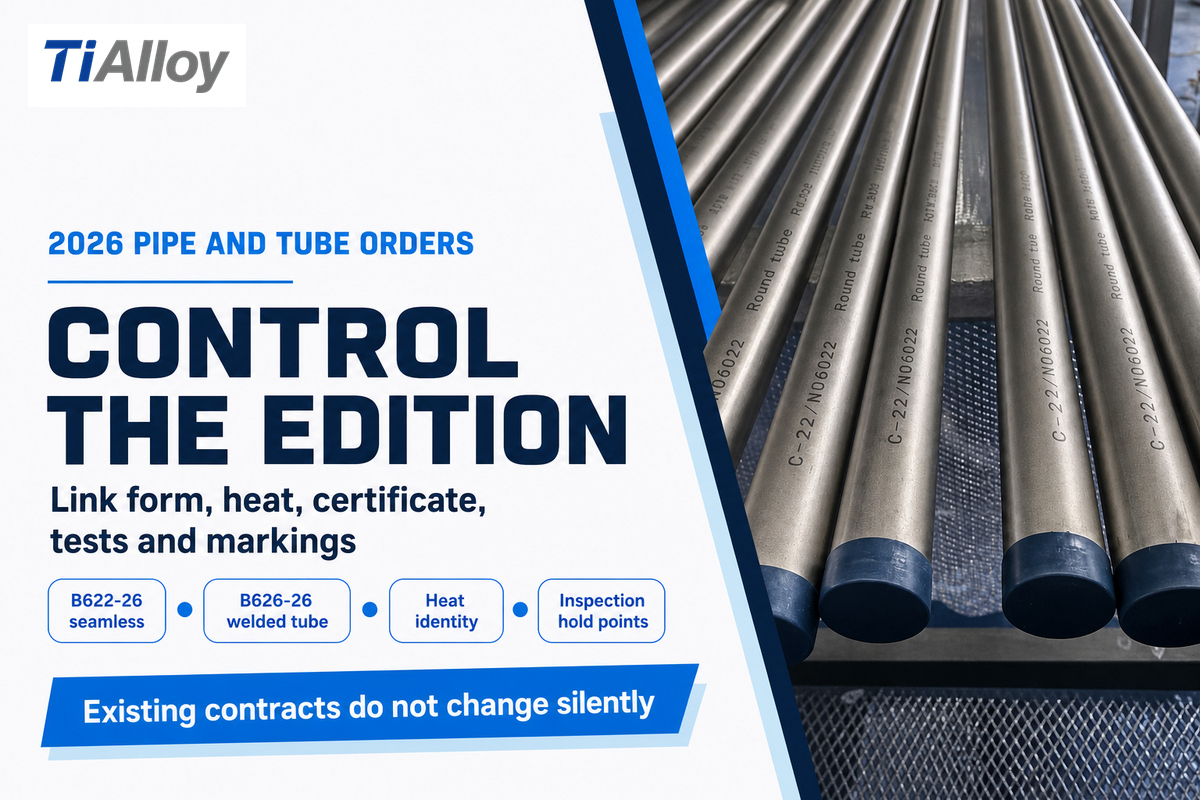
Current 2026 editions of ASTM B622 and B626 make edition control a practical purchasing issue for upcoming pipe and tube orders. This revision does not silently amend an existing contract. Buyers should state the product form and applicable edition, then align certificates, ordered tests, markings and hold points with that basis.
ASTM B622-26 covers nickel and nickel-cobalt alloy pipe and tube made without a welded seam, including N10276 and N06022 in its public scope. ASTM B626-26 covers welded tube. Plate, rod/bar and welded pipe remain bound to the listed standards. For a 2026 project, a specifier should thus check the edition instead of blindly copying a specification package from the past.
| Release item | Document or marking | Owner | Hold point |
|---|---|---|---|
| Grade identity | UNS and heat number | Quality | Before cutting |
| Product form | Ordered ASTM edition | Engineering | Before purchase approval |
| Chemistry and mechanics | Mill test certificate | Quality | Before material release |
| Supplementary tests | Ordered reports | Project inspector | Before shipment |
| Dimensions and finish | Inspection record | Supplier and buyer | Final inspection |
TiAlloy states that its metal-materials business has more than 20 years of manufacturing experience and operates a production base exceeding 30,000 m². Those company facts describe supply capability, not the acceptance of a particular heat or an ISO certificate. Buyers can review the TiAlloy material supply team background, then place order-specific evidence on the release checklist.
For quotation requests for projects in 2026, include grade, form, edition, dimensions, quantity, condition, inspection, packing and destination. TiAlloy supports nickel alloy supply for chemical processing. The project engineer retains the authority to select the material in question. The broader nickel alloy material range can be reviewed if neither candidate has adequate evidence.
The release checklist template can be copied and pasted into a request for quote. The term “project value” refers to the approved service input or ordered requirement; the verification column indicates evidence which closes the row.
RFQ checklist — copy these into your quote request:
| Parameter | Recommended range | Why it matters | How to verify |
|---|---|---|---|
| Grade and UNS | Project-approved value | Prevents name ambiguity | Purchase order and MTC |
| Product form / standard | Applicable current or contract edition | Separates plate, pipe, tube and bar | Approved specification |
| Dimensions and quantity | Drawing or T × W × L / OD × wall × L | Controls feasibility and usable yield | Quote and dimensional report |
| Service chemistry | Normal, cleaning and upset values | Defines the corrosion case | Approved process basis |
| Temperature and exposure | Normal and peak project values | Separates service from heat treatment | Design data sheet |
| Fabrication condition | Weld, filler, heat treatment, finish | Controls local condition | Procedure and inspection plan |
| Inspection package | Project-required tests and certificate | Defines release evidence | ITP, MTC and reports |
| Delivery basis | Destination, Incoterm, packing, date | Creates a comparable total | Commercial quotation |
Evidence capsule: two standards were changed to the 2026 edition, while five product standards govern different forms. Define one applicable edition per ordered form and specify the heat number to link the marking, certificate and delivered material.
Procurement objection: A management system certificate doesn’t replace order evidence. Release the material against its heat identity, governing product specification and ordered inspection package.
Frequently Asked Questions
What is the material equivalent of Hastelloy C22?
Hastelloy C22 is commonly identified as Alloy C-22 and UNS N06022.
W.Nr. 2.4602 is another designation used in trade. These identifiers help specify the grade, but they do not approve a substitution. Match the product standard, supply condition, certificate and project requirements before accepting material under another broadly similar commercial name. The relevant ASTM scope and ordered heat treatment still govern acceptance.
What is another name for Hastelloy C276?
Buyers also use Alloy C-276 and UNS N10276 for Hastelloy C276.
W.Nr. 2.4819 appears in European material designations. Put the exact grade, product form and ordered specification on the enquiry. A similar trade name alone doesn’t establish the material producer, supplied condition or compliance with the purchase order. Check the certificate and marking against that specification before the final material release.
What is C22 Hastelloy?
Hastelloy C22 is a nickel-chromium-molybdenum alloy containing tungsten.
It’s commonly identified by UNS N06022. Its higher chromium content distinguishes it from C276 and supports resistance in many oxidizing chemical environments. Selection still requires the medium, concentration, temperature and fabrication condition; the name doesn’t guarantee suitability for every chloride-bearing process. Review welded areas and crevices separately where they exist.
Is Hastelloy C276 expensive?
C276 generally requires a different purchasing comparison from ordinary stainless steel.
Obtain current quotations for the specified form, dimensions, quantity and inspection package. Compare technically acceptable offers on the same delivery basis; a price per kilogram alone hides meaningful differences.
What is Hastelloy C22 used for?
C22 is considered for demanding chemical process equipment, including some oxidizing chloride and mixed-acid duties.
The alloy also appears as plate, tube or bar for different fabrication routes. For a reactor or heat exchanger, provide normal operation and cleaning conditions before seeking a recommendation. A published application list identifies candidate uses, not blanket approval for the equipment, fluid mixture or design code.
What is Hastelloy C276 used for?
C276 is considered for reactors, heat exchangers, piping and components in chemical processing plants.
Suitability depends on the complete exposure and supplied condition. Confirm corrosion performance and the governing product specification before treating an application example as approval.
Are Hastelloy C-22 and C-276 available in sanitary tubing and fittings?
Specialist suppliers offer the two Hastelloy grades in tubing and fitting forms, but sanitary suitability is separate.
Confirm dimensions, surface finish, weld construction, cleaning compatibility and the applicable hygienic or project standard. TiAlloy’s public industrial listings don’t establish sanitary certification, a particular polishing capability or ready stock. State those requirements before requesting a quotation.
Send a Condition-Complete Alloy Enquiry
Provide the medium, concentration, normal and upset temperature, exposure location, fabrication route, product form, dimensions, quantity, standard edition and inspection package for the proposed order. TiAlloy can confirm supply options and quotation scope; your project authority can complete the service-material approval.
References and Sources
- Haynes International: HASTELLOY C-276 alloy
- Haynes International: HASTELLOY C-22 alloy
- Haynes International: C-22 and C-276 alloys in saturated wet chlorine
- NIST: Using laboratory measurements to predict corrosion service lives
- Failure Analysis of a C-276 Alloy Pipe in a Controlled Decomposition Reactor
- ASTM B575-17(2023)
- ASTM B574-23
- ASTM B619/B619M-19(2023)
- ASTM B622-26
- ASTM B626-26
- USGS Mineral Commodity Summaries 2026: Nickel
Technical content prepared from the cited public sources and the stated client supply information. Author: XCX. Final material selection, code compliance and service approval remain with the project engineering authority.