Get in Touch with TiAlloy Company


Titanium Tube & Pipe refers to the industrial tube-and-pipe product forms addressed by this guide.
Titanium Tube & Pipe requests become difficult to compare when they name only a grade, diameter, or familiar standard. Missing details may concern product form, dimensional convention, application scope, manufacturing route, inspection, documentation, or the construction rules that sit above the material specification.
This is an educational engineering and procurement guide. Readers can use it to turn a service need into a controlled request, but it doesn’t select material for a specific design or provide legal, welding, pressure-system, aerospace, or medical approval.
Scope notice
Standards and regulations change. Confirm the current edition with the responsible materials engineer, fabricator, inspection authority, and, where applicable, the authority having jurisdiction or notified body. Numerical chemistry limits, pressure ratings, and universal welding parameters are intentionally not reproduced here.
1. Titanium Tube or Pipe? Start with the Dimensional Language
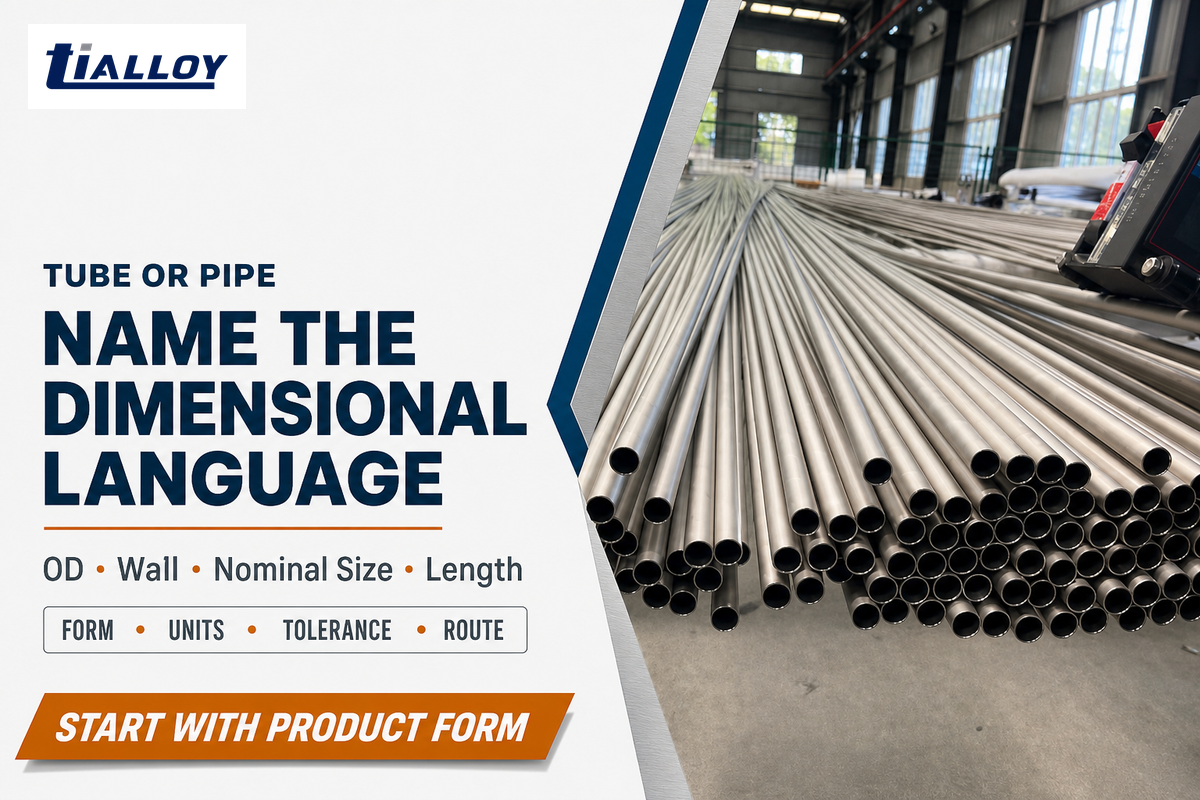
A typical order for tube will refer to an outside diameter and a wall thickness, while a common description of a pipe may refer to a nominal pipe size and a wall size classification (e.g. schedule). These are commonly used terms, but don’t constitute a complete inspection instruction.
Governing specifications, such as the product-specific scopes shown in ASTM B338, drawings, allowable tolerances, units, service condition and inspection methods still determine what the supplier must deliver.
Procurement should first translate the everyday noun into a measurable line item rather than debate whether tube or pipe is the “correct” word. For example, “25 mm titanium tube” leaves at least the wall, tolerance basis, length, grade, condition, route, end state, surface, testing, and document package unresolved.
| Term in the request | What it can establish | What remains unresolved | Buyer action |
|---|---|---|---|
| Tube | A product-form intention | Scope, outside diameter, wall, route | Name specification and dimensions |
| Pipe | A fluid-conveyance or piping intention | Nominal size, wall basis, construction code | Name all three |
| Outside diameter | One external dimension | Tolerance, ovality, wall, method | Add the controlling basis |
| Nominal pipe size | A conventional nominal designation | Actual dimensions and wall designation | State schedule or ordered wall |
| Wall thickness | A nominal material thickness | Minimum or average basis and tolerance | Define the acceptance basis |
| Seamless | A route family | Tests, surface, condition, suitability | Compare the complete route |
| Welded | A fabricated route family | Weld process, examination, acceptance | Add project controls |
| Grade 2 or Grade 5 | An alloy designation | Form, condition, service, approval | Bind grade to a specification |
| Standard length | Almost nothing measurable | Length, tolerance, random/fixed basis | State the ordered length rule |
| Mill certificate | A requested document category | Issuer, results, heat link, required tests | List required content and linkage |
Search language isn’t a material specification
Treat discovery terms such as titanium round, titanium round tube, round tubing, straight tube, titanium products, titanium round bar, rod, filler rod, stainless steel, or tubing for industrial use as unverified search language until the product form and source are confirmed. A result that says metal, pure, CP1, lightweight, straight, precision, high-quality, high-performance processing, high strength, strength of titanium, or corrosion resistance still does not define a controlled property, weight, component requirement, grade, condition, or quality control plan.
Likewise, isolated wall fragments such as 1mm, 1.2mm, or .065 and service labels such as marine, automotive, aerospace industry, or aerospace applications are not order callouts. Build the selection of titanium from approved project inputs that define the construction basis, loads, environment, and inspection path for the actual application.
This guide does not turn that wide range of search language into technical equivalence or supplier endorsement. It keeps tube and pipe specification decisions tied to controlled project sources.
Consumer exhaust tubing, retail stock listings, titanium bar, and decorative tube belong to other buying paths. This guide concerns industrial material where the order, inspection evidence, and downstream fabrication must agree.
2. Build a Dimension Callout from OD, Wall, and Length
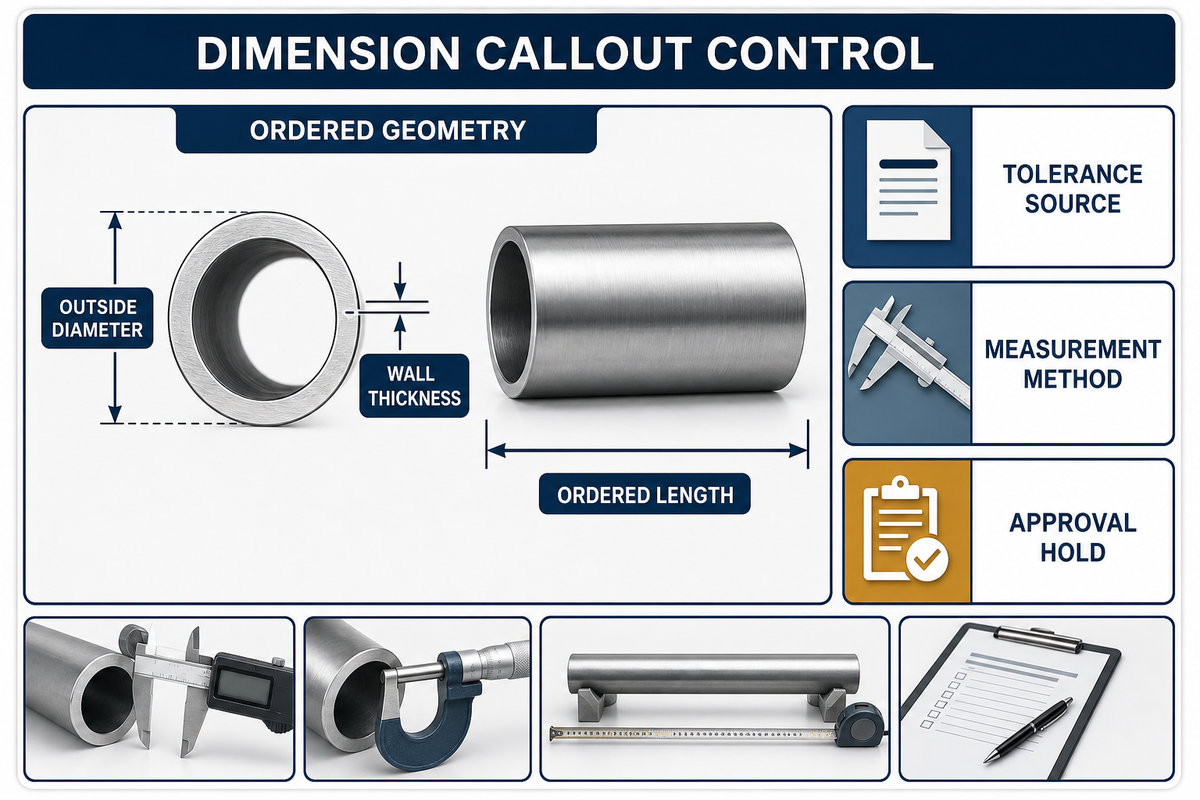
An inspectable callout addresses four questions: what geometry was ordered; what source of tolerance controls it; how the value will be measured; and what deviations need a written hold for approval. “Per standard” is only workable when both the standard number and the revision is referenced; and any out-of-standard drawing requirements are made visible.
For tube: Outer diameter first, followed by the wall thickness, then the ordered length. To that, you add outside diameter tolerance, wall basis, ovality if functional, straightness, cut end condition/surface, and units.
For pipe, specify nominal pipe size, schedule or ordered wall, length basis, ends, and apply the dimensions/project rule. Mixed inch/mm orders should mention the controlling unit instead of assuming conversion will take care of rounding.
Worked notation example, not a design recommendation
“Titanium tube, Grade 2, ASTM B338-17(2026), seamless, annealed; 25.4 mm outside diameter × 1.65 mm nominal wall × 6,000 mm fixed length; dimensional tolerances and tests per the stated specification and purchase order; ends square-cut and deburred; heat-linked report required.”
This example is still incomplete for a real project until service, fabrication, surface, quantity, packaging, construction rules, and any tighter drawing limits are resolved. Its purpose is to show the structure of an orderable sentence.
Apply the same discipline to a piping line. “NPS 2 titanium pipe” isn’t a wall callout. Buyers must name the schedule or wall requirement, applicable pipe specification and revision, route, grade, condition, end preparation, length, test package, and the construction code or project specification where one applies.
3. Use ASTM B338, B861, and B862 Only Within Their Scope
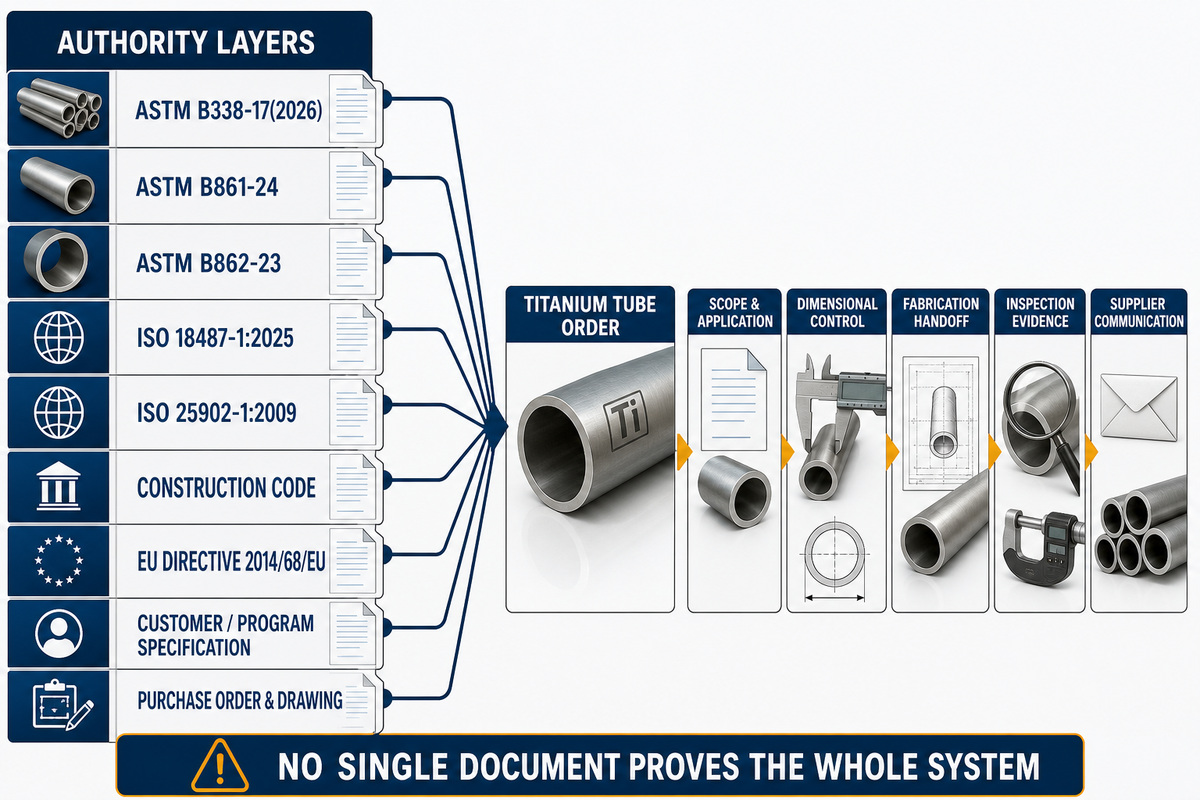
A standard number is useful only when its scope fits the product and application. Three ASTM designations often seen in titanium requests cover different product paths. None forms an exhaustive list or replaces a finished system’s construction and conformity requirements.
According to the official page, ASTM B338-17(2026) covers seamless and welded titanium and titanium-alloy tubes for surface condensers, evaporators, and heat exchangers. Those application words matter. B338 should not be expanded into a general-purpose rule for every item called titanium tube.
ASTM B861-24 addresses seamless titanium and titanium-alloy pipe, while ASTM B862-23 addresses welded pipe. Their published scopes identify general corrosion-resisting and elevated-temperature service. Broader wording does not make either an automatic choice for every system.
| Layer | Public role | Trigger question | What it does not prove alone |
|---|---|---|---|
| ASTM B338-17(2026) | Named heat-exchanger tube scope | Is this condenser, evaporator, or heat-exchanger tube? | General tube or system approval |
| ASTM B861-24 | Seamless pipe material scope | Is seamless pipe the ordered form? | Pressure design or joining approval |
| ASTM B862-23 | Welded pipe material scope | Is welded pipe the ordered form? | Fabricated system conformity |
| ISO 18487-1:2025 | Aerospace tubing example | Does an aerospace program govern? | Eligibility for a specific aircraft program |
| ISO 25902-1:2009 | Eddy-current examination scope | Is this examination invoked by the order? | Complete acceptance or design suitability |
| Construction code | Rules for the finished equipment or piping | Which code and edition govern? | Material identity by itself |
| EU Directive 2014/68/EU | Pressure-equipment safety and conformity | Will equipment enter the European market? | Compliance from an ASTM certificate alone |
| Customer/program specification | Project-specific eligibility and additions | Are approved sources or extra tests required? | General market acceptance |
| Purchase order and drawing | Contractual line-item definition | Which requirements and deviations were agreed? | Engineering correctness without review |
The official ISO 18487-1:2025 page supplies a useful counterexample: it covers seamless titanium-alloy aerospace tubing intended primarily for systems operating at 35 MPa (5,080 psi). Do not substitute that document into an industrial heat-exchanger order. Instead, use it to recognize that application can change the standards path.
For pressure equipment placed on the European market, Directive 2014/68/EU establishes duties related to design, manufacture, inspection, and conformity assessment. A B861 or B862 material report can be one input, but it doesn’t complete those equipment-level obligations. Coordinate the material order with the equipment designer, fabricator, and applicable conformity route.
If you’re having a difficult time understanding product-form terminology, you may wish to use the website product-form-and-standard-crosswalk as an intake aid during the ordering process. Controlled standards and project documents remain authoritative.
4. Choose Seamless or Welded by the Acceptance Path
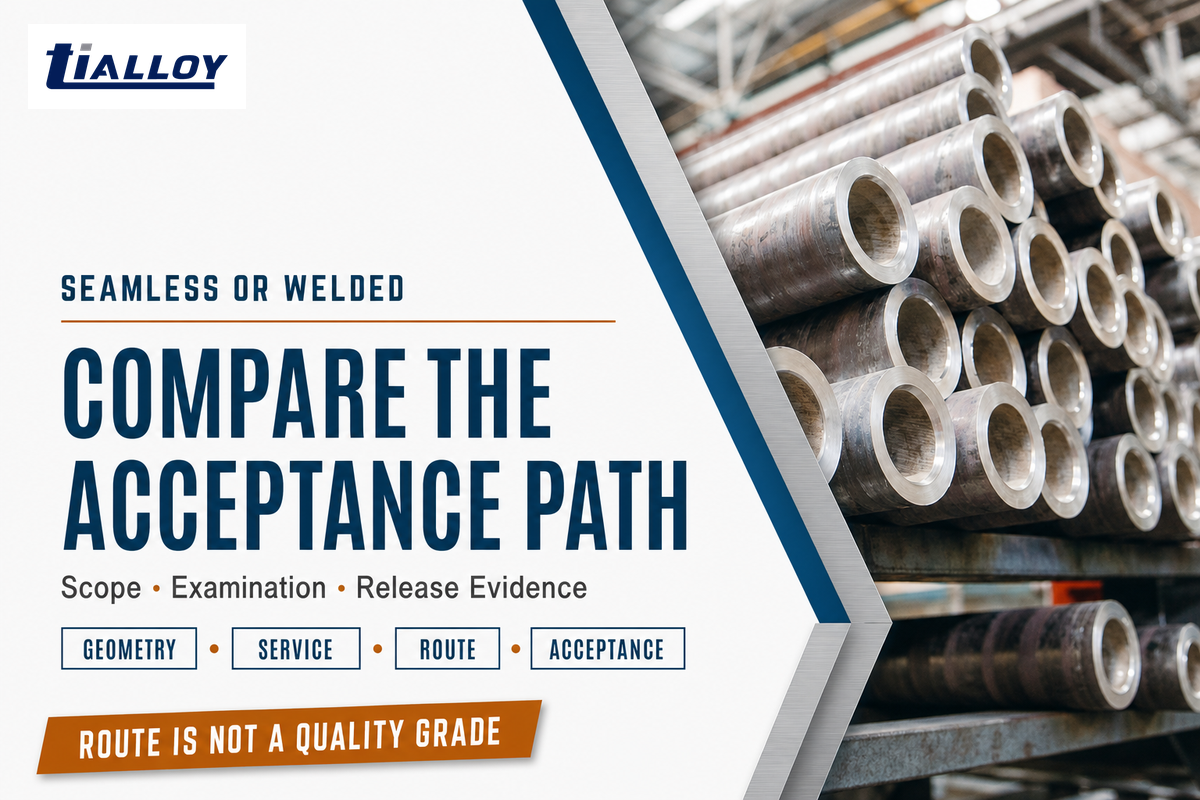
“Seamless is better” isn’t a specification. B338 itself includes both seamless and welded tube within its defined scope, with route-specific manufacture and examination provisions. Route choice becomes defensible when geometry, service, availability, fabrication, inspection, and acceptance fit the project, not because one noun carries a universal quality rank.
| Decision question | Why it matters | Evidence to request | Do not assume |
|---|---|---|---|
| Which product specification applies? | It defines the permitted form and route | Designation and revision | Tube and pipe use one rule |
| Is a weld present? | It changes manufacturing and examination questions | Route declaration and required examination | A hidden weld is acceptable |
| What dimensions are practical? | Route capability varies by geometry | Quoted range and deviation list | Catalog range equals project capability |
| What service consequence applies? | Inspection rigor follows risk and code | Design basis and inspection plan | Route alone proves fitness |
| Will the material be bent or welded again? | Downstream work can change condition and geometry | Fabrication handoff | Mill acceptance covers shop work |
| What examination is required? | Methods differ by route and order | Method, coverage, acceptance, records | “Tested” is enough |
| Can each quote meet the same scope? | A cheaper route may exclude evidence | Line-by-line compliance statement | Unit price is normalized |
| Are deviations permitted? | Uncontrolled substitutions break comparability | Written deviation register | “Equivalent” is self-approving |
| Who approves the final route? | Authority cannot be delegated silently | Named buyer/engineer approval | The supplier owns the design decision |
A manufacturing route is not a quality grade. The defensible comparison is route + scope + examination + release evidence.
5. Use the 4-Gate Scope-to-Release Route
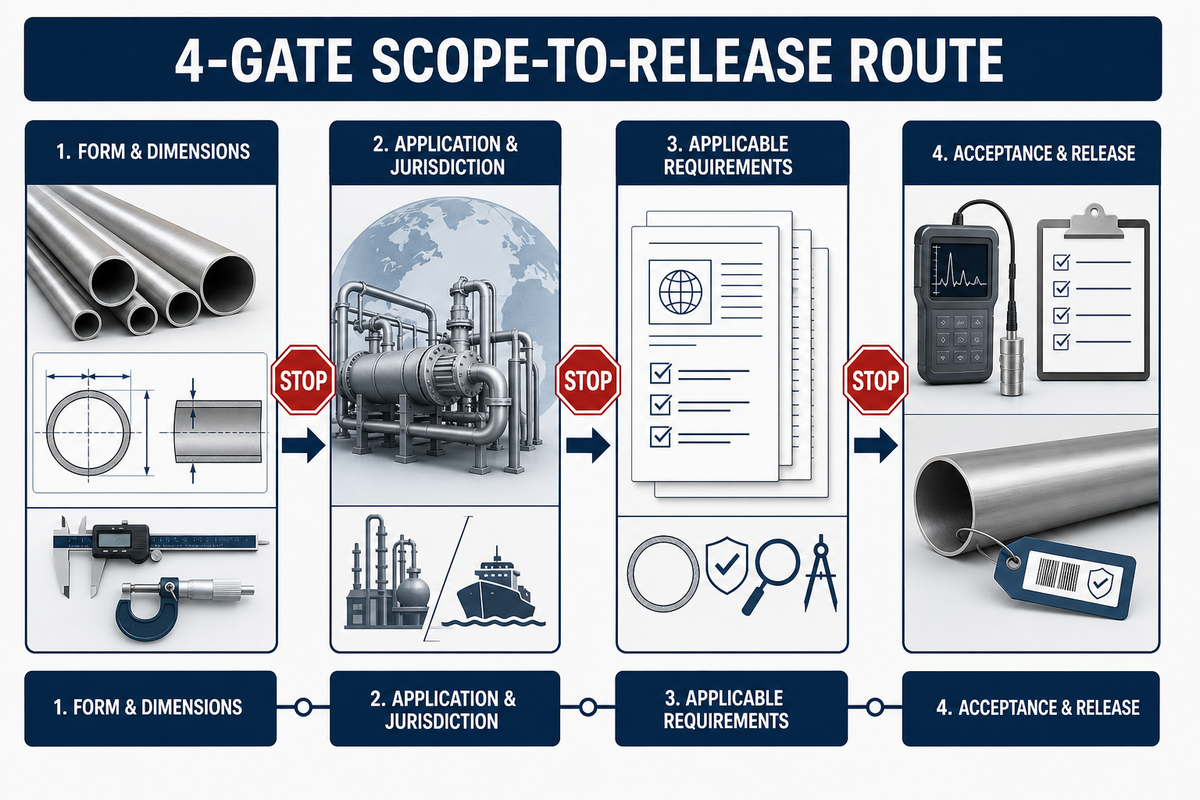
Each line item advances only when one gate produces an explicit input for the next.
| Gate | Decision | Required output | Stop condition |
|---|---|---|---|
| 1. Form and dimensions | Tube or pipe; OD/wall or NPS/wall basis; route and geometry | Inspectable dimensional callout | A supplier can interpret the geometry two ways |
| 2. Application and jurisdiction | Service, temperature, pressure/load, consequence, market and program | Approved design and authority inputs | The application boundary is unknown |
| 3. Applicable requirements | Material specification, construction code, grade, condition, fabrication controls | Controlled document and revision list | A named standard is outside scope |
| 4. Acceptance and release | Tests, sampling, marking, reports, deviations, packaging | Order-ready evidence schedule | A pass/fail result cannot be tied to the delivered material |
Gate 2 is where grade selection begins. Record fluid or atmosphere, concentration and contaminants where relevant, operating and upset temperatures, pressure or mechanical load, expected fabrication, inspection access, failure consequence, expected life, and the governing authority.
A corrosion table or familiar alloy number can help frame questions; it can’t simulate the actual service.
Interstitial chemistry requirements-including hydrogen-are grade- and specification-specific.
Public ASTM abstracts confirm that chemical requirements exist but do not expose all numerical tables. Do not copy a single parts-per-million value from a supplier page and apply it to every grade. Put the exact controlled table and grade on the technical review check list.
A titanium grade selector can organize early questions, while the Grade 2 titanium guide provides grade-specific background. Neither replaces project approval or the current material standard.
6. Hand Fabrication Requirements to the Shop Before Material Release
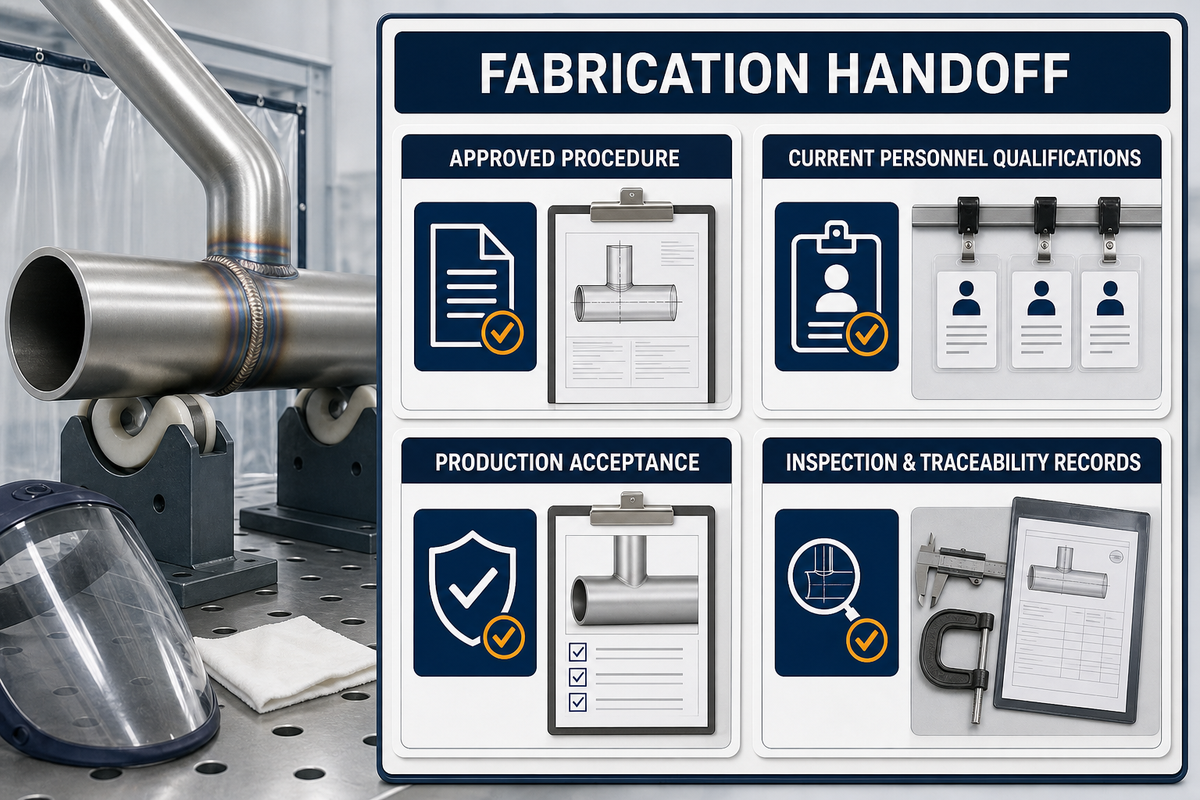
Material can meet its mill specification and still be unsuitable for the planned shop sequence. Bending can introduce springback and section change; titanium welding adds joint preparation, cleanliness, shielding, filler, heat input, distortion, and inspection questions.
Purchase handoffs should name those operations before the supplier commits the condition, length, end state, and test package.
A peer-reviewed tube-bending study shows that springback and section change depend on coupled forming conditions.
No universal bend radius for every titanium grade and tube follows from that study. Its buyer value is narrower: give the fabricator the grade, condition, geometry, bend requirement, tooling constraints, surface condition, and acceptance measurements before material release.
Before release, ask the responsible welding engineer whether the governing project code separately controls procedure qualification, personnel qualification, production-weld acceptance, or inspection records.
Four welding-control questions, verify against the governing code
- Which approved procedure and supporting qualification record govern the joint?
- Which personnel or operator qualifications must be current for the work?
- Which production-weld acceptance criteria and examination methods apply?
- Which inspection, nondestructive-examination, repair, and traceability records must join the release package?
These are review questions, not claims that one code imposes the same documents on every project. Do not infer the answers from a material report or a personnel credential; confirm them against the applicable construction code and the responsible welding engineer’s approved project documents.
Can titanium be welded?
Yes, titanium can be welded using a qualified process and suitable controls. What matters to procurement is whether the material condition, joint design, cleanliness plan, shielding, filler selection, procedure qualification, personnel, production inspection, repair limits, and required records align with the project. Generic online parameters cannot resolve those dependencies.
7. Reconcile Heat Identity, Tests, and Release Documents
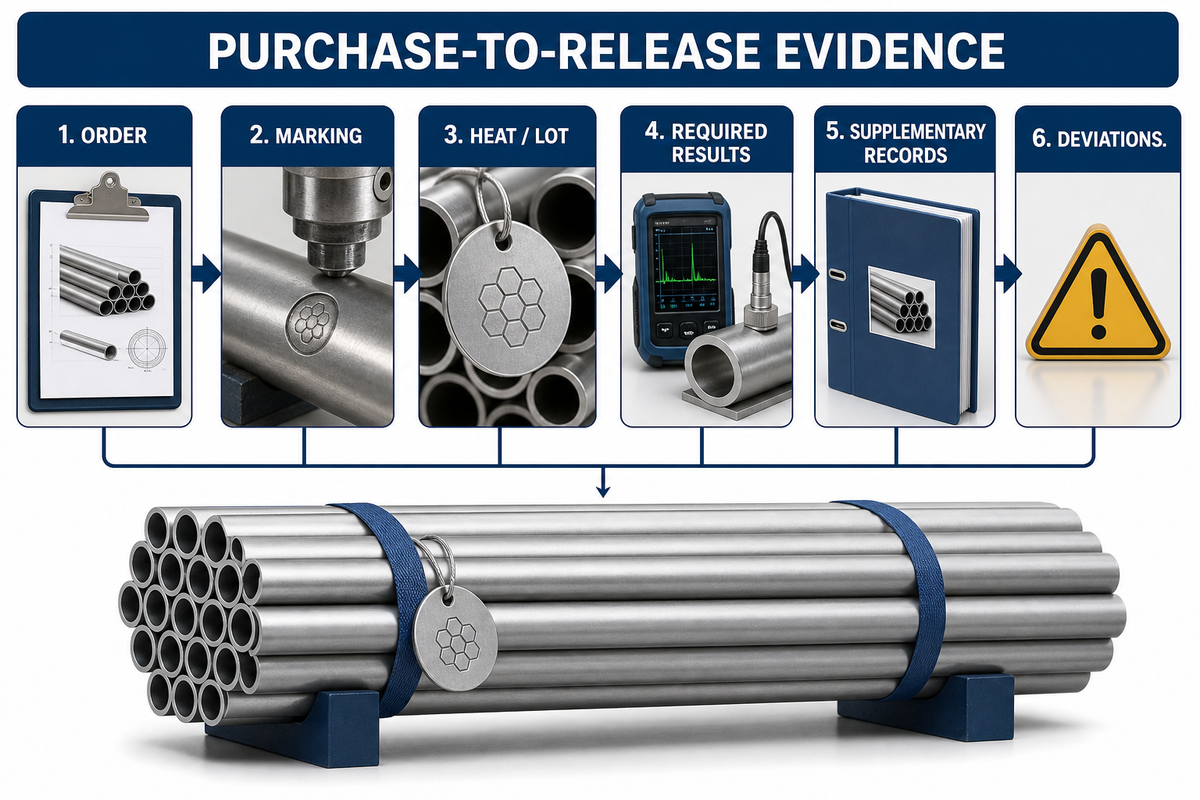
Material test reports have meaning as long as they correlate to the ordered requirement and delivered material. A title alone, when you read it, doesn’t prove you got tested to order, didn’t miss a requirement result, or it got delivered with your order piece.
| Link | Receiving question | Evidence | Failure mode |
|---|---|---|---|
| 1. Order | What was contractually required? | Purchase order, drawing, revisions | The order itself is ambiguous |
| 2. Marking | Does the delivered item carry the required identity? | Product marks and transfer records | Cut pieces lose identity |
| 3. Heat/lot | Can item and report be connected? | Heat, lot, batch, or spool mapping | A report belongs to other material |
| 4. Required results | Are chemistry, mechanical, dimensional, and other results complete? | Report values, methods, sampling | A required result is missing |
| 5. Supplementary records | Were extra tests or witnesses invoked? | Nondestructive, hydrostatic, witness, or inspection records | A base certificate hides exclusions |
| 6. Deviations | What changed from the order, and who approved it? | Deviation and concession register | An informal substitution reaches production |
For welded pipe of NPS 8 and larger, the B862 public scope deserves special attention. B862 notes that this size is often custom made, asks the purchaser to consider applicability carefully, permits a wall thickness outside the referenced table when operating conditions require it, and allows selected provisions or optional supplementary requirements to be invoked by the order. That makes the purchase-to-release chain more, not less, important.
8. Build an 8+4 Titanium Tube-or-Pipe RFQ Control Sheet
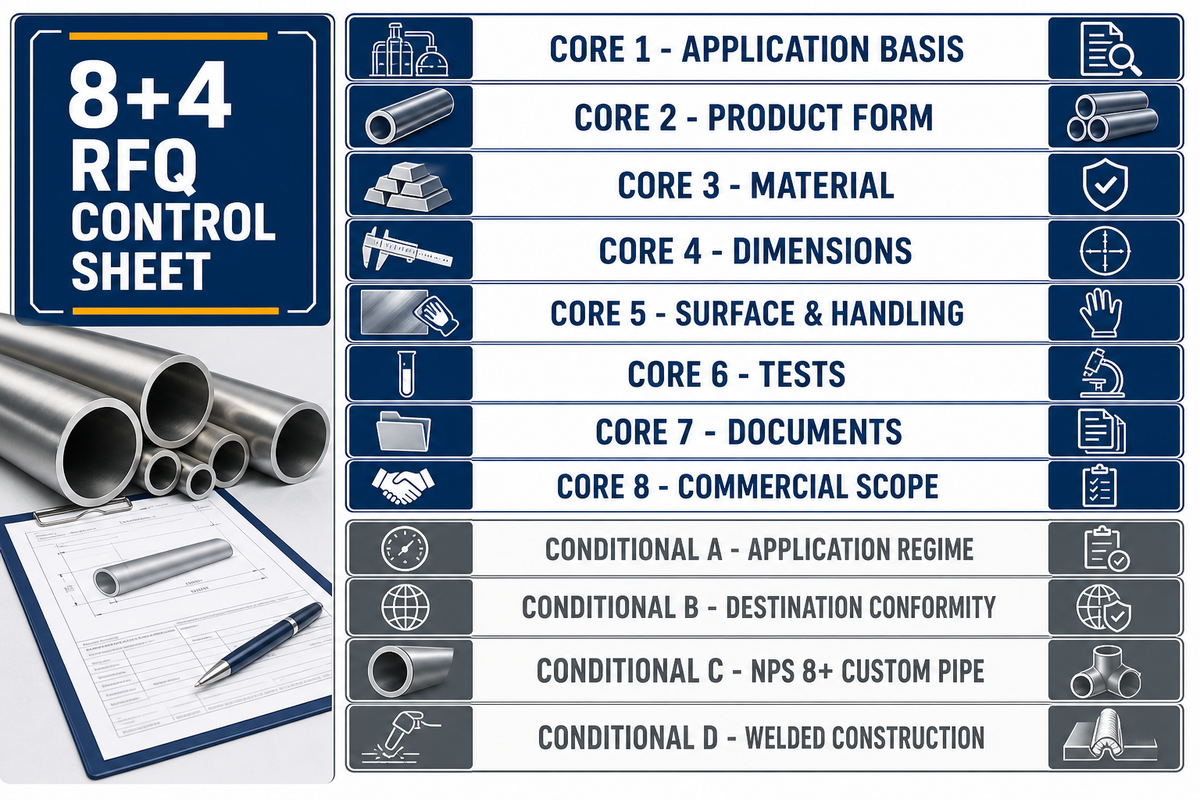
The 8+4 Tube-or-Pipe RFQ Control Sheet separates minimum quote fields from conditional modules. Eight core rows normalize ordinary quotations, while 4 additional rows activate only when the application, destination, size, or fabrication path triggers them. This remains an editorial procurement tool, not a standard.
| Control type / row | Minimum entry | Primary owner | Quote comparison check |
|---|---|---|---|
| Core 1—application basis | Service; temperature (°C); pressure (MPa) or mechanical load (kN); consequence | Plant/design | Same design inputs priced |
| Core 2—product form | Tube/pipe, seamless/welded, dimensional convention | Engineering | No silent form substitution |
| Core 3—material | Grade, condition, material specification and revision | Materials/quality | Same authority and condition |
| Core 4—dimensions | OD (mm) or NPS; wall (mm); length (mm); tolerance basis; ends | Engineering/procurement | Identical usable geometry |
| Core 5—surface and handling | Finish or roughness (µm Ra), cleanliness, protection, identification | Fabrication/quality | No unpriced finishing gap |
| Core 6—tests | Methods, sampling, acceptance, witness needs | Quality | Test scope shown line by line |
| Core 7—documents | Heat-linked reports, inspection records, language | Quality/procurement | Evidence package included |
| Core 8—commercial scope | Quantity (m or pieces), packaging and mass limit (kg), delivery basis, deviations | Procurement/finance | Landed scope is comparable |
| Conditional A—application regime | Aerospace, medical, customer, or sector-specific rules | Program authority | Eligibility explicitly addressed |
| Conditional B—destination conformity | Construction code, directive, assessment route | Designer/compliance | Material and equipment duties separated |
| Conditional C—NPS 8+ custom pipe | Applicability, selected provisions, wall, supplementary tests | Engineering/procurement | Custom assumptions disclosed |
| Conditional D—welded construction | Procedure, personnel, production acceptance, inspection records | Welding/quality | Each required record is priced |
Worked comparison: why the lowest unit price may not be the lowest controlled cost
Consider three quotations for 120 fixed-length tubes. Quote A includes the stated material revision, fixed lengths, the requested examination, heat-linked reports, end protection, and export packing. Quote B lists a lower unit price but changes fixed lengths to random lengths and excludes two inspection records. Quote C appears close to A until the deviation register reveals a different supplied condition and a longer documentary-review window.
Procurement should not average those prices. First normalize usable quantity, cutting loss, inspection scope, report review, packaging, and every accepted deviation. Quality then decides whether missing evidence can be recovered without reinspection. Plant and fabrication teams estimate whether random lengths or a changed condition add cutting, setup, scrap, bending, welding, or schedule risk. Finance compares the controlled landed scope, not the original unit-price column.
No invented savings percentage is needed. The decision becomes visible through the 12 control rows: a quote is comparable only when each row is included, excluded, or priced as an approved alternative. If an exclusion cannot be valued or technically approved, keep it outside the commercial ranking until clarification closes the gap.
Core 8 exposes the finance consequence: a lower unit price may exclude fixed lengths, inspection, packaging, traceability, or documentary review. Procurement should normalize those exclusions before comparing totals. Quality owns the evidence gap; plant and engineering own the risk of material that arrives but cannot be released or fabricated as planned.
Teams can use the RFQ readiness calculator and quote coverage estimator to organize the fields. Treat the completed control sheet, approved drawing, and current project documents as the actual handoff.
Frequently Asked Questions
Titanium tube versus titanium pipe
Tube commonly uses outside diameter and wall thickness; pipe often uses nominal pipe size plus a schedule or ordered wall. Neither label completes an order without the governing specification and acceptance fields.
What does ASTM B338 cover?
ASTM B338-17(2026) covers seamless and welded titanium and titanium-alloy tubes for surface condensers, evaporators, and heat exchangers. This application-limited material specification does not approve a finished pressure system, aerospace installation, medical device, or other regulated product. Buyers should verify the current edition and the construction rules that govern the finished equipment.
Heat identity in receiving
Heat identity links delivered material to its reports. Receiving should reconcile that identifier across the item and order.
Does a material test report prove the tube is fit for service?
No. Reports can document material identity and results against stated purchase requirements, but their value depends on issuer authenticity, heat or lot linkage, required methods, sampling, and complete results. Fitness for service is a wider decision involving design conditions, product form, grade and condition, fabrication history, construction rules, corrosion environment, inspection plan, acceptance criteria, source eligibility, and approved deviations. A certificate cannot repair an ambiguous order, approve an unqualified fabrication process, or satisfy a destination-market conformity assessment by itself.
Responsible project authorities must reconcile those layers for the actual equipment.
Turn the Guide into a Controlled Supplier Conversation
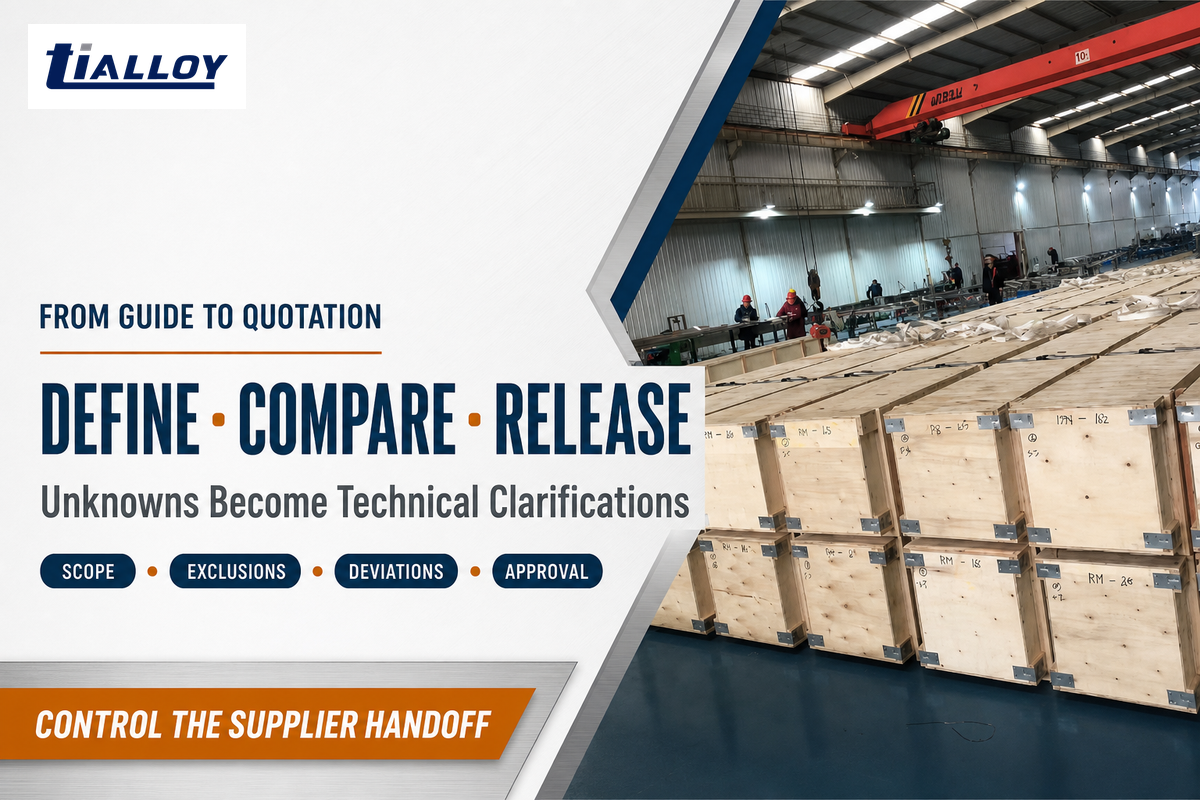
Before contacting suppliers, complete the 4-Gate route and the 8+4 control sheet. Mark unknown inputs for technical clarification rather than allowing a quotation to choose them silently. Ask each supplier to identify exclusions and deviations against the same numbered rows.
For product-form confirmation and order-ready supply discussions, continue to TiAlloy titanium tube and pipe supply options. Keep the commercial conversation downstream of the engineering scope: the selected material, tests, and documents still require project review and written approval.
References & Sources
- ASTM B338-17(2026) official scope page
- ASTM B861-24 official scope page
- ASTM B862-23 official scope page
- ISO 18487-1:2025 official scope page
- ISO 25902-1 eddy-current examination scope
- Directive 2014/68/EU on pressure equipment
- ASME Boiler and Pressure Vessel Code 2025 overview
- Peer-reviewed titanium-alloy tube-bending study
- Critical steps for TIG welding titanium tubing