Get in Touch with TiAlloy Company


Updated October 2026
Titanium heat exchanger tubes are bought as pressure-boundary components, but acceptance requires more than a grade name. A defensible specification connects both fluids, temperature, deposits, tube form, tubesheet joint, inspection, evidence of cleaning, the consequence of a leak, and more, prior to issuing a request for quote.
Quick specifications to settle first
- Component: tube stock, fabricated U-bend, tube bundle, or complete exchanger
- Service basis: composition and temperature of both fluids, including startup, cleaning, and upset cases
- Material basis: grade, governing product specification and edition, construction route, and dimensional basis
- Interface basis: tubesheet material, joint method, support, inspection, and release documents
Titanium heat exchanger tubes should be selected through a service-and-evidence chain, not merely on corrosion reputation. Define both fluids and interfaces, shortlist the grade and tube form, qualify the joint, specify inspection, and release only the records tied to the lot and order.
Key decisions at a glance
- A low general-corrosion rate doesn’t rule out crevice attack, hydriding, fretting, fouling, or joint damage.
- Grade 2 is common, but a higher grade number isn’t a universal quality ranking.
- ASTM B338 identifies a tube product scope; it does not complete the exchanger design or purchase order.
- Static joint tests can’t prove thermal-cycle sealing life.
- Price and lead time belong to a live quotation built from a complete technical basis.
What Are Titanium Heat Exchanger Tubes?
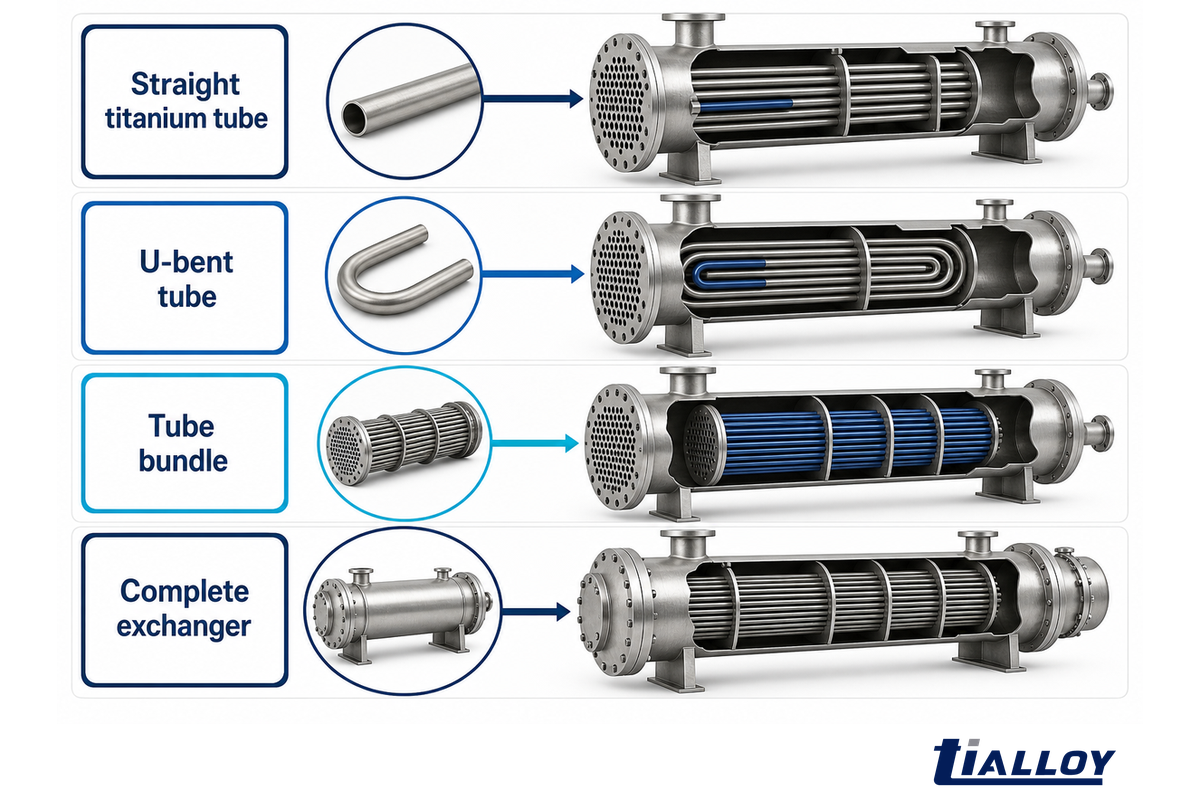
Titanium heat exchanger tubes are thin-walled tubular pressure-boundary components that transfer heat from one fluid to another without mixing the process streams. They may be positioned on the tube side or separate tube side flow from the shell side. The term doesn’t necessarily include a tubesheet, baffles, shell, complete tube bundle or the entire heat exchanger.
Within the heat exchanger industry, titanium exchangers can refer to several equipment architectures. Different pressure-boundary components are used in plate exchangers, and the tube in question is included in a shell heat exchanger. These types of shell and tube equipment use tubing as an effective way to transfer heat without mixing streams.
The tubes are used to transfer heat across a wall; that’s one way to transfer heat indirectly between process streams. Some exchangers are used to heat a cold process stream, while others condense or cool a process stream. Those are different types of heat duty, not different tube product standards.
In search and supplier language, a titanium shell and tube heat exchanger names the full assembly; a titanium coil heat exchanger may denote a different geometry. Neither term is synonymous with loose tube stock.
A shell and tube heat exchanger is comprised of several manufactured parts. The tubing provides heat-transfer surface and contains the fluid. The tubesheet locates and seals each tube. The shell of the exchanger contains the other fluid. Hence, titanium shell is a different design choice than titanium tubing.
| Purchased item | What it includes | Who must complete the definition | Common confusion |
|---|---|---|---|
| Straight titanium tube | Specified grade, route, dimensions, condition, and testing | Purchaser and tube supplier | Treated as finished exchanger hardware |
| U-bent tube | Tube plus project drawing, bend geometry, leg length, and post-bend controls | Exchanger designer, fabricator, and supplier | Ordered from grade and outside diameter alone |
| Tube bundle | Tubes, supports, baffles, rods, and jointed tubesheets as designed | Exchanger designer and fabricator | Used as a synonym for loose tubing |
| Complete exchanger | Thermal and mechanical design, shell, heads, nozzles, bundle, and code documentation | Equipment designer and manufacturer | Assumed to be covered by a tube product standard |
This guide to titanium tube and pipe terminology can be used by buyers to verify terminology prior to issuing an order. Pipe dimensions, tube dimensions, and exchanger drawings shouldn’t be grouped together.
The June 2026 brochure from ASTM Committee B10 names B338 for weld-free and welded titanium and titanium-alloy tubes for condensers and heat exchangers. That product scope helps identify the tube, while pressure design, bundle layout, and the completed equipment remain separate engineering work.
Key takeaway: Name the purchased component before you discuss details like grade, dimensions and price.
When Titanium Earns Its Place and When It Does Not
Titanium is an option when the full service basis supports a stable passive film and its lifecycle advantages outweigh fabrication and joint constraints. It becomes uncertain in strongly reducing, fluoride-bearing, contaminated, deposit-prone, poorly-aerated or severe crevice environments. Both the process streams and all connected metals are to be assessed.
One of the more common assumptions is that titanium is immune in seawater. Deposits, crevices, redox state, contamination, cleaning chemistry, and mechanical loading make that assumption unwise.
Even titanium remains condition-dependent in corrosive service. This is also applicable to the petrochemical and oil and gas plant facilities, where both stream histories need to be described. For any alloy used in chemical equipment, operating conditions comprise cleaning and upset cases as well as the normal duty. Titanium selection should therefore be based on the complete service record.
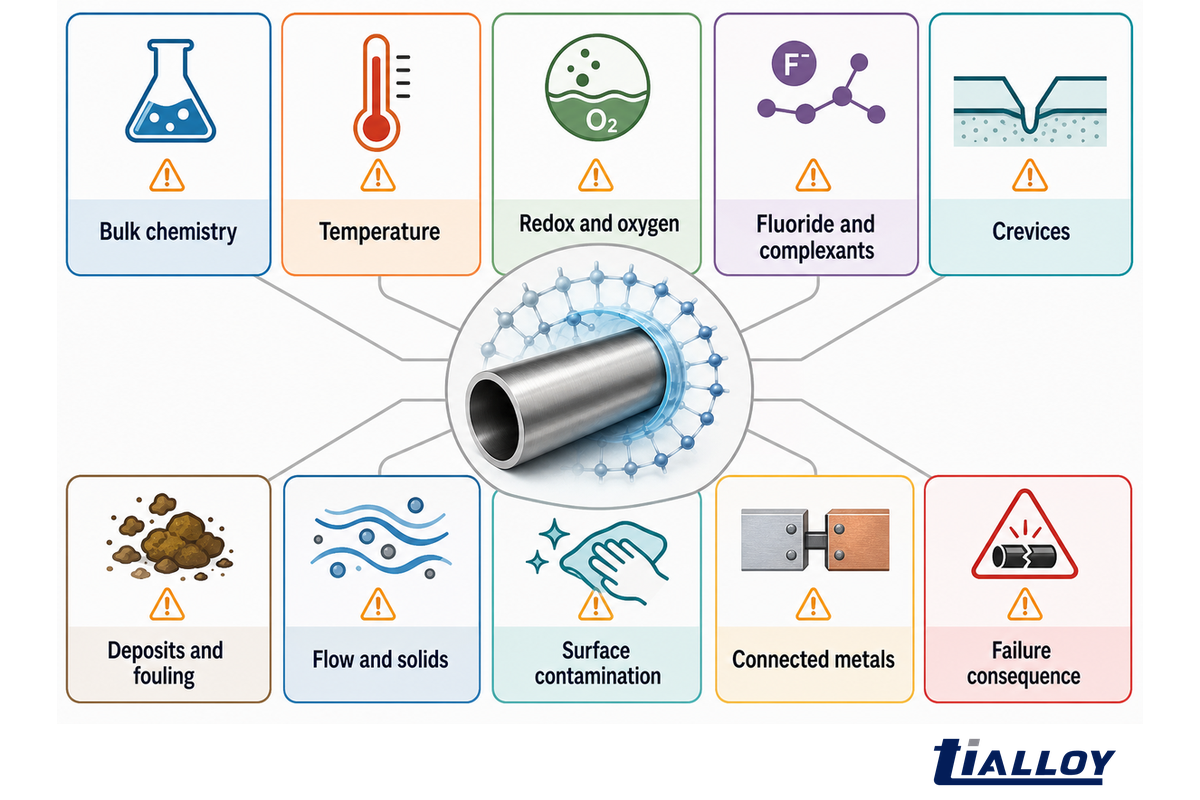
10-Condition Service Mosaic
The 10-Condition Service Mosaic distinguishes the variables that support titanium from those that require corrosion testing or another material.
| Condition | What can support selection | What can challenge it | Verify before release | Limitations / not suitable for |
|---|---|---|---|---|
| Bulk chemistry | Many aerated chloride services | Reducing acids or complexing species | Normal, startup, shutdown, and upset composition | Unknown trace contaminants |
| Temperature | A qualified corrosion window | Hot surfaces or excursions beyond tested data | Bulk, film, wall, and upset temperature | A single supplier maximum without chemistry |
| Redox and oxygen | Conditions that sustain passivity | Strongly reducing or oxygen-starved pockets | Aeration, oxidizers, reducers, and shutdown state | Assuming bulk oxygen represents a crevice |
| Fluoride and complexants | Verified absence or controlled concentration | Film-destabilizing chemistry | Cleaning residues and process carryover | A chloride-only lab certificate |
| Crevices | Drainable, clean, qualified geometry | Tight deposits, gaskets, or stagnant tubesheet zones | Joint geometry and deposit retention | Open-surface data used for a shielded gap |
| Deposits and fouling | Controlled water quality and accessible cleaning | Under-deposit chemistry and lost heat transfer | Foulant type, frequency, and removal method | Corrosion-only material ranking |
| Flow and solids | Stable flow within the equipment design | Vibration, impingement, entrained solids, or erosion | Local velocity and support spacing | One universal velocity limit |
| Surface contamination | Controlled handling and documented cleanliness | Embedded iron, damaged surfaces, or dirty tooling | Cleaning and segregation plan | Visual inspection as the only cleanliness proof |
| Connected metals | Reviewed galvanic and cathodic-protection boundary | Hydrogen generation at an interface | Tubesheet, waterbox, fasteners, and protection system | Tube-only review |
| Failure consequence | Inspection and isolation plan matched to duty | Cross-contamination or inaccessible leakage | Detection, plugging, retubing, and spare strategy | Selection based only on purchase price |
The NRC-hosted technical manual rejects the shortcut that titanium is always immune. Its warning about strongly reducing or complexing conditions explains why seawater success cannot be carried into every chemical process. Chlorine, chloride, moisture, acidity, oxygen, and deposits change the electrochemical boundary in different ways.
Illustrative case, not a design recommendation: a condenser brief lists 18,000 ppm chloride brackish water, a 55 °C normal outlet, a 75 °C upset, an 8 bar design pressure, 19.05 mm tube outside diameter, 0.7 mm nominal wall, and 6,000 mm straight length. That set is useful because it exposes the missing questions: fluoride, reducing contaminants, deposits, local wall temperature, connected metals, cleaning chemistry, and tubesheet crevices.
When not to buy titanium tubing yet
Don’t release a titanium order if either fluid is described as “water,” “brine,” or “chemical.” Pause when the exchanger has a severe stagnant crevice or when impressed-current cathodic protection reaches the titanium interface. State the service basis when an unknown cleaning solution is used, a high-temperature reducing stream is present, or further corrosion testing is needed. The correct action may be further corrosion testing, a different titanium grade, a higher-alloy stainless, a nickel alloy, zirconium, or a change to exchanger geometry. Material selection can’t compensate for an unknown service basis.
Do
- List both normal and upset chemistry
- Record cleaning chemicals and exposure state
- Review deposits, crevices, and connected metals
- Escalate service outside verified corrosion data
Don’t
- Use one chloride limit as a universal rule
- Treat seawater history as proof for every chemical
- Ignore startup, shutdown, or stagnant conditions
- Let grade selection replace exchanger design
One Corrosion Science investigation exposed Grade 2 tubes to a specific simulated dissolving-lye environment at room temperature, 60 °C, 70 °C, 80 °C, and 90 °C. Laboratory pitting increased sharply above 80 °C. In the associated industrial case, the tubes failed within 5,000 operating hours. These two observations describe one investigated service, not a universal titanium ceiling.
Key takeaway: Titanium is a condition-dependent candidate, not an immunity label.
Choosing Grade 1, Grade 2, Grade 7, or Grade 12
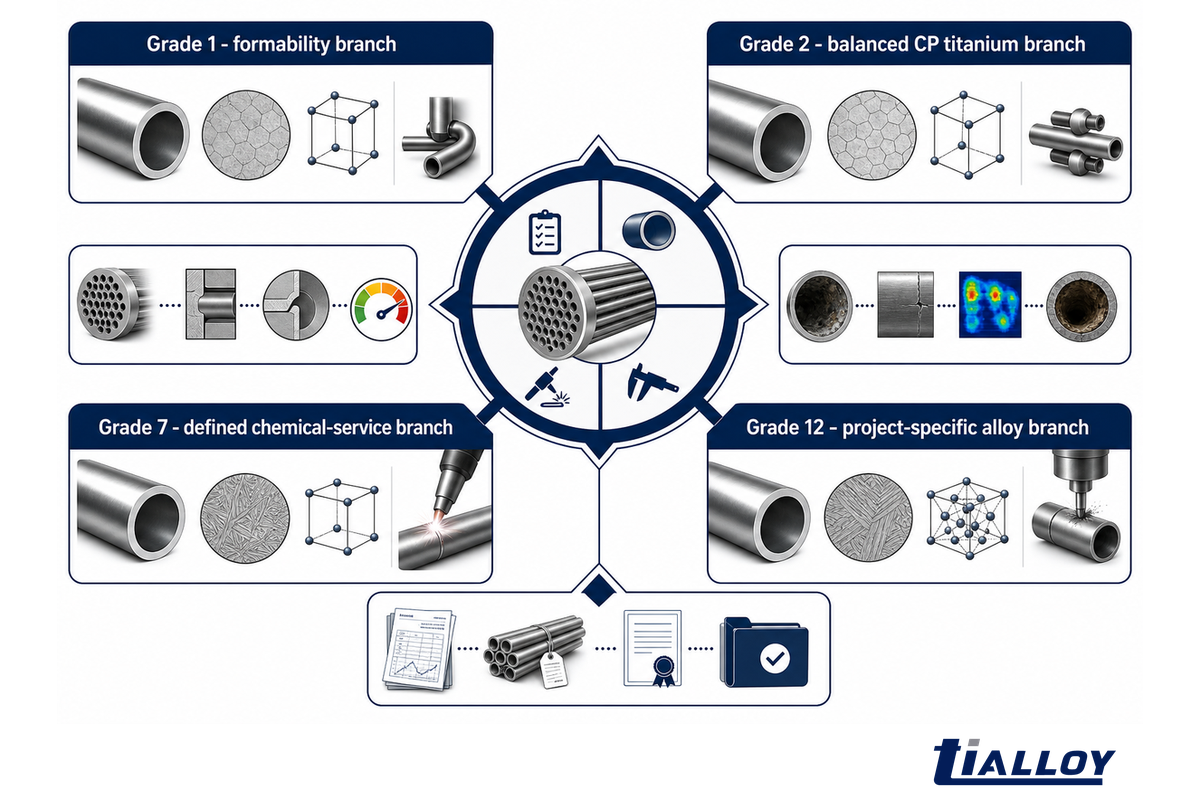
Titanium grade selection should account for the corrosion mechanism, required strength, product-form availability, fabrication route, and governing specification. Grade 1 and Grade 2 are commercially pure titanium candidates, while Grade 7 and Grade 12 modify the chemistry for specific service requirements. A larger grade number doesn’t mean universally better heat exchanger tubing.
Choosing the right grade means matching the grade to the service and purchase requirements; Grade 2 titanium isn’t the default for every duty.
The stronger grade is not always the safer choice for corrosion. Strength, passivity, fabrication and the product-form answer different questions and therefore need to be considered as a case requirement.
| Titanium grade | Selection role | Why it may enter the shortlist | Project verification |
|---|---|---|---|
| Grade 1 | Commercially pure, lower-strength option | Formability or a specified low-strength product condition | Tube availability, wall design, form, and code basis |
| Grade 2 | Common commercially pure grade | Balanced strength, fabrication, and corrosion resistance in qualified service | Actual fluid, joint, tube route, and order specification |
| Grade 7 | Palladium-bearing commercially pure titanium | Selected corrosion margins in defined chemical service | Qualified corrosion data, availability, and joining controls |
| Grade 12 | Titanium alloy with nickel and molybdenum | Project-specific strength and corrosion combination | Temperature, fabrication, product-form, and standard scope |
Is Grade 2 or Grade 5 titanium better for heat exchanger tubing?
Grade 2 is a commercially pure titanium grade commonly considered for corrosion-resistant tube service. Grade 5 is a higher-strength titanium alloy, but higher strength does not make it an automatic substitute. Product-form standard coverage, corrosion behavior, formability, weld procedure, and exchanger design still govern the decision.
The practical question is not “Which grade wins?” It is “Which grade has verified behavior in this fluid and is available in the required tube form under the governing order basis?” A deeper material review of Grade 2 titanium can support that first branch, while the titanium product forms hub helps keep tube availability separate from generic alloy properties.
ASTM’s 2026 directory shows a current designation for B338 tube, but a listing edition does not rank Grade 1, grade 2, Grade 7, or Grade 12 for a particular fluid. The purchase order still requires the project-selected grade and edition backed by a material corrosion review and design.
Key takeaway: Don’t choose a grade based on grade number alone.
How to Write a Titanium Tube Order Basis
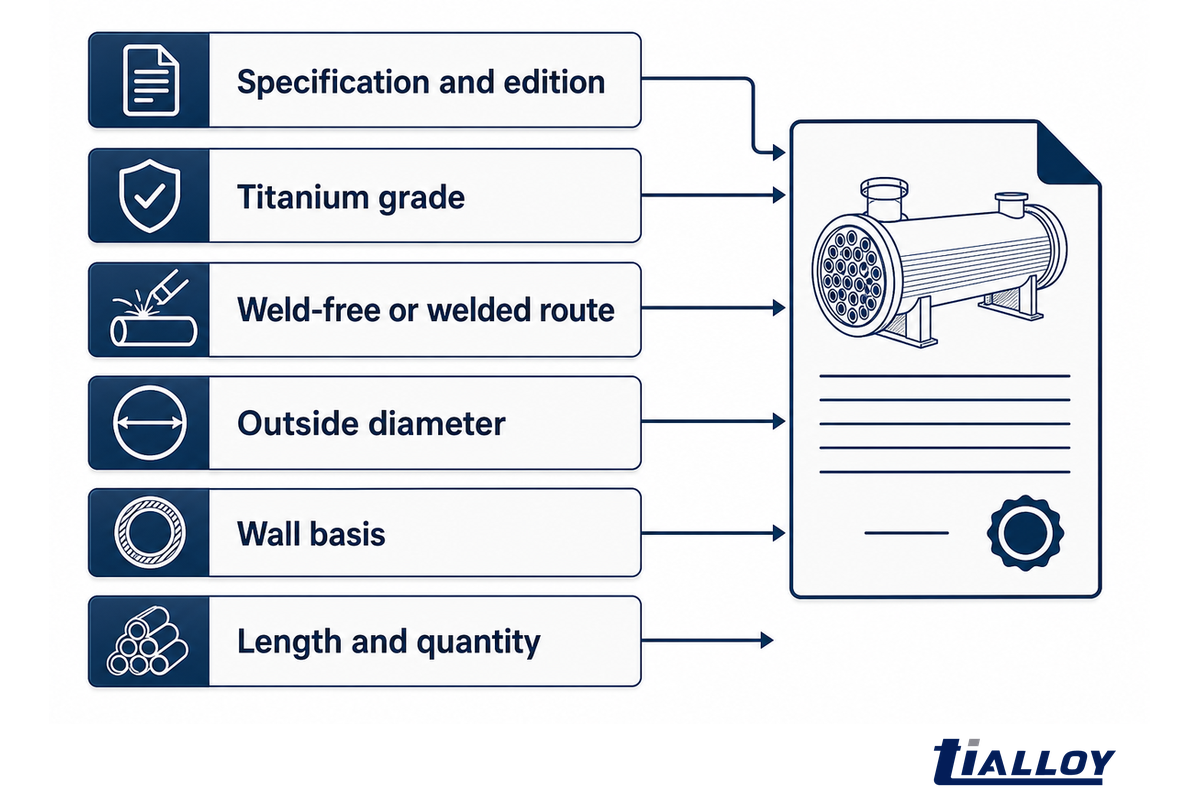
A usable order basis identifies the governing product specification, edition, grade, construction route, dimensions, tube form, condition, inspections, documents, and project requirements. It distinguishes the responsibilities of a tube supplier from thermal and mechanical design, joint qualification, and buyer’s hold points.
Required mechanical properties belong in the governing product basis and lot evidence; they shouldn’t be inferred from a generic grade description.
A purchaser supplement should specify project requirements instead of copying the Base Material Standard. Supplier qualification, witness points, and order-linked record reviews remain separate activities.
What is ASTM B338 titanium tubing?
ASTM B338 is the public designation for a specification covering weld-free and welded titanium and titanium-alloy tubes for condensers and heat exchangers. The standard is a product basis, not a completed datasheet. ASME adoption, project code, edition, grade, dimensions, supplementary requirements, and drawings must be stated where they apply.
ASTM Committee B10 lists B338 as the tube specification for condenser and heat-exchanger service across weld-free and welded titanium products.
| Field | Primary owner | Engineering consequence | Evidence | If unknown |
|---|---|---|---|---|
| Specification and edition | Purchaser / designer | Defines product requirements | Purchase order | Do not infer newest edition |
| Titanium grade | Materials engineer | Chemistry, strength, corrosion role | Material specification | Hold for service review |
| Weld-free or welded route | Designer / purchaser | Qualification and inspection path | Route declaration | Invite route options explicitly |
| Outside diameter | Exchanger designer | Layout, tubesheet, hydraulics | Drawing and report | Quote cannot be compared |
| Wall basis | Exchanger designer | Pressure, stiffness, heat transfer | Drawing and dimensional report | State average or minimum basis |
| Length and quantity | Purchaser | Yield, production route, packing | Cut list | Request budget only |
| Straight or U-bent form | Designer / fabricator | Bend geometry and post-bend controls | Approved drawing | Price excludes bending |
| Condition and heat treatment | Specification / supplier | Properties and fabrication state | Certificate and route record | Clarify before production |
| Surface and cleanliness | Purchaser / supplier | Contamination and joining | Procedure and inspection | Agree acceptance wording |
| Nondestructive examination | Specification / project | Detectable discontinuities and release | Signed test report | Use governing minimum only |
| Witness and hold points | Purchaser / inspector | Schedule and release authority | Inspection plan | No witness priced |
| Documents and packing | Purchaser / exporter | Traceability and shipment protection | Document index and packing list | Supplier standard applies |
In the illustrative 19.05 mm OD, 0.7 mm wall, 6,000 mm straight-tube case, the order can record 18,000 ppm chloride and 75 °C upset data without converting either value into a material guarantee. The designer still owns the 8 bar pressure basis, wall calculation, tubesheet drawing, joint procedure, and support arrangement. The supplier owns conformance to the agreed tube order.
Key takeaway: “ASTM B338 tube” bases the order; it does not complete the order.
Titanium vs Stainless Steel vs Copper-Nickel: Compare the Service, Not the Brochure
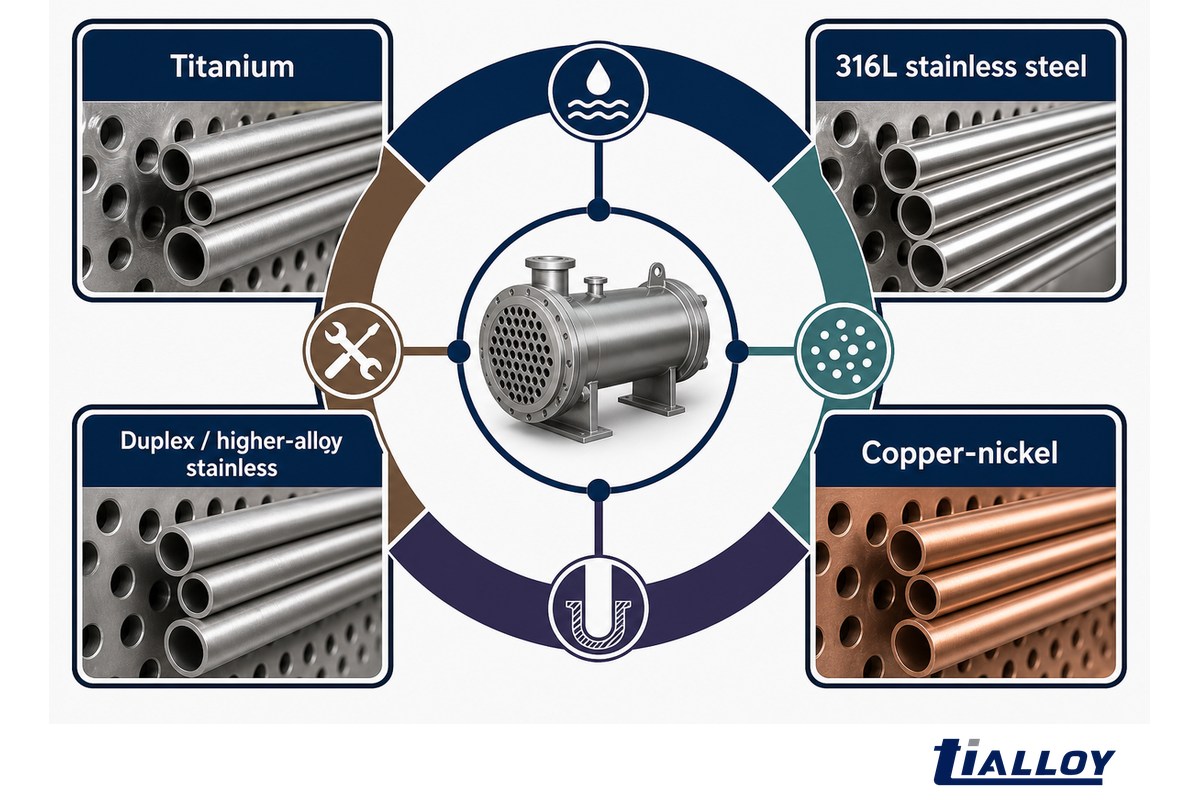
Titanium, 316L stainless steel, duplex stainless steel, nickel alloys, and copper-nickel should be compared against the same fluids, fouling state, wall basis, joint design, cleaning plan, and maintenance plan. Neither thermal conductivity nor raw tube price alone can determine the right material for a shell and tube heat exchanger.
In a comparative assessment, the least expensive tube may not be the best lifecycle option, depending on the consequences of cleaning, outage, inspection, retubing and lost-duty time.
Titanium tubes and stainless steel tubes should be compared with steel pipes only when their product form and service are the same. Carbon steel may be used in selected shell components, but that doesn’t justify including it in the same tube shortlist. A zirconium shell is a different equipment decision as compared to a titanium tube decision.
Are titanium tubes better than stainless steel tubes?
Titanium and stainless steel tubes must be compared for the specified seawater or high-chloride conditions, including corrosion behavior, fabrication, maintenance, and expected service life. Duplex and higher-alloy stainless aren’t equivalent to ordinary 316L. The case changes with temperature, crevices, deposits, the state of oxygen, wall thickness, fabrication, inspection, and expected service life.
| Same-basis question | Titanium | 316L stainless steel | Duplex / higher-alloy stainless | Copper-nickel | Limitations / verify |
|---|---|---|---|---|---|
| Seawater or brackish water | Strong candidate in qualified service | Localized-corrosion margin may narrow | Grade-specific review | Established in selected water systems | Temperature, deposits, velocity, and biology |
| Reducing chemical process | May need alloying or rejection | Chemistry-specific | Chemistry-specific | Often not the default | Redox, contaminants, and corrosion testing |
| Crevice severity | Not immune | Localized attack risk | Improved margin is grade-dependent | Geometry and water chemistry matter | Joint and deposit geometry |
| Heat-transfer calculation | Thin-wall design may offset lower bulk conductivity | Wall and fouling basis required | Wall and fouling basis required | Conductivity is only one resistance | Use one thermal model and clean/dirty cases |
| Fabrication and repair | Clean handling and qualified welding | Broad shop familiarity | Heat input and phase balance controls | Process-specific joining practice | Local repair capability and procedure qualification |
| Lifecycle decision | Compare cleaning, downtime, and retubing risk | Lower initial cost may or may not survive service | Higher alloy cost needs service justification | Water-system history matters | Same duty, period, inspection, and outage basis |
You can consider stainless steel tubes after separating austenitic stainless from duplex. For a more limiting 316L boundary, refer to the 316L stainless steel decision guide. More aggressive chemistry may move the shortlist toward nickel alloys for chemical processes, while titanium and zirconium belong in an engineering escalation rather than a keyword-driven substitution.
The bulk thermal conductivity number cannot decide a tube heat exchanger. Wall thickness, film coefficients, fouling resistance, flow, geometry, corrosion allowance, and cleaning state all sit in the heat-transfer path. Compare one fluid-to-fluid duty and one maintenance horizon, then choose the material.
Key takeaway: Compare materials on the same exchanger calculation and maintenance window basis.
Weld-Free or Welded, Straight or U-Bent: What the Form Changes
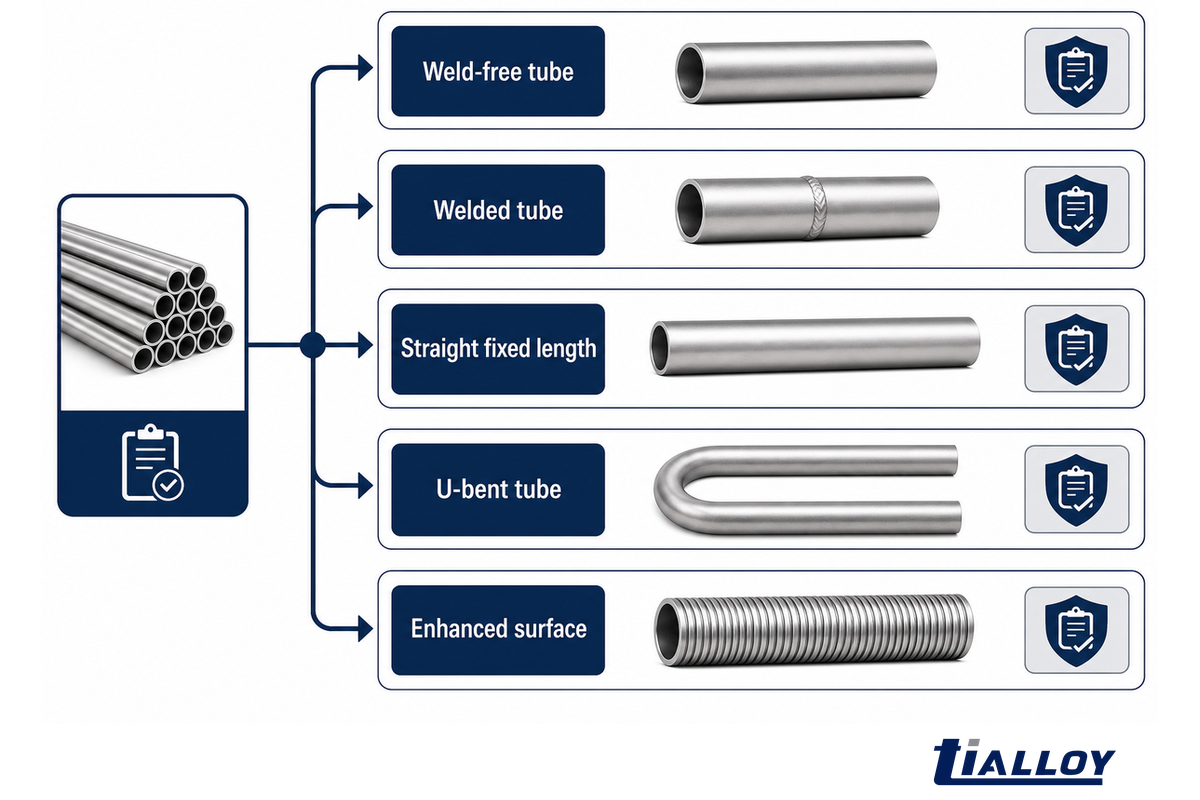
Tube route and supplied form change qualification, inspection, geometry, yield, and downstream fabrication. A weld-free tube has no longitudinal weld; a welded tube depends on seam manufacture and examination. Straight and U-bent heat exchanger tubing need different drawings and controls. Neither route name proves fitness without order-related evidence.
| Route or form | What changes | Evidence to request | Limitations / not suitable for |
|---|---|---|---|
| Weld-free tube | Starting route, reduction history, dimensional capability | Route declaration, heat treatment, dimensional and NDE reports | Assuming route alone proves quality |
| Welded tube | Strip input, seam process, weld condition, examination | Applicable standard, seam qualification, NDE and heat-treatment evidence | Use where the order basis excludes the route |
| Straight fixed length | Cut plan, end condition, packing and field fabrication | Length report, end protection, traceability | Undefined final joint or trim allowance |
| U-bent tube | Bend radius, tangent, leg, ovality, thinning, cleanliness | Approved bend drawing and post-bend inspection plan | Ordering from developed length alone |
| Enhanced surface | Residual wall, surface geometry, inspection access | Qualified drawing, base-tube basis, final inspection | Treating it as ordinary smooth tube |
ISO 18762:2016 publishes technical delivery conditions for welded titanium tubes used in condensers and heat exchangers. The official page records confirmation in 2021 and systematic review in 2026. Its welded-tube scope illustrates the central point: an applicable route standard can be valid without making welded universally better than a weld-free route.
Replacing a failed tube in the maintenance window may lead a team to prefer the already qualified route by original equipment design. For a new chemical plant, alternatives may be permissible if the designer reviews route-related inspections, dimensions and fabrication and joint effects. The purchasing instruction may state that route alternates are prohibited, permitted with approval, or requested as priced options.
The official ISO page identifies a 2016 edition, a 2021 confirmation, and a 2026 review cycle. Those dates help control document currency, but they do not define bend geometry, approve a weld procedure, or qualify a completed tube-to-tubesheet joint.
Key takeaway: route and form are specification variables, not quality labels.
The Tube-to-Tubesheet Joint: Why the Tube Cannot Be Specified Alone
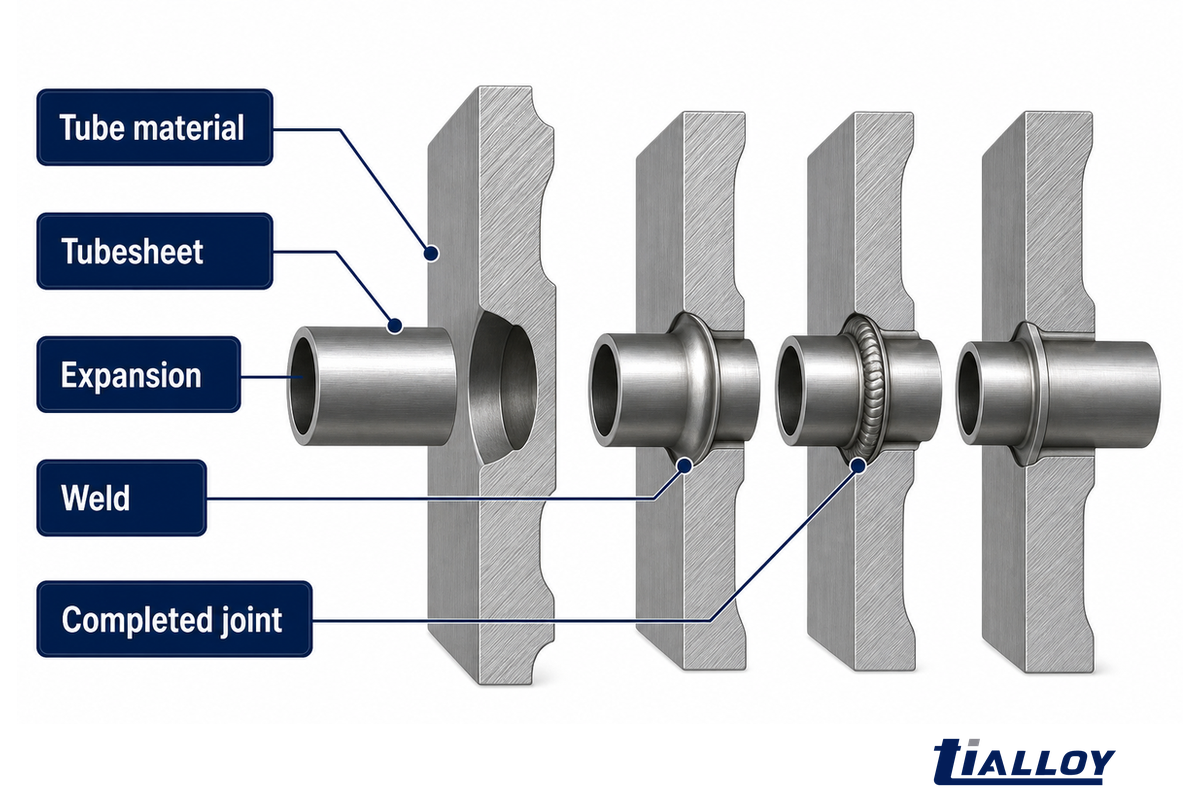
A tube-to-tubesheet joint combines tube properties with tubesheet material, hole finish, ligament geometry, expansion method, welding sequence, cleanliness, and fabrication procedure. A conforming titanium tube can still leak with a poor design or implementation of the joint. Qualification of a joint is the responsibility of the exchanger designer and fabricator, not the tube supplier.
A thin-wall titanium tube can be damaged when joint geometry is poorly designed and implemented. Joint qualification belongs to the exchanger designer and fabricator, not the tube certificate.
| Boundary | Tube supplier evidence | Designer / fabricator responsibility | Release question |
|---|---|---|---|
| Tube material | Grade, heat, properties, dimensions, required NDE | Allowables and service suitability | Does the lot match the order? |
| Tubesheet | Outside tube scope | Material, cladding, hole, groove, ligament, corrosion allowance | Is the interface design frozen? |
| Expansion | Tube dimensional and property inputs | Method, target, sequence, tooling, mockup | Has the procedure been qualified? |
| Weld | Material identity and condition | Joint design, shielding, qualification, examination | Are cleanliness and procedure records linked? |
| Completed joint | No service-life guarantee | Leak test, mockup, cyclic loads, inspection and monitoring | What does each test prove? |
A 2025 Grade 2 experiment used 19.05 mm outside-diameter tube and compared 4%, 6%, and 8% expansion conditions across expanded, welded, and combined joint variants. Pull-out tests and macrosections showed that process sequence and joint geometry affect the static behavior of the joint. The paper also reports inconsistent nominal wall values in different sections, so this guide doesn’t use either value or the disputed derived path as an acceptance limit.
The experiment is useful for one reason: it breaks the assumption that “expanded” or “welded” is a complete procedure. It does not prove thermal-cycle sealing, corrosion performance at the interface, vibration endurance, or field service life. Static pull-out strength and a clean macrosection answer narrower questions.
For the hypothetical 19.05 mm OD and 0.7 mm wall tube at 8 bar, the purchase record can pass the dimensions to the joint team. It cannot select an expansion percentage from these numbers. The 6,000 mm length, 75 °C upset, tubesheet material, hole preparation, thermal movement, and fabrication sequence must enter a qualified joint plan.
Three expansion conditions, 4%, 6%, and 8%, changed static joint behavior in the 2025 experiment. None of those percentages should be copied into a remote procedure. Joint geometry, leak testing, thermal cycle and exchanger loads must be analyzed together.
Key takeaway: Tube conformance is an input to joint qualification, not proof of joint reliability.
Why Titanium Tubes Still Leak: A Damage-to-Inspection Guide
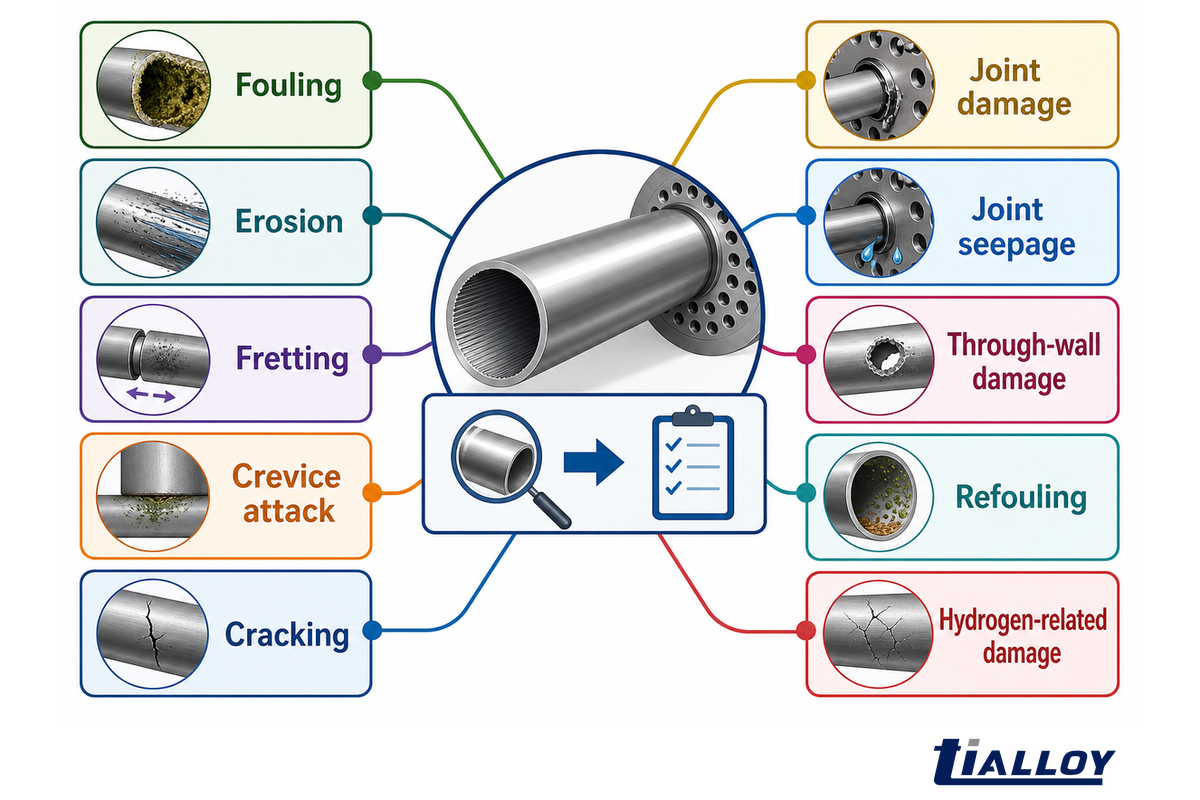
Titanium tubes may lose duty or leak due to fouling, erosion, fretting, vibration, crevice attack, hydrogen-related damage, fabrication defects, or tube-to-tubesheet joint failure. Symptoms don’t always point to the root cause. Record the location and type of failure, assess the impacted population, examine a representative sample, and match the cause to the effect.
Stress corrosion cracking is one candidate mechanism, but crack shape alone doesn’t always establish it. A wrong tube diagnosis can send a maintenance team toward material replacement when the actual cause sits in a joint, support, flow path, or cleaning practice.
Will titanium heat exchanger tubes leak?
Yes. A condenser can lose heat transfer without a through-wall hole, and a joint can leak while the tube body remains sound. Diagnosis distinguishes extent from mechanism prior to a repair being prescribed.
“The first step is to obtain a sample of the tube that failed for metallurgical examination to determine the failure mode.”
POWER describes a titanium condenser leak due to wet-steam impingement. The example is applicable because even excellent corrosion resistance didn’t exclude a mechanical damage path.
Do not upgrade the tube alloy until the team has determined whether damage originated on the tube side, shell side, joint, or support. Retubing is the practical window to inspect otherwise hidden tubesheet and baffle conditions.
Leak Morphology Rosetta
The Leak Morphology Rosetta translates a symptom into the next request for evidence, without feigning that inspection has revealed the damage mechanism.
| Damage type | Primary classification clue |
|---|---|
| Fouling | Duty loss without leakage |
| Erosion | Directional inlet-end thinning |
| Fretting | Support-point wear |
| Crevice attack | Shielded localized cavity |
| Cracking | Axial or branched morphology |
| Joint damage | Tubesheet-zone concentration |
| Joint seepage | Tube-end leak with intact body |
| Through-wall damage | Scattered leaking population |
| Refouling | Shorter interval after cleaning |
| Hydrogen-related damage | Brittle features plus interface history |
| Observed path | Typical clue | Plausible mechanism | Corroborating evidence | Next decision | Limitations / not suitable for |
|---|---|---|---|---|---|
| Duty loss, no leak | Rising approach temperature or pressure drop | Biofilm or mineral fouling | Performance trend, deposit sample, bore inspection | Cleaning trial and refouling review | Do not classify as wall failure |
| Inlet-end thinning | Directional wear near entry | Impingement, solids, or local turbulence | Thickness map, flow review, deposit analysis | Correct flow path before retubing | One velocity limit cannot diagnose it |
| Support-point wear | Localized scar at baffle or support | Fretting or vibration | Location map, vibration and support review | Repair support condition, not only tube | Corrosion coupon data is insufficient |
| Under-deposit pit | Shielded localized cavity | Occluded chemistry or crevice corrosion | Deposit chemistry and metallography | Change water, cleaning, or material boundary | Bulk-fluid analysis alone |
| Axial or branched crack | Crack morphology rather than uniform loss | Stress corrosion, hydride, fatigue, or fabrication damage | Sectioning, microscopy, chemistry, stress history | Identify mechanism before material change | Remote visual verdict |
| Tubesheet-zone crack | Damage concentrated inside the joint | Thermal mismatch, residual stress, or joint detail | Joint section, fabrication record, thermal history | Requalify joint and boundary | Replacing tube grade alone |
| Joint seepage | Leak at tube end with intact body | Expansion, weld, groove, or surface issue | Leak test, joint records, macrosection | Repair under qualified procedure | Using material certificate as joint proof |
| Random through-wall leak | Scattered population | Defect, local attack, impact, or mixed causes | Full map plus representative failed sample | Set plugging and retube threshold | One sampled tube without population map |
| Cleaned surface refouls quickly | Shorter interval after treatment | Roughness or changed surface condition | Surface review, biofilm trend, method record | Revise method and verify outcome | Assuming every mechanical cleaning is restorative |
| Hydrogen-related embrittlement | Brittle features with relevant interface history | Hydrogen generation and uptake | Metallography, hydrogen analysis, cathodic review | Remove the generation mechanism | Diagnosing from crack shape alone |
80 °Claboratory pitting change
within 5,000 hoursreported plant-tube failure window
24 yearscondenser service case
about 200 tubesreported plugged population
The two cases shouldn’t be combined. The study involving dissolving-lye looked at rapid corrosion in one simulated environment. The long-service power plant study found cracks focused in the tubesheet and linked the pattern to thermal mismatch in a semi-filled joint. One study highlights concerns with respect to service chemistry, and the other concerns design with respect to interface.
The laboratory series included 60 °C, 70 °C, 80 °C, and 90 °C exposures; the power-station case instead reported 24 years of service. The different scales reinforce why a temperature series and a field history answer different questions.
A 2008 cooling water study adds a non-leak failure path. During the tested treatment and re-exposure conditions, the mechanical treatment of titanium surfaces became rougher and resulted in faster biofilm formation and stronger adhesion. This finding doesn’t mean that all mechanical cleanings will result in failure. It means the method of cleaning, the condition of the surface, the removal of deposits, and the refouling interval should be in the same maintenance review.
- Stabilize the event: isolate the leaking path and preserve operating data before conditions change.
- Map the population: record tube row, span, joint location, signal type, and affected count.
- Preserve a representative sample: avoid cutting away the fracture or deposit that carries the mechanism evidence.
- Identify the mechanism: combine metallography, chemistry, dimensions, deposits, and operating history.
- Correct the system cause: change material, joint, support, flow, chemistry, or cleaning only when the evidence supports it.
The 24-year case concerned approximately 200 plugged tubes and joint-zone cracking. A separate report on lye service indicated plant tubes failing within 5,000 operating hours, and laboratory pitting increased above 80 °C. Correctly associating a remedy case with its correct case family can help diagnose the true cause during the next outage.
Key takeaway: Inspection boundaries show extent; failure analysis identifies mechanism.
What Changes Price and Lead Time?
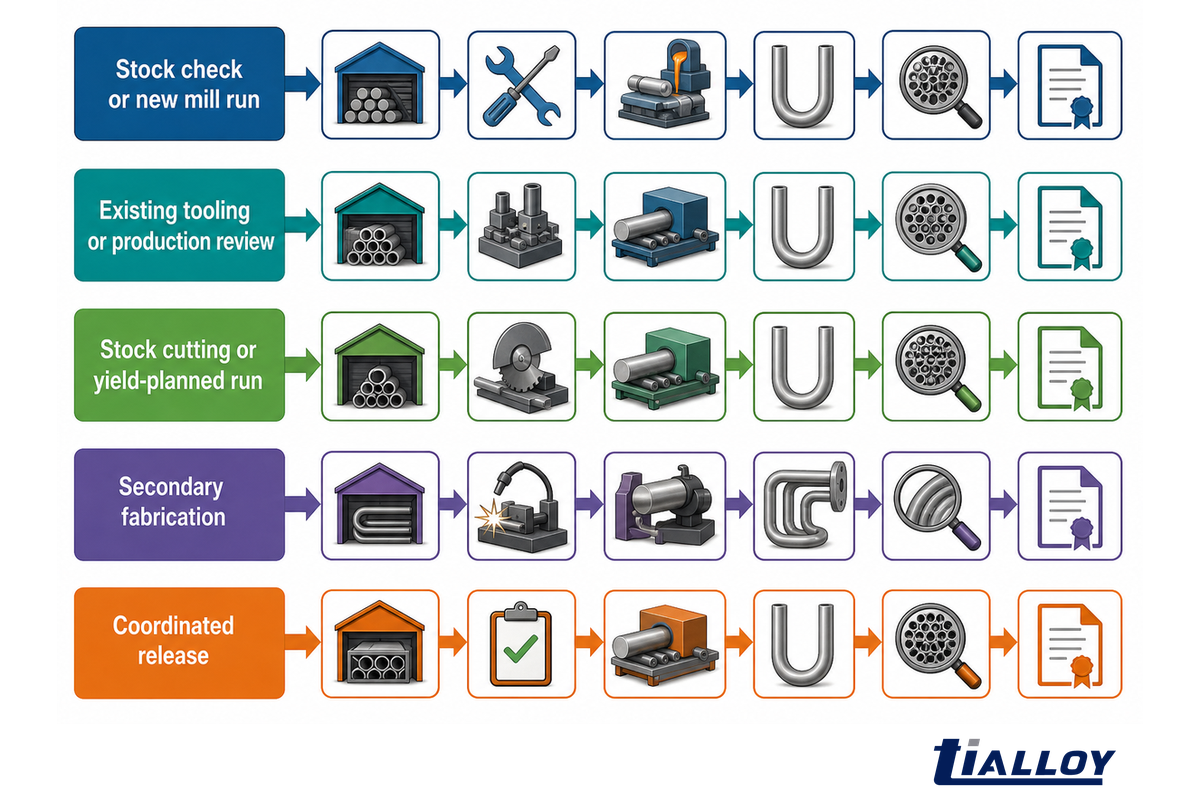
Titanium tube price and lead time change with grade, dimensions, wall basis, length, quantity, manufacturing route, U-bending, heat treatment, inspection, witness points, documents, and export packing. A quote may follow a stock, mill-production, or secondary-fabrication path. No fixed premium or delivery band is applied without these inputs.
| Quote driver | Controlling input | Likely schedule path | Evidence needed |
|---|---|---|---|
| Grade and product form | Exact grade under governing specification | Stock check or new mill run | Material/order basis |
| Outside diameter and wall | Dimensional basis and tolerance | Existing tooling or production review | Drawing or datasheet |
| Length and quantity | Cut length, total pieces, overage | Stock cutting or yield-planned run | Cut list |
| Tube route | Weld-free, welded, or approved alternative | Route-specific capacity | Qualification requirement |
| U-bending | Drawing, bend radius, legs, tangents | Secondary fabrication | Approved drawing and inspection plan |
| Heat treatment | Grade, route, condition, post-bend need | Mill or subcontract process | Procedure and record |
| Inspection | Methods, extent, acceptance basis | Standard or added testing | Inspection and test plan |
| Witness points | Inspector, notice, hold/review points | Coordinated release | Approved plan |
| Documentation | Certificate, reports, language, dossier index | Standard or project dossier | Document register |
| Export packing | Cleanliness, ends, cases, destination | Domestic or export preparation | Packing specification |
Raw material accounts for only one cost line. Small lots, non-standard alloy tubes, additional tests, third-party inspection and export packaging can also affect the rate. A request that says only “titanium for heat exchanger” forces each supplier to assume a different scope, so the resulting prices are not comparable.
The current B338 designation can anchor a tube request, but it can’t supply quantity, project edition, U-bend geometry, witness points, dossier structure, or export packing. Clarifying those fields before enquiry reduces commercial uncertainty without inventing a price or delivery promise.
Key takeaway: Quotes that are comparable require a comparable technical and commercial basis.
The Evidence Trail to Request Before You Buy
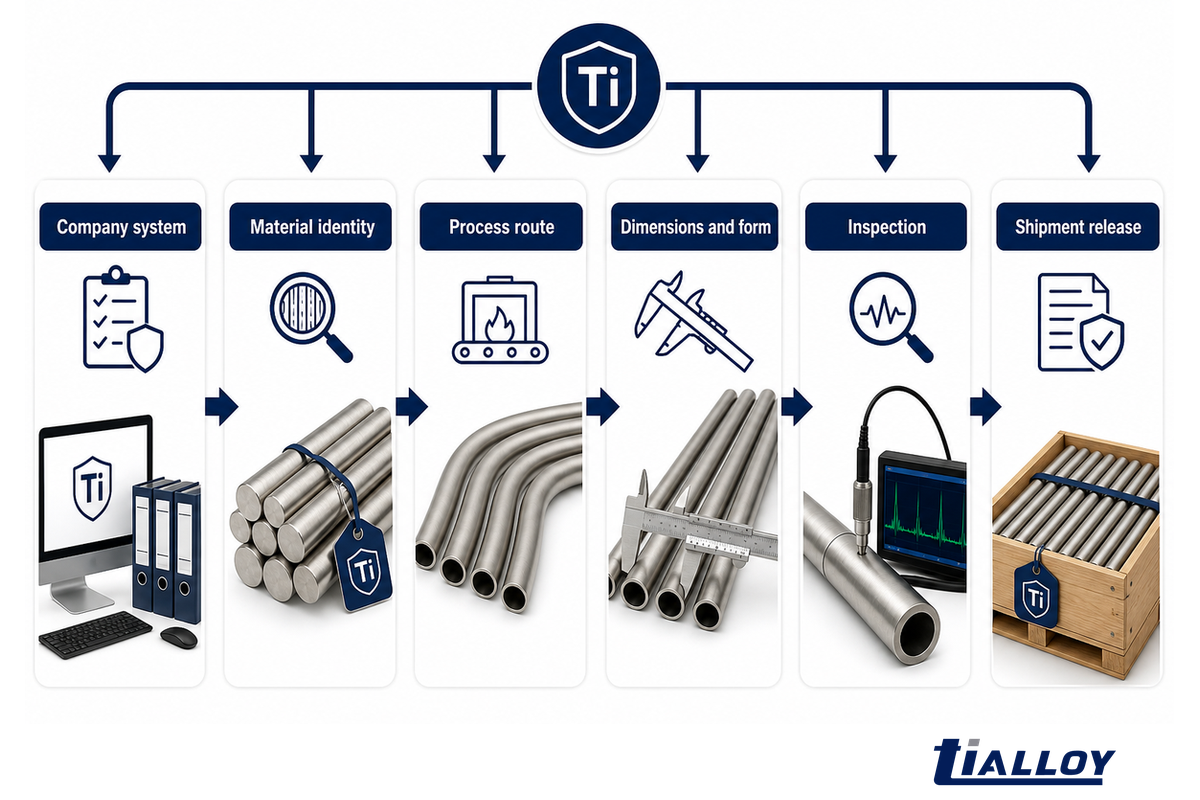
A strong evidence trail links the actual tube lot to material identity, manufacturing route, dimensions, required inspection, conformity review, and shipment. ISO 9001 describes a management system; it does not certify a particular titanium tube. Verify who made, processed, inspected, exported and released each item linked to the order.
TiAlloy reports more than 20 years in metal manufacturing and a modern production facility exceeding 30,000 m². The company supplies titanium, stainless steel, and nickel-alloy plates, tubes, and bars for aerospace, chemical, energy, marine, medical, and general industrial sectors. It also reports ISO 9001 and an occupational health and safety management system. These are company-reported capability facts, not lot acceptance evidence; TiAlloy manufacturing and quality background provides the organizational context.
| Evidence layer | Always useful | Project-specific addition | What it does not prove |
|---|---|---|---|
| Company system | Current scope, facility role, quality procedures | Approved-vendor or audit requirement | Specific-lot conformance |
| Material identity | Heat, grade, chemistry, product form | Purchaser’s edition and supplements | Joint or service reliability |
| Process route | Maker, processor, route, heat treatment | Subcontract approval and surveillance | Invisible process steps not recorded |
| Dimensions and form | OD, wall, length, straightness or bend geometry | Project drawing characteristics | Thermal design adequacy |
| Inspection | Method, extent, result, traceable report | Hold points and third-party witness | Future fouling or fatigue |
| Shipment release | Piece/lot link, packing list, protected condition | Export marks, dossier index, destination rules | Condition after mishandling in transit |
A sample certificate shows document format, but not approval of an unissued lot. Prior to a technical release, confirm if the listed mill produced the tube, provided the raw material, performed the process, or just provided a commercial document. Subcontracted U-bending, heat treatment, or inspection must preserve the trail to the same order.
Once the technical basis is aligned, use the commercial owner’s titanium heat exchanger tube supply options for available scope and enquiry. The guide leaves live availability, pricing, and order execution to that page.
ISO 18762 identifies delivery conditions for welded titanium tubes; ASTM’s current directory identifies the B338 tube specification. Neither public scope proves that a particular heat, bend, weld, examination, or shipment met an order. The release pack connects each record to the actual material.
Key takeaway: Management-system evidence qualifies the organization; order-linked records release the product.
The 6-Record Release Vault: A Final Technical Handoff
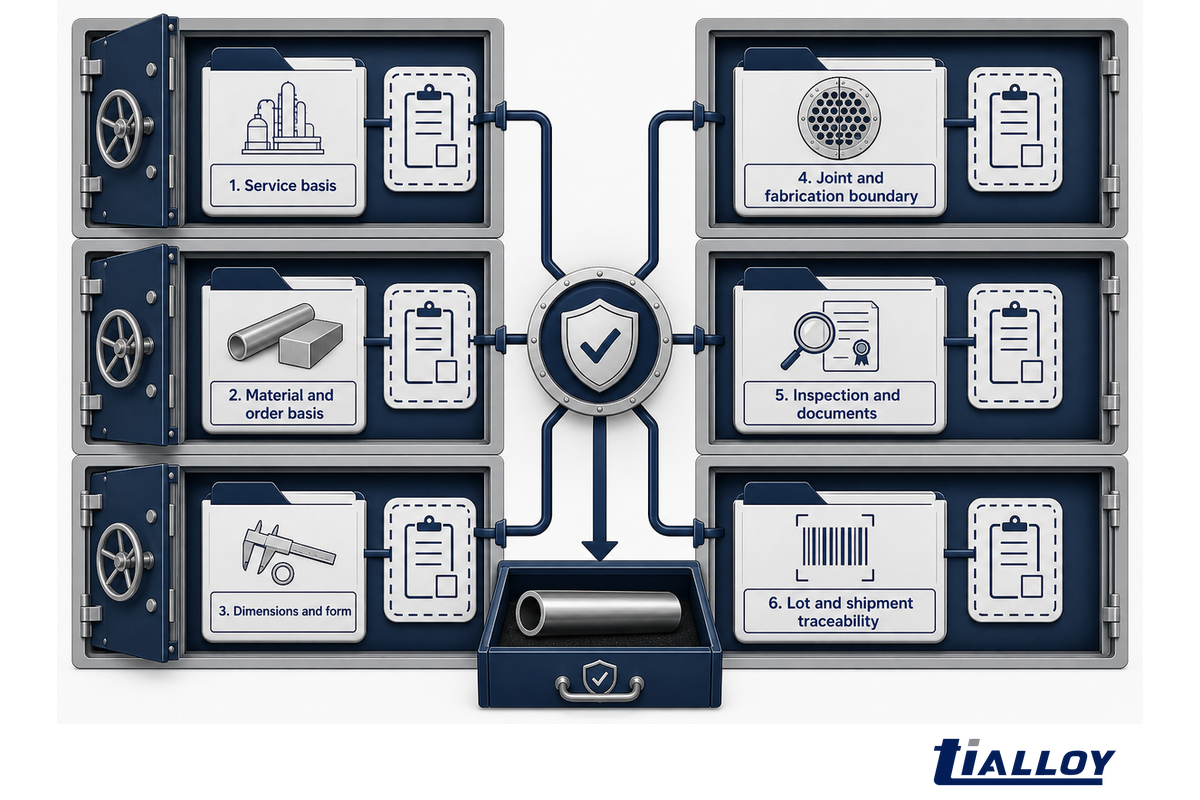
The 6-Record Release Vault is a one-page handoff that links service requirements, material basis, dimensions, joint boundary, inspection plan and traceability prior to a commercial inquiry. Each record has an owner and an open item flag. Don’t release the request if there’s an open item that can affect the material, form, testing or scope.
6-Record Release Vault
The Release Vault converts six technical record groups into one controlled enquiry. The Release Vault doesn’t state that records can foresee service needs.
| Record group | Minimum content | Owner | Open-item flag | Do not release if |
|---|---|---|---|---|
| 1. Service basis | Both fluids, temperatures, pressure, deposits, cleaning, upset state | Process / materials engineer | Unknown contaminant or condition | Material can still change |
| 2. Material and order basis | Grade, product specification, edition, route, condition | Materials engineer / purchaser | Alternate not dispositioned | Edition or grade is inferred |
| 3. Dimensions and form | OD, wall basis, length, quantity, straight/U-bent drawing | Exchanger designer | Drawing not approved | Quote geometry is ambiguous |
| 4. Joint and fabrication boundary | Tubesheet, expansion/weld scope, cleanliness, post-bend work | Designer / fabricator | Procedure ownership unclear | Supplier scope hides interface work |
| 5. Inspection and documents | Methods, extent, witness points, acceptance basis, dossier index | Quality / purchaser | Acceptance requirement missing | Reports cannot be priced or scheduled |
| 6. Lot and shipment traceability | Heat-to-piece link, packing, marks, release, destination | Supplier / exporter / inspector | Traceability break | Pieces cannot be tied to records |
The hypothetical case is ready for commercial handoff only when its 18,000 ppm chloride, 55 °C normal outlet, 75 °C upset, 8 bar design pressure, 19.05 mm OD, 0.7 mm wall, and 6,000 mm length sit beside the grade, edition, tube route, joint boundary, inspection plan, and open items. Those values remain illustrative, not a recommended design.
The Vault documents the agreed order. It cannot prove future fouling behavior, thermal-cycle sealing life, cleaning outcome, or the absence of an unmodeled upset. Conformance evidence and evidence of service reliability answer different questions.
Key takeaway
Release a titanium tube enquiry only when all 6 record groups have named owners and any material-changing question remains visibly open.
For a project-ready review, take the completed handoff to the heat exchanger tube commercial page and use the enquiry fields to verify supply, inspection, documents, packing, price and schedule.
Discuss a titanium tube requirement
Frequently Asked Questions
What is a tube bundle in a heat exchanger?
View answer
A tube bundle is the removable or fixed assembly of many parallel tubes, supports, baffles, tie rods, and related parts that carries one fluid while another contacts the outside surfaces. The tube material is only one bundle decision. Layout, support spacing, tube-to-tubesheet joint, thermal movement, inspection access, and cleaning access still require exchanger design.
What is the difference between weld-free and welded titanium tube?
View answer
Weld-free tube is produced without a longitudinal seam, while welded tube starts from formed strip and includes a welded seam. Neither route is automatically superior for every heat exchanger. The governing specification, grade, dimensions, seam qualification, heat treatment, nondestructive examination, surface condition, and project acceptance basis must support the route chosen.
How long does titanium tubing last in a heat exchanger?
View answer
There’s no universal service-life figure. Life depends on both fluid chemistries, temperature, velocity, deposits, vibration, support, joint design, cleaning, shutdown conditions, and inspection response. A low general-corrosion rate doesn’t prevent fretting, erosion, joint damage, crevice attack, or hydrogen-related damage. Assess life against the actual operating exchanger and its maintenance record.
Where can I buy titanium tubing?
View answer
The TiAlloy commercial page lists the current heat exchanger tube supply scope and its enquiry path. Before contacting a source, prepare grade, dimensions, tube form, quantity, inspection, documents, and service conditions so quotations share one technical basis.
What is the maximum temperature for titanium heat exchanger tubing?
View answer
Titanium heat exchanger tubing has no single maximum temperature that’s safe across all grades, fluids, and exchanger designs. Temperature changes corrosion behavior, strength, hydrogen-uptake risk, fouling, joint behavior, and the validity of published data. One Grade 2 dissolving-lye paper reported a laboratory pitting increase above 80 °C and, separately, industrial tube failure within 5,000 operating hours in the investigated service. Use qualified corrosion information for both fluids, then have the exchanger designer verify pressure, thermal stress, joints, supports, and upset conditions.
Which material has better heat transfer?
View answer
No tube material transfers heat best by bulk thermal conductivity alone. Overall duty also reflects wall thickness, film coefficients, fouling, flow, geometry, and corrosion allowance. Compare candidates in the same clean and dirty thermal model.
Why is titanium more expensive?
View answer
Titanium tube cost can reflect primary metal, melting route, tube-making route, yield loss, nonstandard dimensions, small lots, U-bending, heat treatment, inspection, witness points, documentation, and export packing. Stock cutting, a new mill run, and secondary fabrication follow different commercial paths. The useful comparison is total installed and maintained exchanger cost on one service basis, including cleaning, downtime, retubing risk, inspection access, and required evidence. A live quotation owns the final price and schedule because current availability, quantity, destination, and release requirements can change every offer.
How this guide was prepared
The guide separates public standard scope, peer-reviewed cases, power-industry failure reporting, and company-provided facts. Case numbers remain tied to their tested environments. No universal temperature, chloride, velocity, price, or lead-time limit is inferred. Product availability and commercial execution remain with the existing supply page.
Related TiAlloy resources
References & Sources
- Committee B10 Standards Brochure, June 2026, ASTM International
- Titanium-alloy corrosion manual, U.S. Nuclear Regulatory Commission document archive
- Grade 2 tube corrosion study in simulated dissolving lye, Corrosion Science
- ISO 18762:2016 official scope and lifecycle page, International Organization for Standardization
- Grade 2 titanium tube-to-tubesheet joint experiment, Scientific Reports, 2025
- Taming Condenser Tube Leaks, Part II, POWER Magazine
- Failure of Titanium Condenser Tubes After 24 Years Power Plant Service, Technical University of Denmark research portal
- Studies on enhancement of biofilm formation and adherence due to mechanical treatment of titanium surfaces in cooling-water systems, Biofilms, 2008