Get in Touch with TiAlloy Company

Aerospace Solutions: A Guide to Material Selection, Verification, and Change Control

A materials and evidence-readiness guide
Aerospace Solutions are coordinated material-selection, process, evidence, and change-control decisions that connect service conditions, product forms, manufacturing routes, and traceability to an authorized release without confusing a familiar alloy name or certificate with program approval.
Quick answer: An aerospace materials solution is a controlled chain, not a product label. It begins with the service envelope, defines the exact material, form, condition and route, matches evidence to each claim, preserves identity and physical condition through every handoff, and sends changes or exceptions to the authority assigned by the program or contract.
What this guide covers: the engineering and quality questions that make a material decision reviewable. It does not publish product availability, price, MOQ, lead time or a quotation. Those commercial questions belong to TiAlloy’s aerospace solutions page and are linked only at the final handoff.
What Does an Aerospace Materials Solution Actually Solve?
Buyers may need to reduce part mass, survive elevated temperatures, resist corrosion, manage fatigue risk, retain traceability, qualify a process, or keep a released configuration unchanged. An alloy family, by itself, doesn’t directly address these needs. A buyer looking for a solution to these needs would need to define the requirement, restrict the scope of the material to be considered, provide evidence, and make an authorization decision to release the material.
This distinction is practical. The FAA’s active AC 20-154A addresses receiving-inspection system development and traceability, but it’s non-mandatory guidance and describes one acceptable approach. Meanwhile, 14 CFR 21.137 sets quality-system requirements for production-certificate applicants and holders. Neither source should be turned into a universal supplier checklist. The governing design data, contract, customer flowdowns, approval basis and assigned authorities determine what applies.
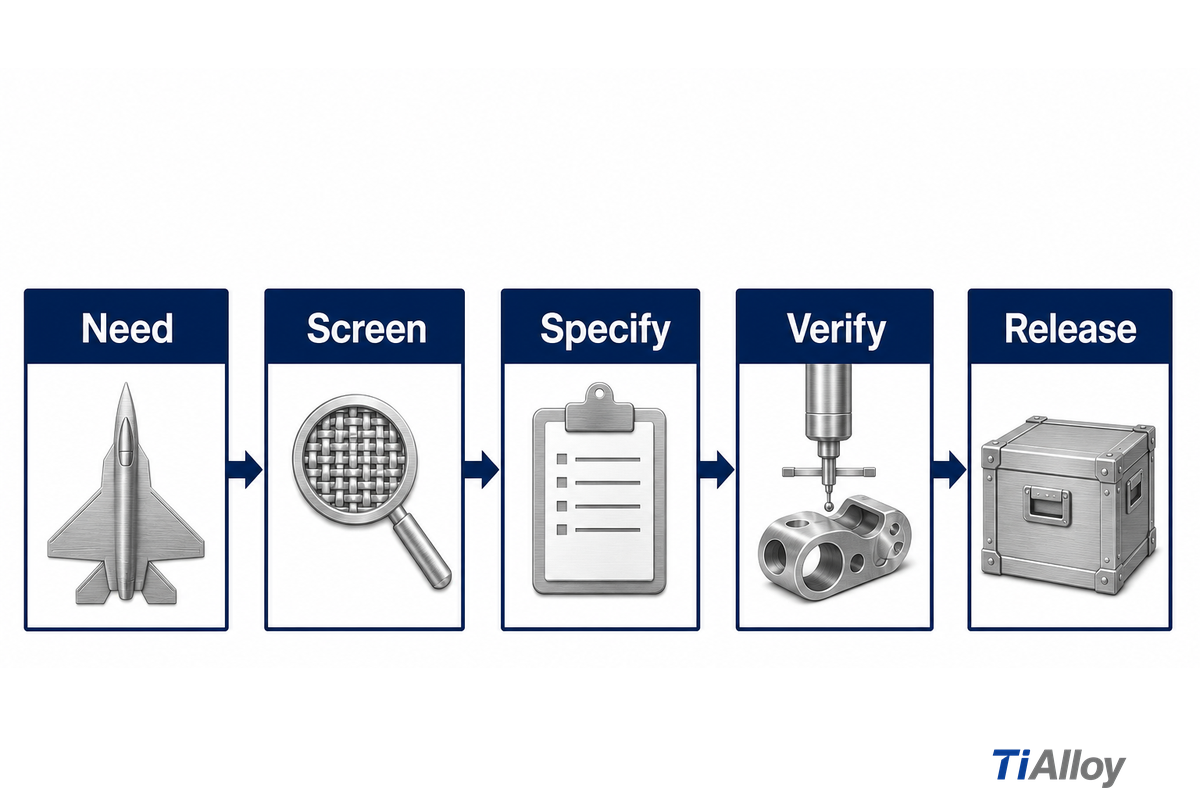
5-Stage Service-to-Evidence Map
Need
Define service and consequence.
Define service and consequence.
Screen
Compare feasible families and routes.
Compare feasible families and routes.
Specify
Control form, condition and revision.
Control form, condition and revision.
Verify
Match evidence to each claim.
Match evidence to each claim.
Release
Use the assigned authority.
Use the assigned authority.
This approach prohibits the use of a default or simplified approach, i.e. “usually we use this alloy family” or “usually we use this grade.” Each rung of the ladder provides an input for the next rung. If the service condition is undefined, screening isn’t defined. If the controlled definition isn’t complete, test results can’t verify the intended condition. If the decision authority isn’t named, an exception can be given and circulated to other persons without a legitimate disposition.
Start With the Service Envelope, Not an Alloy Name
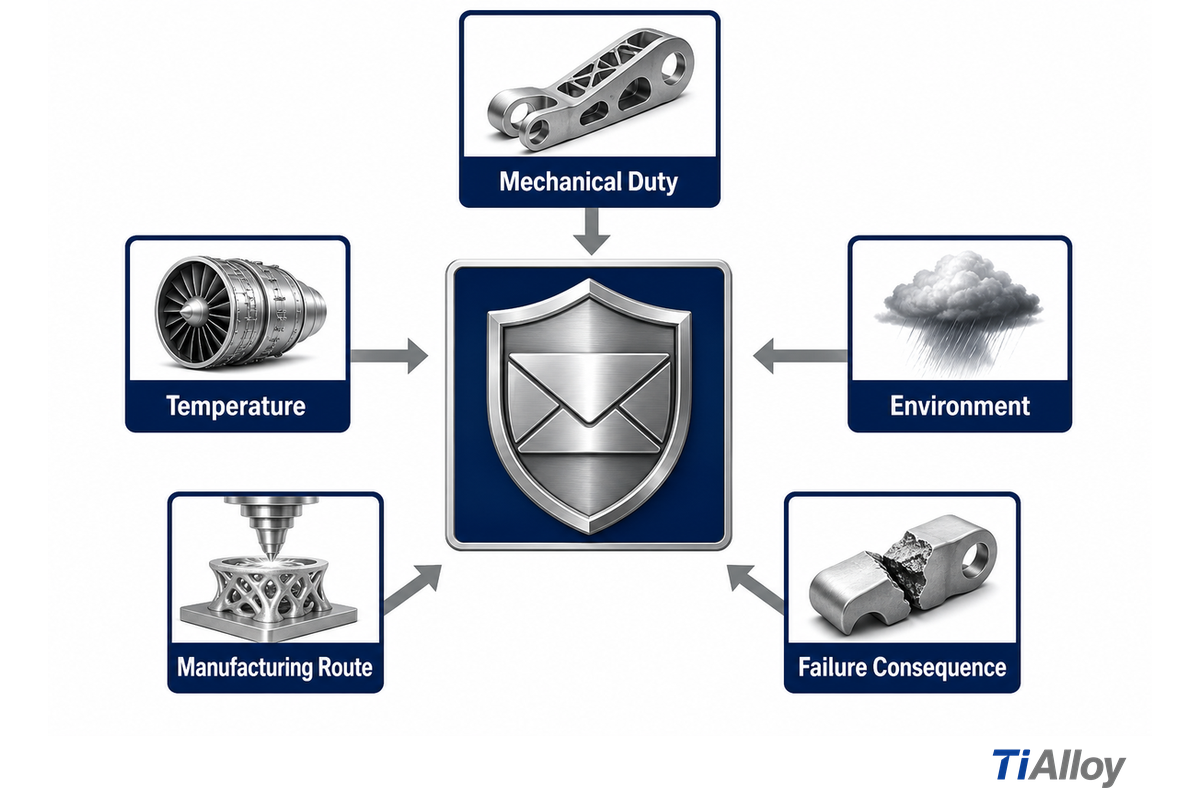
Criteria for material selection shouldn’t be defined by preference, but rather by the conditions of the application. Those conditions should be defined in terms of load (type, magnitude, location and direction), frequency and duration, operating and transient temperatures, thermal gradients, pressures, vibration and contact stresses, and expected life. The chemical and physical conditions of the environment should also be defined. Those conditions might include humidity, corrosive gases, fuels and lubricants, cleaning agents, radiation, vacuum, or products of combustion.
As part of defining the environmental envelope, manufacturing can also be defined. The way a product is formed and finished can also affect the delivered condition and the evidence needed to accept it. The AMPP materials-selection overview makes the basic point that there’s no material that resists all corrosive conditions. The balance of available information and expected life should also be part of the selection consideration.
The consequence of a wrong assumption helps the assigned authorities decide how much evidence and control the application requires. Ask whether a failure could affect finish, replaceability, system availability, flight safety or regulatory obligations, then identify who owns the design requirement, special-process decision and release decision. This is a scoping exercise, not a universal rule for prototypes, ground support or flight hardware.
| Input | Questions to settle before screening | Why it changes the evidence |
|---|---|---|
| Mechanical duty | Static, cyclic, impact, creep or fracture-sensitive? Which direction and life basis? | Properties and test orientation must match the actual claim. |
| Temperature | Continuous, peak, transient and gradient? | Condition, oxidation, creep and coating needs may change. |
| Environment | Moisture, salt, fluids, galvanic contact, vacuum or hot gas? | Compatibility and corrosion evidence become service-specific. |
| Manufacturing route | Wrought, cast, powder, additive, welded, heat treated or coated? | Route controls microstructure, defects and required process records. |
| Failure consequence | What happens if the assumption is wrong? | Criticality affects qualification depth and approval authority. |
A public reference document shouldn’t be designed to be used as a design-allowable material document. The output at this stage should be a bounded problem statement that describes the expected service, service life, geometry, manufacturing route, inspection, consequences of failure, and program constraints. The statement should also define the overall constraints of the program. Engineering teams can use these constraints to screen candidate materials against the same questions used across the wider aviation industry.
How Should You Screen Aerospace Material Families?

Titanium alloys, nickel alloys and stainless steels may enter an aerospace screening exercise, but no family wins through a generic property ranking. Compare candidates under the same product form, supplied condition, manufacturing route, temperature, environment and test basis. Evidence for one form or process shouldn’t be treated as evidence for a different form or route without an authorized technical basis.
| Family | Questions it often raises | Evidence to request next |
|---|---|---|
| Titanium alloys | Which service requirement, form, supplied condition and manufacturing route make titanium a candidate? | Exact form and condition; route and heat-treatment records; applicable property and test basis; surface and handling controls where required. |
| Nickel alloys | Which temperature, environment, fabrication and final-condition requirements make a nickel alloy a candidate? | Product-form specification; required condition; applicable process qualification; test basis; chemistry and traceability records. |
| Stainless steels | Which environment, temperature, fabrication and final-condition requirements make stainless steel a candidate? | Exact grade, form and condition; applicable mechanical, corrosion and surface requirements; lot and processing identity. |
Evidence specific to a process isn’t academic. For example, in a study of Ti-6Al-4V performed by NIST, using electron beam melting, it was reported that fatigue limit stress was in the range of 200-250 MPa under specified test conditions and fatigue cracks were initiated from lack of fusion. That value doesn’t define a design allowable. It illustrates that process conditions and the population of defects can affect performance, even if the alloy remains the same.
Family screening should produce a short list and a visible set of unanswered questions. A possible mass, temperature or corrosion benefit doesn’t close the decision if joining, inspection, supplied condition, form, route or evidence remains unresolved. Keep those gaps open until the assigned engineering and quality authorities define the acceptance basis.
Translate the Design Requirement Into a Controlled Material Definition
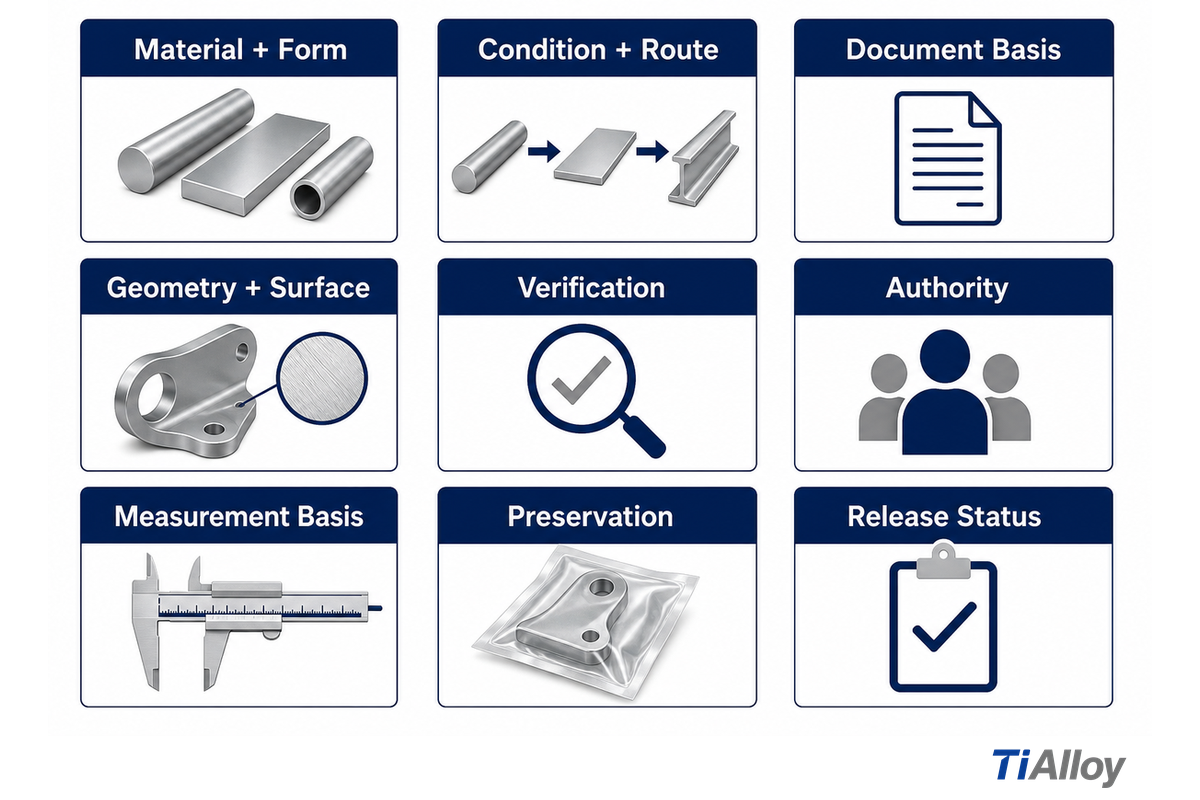
The name of a grade is an initial identification, not a complete purchasing definition. The controlled definition should name the material designation, product form, condition and route, the specification and revision, dimensions, tolerances, surface condition and treatment, required tests, marking and record evidence, and any special clauses concerning source and approval.
Public standards records identify the boundary. For example, SAE AMS4928X references specific product forms of Ti-6Al-4V as well as an annealed condition under a specific revision. The designation “Ti-6Al-4V” doesn’t mean every form, condition, dimension, test, or route covered (or not covered) by that record. The current purchase document and licensed standard text remain controlling.
A compact definition template
| Definition category | What to record | Failure prevented |
|---|---|---|
| Material and form | Exact designation plus plate, sheet, bar, tube, wire, forging, casting, powder or other form. | Assuming one grade applies identically to every form. |
| Condition and route | Temper or heat treatment, melt/remelt route, forming route, AM process or other controlled history. | Comparing properties from a different material state. |
| Document basis | Specification number, revision and order-specific clauses. | Using an obsolete or incomplete requirement. |
| Geometry and surface | Dimensions, tolerances, finish, machining allowance and edge/surface condition. | Receiving the right chemistry in the wrong usable form. |
| Verification | Ordered tests, sampling, values, inspection method, marking and records. | Accepting a generic certificate that does not answer the order. |
| Authority | Required customer, design, source, process or deviation approvals. | Letting a seller or buyer silently authorize a controlled change. |
| Measurement basis | Test temperature, orientation, units, sampling location and any conversion rule. | Comparing values measured on incompatible bases. |
| Preservation | Packaging, storage environment, shelf life, contamination and handling limits where applicable. | Losing physical conformity while records remain intact. |
| Release status | Inspection status, open exceptions, authorized disposition and release record. | Moving unidentified or unresolved material into use. |
Record the governing source, unit system, test conditions and authorized conversion method whenever values are compared. A converted number isn’t an aerospace limit, design input or substitute test basis unless the governing requirement says so.
Keep the supplying legal entity and processing sites identifiable. A coordinated supply network or listed capability shouldn’t be treated as proof that every operation is performed in-house for every order. The purchase requirement, route and records should identify who performed the work for the delivered lot.
Which Claim Does Each Document Actually Support?
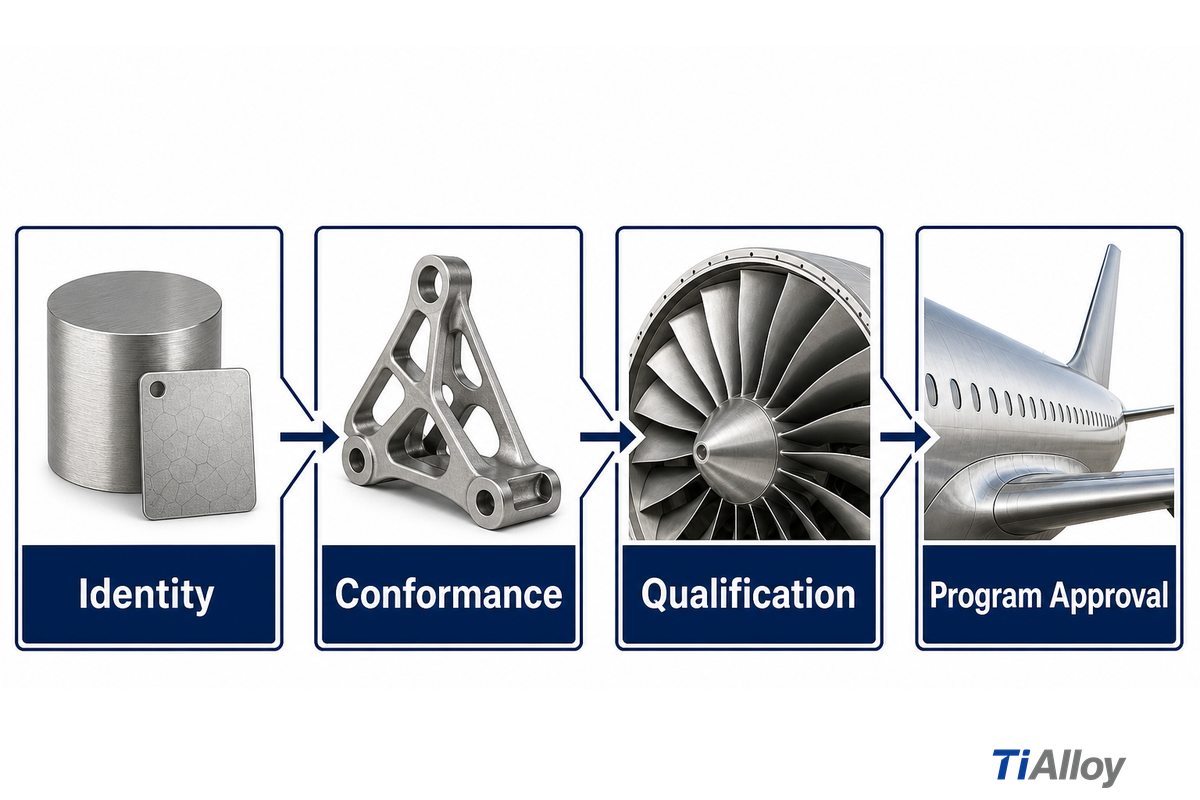
Documents are useful when they’re associated with a specific claim because identity tells the buyer what the item is, while the remaining layers address conformance, qualification, and authorization for use. One recurring error is treating identity, conformance, qualification, and program approval as synonyms. They’re different layers with different decision owners.
| Evidence layer | Question answered | Possible evidence | What it does not prove by itself |
|---|---|---|---|
| Identity | What item, heat or lot is this? | Marking, heat/lot identifiers, purchase and shipment reconciliation. | That every ordered requirement was met. |
| Conformance | Did the delivered item meet specified requirements? | Actual ordered test results, inspection records, process records and a valid conformity statement. | Suitability for an unlisted use or a different condition. |
| Qualification | Has the material/process/part been shown suitable for a defined basis? | Approved qualification plan, statistical or equivalence evidence, process controls and defined limitations. | Universal approval across parts, sites, routes or programs. |
| Program approval | May this defined item be used under the governing design and program? | Disposition or approval from the assigned design, customer, production or regulatory authority. | Transferability to another program or changed configuration. |
NIST’s overview of additive manufacturing qualification describes the qualification of the material, the process, and the part. The same overview notes that historical empirical programs can involve thousands of tests and take 5–15 years. These examples are illustrative and not prescriptive of required or normal commercial lead times. Their value here is conceptual: a grade name and one certificate can’t stand in for a qualification basis that includes process and part behavior.
The integrity of evidence is as important as the presence of a document. According to NASA, two Taurus XL missions worth more than $700 million were lost because of faulty material and falsified certifications. This case doesn’t mean that every certificate is unreliable; it shows why traceability and test evidence must reconcile to the physical item and trustworthy source data.
“NASA relies on the integrity of our industry throughout the supply chain.”
NASA investigation statement
Working rule: Ask, “What exact claim does this document support, for which lot, form, condition, route, revision and organization?” A material test report, certificate of conformity, quality-system certificate and customer approval are complementary only when each is valid and within scope.
Keep Evidence and Physical Condition Continuous Through Every Handoff
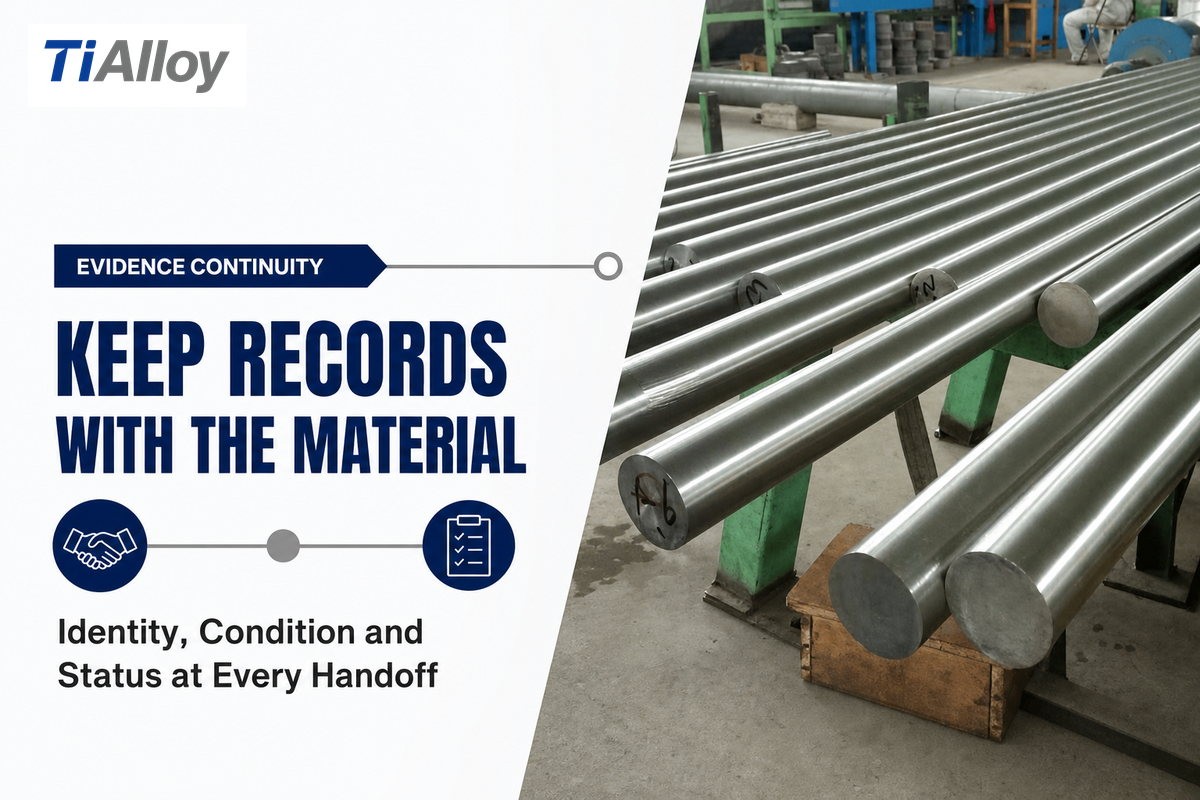
The absence of traceability means that records no longer point to the same controlled object. It may begin with a heat, lot, or batch and continue through receipt, storage, cutting, outside processing, inspection, repackaging, and release. Each split, merge, relabel, or status change needs a reconciliation point appropriate to the program.
Evidence Continuity Handoff Map
| Handoff | Identity check | Process or condition check | Record that closes the handoff |
|---|---|---|---|
| Source to receipt | Order, legal entity, heat/lot, form, identification and marking agree. | Packaging, damage, contamination and storage needs are checked. | Receiving status linked to shipment and required certificates/tests. |
| Receipt to controlled storage | Heat/lot, form, quantity, location and acceptance status remain linked. | Segregation, packaging and the applicable preservation conditions are maintained. | Stock record and location control reconcile the stored item to receiving status. |
| Receipt to cut pieces | Parent identity is transferred under the approved method. | Cutting does not obscure status or mix material. | Piece or traveler identity reconciles to the parent lot. |
| Piece to special process | Processor receives the correct item and revision. | Approved instruction, equipment, personnel and parameters apply. | Process record names item/lot, route, results and process source. |
| Process to inspection | Processed item remains identifiable. | Required NDE/test method, calibration and acceptance basis are current. | Actual results and status link back to the controlled item. |
| Inspection to nonconformance review | The affected item, quantity and status are segregated and identifiable. | Evaluation uses the applicable requirement, evidence and authorized disposition path. | Nonconformance record links the decision and any reinspection to the same item. |
| Inspection to release | Quantity, identity and status reconcile. | Open exceptions, preservation and packaging are controlled. | Authorized release record references the complete evidence set. |
| Release to shipment | Labels, quantity, customer order and released identity agree. | Final packaging and handling preserve the approved condition through dispatch. | Shipment record connects the released evidence set to the dispatched items. |
The qualification of a process also deserves special consideration. Heat treatment, welding, coating, NDE, and additive manufacturing may require qualified procedures, personnel and equipment, plus in-process evidence. Evidence of receipt can’t prove the qualified condition of an uncontrolled furnace cycle, weld parameter, or inspection method.
Physical preservation is equally important. Proper documentation can’t undo damage from mishandling, corrosion, contamination, foreign-object debris, expired preservation, and broken packaging. 14 CFR 21.137, in the context of a production certificate, outlines procedures for handling and storage to prevent damage and deterioration and includes quality-record controls. In other contexts, use the applicable contract, specification, and approved system, rather than borrow a retention period or preservation limit from an unrelated program.
How Should Supplier-System Evidence Be Read?
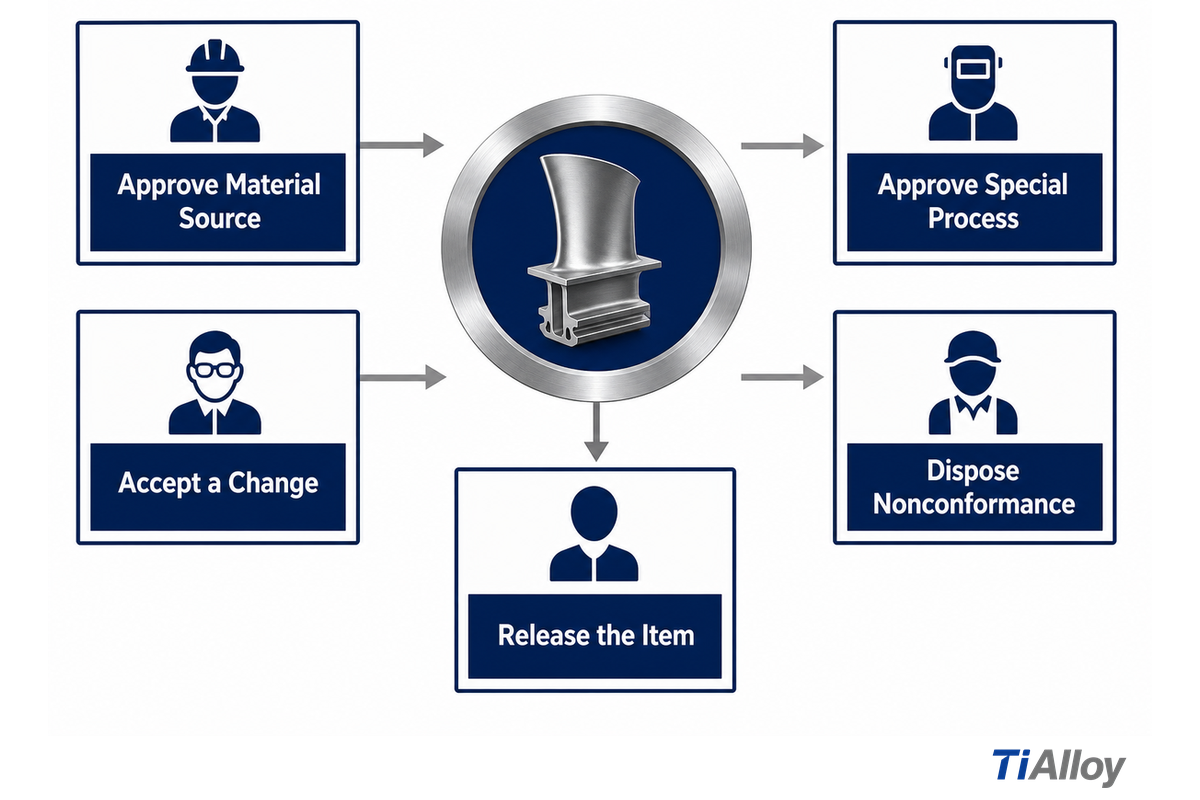
Treat supplier-system evidence and order evidence as separate review layers. For any certificate presented, verify the named legal entity, site, stated scope, standard, revision, status and issuing body from the applicable authoritative record. Then review customer approvals, approved-source requirements, special-process sources and order-specific flowdowns on their own evidence.
The IAQG Supply Chain Management Handbook’s “Buy” resources discuss supplier capability assessment, flowdown, verification, monitoring and sub-tier control from a buyer-side perspective. These are guidance and assessment resources. Using SCMH, SCA or AIMM doesn’t certify a supplier, and mentioning 9100- or 9120-series systems doesn’t prove that TiAlloy, or any named organization, holds a current certificate.
| Decision | Authority to name | Evidence question |
|---|---|---|
| Approve a material source | Customer, design organization or contract-assigned supplier authority. | Is this legal entity/site within the required approval and scope? |
| Approve a special process | Program-defined process authority. | Are source, procedure, equipment, personnel and validity controlled? |
| Accept a change | Configuration/design/customer authority specified by the program. | What requirement changed, and what equivalence or requalification is required? |
| Dispose a nonconformance | Authorized material review or engineering function. | Who may reject, rework, repair or approve another disposition? |
| Release the item | Assigned production/quality/customer authority. | Are requirements, evidence, status and exceptions reconciled? |
This authority map keeps organization-level assurance, order conformance and program approval as separate questions. The applicable contract, approved procedures and assigned roles determine how the answers connect for a specific order.
Control Substitutions and Revisions Before They Break the Evidence Chain
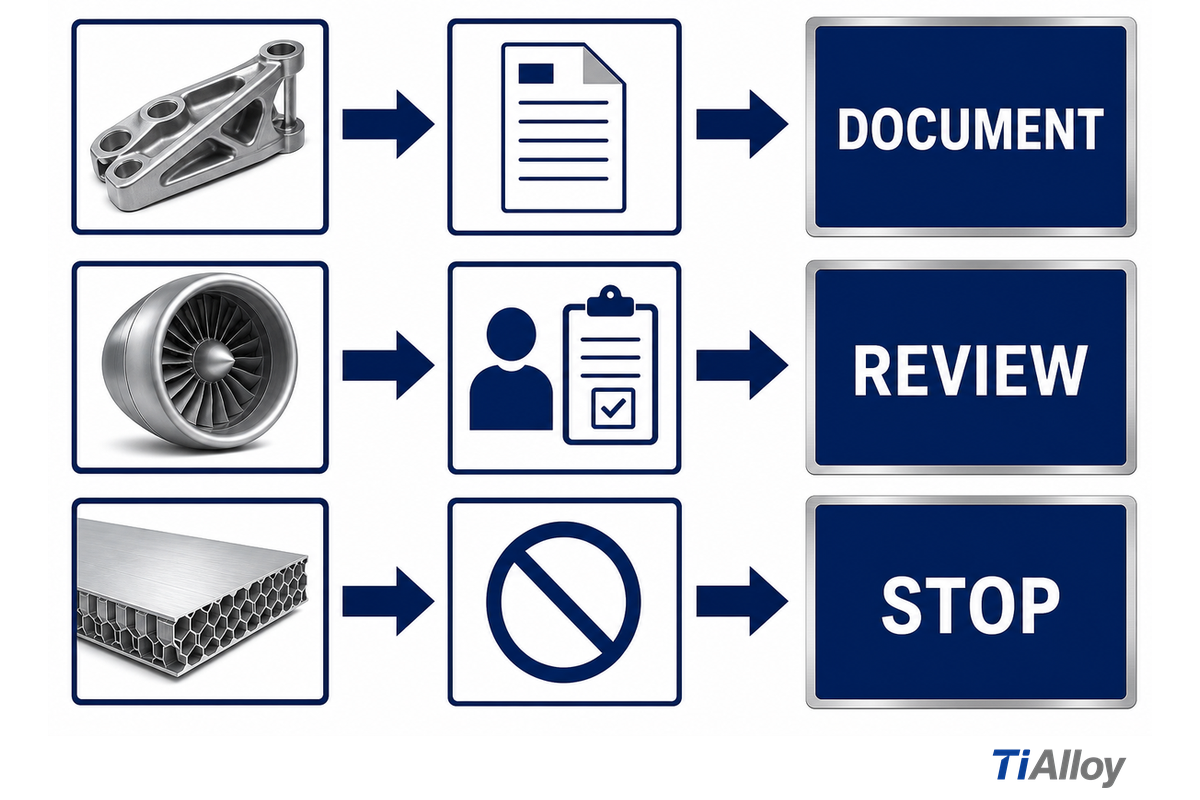
A substitution is a proposal for review, not automatic interchange. Factors such as similar chemistry, higher strength, a newer process, or lower cost don’t resolve behavior, form, condition, microstructure, defects, inspection, configuration, or approval issues. For example, an alloy substitution described by NASA in a lesson learned from a flight assessment showed directional behavior and fit-up stresses from other features contributing to cracking. An alloy substitution could have consequences beyond the material of concern.
Substitution Stoplight
No controlled requirement or evidence path changes, and the assigned procedure explicitly permits the variation. Record the basis and maintain traceability.
A source, site, lot basis, product form, condition, revision, inspection method or sub-tier changes. Route an impact assessment to the assigned authority.
Material designation, route, process parameters, heat treatment, performance basis, approval basis or required evidence changes without an approved disposition.
Identify affected requirements first for any changes. These include source and melt/heat, machine or software, parameter sets, tooling, heat treatment, finishing, inspection, site, and sub-tier. Next, determine who will make the decision, what equivalence or requalification evidence is required, and how records and configuration data will be updated before release.
NIST’s qualification work provides an example of why a “minor” process change can be consequential in an empirical qualification context. The response, however, isn’t to demand full requalification for every clerical revision. It’s to avoid assuming the change is benign before the responsible authority evaluates its scope. Where the customer or program flows down work-transfer, APQP, PPAP, or other planning requirements, map the applicable deliverables and approval gates. Through these, define requirements for work approval before changing source, site, process, or sub-tier. They don’t necessarily apply to every metal purchase order.
What Should Happen When the Evidence Does Not Reconcile?
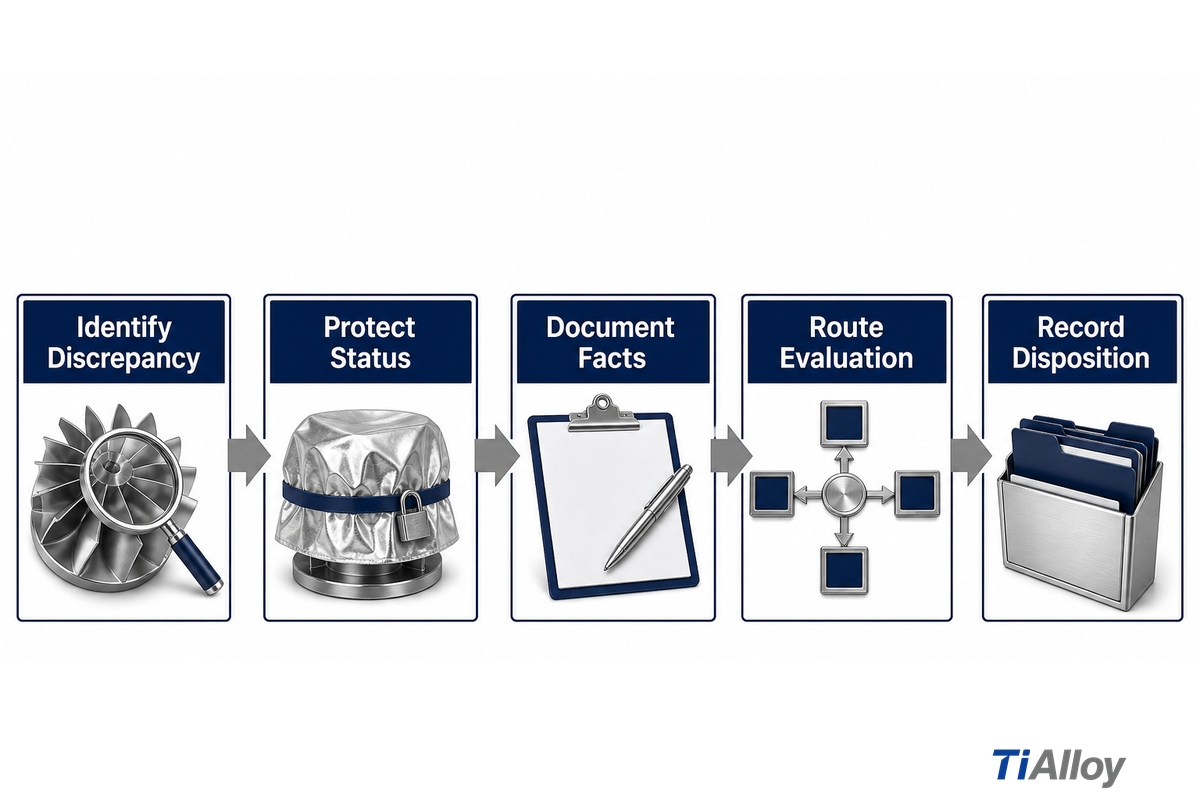
A mismatch can’t be fixed through editing a certificate, guessing a missing condition or choosing the nearest entry in a catalog. First, correctly identify the discrepancy. Examples include wrong revision, missing heat number, discrepancy in quantity, missing test value, unapproved processor, broken marking, damaged package, or an item that doesn’t conform to the documentation.
- Protect status. Make the hold visible in the applicable physical and electronic controls defined by the approved procedure.
- Segregate when required. Preserve the identity and condition of the material while avoiding mix-ups, contamination, or further processing.
- Document the facts. Be factual and accurate. State explicitly the requirement, observed evidence, identity of the affected item or lot, and affected quantity without inventing a cause.
- Route evaluation. Forward the case to the appropriate authority defined in the approved quality, design and contract system for a decision.
- Record the disposition. Implement only the authorized disposition, reconcile the affected records and complete any recurrence action required by the approved procedure.
According to its stated scope, 14 CFR 21.137 calls for the identification, documentation, evaluation, segregation and disposal of nonconforming items through approved procedures. This pattern of control is useful, but public articles can’t authorize “use as is,” repair, rework, return or scrap for a reader’s program. The approved procedures and assigned roles control.
Evidence gaps may also show a larger escape. If the same heat was split, processed, or shipped to some other location, retain the genealogy needed for an impact review. The objective isn’t to fill a single missing field. It’s to understand the physical material, the processes, records and downstream choices affected.
An Adaptable Evidence-Readiness Review
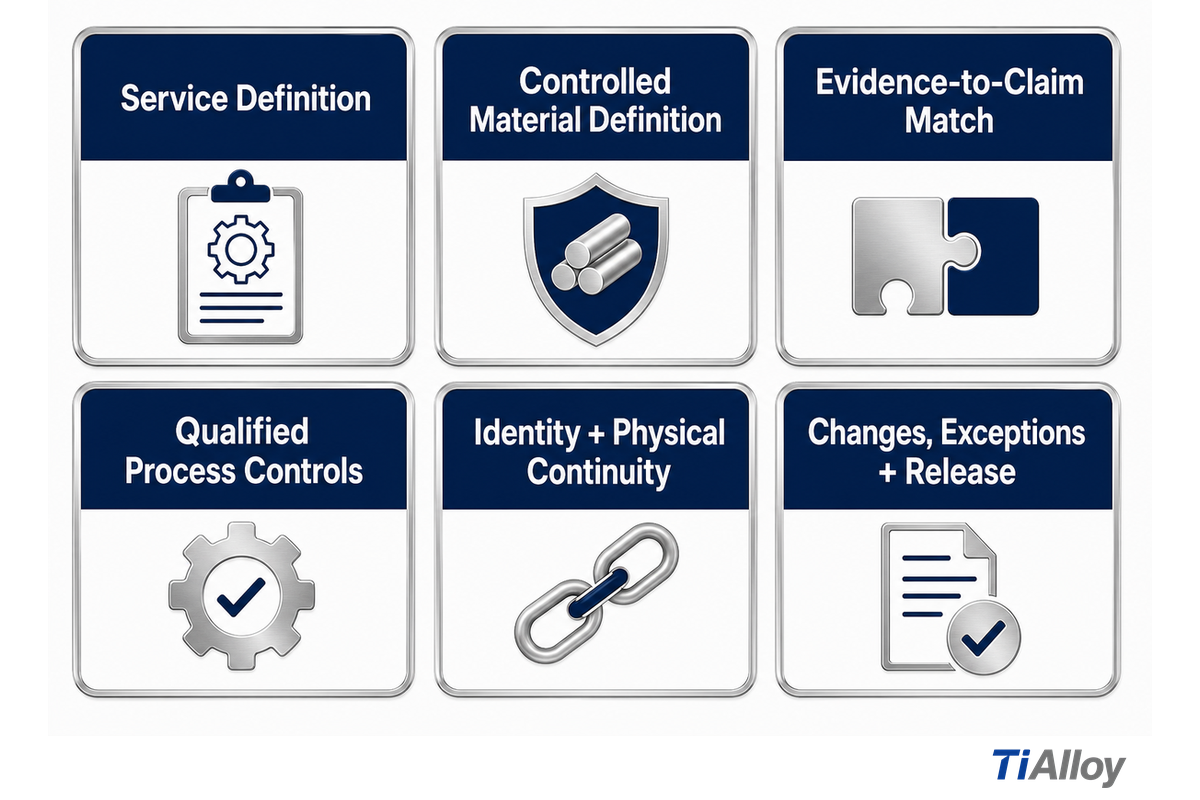
This review is a planning aid, not a universal aerospace assurance or release model. IAQG’s Plan and Manage resources provide broader buyer-side planning context. Use the prompts only to expose missing inputs and route them to the authority named by the applicable contract, design data and approved procedures. Completing the table never makes a material “aerospace approved.”
| Review lens | Question to answer | Reason to seek assigned review |
|---|---|---|
| Service definition | Which loads, temperatures, environments, life assumptions, routes, inspections and consequences govern the decision? | A key operating condition or failure consequence remains assumed. |
| Controlled material definition | Do designation, form, condition, route, revision, dimensions and required tests agree? | A family name or legacy shorthand substitutes for the current definition. |
| Evidence-to-claim match | Which in-scope record supports each identity, conformance or qualification claim? | A certificate is asked to prove an unlisted process, property or approval. |
| Process controls | Which procedures, equipment, personnel, parameters and inspection basis are required by the governing documents? | A process, source or parameter change lacks the required impact review. |
| Identity and physical continuity | How do heat or lot identity and status reconcile through cuts, processing, storage, packaging and shipment? | Records remain intact but identity, preservation or condition has broken. |
| Changes, exceptions and release | Who may decide each open item, and which record shows the authorized disposition or release? | “Equivalent,” “better” or “supplier approved” is used without the assigned authority. |
Use these prompts before quotation or release only as an input check. The governing program and assigned authorities still decide what evidence is sufficient and who may act. Once the engineering and evidence questions are bounded, product-form requests and order-specific supply discussions can move to the commercial channel.
Move From an Evidence-Ready Requirement to a Supply Discussion

For context, check out TiAlloy’s aerospace material options or read TiAlloy’s manufacturing and supply background. Any certifications, process routes, sources, test packages or approvals need to be verified for the legal entity and order in question.
Frequently Asked Questions
Does “aerospace-grade” mean a material is approved for an aircraft part?
No. “Aerospace-grade” isn’t a complete approval statement. A usable decision still needs the exact material designation, product form, supplied condition, manufacturing route, governing specification and revision, required tests, traceability, customer flowdowns and approval authority. A material can match a familiar chemistry yet fail the ordered condition, form, process or program requirements. The phrase also doesn’t identify the legal entity, manufacturing site, special-process source, certificate scope or customer approval that may apply. Treat it as a prompt to ask for the controlled definition and evidence, not as permission to buy, install or release material. When criticality is high, the assigned design and quality authorities should define the acceptance basis before procurement begins.
What records should travel with aerospace metal stock?
The required package is contract- and program-specific, but the record chain commonly needs enough information to reconcile the purchase requirement, material identity, heat or lot, product form, condition, applicable specification and revision, ordered test results, marking, processing history where required, inspection status and any approved deviations. The important test is continuity: records and physical identifiers must still point to the same controlled material after receipt, cutting, outside processing and release.
Can one alloy or standard work for all aerospace applications?
No. Aerospace service conditions vary by load, temperature, environment, life, manufacturing route, inspectability and consequence of failure. Standards also have defined product-form, condition and test scopes. A designation suitable for one component or supplied form may not establish suitability for another. Screen material families against a defined service envelope, then confirm the exact design and program requirements with the responsible engineering and quality authorities.
How should supplier-system evidence be separated from order evidence?
Verify any presented certificate against the applicable authoritative record for its named legal entity, site, stated scope, standard, revision and status. Then separately reconcile the purchase requirement, heat or lot identity, product form, supplied condition, process route, ordered tests, inspection status and customer approvals. Organization-level evidence and order-level evidence answer different questions; neither should silently stand in for the other.
When should a proposed material substitution be stopped for review?
Stop and route the change for formal review whenever it alters a controlled assumption or evidence path, for example the material designation, source, product form, supplied condition, manufacturing route, heat treatment, specification revision, required test, marking method, traceability route or approval basis. “Equivalent” should be a conclusion reached by authorized roles, not a shortcut taken from a catalog description.
References & Sources
- FAA AC 20-154A, Aircraft Parts Receiving Inspection.
- 14 CFR § 21.137, Quality system.
- IAQG SCMH, Plan & Manage.
- IAQG SCMH, Buy.
- NIST, Additive Manufacturing Fatigue and Fracture.
- NIST, Qualification of Additive Manufacturing Materials, Processes, and Parts.
- SAE AMS4928X public specification record.
- AMPP, Materials Selection and Design for Corrosion Control.
- NASA, Investigation of two science mission launch failures.
- NASA NTRS, Flight assessment lessons on a material substitution.
- NASA, Quality assurance requirements, Chapter 4.
- NASA-HDBK-6025, Materials documentation and traceability guidance.
WHY WE PUBLISH
About TiAlloy
TiAlloy supplies titanium, stainless steel, nickel alloy and clad plate for specification-driven industrial orders. Our technical guides are written to help buyers align product form, governing standard, test scope and release documents before a quotation is compared.
01Melt & formPlate, sheet, pipe, tube, bar, wire and forgings
02ProcessHeat treatment, finishing, inspection and export packing
03VerifyEN 10204 Type 3.1 certificate and order documents